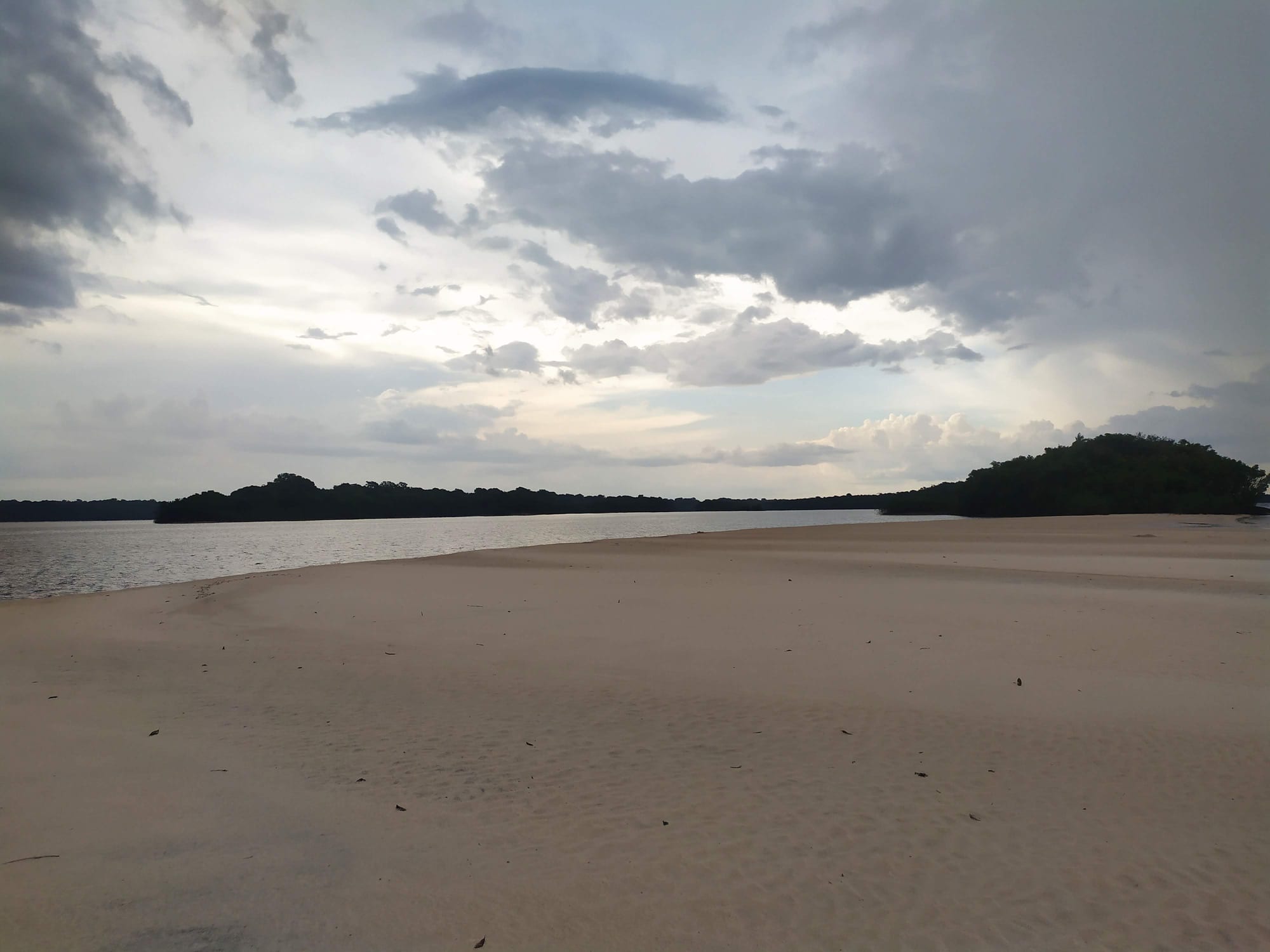
A wide pale sandbank on the dark Rio Negro, with low forested islands under a cloudy evening sky

Manaus & the Western Amazon, Brazil

Novo Airão

A river beach in Anavilhanas National Park, the island archipelago in the Rio Negro off Novo Airão. (GuilhonAmazonia / Wikimedia Commons · CC BY-SA 4.0)

A small river town on the Rio Negro upstream of Manaus, reached by road across the Rio Negro Bridge. It grew up after the decline of old Airão further upriver, and now lives largely from the protected forests around it: it is the gateway to the Anavilhanas archipelago and Jaú National Park, and known for river dolphins and woodcraft.

Neighbourhoods

  • Town centre
    • First-time visitors
    • Crafts

    A grid of low streets and a main square a short walk from the river, with the town's guesthouses, small shops, craft workshops and the tourist information centre at the entrance to town. Quiet in the day and liveliest in the evening.

    Open in Maps
  • Riverfront and port
    • River trips
    • Wildlife

    The landing on the Rio Negro, where boatmen are hired for trips into the islands and riverboats tie up. The waterline moves a long way between seasons: at low water a wide sandy beach opens below the town.

    Open in Maps

Things to do

In and around the town

  • Pink river dolphinsattraction

    Feeding and swimming with Amazon river dolphins, offered at a small floating café by the harbour, is one of the town's best-known draws.

    Open in Maps
  • Craft centresattraction

    Three craft centres, specialising in wood and recycled paper, in straw and in Indigenous goods; the wood and paper centre is the foundation of Almerinda Malaquias, which teaches local people.

    Open in Maps
  • Anavilhanas National Parkpark

    One of the largest river archipelagos in the world, a maze of forested islands in the Rio Negro off the town, where boat and canoe trips pass through flooded forest; part of the Central Amazon Conservation Complex World Heritage Site.

    Open in Maps

Short trips from the town

  • Rio Negro State Park North Sectionpark

    A state park protecting rainforest west of the Rio Negro, which also contains the ruins of Velho Airão, the old town of Airão, visited by boat from Novo Airão.

    Open in Maps

Seasonal events

  • Festa de São SebastiãoJanuary

    A town festival in honour of Saint Sebastian.

  • Festa de Santo ÂngeloMay

    The festival of the town's patron saint.

  • Festival folclóricoJuly

    The town's folklore festival of music and dance.

  • Eco-Festival do Peixe-BoiOctober

    A festival named after the Amazonian manatee, with an environmental theme.

Eat and drink

Long-standing places and food districts in Novo Airão. Hours, ratings and directions come from your maps app, always current.

Novo Airão classics

  • Grilled river fishrestaurant

    Tambaqui and other Rio Negro fish, grilled or fried and served with farinha, the coarse manioc flour of the region.

    Open in Maps
  • Tambaquirestaurant

    The large fruit-eating river fish whose meat is popular across the Amazon, served in many ways, among them grilled ribs.

    Open in Maps

Experience Novo Airão

History

The lower Rio Negro around Novo Airão was home to Indigenous peoples including the Waimiri-Atroari, Crichanã, Carabinari and Jauaperi. In 1668 Jesuits founded a settlement named Santo Elias de Jaú at the mouth of the Jaú River, believed to be one of the first Portuguese settlements in the Amazon. In 1759 it was raised to a town and named Airão by Joaquim de Melo Póvoas, the first governor of the captaincy of São José do Rio Negro.

Old Airão grew into a medium-sized settlement on the riverbank, but it later declined; its district was absorbed into Manaus, and after its dissolution in 1938 the name passed to Novo Airão, New Airão, downstream. The old town, now called Velho Airão, is almost uninhabited and lies inside a state park, a destination for boat trips from the new town.

The 20th century made the area a centre of conservation. Anavilhanas began as an ecological station in 1981 and became a national park, and Jaú National Park was later joined by Anavilhanas and the reserves of Mamirauá and Amanã to form the Central Amazon Conservation Complex, a World Heritage Site. Much of the municipality now lies inside protected areas, which have shaped the town's turn to tourism.

Culture & Customs

Craft is the town's cultural signature. Novo Airão's work in wood and natural fibres is known for its quality, and the town has craft centres specialising in wood and recycled paper, in straw and in Indigenous goods; the best known is the foundation run by Almerinda Malaquias, which teaches local people the craft.

The church calendar and the river shape the year. The town celebrates São Sebastião in January and its patron, Santo Ângelo, in May, holds a folklore festival in July, and in October an eco-festival named after the Amazonian manatee carries an environmental message.

The pink river dolphins are at the centre of the town's tourism. Contact with them at the town's beach is its main attraction, and many visitors come to feed or swim with them. Boatmen, guides and craft makers are a familiar part of the working town. Visitors also come to see the islands of Anavilhanas and the river communities around them, and the town's craft can be bought at the association's headquarters or in shops around the town.

Daily Life

The municipality had about 20,400 people in 2021, by the estimate of the Brazilian statistics institute IBGE, the smallest population in its microregion. Its territory is vast — about 37,800 square kilometres, bordering the state of Roraima — and most of it is forest, much of it protected.

Tourism is an important source of income: visitors come to reach the islands and the national parks, to visit Indigenous and river communities and to see the dolphins, and guesthouses, lodges and boatmen depend on them. The town is also known for its crafts and its boatbuilding. Because bus and boat times make a day trip from Manaus difficult, most visitors stay overnight.

The river sets the rhythm of the year. From August the water drops quickly, beaches appear from September, and aquatic animals such as dolphins, caimans and giant otters are seen more often; in the high-water months the forest floods and boats can move among the trees.

Food

Food here is the food of the Rio Negro. Fish comes first — tambaqui grilled over charcoal, and other river fish fried or stewed — eaten with rice, beans and farinha, the coarse manioc flour that accompanies almost every meal in the Amazon.

Many meals are simple and home-style, served in small restaurants near the river and the square. Regional fruit such as cupuaçu and açaí appears in juices and desserts, and guaraná is the everyday soft drink. Visitors heading into Jaú National Park are advised to bring supplies from Manaus or Novo Airão, since there is little to buy upriver.

As elsewhere on the Rio Negro, tacacá — a hot, sour soup of tucupi broth from manioc, tapioca gum, dried shrimp and jambu leaves that numb the lips — is a late-afternoon snack, and manioc in its many forms, from farinha to tapioca pancakes, is the staple behind every plate. Fish is bought at the waterfront when the boats come in.

Planning tools

Budget

The town itself is inexpensive, with guesthouses, small hotels and simple restaurants. The main costs are boat trips into the islands and the national parks, and the all-inclusive rates of lodges on the river.

Daily Budget Midrange
USD 90–180 (comfortable guesthouse, restaurant meals, a hired boat trip); river lodge packages often USD 160–390 per person per day
Daily Budget Shoestring
USD 35–60 (guesthouse room, fish lunches, bus from Manaus)

Hire boatmen at the port or through the tourist information centre, and agree the route and price before setting out.

Best Time to Visit

High water, roughly from February or March to July, lets boats and canoes glide into the flooded forest of the islands. From August the river falls quickly and dolphins, caimans and giant otters are seen more often; from September white-sand beaches appear.

Suggested Number of Days

Bus and boat times make a day trip from Manaus difficult, so most visitors spend at least a night or two. A trip deep into the national parks upriver adds several more days.

First Visit
2–3 days
With Surroundings
4–6 days

Transportation

The town is small enough to walk. Everything beyond it is by water: boatmen at the port run trips into the islands, to the old town and occasionally up the Jaú River.

Bring sun protection, a hat and repellent for boat trips, and allow for changing water levels.

Airport & Station Connections

From Manaus the road crosses the Rio Negro Bridge, follows the AM-070 and turns onto the AM-352 to Novo Airão. Buses leave the Manaus bus terminal early in the morning, and boats leave the Port of Manaus in the evening.

Walkability

The town centre and riverfront are compact and easy to walk, though the heat makes midday walking tiring. There are few pavements beyond the centre.

Safety

Brazil has high rates of crime, including violent crime, and it is the main practical concern for visitors — though very unevenly distributed. Novo Airão is a small, quiet town; the practical risks are on the water and in the forest. Malaria is present in rural areas of the region and yellow fever vaccination is advised.

Travel in the forest and on the river only with licensed guides, enter the national parks only with the required permits, and use repellent. Check current official travel advice before travelling.

Climate

Equatorial, hot and humid all year, with heavy rain for much of the year and a somewhat drier season in the second half of the year, when the river falls.

Summer
December–February is the southern-hemisphere summer and the wet season — hot and humid, roughly 24–32°C, with the river rising
Winter
June–August is drier and still hot, roughly 25–34°C, and the river starts to fall from August

Local Customs

Portuguese is spoken everywhere and English is rare. Life is relaxed and informal, centred on the river, the square and church festivals. The national parks are protected, and damage to plants or animals inside them is a federal crime.

Dress is casual; ask before photographing people, and follow the guides' rules when near the dolphins.

Common Payment Methods

The currency is the Brazilian real (BRL, R$). Pix and cards are widely used, but a small town has few ATMs, so bring enough cash from Manaus for boatmen, small shops and market stalls.