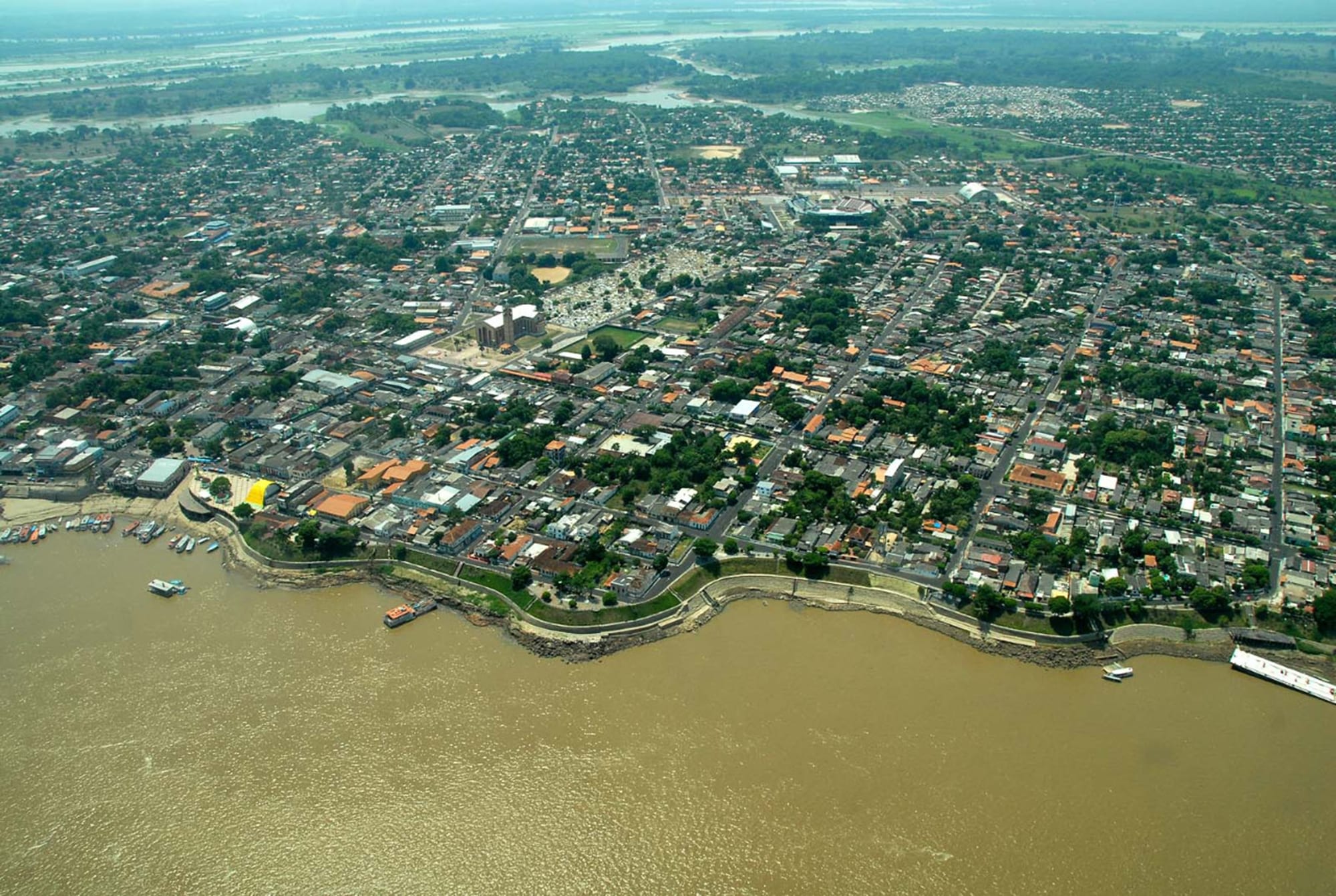
Aerial view of a low-rise town with orange roofs and a grid of streets spreading back from the bank of a wide brown river, with boats along the shore

Brazil

Manaus & the Western Amazon

Parintins, home of the Boi-Bumbá folk festival, on the Amazon River in the state of Amazonas. (Mário Oliveira - MTUR / Wikimedia Commons · Public domain)

The rainforest heart of Brazil, covering Amazonas, Acre, Rondônia and Roraima — a region of vast rivers and few roads, centred on the rubber-boom city of Manaus and the Meeting of the Waters, with flooded-forest reserves such as Mamirauá, the rubber-tapper country of Acre and the Indigenous lands of the far north.

Explore Manaus & the Western Amazon

History

The western Amazon was home to large Indigenous societies long before Europeans: the first Spanish expedition down the river in 1542 reported dense settlements along its banks, and the Omagua and others farmed the floodplains. Today the region holds many of Brazil's Indigenous peoples, among them the Yanomami, the Tikuna, the Baniwa and the Macuxi, as well as several groups living without contact in the Javari valley.

The Portuguese built a fort at the mouth of the Rio Negro in 1669, the seed of Manaus, but the region stayed marginal until the rubber boom from the 1870s to about 1912. Rubber, tapped by migrants from drought-stricken Ceará and by forced Indigenous labour, made Manaus one of the richest cities in the Americas; the Teatro Amazonas opened in 1896. Acre, then claimed by Bolivia, filled with Brazilian tappers who rebelled, and Brazil acquired it through the Treaty of Petrópolis in 1903, agreeing to build the Madeira-Mamoré railway around the rapids near Porto Velho; thousands of workers died building it. The boom collapsed when Asian plantations grown from Amazon seeds undercut Brazilian rubber.

Manaus revived after its free-trade zone opened in 1967. Paved roads brought settlers and cattle ranching to Rondônia, which became one of the most deforested parts of the Amazon. In Acre the rubber-tappers' leader Chico Mendes, who fought forest clearance, was murdered in Xapuri in 1988. A gold rush onto Yanomami land in the late 1980s caused epidemics and violence; the territory was demarcated in 1992, but miners returned, and in 2023 the federal government declared a health emergency over malnutrition and malaria there and launched operations to remove them.

Culture & Customs

River life shapes the culture. The caboclos, riverside people of mixed Indigenous and Portuguese descent, live in stilt and floating houses, fish, farm manioc on the floodplains and travel by canoe and riverboat. Indigenous identity is stronger here than anywhere else in Brazil: in São Gabriel da Cachoeira on the upper Rio Negro most people are Indigenous, and Nheengatu, Tukano and Baniwa have co-official status alongside Portuguese.

The great festival is Parintins's Boi-Bumbá at the end of June, when two associations, the red Boi Garantido and the blue Boi Caprichoso, compete over three nights in a purpose-built arena with giant animated floats, drums and songs drawing on Amazonian legend. Supporters of each will not wear the other's colour. Manaus holds an opera festival in the Teatro Amazonas, a legacy of rubber-boom taste.

Acre gave birth to Santo Daime, a religion founded in the 1930s by the rubber tapper Raimundo Irineu Serra, whose rituals use ayahuasca, a brew made from forest plants; its churches have since spread worldwide. Rondônia, settled largely by migrants from the south, has a more southern and rural feel, with gaúcho traditions and sertanejo music. Roraima mixes Indigenous peoples, northeastern migrants and, since the late 2010s, a large number of Venezuelans who crossed at Pacaraima fleeing their country's crisis.

Daily Life

Around seven million people live in these four states, and Manaus alone holds about two million of them. Porto Velho, Boa Vista and Rio Branco each have several hundred thousand; beyond them, towns such as Tefé, Parintins, Tabatinga and Ji-Paraná are small, and much of the population lives along rivers.

The Manaus free-trade zone keeps factories assembling motorcycles, electronics and appliances, protected by tax breaks, and is by far the largest employer. Rondônia and parts of Acre live on cattle, soya and hydroelectric dams on the Madeira, while fishing, açaí, Brazil nuts and manioc sustain river communities. Guaraná, grown around Maués, supplies Brazil's soft-drink industry.

Environmental pressures dominate public debate. Deforestation spread along the roads of Rondônia and southern Amazonas and has fallen since 2023 after rising in the preceding years. Illegal gold mining has polluted rivers with mercury and brought disease and violence to Indigenous lands, above all the Yanomami territory. In 2022 the journalist Dom Phillips and the Indigenous expert Bruno Pereira were murdered in the Javari valley. Manaus suffered badly in the COVID pandemic, running out of hospital oxygen in January 2021, and the droughts of 2023 and 2024 stranded riverboats and cut off communities.

Food

River fish anchor the diet. Tambaqui, a large fruit-eating fish, is grilled as thick ribs over charcoal; pirarucu, one of the world's largest freshwater fish, is salted and dried like cod, and in Manaus pirarucu de casaca is a festive favourite. Jaraqui and matrinxã are everyday fish, eaten fried with farinha, the coarse manioc flour served at every meal; the granular farinha from Uarini is especially prized.

Tacacá, a hot, sour soup of yellow tucupi broth (from fermented manioc juice), gummy tapioca starch, dried shrimp and jambu leaves that numb the lips, is sold in the afternoon from gourd bowls. Manaus's breakfast favourite is the x-caboquinho, a roll filled with the orange flesh of the tucumã palm fruit, coalho cheese and fried plantain. In Roraima, damurida is a soup of Macuxi Indigenous origin, and in Acre the hearty breakfast called baixaria combines cuscuz, minced beef and a fried egg.

Fruit is the other treasure: cupuaçu, a cousin of cacao with tangy white pulp, used in juice, cream and sweets; açaí; bacaba; camu-camu, rich in vitamin C; and Brazil nuts. Guaraná from Maués is drunk as soda or grated from a dried stick into water.

Attractions & Natural Wonders

In Manaus, the pink-and-gold Teatro Amazonas faces the wavy-tiled São Sebastião square, and the iron Adolpho Lisboa market sits by the port where riverboats load. The Museu da Amazônia has a forest observation tower, and Ponta Negra is the city's river beach. Boats run downstream to the Meeting of the Waters, where the Rio Negro and the Solimões flow side by side before merging into the Amazon.

Up the Rio Negro, the Anavilhanas National Park is a maze of hundreds of islands, with river dolphins at Novo Airão; beyond lies the vast Jaú National Park, part of the Central Amazon Conservation Complex, a UNESCO World Heritage Site. North of Manaus, Presidente Figueiredo has waterfalls and caves. Upstream on the Solimões, the Mamirauá reserve near Tefé offers canoe trips through flooded várzea forest to see uakari monkeys, sloths and caimans. Downstream, Parintins fills for its June festival.

In Acre, Rio Branco has a riverside promenade and the museum in the Palácio Rio Branco, and ancient geometric earthworks, the Acre geoglyphs, have been exposed in cleared land around it. In Xapuri, Chico Mendes's house is preserved, and the Chico Mendes Extractive Reserve has rubber trails through the forest. In Rondônia, Porto Velho keeps locomotives of the Madeira-Mamoré railway, and the 18th-century Real Forte Príncipe da Beira guards the Guaporé on the Bolivian border. In Roraima, Boa Vista is the gateway to the savanna and the Serra do Tepequém; Brazil's side of Mount Roraima is protected and the usual trail begins in Venezuela.

Cities in Manaus & the Western Amazon

Planning basics

Budget

Manaus itself is moderately priced, with hostels, city hotels and cheap market food, but almost everything in the forest is sold as a package. Jungle lodges, Mamirauá's floating lodge and guided river trips charge all-inclusive daily rates that can equal a week in the city, and domestic flights are the only practical way between the capitals. Slow public riverboats are the budget alternative.

Daily Budget Midrange
USD 90–180 in town; jungle lodge packages often USD 160–390 per person per day
Daily Budget Shoestring
USD 35–60 (hostel, market and por quilo meals, riverboat hammock passage)

Book lodges and guides through registered operators in Manaus rather than touts at the port or airport, and confirm what the daily rate includes.

Safety

Manaus has high rates of violent crime, and drug-trafficking routes along the Solimões and the borders with Colombia, Peru, Bolivia and Venezuela bring violence to some river towns. Illegal gold mining causes conflict in Indigenous territories, which are closed to visitors without official authorisation. Malaria is present in rural areas, and yellow fever vaccination is advised.

Travel in the forest only with licensed operators, avoid the city centre and port area of Manaus after dark, and use repellent. Check current official travel advice before travelling.

Climate

Equatorial, hot and humid all year, around 26–33°C, with heavy rain most of the year and a somewhat drier season from about June to November south of the equator. Roraima, north of the equator, has its rains roughly from April to September. River levels drive life: at Manaus the water peaks around June and falls to its lowest around October and November, and severe droughts in 2023 and 2024 left rivers at record lows.

Summer
hot, humid and very wet from December to May, 24–32°C, with rivers rising
Winter
hot and drier from June to November, 25–34°C; occasional cold snaps called friagens reach Acre and Rondônia

Transportation

Rivers and aircraft do the work of roads. Manaus has road links only north to Boa Vista and west to a few towns; the BR-319 south to Porto Velho is largely unpaved and often impassable. Rio Branco and Porto Velho connect by the BR-364 to southern Brazil. Riverboats carry hammock passengers from Manaus to Tefé, Parintins and Santarém, with faster launches on some routes; Anavilhanas is about three hours by road to Novo Airão.

On overnight riverboats bring a hammock, rope and padlock, and keep valuables on the person; allow slack for delays in both boats and flights.

Best Time to Visit

Both seasons have their appeal. High water, roughly April to July, lets canoes glide into the flooded forest of Anavilhanas and Mamirauá and is good for seeing river dolphins and monkeys. Low water, about September to December, exposes white-sand river beaches and makes forest walks easier. Parintins's festival falls on the last weekend of June.