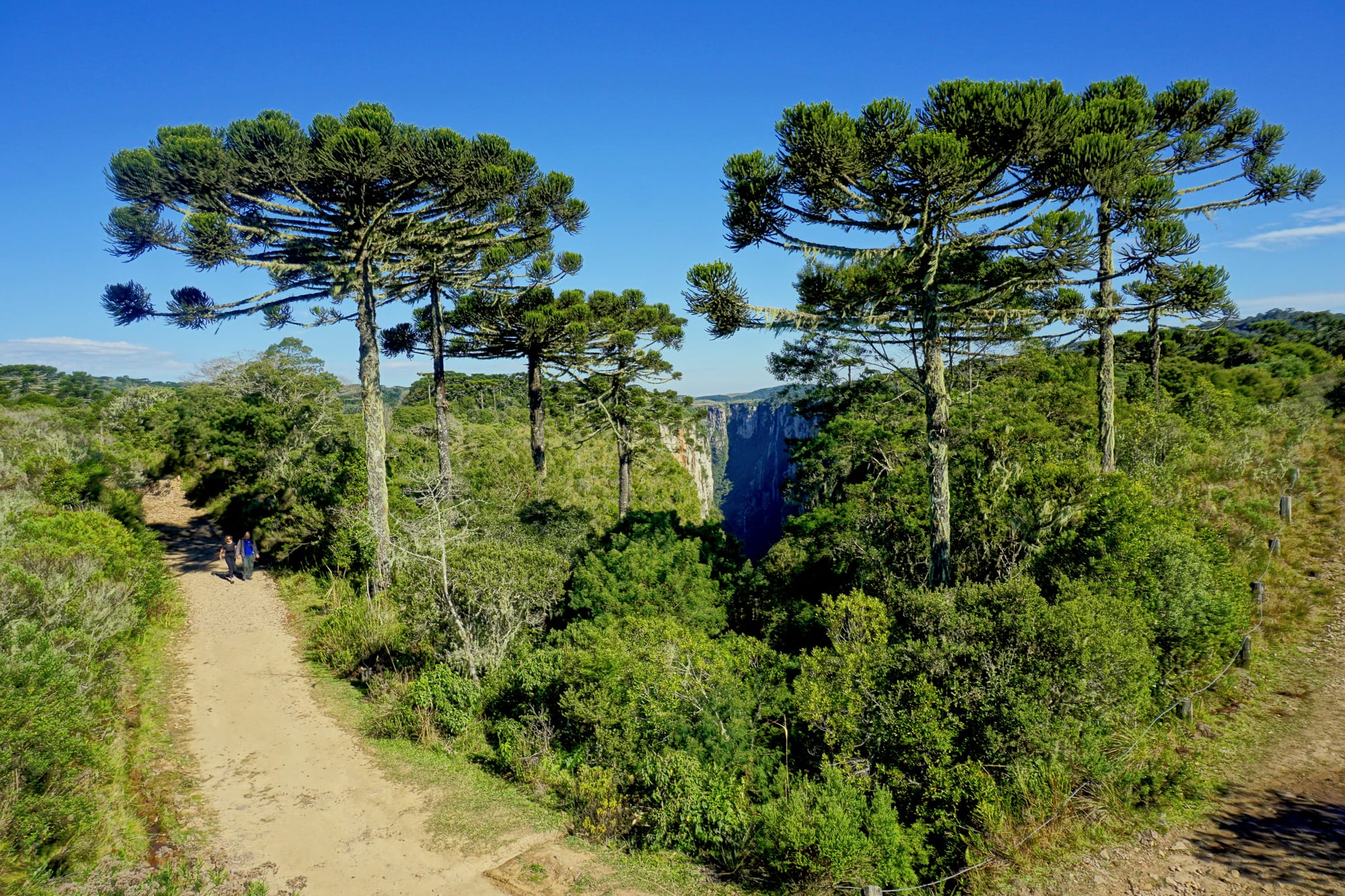
Tall araucaria pines above green scrub and a dirt path, with the sheer rock walls of a canyon in the distance

Brazil

The South

Araucaria pines on the rim of the Itaimbezinho canyon in Aparados da Serra National Park, Rio Grande do Sul. (Germano Roberto Schüür / Wikimedia Commons · CC BY-SA 3.0)

Brazil's three southernmost states — Paraná, Santa Catarina and Rio Grande do Sul — a subtropical region of araucaria highlands, canyons and pampas, shaped by gaúcho ranching and German, Italian and Slavic immigration, running from the Iguaçu falls on the Argentine border to the island city of Florianópolis and the wine hills of the Serra Gaúcha.

Explore The South

History

Guarani, Kaingang and Charrúa peoples lived here when Portugal and Spain began competing for the region. Jesuits gathered Guarani into mission towns in the 17th and 18th centuries, and when the 1750 Treaty of Madrid gave seven of them to Portugal, the Guarani War followed; the ruins of São Miguel das Missões are their best-known remnant. Portugal secured the coast with settlers from the Azores, who shaped Florianópolis and early Porto Alegre, while the open pampas became cattle country worked by gaúcho horsemen. Charque, dried salted beef produced by enslaved workers in Pelotas, fed the plantations further north.

Rio Grande do Sul's ranchers rose against the empire in the Farroupilha Revolution of 1835–1845, briefly declaring a republic; Giuseppe Garibaldi fought for them and married Anita, from Laguna in Santa Catarina. From 1824 German immigrants settled São Leopoldo, Blumenau and Joinville, Italians reached the Serra Gaúcha from 1875, and Poles and Ukrainians farmed Paraná. The Contestado War of 1912–1916 on the Paraná–Santa Catarina border ended a messianic peasant uprising with thousands of deaths.

Getúlio Vargas, a gaúcho, took power in 1930. In the late 20th century Curitiba became a model of urban planning under mayor Jaime Lerner, the Itaipu dam was built on the Paraná river with Paraguay, and Porto Alegre pioneered participatory budgeting and hosted the first World Social Forum in 2001.

Culture & Customs

The gaúcho tradition defines Rio Grande do Sul: chimarrão, bitter mate drunk from a gourd and passed around a circle, wide bombacha trousers, horsemanship and tradition centres, the CTGs, that teach folk dance and song. Semana Farroupilha in September celebrates the revolution, and gaúchos use tu rather than você and share words with their Spanish-speaking neighbours.

European immigrant culture is equally visible. Hunsrik, a German dialect, survives in parts of Rio Grande do Sul and Santa Catarina, and Talian, based on Venetian, in the Serra Gaúcha. Blumenau's Oktoberfest is Brazil's largest, Caxias do Sul holds the Festa da Uva grape festival, and Gramado's film festival and Christmas lights draw national crowds. Paraná's Ukrainian communities around Prudentópolis keep onion-domed churches and painted Easter eggs.

On Santa Catarina's island, Azorean heritage shows in the boi-de-mamão folk play and the manezinhos, as long-established islanders are known. Football rivalries run hot: Grêmio against Internacional in Porto Alegre's Gre-Nal, and Athletico Paranaense against Coritiba in Curitiba.

Daily Life

About 30 million people live in the three states. Curitiba has around 1.8 million, Porto Alegre about 1.3 million, and Florianópolis about 550,000; Joinville is Santa Catarina's largest city, and Londrina, Caxias do Sul and Foz do Iguaçu are important regional centres. Living standards are among the highest in Brazil, though inequality and urban poverty remain.

Agriculture is huge: soya, maize and wheat on the plateau, rice in the lowlands of Rio Grande do Sul, tobacco, and pork and poultry in western Santa Catarina. Industry includes cars around Curitiba, machinery, furniture and textiles in the German valleys, wine and machinery in the Serra Gaúcha, and hydroelectric power from Itaipu. Florianópolis has a growing technology sector.

Days are shaped by the climate: chimarrão in the morning, a hearty lunch, winter heaters in houses not built for cold. Recovery from the 2024 floods and the region's exposure to droughts and storms are the pressing issues.

Food

Churrasco is the south's gift to Brazil: beef, sausage and chicken on skewers, seasoned with coarse salt and roasted over embers, often slowly for hours for costela, beef ribs. Arroz de carreteiro, rice cooked with charque, was the food of the ox-cart drivers, and sagu, tapioca pearls simmered in red wine, is a gaúcho dessert.

Italian settlers created the galeto meal of the Serra Gaúcha, roast chicken with polenta, pasta and salads served in rounds, and the region makes most of Brazil's wine, including well-regarded sparkling wine. German towns serve the café colonial, a vast spread of breads, cuca crumble cakes, sausages and preserves, alongside beer and sauerkraut, and Gramado is known for chocolate.

Paraná's classic is barreado from the coastal towns of Morretes and Antonina, beef slow-cooked for hours in a sealed clay pot and eaten with cassava flour and banana. Winter brings pinhão, the seeds of the araucaria pine, boiled or roasted. Santa Catarina farms oysters and mussels, and Florianópolis restaurants serve them fresh at Ribeirão da Ilha and Santo Antônio de Lisboa.

Attractions & Natural Wonders

In western Paraná, Iguaçu National Park, a UNESCO World Heritage Site, protects the Brazilian side of the Iguaçu falls: a trail from the park road follows the canyon with views across the cascades, ending on a walkway near the Devil's Throat. Foz do Iguaçu also has a bird park and tours of the Itaipu dam. Curitiba offers its botanical garden, Niemeyer's eye-shaped museum, the Wire Opera House and the Sunday fair in Largo da Ordem, with the Serra do Mar train to Morretes, the sandstone formations of Vila Velha State Park and Ilha do Mel nearby.

Florianópolis has dozens of beaches, the dunes of Joaquina, the Lagoa da Conceição and the restored Hercílio Luz bridge. Along the coast, Praia do Rosa and Garopaba see southern right whales in winter, while inland Blumenau and Pomerode keep their German character and the Serra do Rio do Rastro road zigzags up to the cold plateau at Bom Jardim da Serra.

In Rio Grande do Sul, Gramado and neighbouring Canela, with its Caracol waterfall, anchor the Serra Gaúcha; Bento Gonçalves is the base for the Vale dos Vinhedos wineries. The Aparados da Serra and Serra Geral national parks hold the Itaimbezinho and Fortaleza canyons. Porto Alegre has the Mercado Público, the Iberê Camargo Foundation and sunsets over the Guaíba, and São Miguel das Missões lies in the far west.

Cities in The South

Planning basics

Budget

Costs in the south are close to the national average, with sharp seasonal peaks: Florianópolis and the Santa Catarina beaches in December to February, and Gramado in July and during its Christmas season, when hotels charge well above normal. Foz do Iguaçu has a wide range of accommodation, and park tickets plus boat trips are the main extra. Curitiba, Porto Alegre and the interior towns are good value.

Daily Budget Midrange
USD 90–180 (mid-range hotel or pousada, churrascaria dinners, wine tours, a hire car)
Daily Budget Shoestring
USD 35–60 (hostel, buffet lunches, intercity buses, park entry)

Visit Gramado and the Serra outside July and December, and Florianópolis in March or April, for much lower prices.

Safety

The south has lower crime rates than much of Brazil, though Porto Alegre and Curitiba have the usual robbery and phone-theft risks in central areas at night. Foz do Iguaçu is a busy border town on the triple frontier with Argentina and Paraguay, known for smuggling. The bigger hazards are natural: rip currents on open beaches, winter driving on mountain roads, and extreme rain — the 2024 floods in Rio Grande do Sul killed more than 180 people and swamped much of Porto Alegre.

Swim only at guarded beaches, keep food away from the coatis at Iguaçu, and check weather warnings in the rainy months. Check current official travel advice before travelling.

Climate

The south is subtropical, with real seasons. Summers are hot and humid, often above 35°C in Porto Alegre and at Foz do Iguaçu, while winter cold fronts bring frost to the highlands and occasional snow around São Joaquim and Urubici. Rain falls year-round, and the region is prone to severe storms, cyclones and floods.

Summer
hot and humid, 25–38°C in the lowlands; milder on the plateau and in the Serra Gaúcha
Winter
cool to cold, 5–20°C, with frost in the highlands and cold, damp spells in the cities

Transportation

Foz do Iguaçu, Curitiba, Florianópolis and Porto Alegre all have airports with flights to São Paulo. Long-distance buses are comfortable: Curitiba to Florianópolis takes about 5 hours, Florianópolis to Porto Alegre about 6, Porto Alegre to Gramado about 2, and Curitiba to Foz do Iguaçu is an overnight ride. A tourist train descends the Serra do Mar from Curitiba to Morretes. A car is the best way to explore the Serra Gaúcha, the canyons and the Santa Catarina coast.

Fly to Foz do Iguaçu rather than taking the bus; allow a full day for the Brazilian side of the falls.

Best Time to Visit

Spring (September to November) and autumn (March to May) suit most of the region, with mild weather and fewer crowds. The beaches are at their best from December to March. Iguaçu can be visited year-round; the falls carry most water after heavy rain, while clearer skies make spring and autumn pleasant. The grape harvest in the Serra Gaúcha runs from January to March, and July brings winter tourism to the mountains.