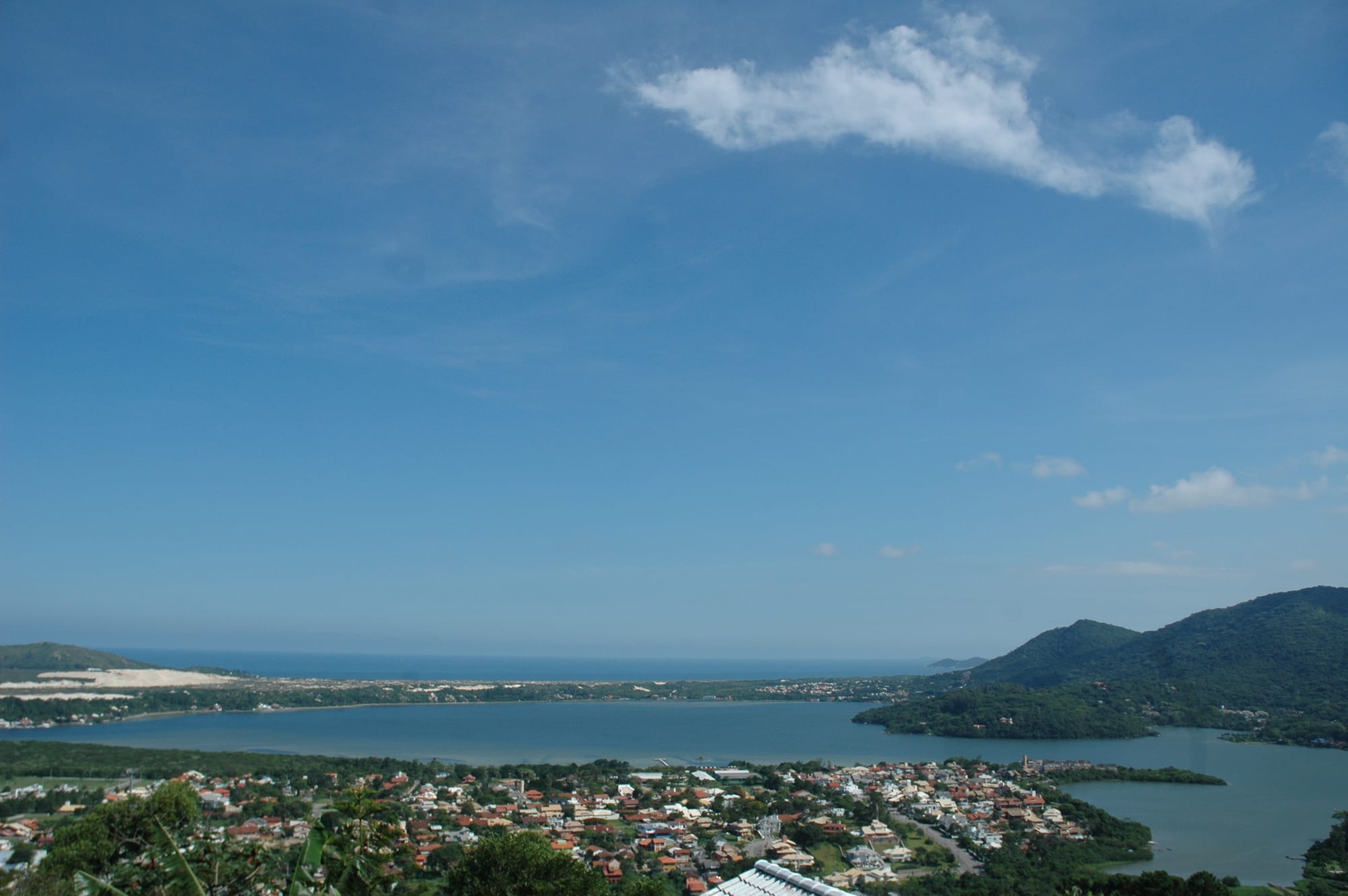
A wide blue lagoon below green hills, with red-roofed houses in the foreground and white dunes and the ocean beyond

The South, Brazil

Florianópolis

The Lagoa da Conceição on Santa Catarina Island, with the dunes and the Atlantic in the distance. (Cleison Cipriani / Wikimedia Commons · CC BY-SA 3.0)

The capital of Santa Catarina, spread over Santa Catarina Island and a strip of the mainland, joined by three bridges. Settled from the 17th century and shaped by Azorean immigrants in the 18th, it grew into a university and technology city with dozens of beaches, a large coastal lagoon, dunes and old fishing villages, and is one of Brazil's favourite summer destinations.

Neighbourhoods

  • Centro
    • Historic district
    • Close to public transport
    • Markets

    The old Desterro on the island's west shore, facing the mainland: the Cruz e Sousa Palace, the Public Market under its old fig trees, government buildings and busy shopping streets. The long-distance bus terminal and the main bridges are here, but the beaches are a bus ride away.

    Open in Maps
  • Lagoa da Conceição
    • Nightlife
    • Best for food
    • Students and nightlife

    The district beside the island's largest lagoon, ringed by hills and dunes, with the city's greatest concentration of restaurants, bars and shops. Popular with young Brazilians, foreign residents and backpackers, it is also close to Joaquina and Mole beaches.

    Open in Maps
  • Barra da Lagoa
    • Beaches
    • Learning to surf
    • Quiet and residential

    A fishing village where the canal from the lagoon meets the open sea, with a gentle cove that is good for learning to surf and a long beach running north towards Moçambique. Fishermen still sell their catch to the local seafood restaurants.

    Open in Maps
  • Northern beaches
    • Beaches
    • Families

    The built-up resort beaches of the north of the island, such as Canasvieiras and Ingleses, with rows of apartments and holiday rentals. They are the favourites of Argentine summer visitors and are crowded in January and February.

    Open in Maps
  • Campeche and the south
    • Beaches
    • Surfing
    • Nature

    The less developed southern half of the island: the long surf beach of Campeche facing Campeche Island, and further south quieter beaches, forested hills and fishing communities.

    Open in Maps
  • Santo Antônio de Lisboa
    • Historic district
    • Best for food
    • Sunset

    A small 18th-century Azorean settlement on the island's north-west bay, with listed houses, a colonial church and a waterfront lined with seafood restaurants.

    Open in Maps

Things to do

Landmarks and the old centre

  • Hercílio Luz Bridgelandmark

    The first bridge to link the island to the mainland, opened in 1926 and the longest suspension bridge in Brazil; closed in 1991, it reopened after a full restoration at the end of 2019.

    Open in Maps
  • Mercado Públicomarket

    The public market, in business since 1898, with two wings of food stalls, bars and craft shops either side of a central passage, and a favourite meeting place for locals.

    Open in Maps
  • Cruz e Sousa Palacemuseum

    The former governor's residence, restored to house the Santa Catarina Museum and named after the city's Symbolist poet Cruz e Sousa.

    Open in Maps

The lagoon and the beaches

  • Lagoa da Conceiçãopark

    The largest lagoon on the island, surrounded by hills and dunes and linked to the sea by a canal, and the island's main centre for water and outdoor sports.

    Open in Maps
  • Praia da Joaquinabeach

    An ocean beach that surfers from around the world discovered in the 1970s, beside the dunes where sandboarding is popular.

    Open in Maps
  • Praia Molebeach

    A short beach of soft sand between rocky headlands near the lagoon, popular with surfers, paragliders and young crowds, and known for its LGBTQ scene in summer.

    Open in Maps
  • Praia do Campechebeach

    About 5 kilometres of white sand and strong surf on the island's east coast, facing Campeche Island.

    Open in Maps
  • Campeche Islandattraction

    A small island about 1,250 metres off the coast in front of Campeche beach, of archaeological interest for the paintings found across it, and reached by boat.

    Open in Maps
  • Ingleses and Santinho dunestrail

    The dunes between Ingleses and Santinho beaches in the north-east of the island, crossed by a 4-kilometre walk and used for sandboarding; Santinho is named after a figure carved in a rock on its headland.

    Open in Maps

Azorean villages

  • Santo Antônio de Lisboaneighborhood

    A historic Azorean settlement, with preserved colonial houses, its church and seafood restaurants along the bay.

    Open in Maps
  • Ribeirão da Ilhaneighborhood

    One of the oldest Azorean settlements on the island, on the south-west shore, with terraced colonial houses around the church of Nossa Senhora da Lapa, opened in 1806, and Brazil's largest oyster production.

    Open in Maps

Nature and forts

  • Rio Vermelho State Parkpark

    Forest and restinga in the north-east of the island, with an ecological trail where animals rescued by the environmental police can be seen.

    Open in Maps
  • Anhatomirim Fortresslandmark

    The colonial fortress of Santa Cruz on Anhatomirim Island, in the neighbouring municipality of Governador Celso Ramos, built by José da Silva Paes, where many prisoners were shot after the Federalist Revolt of the 1890s.

    Open in Maps

Sport

  • Avaí FC at the Ressacadaattraction

    One of the city's two big football clubs, founded in 1923, playing in blue and white at the Ressacada stadium in the south of the island.

    Open in Maps

Seasonal events

  • Festa do Divinoaround 40 days after Easter, usually May

    The Holy Spirit festival of Azorean origin, held since colonial times, with a procession, music and street food, celebrated especially in Lagoa da Conceição and the old villages.

  • Fenaostradates vary from year to year

    The National Oyster Festival, created in 1999 to celebrate the oysters farmed around the island.

Eat and drink

Long-standing places and food districts in Florianópolis. Hours, ratings and directions come from your maps app, always current.

Florianópolis classics

  • Oysters at Ribeirão da Ilhaneighborhood

    Fresh oysters from the farms in the bay, served in waterfront restaurants in the district that produces more oysters than anywhere else in Brazil.

    Open in Maps
  • Santo Antônio de Lisboa seafrontneighborhood

    A row of seafood restaurants on the bay, known for oysters, mussels and fish, and for sunset views towards the mainland.

    Open in Maps

Food districts and markets

  • Mercado Públicomarket

    The 19th-century public market in the centre, with fish and food stalls and crowded bars in its central passage.

    Open in Maps
  • Lagoa da Conceiçãoneighborhood

    The island's densest cluster of restaurants and bars, from seafood to vegetarian cafés and organic markets.

    Open in Maps
  • Barra da Lagoaneighborhood

    A fishing village at the lagoon's mouth where restaurants buy shrimp and fish straight from the local boats.

    Open in Maps

Experience Florianópolis

History

Carijó people, a Tupi group, lived on the island long before Europeans arrived, leaving shell mounds, sambaquis, up to 4,000 years old; they called it Meiembipe, "mountain along the channel". The Portuguese landed around 1514 and named it Ilha dos Patos, the island of ducks, before it became Santa Catarina in 1526, a supply stop for ships bound for the Río de la Plata. Permanent settlement began in 1673, when the bandeirante Francisco Dias Velho arrived with his farming company, and in 1678 a chapel was built to Nossa Senhora do Desterro, which gave the town its first name.

Its position halfway between Rio de Janeiro and Buenos Aires made it strategic. In 1739 Desterro became capital of a new captaincy, and a ring of fortresses was built around the bay. Between 1747 and 1756 about 6,000 settlers arrived from the Azores and Madeira, founding villages such as Santo Antônio de Lisboa and Ribeirão da Ilha and bringing farming, linen and cotton weaving, and fishing; the island was also an important whaling centre. In 1823 Desterro became capital of the province of Santa Catarina.

After the fall of the monarchy, the Federalist Revolt spread here from Rio Grande do Sul, and Desterro briefly became the rebels' capital. President Floriano Peixoto crushed the rising, many of its supporters were shot at the Anhatomirim fortress, and in the 1890s the city was renamed Florianópolis, "Floriano's city". The Hercílio Luz Bridge reached the island in 1926. From the late 20th century the federal university, tourism and a growing technology industry turned the quiet capital into one of Brazil's most desirable cities.

Culture & Customs

Azorean heritage is the root of island culture. The Florianopolitan dialect, brought by the Azorean settlers, is still heard in the old villages, and long-established islanders are proudly known as manezinhos. Women in Lagoa da Conceição and Ribeirão da Ilha still make bobbin lace, renda de bilro, and traditions such as the Festa do Divino, the Holy Spirit festival held since colonial times, survive alongside the newcomers' culture. The city's Symbolist poet Cruz e Sousa is commemorated in the restored governor's palace that bears his name.

Florianópolis is also one of the centres of Brazilian surfing. Surfers from around the world discovered Joaquina in the 1970s, and Praia Mole has hosted rounds of the world surf tour. The island is known for its outdoor lifestyle — water sports on the lagoon, sandboarding on the dunes, trails over the hills — and for an open, relaxed atmosphere, with a well-known LGBTQ scene in summer.

Football divides the city between Avaí, in blue and white, and Figueirense, in black and white, whose home is in the mainland district of Estreito. Rowing clubs between the bridges keep an older sporting tradition alive.

Daily Life

About 537,000 people lived in Florianópolis at the 2022 census, the second-largest city in Santa Catarina after Joinville, and the metropolitan area has an estimated 1.1 million. Most residents live on the mainland and in the centre and north of the island; the southern half is much less built up. The city scores among the highest in Brazil on the human development index.

Commerce and services make up almost the whole economy. Tourism is a staple, and information technology has become one of the biggest earners: companies grew out of an incubator at the Federal University of Santa Catarina, and local officials have long promoted the island as a Brazilian Silicon Valley with beaches. The university and the state government are major employers, and fishing and oyster farming continue in the old villages.

The city's popularity has brought pressure. Brazilians from other states and foreigners have moved to the island, and summer traffic jams on its few roads are notorious. Environmental limits on building, rising sea levels and coastal erosion are live issues, and mangroves are being replanted around the city to protect the shore.

Food

Seafood defines the island's table. Santa Catarina farms oysters and mussels, and Ribeirão da Ilha is the country's biggest oyster-producing district: oysters are the speciality of restaurants along the bay at Ribeirão and Santo Antônio de Lisboa. Shrimp caught in the lagoon at night is sold to the restaurants of Barra da Lagoa, and fish dishes range from simple fried fillets to stews served with rice and pirão, a porridge-like dish of manioc in fish stock.

In winter the mullet, tainha, runs along the coast, and fishermen on the beaches of the north haul it in with nets, a tradition from Azorean times. Grilled tainha, tainha grelhada, is a favourite of the season.

The Mercado Público in the centre has been a hub of food stalls and bars since the 1890s, and Lagoa da Conceição has the island's widest choice of restaurants and organic markets. As in the rest of southern Brazil, churrasco and buffet lunches are everyday food, and the Fenaostra oyster festival celebrates the local harvest.

Planning tools

Budget

Florianópolis is one of the more expensive places in southern Brazil in high summer, when the island fills with visitors from São Paulo, Argentina and Uruguay and rental and hotel prices climb steeply. Outside January and February costs fall considerably. Seafood dinners are the main splurge; buffet lunches and bus fares are cheap.

Daily Budget Midrange
USD 90–180 (pousada or hotel near a beach, seafood dinners, a hire car or app rides between beaches)
Daily Budget Shoestring
USD 35–60 (hostel in Lagoa or Barra da Lagoa, buffet lunches, city buses)

Visit in March or April, when the sea is still warm and prices are much lower than in high summer.

Best Time to Visit

December to March is beach season, hot and busy, with the most rain from January to March. March to May is warm, quieter and good value. Winter, June to August, is the driest time and too cool for most swimmers, but brings the mullet fishing season, and penguins sometimes swim into the Barra da Lagoa canal.

Suggested Number of Days

Three or four days give time for the centre, the lagoon and several beaches. A week suits a beach holiday or trips along the Santa Catarina coast. The island is large and traffic is slow in summer, so where to stay changes how much can be seen.

First Visit
3–4 days
With Surroundings
5–7 days

Transportation

City buses run through a set of neighbourhood terminals, such as those at Lagoa and Santo Antônio de Lisboa, connecting the centre with the beach districts, but journeys can be slow. Many visitors hire a car to explore the beaches; app rides are widely available.

Expect long queues of traffic on the island's few roads on summer weekends; travel early in the day.

Airport & Station Connections

Hercílio Luz International Airport, in the south of the island about 14 kilometres from downtown, has a terminal opened in 2019, domestic flights, seasonal flights from Buenos Aires, Santiago and Montevideo and, since 2024, a direct flight to Lisbon. The Rita Maria bus terminal, beside the bridges, has services across southern Brazil and to neighbouring countries; Curitiba is about 300 kilometres away.

Walkability

The centre and the village cores of Lagoa, Santo Antônio de Lisboa and Ribeirão da Ilha are pleasant on foot. The island itself is long and hilly, with the beaches spread around its coast, so moving between districts needs a bus or a car.

Safety

Brazil has high rates of crime, including violent crime, and it is the main practical concern for visitors — though very unevenly distributed. The south has lower crime rates than much of Brazil, and Florianópolis was ranked the safest state capital in a 2024 national security atlas; ordinary care with phones and bags still applies. The bigger hazards are natural: rip currents on the open ocean beaches.

Swim only at guarded beaches, take app rides late at night, and do not leave valuables unattended on the sand. Check current official travel advice before travelling.

Climate

Humid subtropical, with distinct seasons and an average temperature of about 21.5°C. Rain falls all year, most heavily from January to March, and humidity is high. Summer is December to February.

Summer
warm to hot and humid — the rainiest season, with the hottest days occasionally approaching 39°C
Winter
mild and the driest time of year — cool nights, with lows commonly down to around 6–11°C

Local Customs

Long-established islanders call themselves manezinhos, and their Azorean-influenced accent and turns of phrase are a source of pride and gentle teasing. A service charge is usually added to restaurant bills. Beachwear is fine on the beach and in beach districts but not in the centre or in churches.

On beaches that are popular with the LGBTQ community, as anywhere, photograph people only with their permission.

Common Payment Methods

The currency is the Brazilian real (R$). Cards and the instant Pix transfer system are accepted almost everywhere, including at many beach kiosks. Carry a little cash for buses, small stalls and village shops, and withdraw it by day from ATMs inside banks or shopping centres.