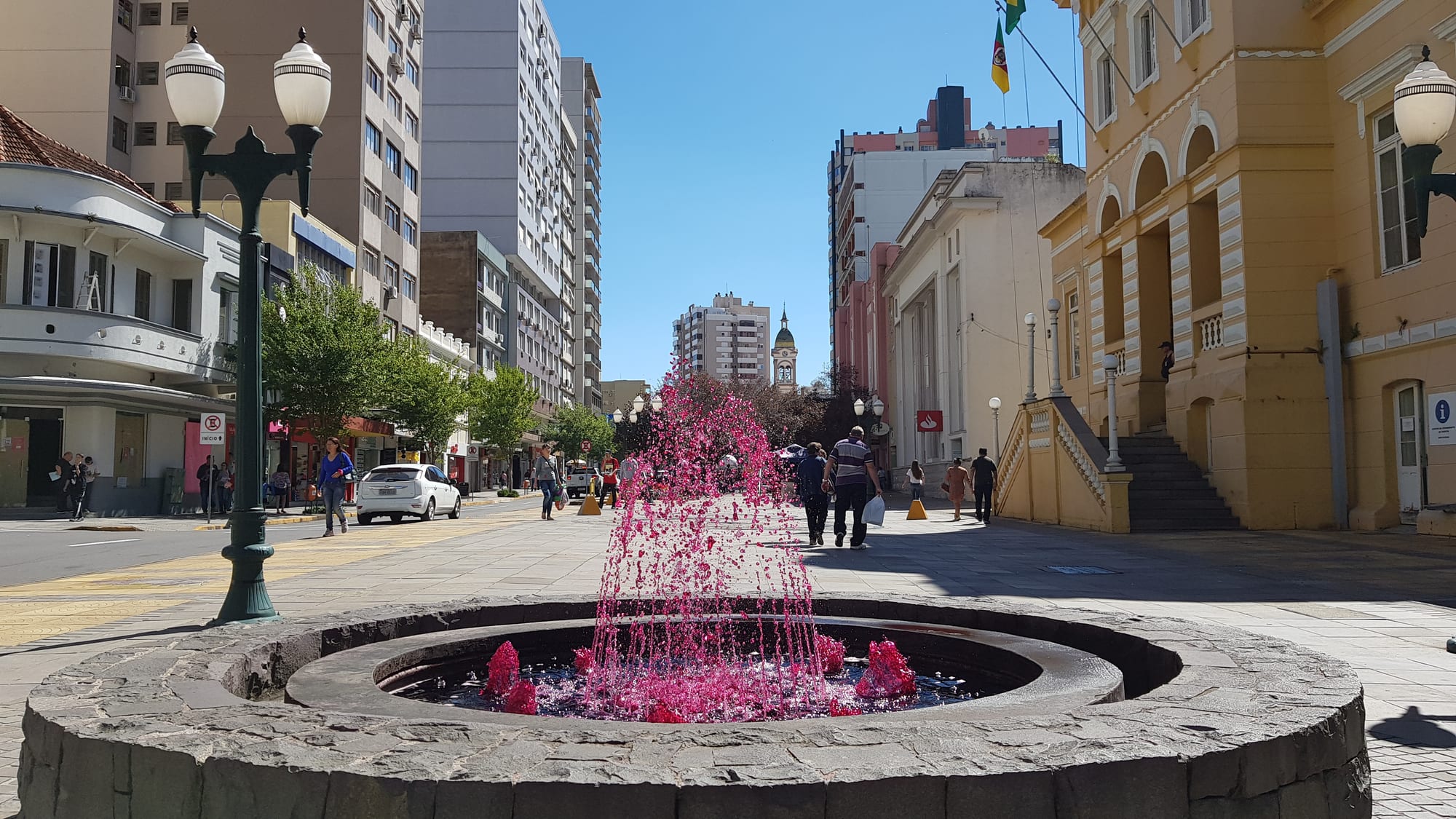
A fountain of wine-coloured water on a paved pedestrian street, with a yellow colonial building on the right and tower blocks behind

The South, Brazil

Bento Gonçalves

The Via del Vino in the centre of Bento Gonçalves, beside the city hall and historic buildings. (Vagner XX / Wikimedia Commons · CC BY-SA 4.0)

A hill city of about 120,000 in the Serra Gaúcha of Rio Grande do Sul, founded in 1875 as a colony for Italian immigrants who planted vines on its slopes. It is Brazil's largest wine producer and a major furniture centre, and visitors come for the cellars of the Vale dos Vinhedos, the stone farmhouses of the Caminhos de Pedra and a steam train through the vineyards.

Neighbourhoods

  • Centro
    • First-time visitors
    • Close to the bus station
    • Shopping

    The commercial centre on the hilltop, with the city hall and historic buildings around the pedestrian Via del Vino, the church of Santo Antônio, shops, restaurants and the intercity bus station. It is the practical base for travellers without a car.

    Open in Maps
  • Cidade Alta
    • Close to the train
    • Restaurants

    A district just beyond the centre where the old railway station stands, the starting point of the Maria Fumaça steam train. Restaurants and inns make it a convenient alternative to the centre.

    Open in Maps
  • Vale dos Vinhedos
    • Wine country
    • Countryside
    • Couples

    The valley of vineyards on the city's western side, shared with Garibaldi and Monte Belo do Sul, where wineries, restaurants and country inns line the roads. Staying here means waking among the vines but depending on a car or tours.

    Open in Maps
  • São Pedro and the Caminhos de Pedra
    • Rural heritage
    • Quiet stays

    The rural district of São Pedro, one of the earliest areas of immigrant settlement, where old stone and timber farmhouses along a country road now hold small wineries, museums and restaurants.

    Open in Maps

Things to do

In the city

  • Via del Vinolandmark

    The pedestrian street in the centre where the city hall and several historic buildings stand, decorated with fountains and wine imagery.

    Open in Maps
  • Pipa Pórticolandmark

    The city gateway built in the shape of a giant wine barrel, one of Bento Gonçalves's main symbols.

    Open in Maps
  • Santo Antônio Churchlandmark

    The main church of the city's patron saint, whose parish was founded in 1884 by the immigrant colony; its tower was completed in 1933.

    Open in Maps
  • Epopeia Italianamuseum

    A museum of the city's Italian immigrant heritage.

    Open in Maps

Wine country

  • Vale dos Vinhedosneighborhood

    An 82-square-kilometre valley of vineyards and wineries, the first Brazilian wine region to earn a protected designation of origin, most of it inside Bento Gonçalves.

    Open in Maps
  • Caminhos de Pedratrail

    A rural heritage road, opened to visitors in 1992, past stone houses built by the first Italian settlers — one, from around 1878, appeared in the film O Quatrilho.

    Open in Maps
  • Maria Fumaçaattraction

    A tourist steam train on the old railway line from Bento Gonçalves through Garibaldi to Carlos Barbosa, about 23 km, with wine and grape juice tastings and Italian and gaúcho music on board.

    Open in Maps
  • Ernesto Dornelles Bridgeviewpoint

    The arch bridge over the Rio das Antas on the road to Veranópolis, held up by two parallel arches with no piers, above the deep, winding valley of the river.

    Open in Maps

Short trips from the city

  • Garibaldiattraction

    The neighbouring town of Italian and German settlers to the south, known for its wine and above all its sparkling wine.

    Open in Maps
  • Pinto Bandeiraattraction

    A small hill municipality of vineyards to the east, separated from Bento Gonçalves and established in its own right in 2013.

    Open in Maps
  • Caxias do Sulattraction

    The largest city of the Serra Gaúcha and the second city of Rio Grande do Sul, another former Italian colony, host of the Festa da Uva grape festival.

    Open in Maps
  • Gramadoattraction

    The highland resort town of timbered buildings, chocolate shops and festivals, about 70 km to the east in a straight line.

    Open in Maps

Seasonal events

  • Grape harvestfrom early January

    The vindima, when the grapes are picked in the Vale dos Vinhedos and around the city, celebrated with events such as Bento em Vindima.

  • Festa de Santo AntônioJune

    The feast of the city's patron saint on 13 June, a municipal holiday.

Eat and drink

Long-standing places and food districts in Bento Gonçalves. Hours, ratings and directions come from your maps app, always current.

Bento Gonçalves classics

  • Galeto restaurantsneighborhood

    The Italian-immigrant galeto meal of the Serra Gaúcha — roast spring chicken with polenta, pasta, soup and salads served in rounds — is the city's signature.

    Open in Maps
  • Churrascariasneighborhood

    Gaúcho barbecue houses serving beef, sausage and chicken roasted on skewers over embers, carved at the table.

    Open in Maps

Wine country tables

  • Vale dos Vinhedosneighborhood

    Winery tasting rooms and country restaurants serving Italian-style cooking with the valley's still and sparkling wines.

    Open in Maps
  • Caminhos de Pedraneighborhood

    Restaurants, museums and small wineries in old houses, many of them stone, from the time of the first Italian settlers.

    Open in Maps

Experience Bento Gonçalves

History

Kaingang people moved through the forests along the Rio das Antas before European settlement, and were driven out progressively by hired raiders in the late 19th century. Drovers passing a small wooden cross on the trail knew the spot as Cruzinha. In 1875 the imperial government created four colonies for Italian immigrants in the Serra Gaúcha, and the one here, named Dona Isabel after the princess, received its first 25 families that year, mostly from Trento; over the following decades the settlers came mainly from Veneto, Trentino and Lombardy.

The colonists cleared steep, forested plots, built chapels around which communities formed, and turned to grapes and wine. In 1890 the colony separated from Montenegro and was renamed after Bento Gonçalves da Silva, leader of the Farroupilha Revolution. The railway reached the city in 1919, linking it to Porto Alegre, and new arrivals from Poland, Germany, Sweden, France and Spain joined the Italian majority. Ernesto Geisel, president of Brazil from 1974 to 1979, was born here in 1907.

In 1967 the city held the first National Wine Festival, the Fenavinho, and wine, furniture and metalworking grew into major industries. Regular passenger trains ended in the 1970s, and from 1993 the line to Garibaldi and Carlos Barbosa was revived for steam-train tourism. The Vale dos Vinhedos gained Brazil's first wine designation of origin in 2012, and in 2016 the city made Talian a co-official language.

Culture & Customs

Bento Gonçalves is one of the centres of Italian immigration in Brazil, and that heritage is cultivated deliberately. Talian, the dialect descended from the Venetian and other northern Italian speech of the settlers, is still spoken, and since 2016 has been co-official with Portuguese. Italian choirs and tarantella are part of local celebrations and of the entertainment on the steam train.

Catholic faith shaped the colony: chapels were the first community buildings in each settlement line, and the city's patron, Saint Anthony of Padua, is honoured with a municipal holiday on 13 June. The Caminhos de Pedra preserves the stone and timber farmhouses of the first generations and was among the first rural tourism routes in Brazil; it was declared part of the state's historic and cultural heritage in 2009.

Wine is a cultural as well as an economic identity. The Fenavinho, the harvest season and the presence of a federal wine research and education centre make winemaking a matter of civic pride, and the giant wine-barrel gateway at the city entrance announces it. Gaúcho traditions — chimarrão, churrasco and the state's own accent — sit comfortably alongside the Italian ones.

Daily Life

About 123,000 people lived in the municipality at the 2022 census. Bento Gonçalves is among the ten largest economies in Rio Grande do Sul, the country's largest wine producer and home to its second-largest furniture industry, with metal, mechanical, plastics and chemical factories as well. Its human development index has long been among the highest in the state.

The city's exhibition park, built for the Fenavinho, hosts trade fairs for furniture, furniture machinery and wine machinery that bring business visitors throughout the year, alongside well over a million tourists. Vineyards surround the city, and the harvest, which begins in early January, brings a rush of work for growers and wineries.

Daily life follows a small-city rhythm: residents live in the hilltop centre and the neighbourhoods spreading down the slopes, and the rural districts keep their chapels and community halls. Mornings start early in the factories, lunch is the main meal, and chimarrão is passed around at home and at work. Traffic, water supply and the pressure of tourism on the countryside are local concerns.

Food

The food of Bento Gonçalves is the cooking of the Italian settlers adapted to Brazilian ingredients. The galeto is the classic meal: spring chicken roasted on the grill, served in rounds with soup, polenta, pasta, salad and bread until the diners stop. Polenta often appears fried.

Wine is the city's product. Bento Gonçalves is Brazil's largest producer of grapes, wine and grape products, from table wines of American and hybrid grapes to wines of European varieties and well-regarded sparkling wines. The Vale dos Vinhedos was the first Brazilian region to receive a protected designation of origin, and its wineries welcome visitors for tastings. The city is home to Vinícola Aurora, Brazil's largest wine cooperative, and Casa Valduga is the largest winery in the valley. Grape juice, the non-alcoholic counterpart, is equally local and widely sold.

Gaúcho cooking is everywhere too: churrascarias serve beef, sausage and chicken roasted over embers, and the restaurants, museums and small wineries in the old farmhouses of the Caminhos de Pedra welcome visitors.

Planning tools

Budget

Bento Gonçalves is cheaper than Gramado and costs are close to the regional average. The main extras are winery tastings, the steam train and transport into the countryside, either a hire car, tours or taxis. Weekends and holiday periods fill the valley's inns.

Daily Budget Midrange
USD 90–180 (mid-range hotel or valley inn, galeto and churrascaria dinners, wine tours, a hire car)
Daily Budget Shoestring
USD 40–70 (simple hotel in the centre, buffet lunches, local buses)

Plan tastings with a designated driver or a tour, since the wineries are spread over country roads.

Best Time to Visit

The grape harvest, which in southern Brazil begins in early January, is the liveliest time in the vineyards. Spring and autumn bring mild weather and fewer visitors, and winter is cool, with frost common, but suits wine and hearty food.

Suggested Number of Days

Two or three days cover the city and its wine country. Four or five allow time for neighbouring towns and the wider Serra Gaúcha; a car adds flexibility, while relying on tours and taxis takes longer.

First Visit
2–3 days
With Surroundings
4–5 days

Transportation

The centre is walkable, and city buses serve the urban area, but the wineries and rural districts are spread across hilly country roads. Most visitors use a hire car, taxis or ride-hailing, or organised tours, and intercity buses link the city to Caxias do Sul, Farroupilha and other towns of the region.

Arrange transport for winery visits rather than driving after tastings.

Airport & Station Connections

The nearest airport is at Caxias do Sul, about 41 km away by road and roughly 50 minutes by car. Most visitors fly into Porto Alegre's Salgado Filho airport, about 120 km away, roughly an hour and three quarters by car, and continue by hire car or by one of the frequent executive buses to the city's bus station.

Walkability

The hilltop centre is compact and easy on foot, with steep streets in places. Everything beyond it — the valley, the stone farmhouses and the river — needs transport.

Safety

Brazil has high rates of crime, including violent crime, and it is the main practical concern for visitors — though very unevenly distributed. Bento Gonçalves is a prosperous city, and ordinary care with valuables applies in the centre. In May 2024 it was among the municipalities with the most deaths in the floods across Rio Grande do Sul, and landslides struck both ends of the Ernesto Dornelles Bridge. Wet, winding country roads and fog are the main practical hazards.

Avoid driving rural roads after dark in fog or heavy rain. Check current official travel advice before travelling.

Climate

A humid subtropical highland climate at around 690 metres, with rain spread through the year. Seasons are southern-hemisphere, so summer is December to February.

Summer
warm, with occasional heat — the record is close to 38°C
Winter
mild by day, with frequent frosts and, rarely, snow — the record low is about −4.5°C

Local Customs

Italian roots are visible everywhere, from surnames and food to Talian, the Venetian-based dialect that the city adopted as a co-official language in 2016. Gaúcho habits such as chimarrão are shared as well. A service charge is usually added to restaurant bills, dress is casual, and most people are Catholic.

Tastings are an invitation to sip rather than drink heavily; ask before photographing people, and dress modestly in churches.

Common Payment Methods

The currency is the Brazilian real (R$). Cards and Pix are accepted almost everywhere, including wineries; a little cash helps at rural stalls. ATMs inside banks are the most reliable for foreign cards.