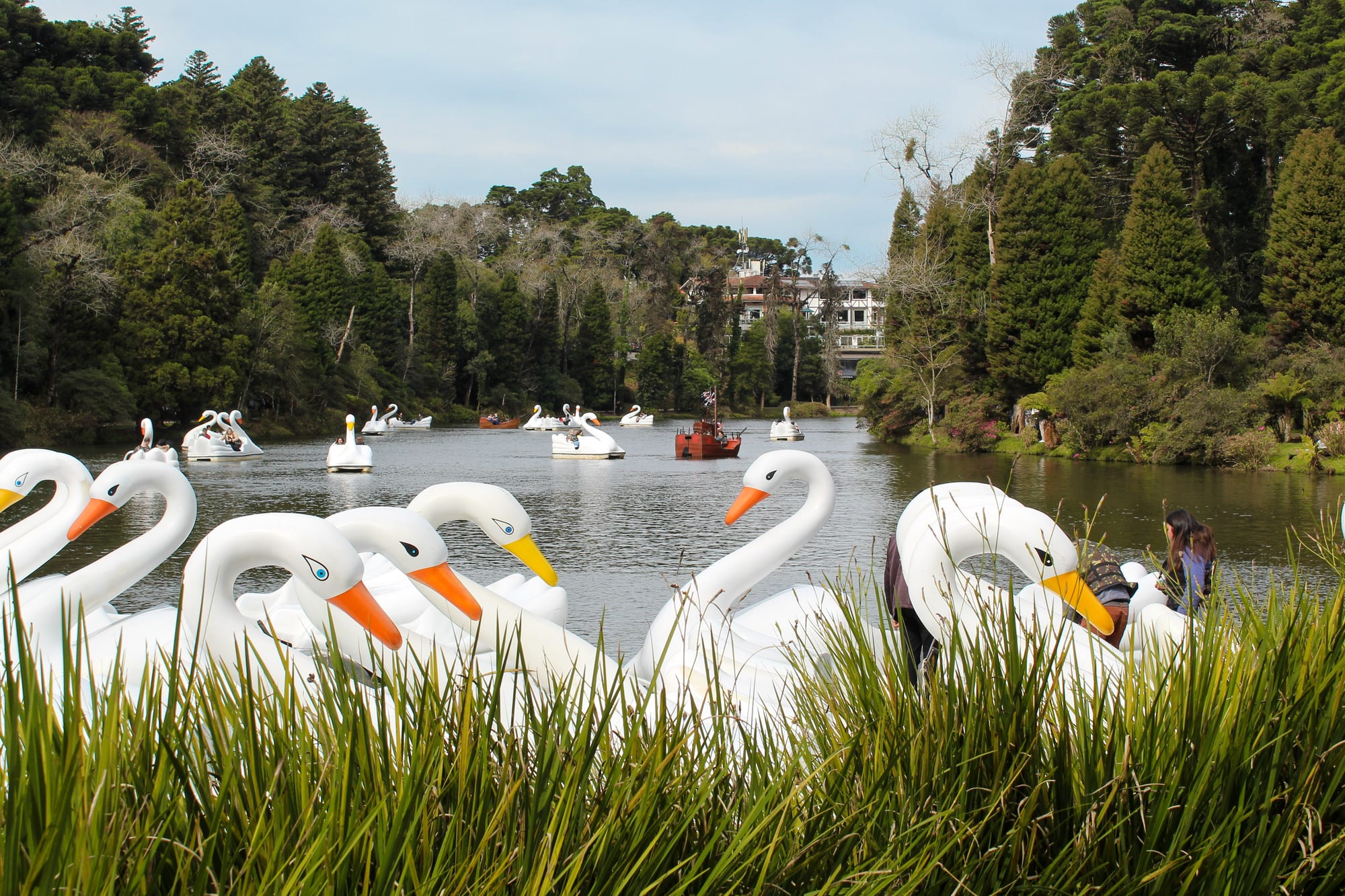
White swan-shaped pedal boats on a calm lake ringed by dark pines and araucarias, with a large house among the trees

The South, Brazil

Gramado

Swan pedal boats on Lago Negro, the lake planted with Black Forest pines on the edge of central Gramado. (Yeuxpapilon / Wikimedia Commons · CC BY-SA 4.0)

A small highland town at about 850 metres in the Serra Gaúcha of Rio Grande do Sul, settled by Azorean descendants and then German and Italian immigrants. A summer retreat since the early 20th century, it is now one of Brazil's busiest domestic destinations, known for its timbered buildings, chocolate, Brazil's leading film festival and a Christmas season that runs for months.

Neighbourhoods

  • Centro and Avenida Borges de Medeiros
    • First-time visitors
    • Shopping
    • Close to the bus station

    The tourist heart of the town, strung along Avenida Borges de Medeiros: the church of São Pedro, the Palácio dos Festivais, the acrylic-roofed Rua Coberta, squares, chocolate shops and restaurants. The bus station is on the same avenue, and the whole area is easily covered on foot, which makes it the obvious base without a car.

    Open in Maps
  • Around Lago Negro
    • Quiet and residential
    • Walks
    • Families

    Wooded streets about a kilometre and a half from the town hall, around the lake planted with Black Forest pines in the 1950s. Hydrangeas line the roads in late spring, and the area mixes holiday houses with inns a short walk from the centre.

    Open in Maps
  • Avenida das Hortênsias
    • Road-trip bases
    • Attractions

    The main road out of town towards Canela, lined with hotels, fondue restaurants, themed attractions and a wax museum. It suits travellers with a car who want easy access to both towns.

    Open in Maps
  • Vale do Quilombo and the countryside
    • Countryside
    • Viewpoints
    • Quiet stays

    Farmland and forested valleys below the plateau edge, with a viewpoint over the Vale do Quilombo and rural lanes of country inns and smallholdings. A car is needed.

    Open in Maps

Things to do

In and around the town

  • Lago Negropark

    An artificial lake created in 1953, ringed by trees whose seedlings were brought from Germany's Black Forest, with a lakeside path, pedal boats and craft stalls.

    Open in Maps
  • Rua Cobertalandmark

    A short shopping street in the centre covered by an acrylic roof, lined with cafés and especially popular when it is lit for Christmas.

    Open in Maps
  • Palácio dos Festivaislandmark

    The cinema on Avenida Borges de Medeiros that hosts the Gramado film festival each year.

    Open in Maps
  • Mini Mundoattraction

    An open-air miniature park opened in 1983, with more than 140 buildings from around the world reproduced at one twenty-fourth of their size, from Neuschwanstein to Porto Alegre's Usina do Gasômetro.

    Open in Maps
  • Parque Knorrpark

    A park in the town whose Christmas-themed Aldeia do Papai Noel — Santa Claus's village — is one of Gramado's best-known family attractions.

    Open in Maps

Short trips from the town

  • Canelaattraction

    Gramado's neighbour a few kilometres east, a town of similar mountain character and the base for the region's hiking, climbing and rafting.

    Open in Maps
  • Caracol Fallsviewpoint

    A waterfall that drops about 130 metres off basalt cliffs in Caracol State Park, about 7 km from Canela, seen from viewpoints, an observation tower and a 927-step trail to its base.

    Open in Maps
  • Mundo a Vapormuseum

    A theme park in Canela of working replicas of steam-powered machines, known for its facade recreating the 1895 Montparnasse train crash in Paris.

    Open in Maps
  • Nova Petrópolisattraction

    A smaller town of German descendants on the Rota Romântica west of Gramado, where a German dialect is still widely spoken.

    Open in Maps
  • Aparados da Serra National Parkpark

    A national park created in 1959 to protect the Itaimbezinho canyon, cut into the edge of the plateau.

    Open in Maps

Seasonal events

  • Gramado Film FestivalAugust

    Brazil's leading film festival, first held in 1973 and open to Latin American films since 1992, with screenings at the Palácio dos Festivais and the Kikito as its trophy.

  • Natal LuzNovember to January

    A Christmas festival of parades, concerts, shows and lights that began in 1986 as a single concert and has grown into one of the longest Christmas festivals in the world.

Eat and drink

Long-standing places and food districts in Gramado. Hours, ratings and directions come from your maps app, always current.

Gramado classics

  • Chocolate shopsneighborhood

    Gramado makes its own chocolate in many small factories, and shops selling homemade bars, bonbons and hot chocolate line the main avenue.

    Open in Maps
  • Fondue restaurantsneighborhood

    Cheese, meat and chocolate fondue is the town's typical winter dinner, served in many restaurants in the centre and along Avenida das Hortênsias.

    Open in Maps
  • Café colonialrestaurant

    The German-immigrant afternoon spread of breads, cuca crumble cakes, cold meats, cheeses and preserves, served in houses specialising in it in and around the town.

    Open in Maps

Cafés and streets

  • Rua Cobertaneighborhood

    The covered street's cafés and restaurant terraces stay sheltered from rain and cold, which makes it a natural meeting place in winter.

    Open in Maps

Experience Gramado

History

Gramado was first settled in 1875 by Portuguese-speaking families of Azorean descent. German immigrants followed about five years later, and soon after them Italians from the settlements around Caxias do Sul, giving the area the mix of origins it still celebrates. In 1913 the settlement's centre moved to Linha Nova, where the town centre stands today, and in 1921 a railway brought by José Nicoletti Filho, regarded as the town's founder, connected it to the wider region.

The railway made the cool plateau a summer retreat for families from Porto Alegre, and by the 1930s Gramado was known as a holiday resort. It was still part of the municipality of Taquara until 1954, when it became a municipality in its own right. In 1953 Leopoldo Rosenfeld dammed a creek on land burned in a fire a decade earlier to create Lago Negro, planting its banks with trees from the Black Forest — an early example of the deliberate European styling that became the town's identity.

The film festival, first held in 1973, gave Gramado a national profile, and the Natal Luz Christmas festival, begun in 1986, turned it into a destination for much of the year. Tourism, furniture-making and chocolate have since made it one of the most prosperous small towns in the state. In December 2024 a small plane crashed in the town, killing all ten people on board.

Culture & Customs

The film festival is the town's great cultural event. Started in 1973, it became the Festival of Brazilian and Latin Cinema in 1992, and its trophy, the Kikito, has become a symbol of Gramado itself. Natal Luz, at the other end of the year, fills the streets with parades, concerts and lights for weeks; the Guinness World Records recognises it as the longest Christmas festival in the world. The Festa da Colônia celebrates the Azorean, German and Italian groups who settled the area.

Gramado sits on the Rota Romântica, a scenic route through towns founded by German immigrants, where German roots show in the architecture and food. The town's half-timbered and alpine-style buildings reflect that heritage, and the town is part of the Região das Hortênsias, named after the hydrangeas that bloom along its roads.

Beneath the European look, the town is part of gaúcho Rio Grande do Sul, sharing its chimarrão, churrasco and accent. Gramado's people are mostly Catholic, with the apostle Peter as patron, and the church of São Pedro stands in the centre.

Daily Life

The municipality's population was estimated at about 40,000 in 2022, most of them living in the urban area. Tourism dominates the economy, with domestic visitors arriving in their millions, and the town's residents work in hotels, restaurants, shops and attractions. Furniture-making, knitwear and chocolate factories are the other main employers, along with construction, one of the most profitable local sectors. Small family firms, mostly of Italian and German descent, make honey, jam, wine, cheese, bread and cuca.

Life follows the tourist calendar more than the seasons. Winter, the July school holidays, the film festival in August and the long Christmas season bring the busiest weeks, when traffic slows on the main roads and prices rise; autumn and the quieter weeks of spring belong more to residents. The town borders Canela, its fellow resort.

The town has to manage heavy traffic and its own success as a destination. Winter brings occasional frosty mornings, a rarity in Brazil that draws visitors from the hotter north.

Food

Gramado's food is a blend of the region's immigrant traditions and dishes adapted for visitors seeking a cold-weather holiday. Chocolate is the town's best-known product: nineteen chocolate factories and many shops sell homemade bars, bonbons and thick hot chocolate, and chocolate-themed events are part of the calendar.

Fondue is the classic winter dinner, with cheese, then meat cooked at the table, then chocolate with fruit, served in many restaurants. The café colonial, the German-immigrant afternoon spread, offers breads, cuca crumble cakes, cold meats, cheeses, jams and pastries in long sittings. From the Italian side comes the Serra Gaúcha's galeto meal of roast chicken with polenta, pasta and salad.

Rio Grande do Sul's churrasco, beef and sausage roasted over embers, is easy to find, and wine from the Italian-settled towns of the Serra Gaúcha is served by the glass across town. Chimarrão, the bitter mate tea of the gaúchos, is drunk by locals rather than sold to visitors.

Planning tools

Budget

Gramado is one of the more expensive towns in southern Brazil, because it caters to domestic holidaymakers. Hotel prices rise sharply in July and through the Christmas season, and many of the themed attractions charge separate admission. Walking the centre, the lake and the covered street costs nothing.

Daily Budget Midrange
USD 100–200 (mid-range inn or hotel, fondue dinners, attraction tickets, a hire car or tourist bus)
Daily Budget Shoestring
USD 45–75 (hostel or simple inn, buffet lunches, buses and walking)

Stay outside July and late December for lower prices, and pick a base in the centre if travelling without a car.

Best Time to Visit

Gramado has visitors all year. Winter, from June to August, brings the largest crowds, cold weather, fog and frost, and occasional snow; the film festival is in August. Late spring is when the hydrangeas flower, and the Christmas season fills the town from November to January. Autumn and the quieter weeks of spring are the cheapest and calmest.

Suggested Number of Days

Two or three days cover Gramado itself. Four or five allow time for the neighbouring towns and the wider Serra Gaúcha as well; a car or the tourist bus makes the difference to how much fits in.

First Visit
2–3 days
With Surroundings
4–5 days

Transportation

The centre is best explored on foot. Local buses are cheap but meant for residents and of little use to visitors. A hop-on hop-off tourist bus runs circuits between Gramado and Canela by day, taxis and ride-hailing are available, and a hire car is the most practical way to reach the sights outside town.

Drive mountain roads carefully in winter fog and rain, and avoid them after dark if unfamiliar with the area.

Airport & Station Connections

Most visitors fly to Salgado Filho International Airport in Porto Alegre, about 95 km south-west, and continue by intercity bus — some services call at the airport — or hire car. The smaller Hugo Cantergiani airport at Caxias do Sul is about 60 km away, and Canela's small airport, 8 km away, has had some scheduled flights from Porto Alegre.

Walkability

The centre is compact, pleasant and easy to walk, with the main sights, shops and restaurants along one avenue and Lago Negro within walking distance. Hills and wet pavements make good shoes useful, and the attractions along the road to Canela need transport.

Safety

Brazil has high rates of crime, including violent crime, and it is the main practical concern for visitors — though very unevenly distributed. Gramado is a well-developed tourist town and safer than most Brazilian cities; ordinary care against pickpockets in crowds is the main precaution. Winter fog, frost and wet mountain roads are the bigger practical hazards.

Keep valuables out of sight in crowded streets during festivals, and check weather warnings before driving in the mountains. Check current official travel advice before travelling.

Climate

A temperate highland climate at about 850 metres, with rain spread through the year and sudden cold fronts. Seasons are those of the southern hemisphere, so summer is December to February.

Summer
mild — averages run from about 13°C at night to 25°C by day, with occasional hotter days and cool evenings
Winter
cold for Brazil — averages from about 7°C to 17°C, with heavy frost, fog and occasional snow

Local Customs

Gramado has strong German and Italian roots and the town cultivates a European image, but it shares Rio Grande do Sul's gaúcho habits, such as chimarrão, the bitter mate tea passed around a circle. A service charge is usually added to restaurant bills. Dress is casual, with warm layers needed in winter. Most residents are Catholic.

Greet people with a handshake or, among acquaintances, a kiss on the cheek; ask before photographing residents, and dress modestly inside churches.

Common Payment Methods

The currency is the Brazilian real (R$). Cards and the instant Pix transfer system are accepted almost everywhere in the town; a little cash helps for craft stalls and small purchases. ATMs inside banks are the most reliable for foreign cards.