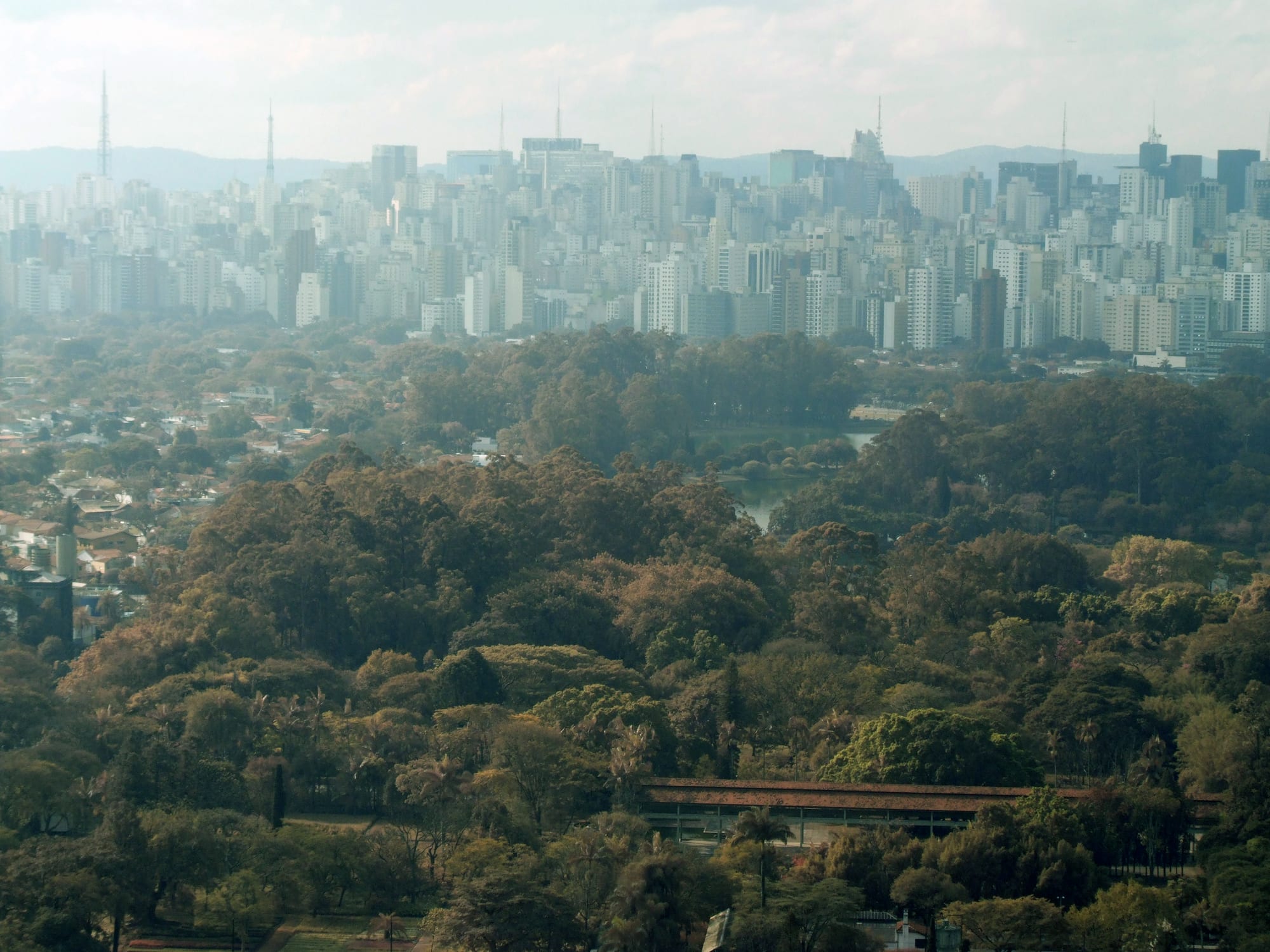
The dense tree canopy of Ibirapuera Park with a lake, and a wall of São Paulo high-rises in haze behind

Brazil

São Paulo

Ibirapuera Park and the high-rises of São Paulo seen from above. (Sérgio Valle Duarte / Wikimedia Commons · CC BY 3.0)

Brazil's most populous and wealthiest state, in the south-east — the vast metropolis of São Paulo on its plateau, a forested Atlantic coast from Santos to the island of Ilhabela and the beaches of Ubatuba, the mountain resort of Campos do Jordão, and an interior built on coffee, sugar cane and oranges.

Explore São Paulo

History

The plateau above the Serra do Mar was Tupi and Guaianá land when the Portuguese founded São Vicente on the coast in 1532, one of the first towns in Brazil. In 1554 Jesuits led by Manuel da Nóbrega and José de Anchieta set up a mission college on the plateau at Piratininga, the origin of the city of São Paulo. For two centuries it was a poor frontier town, and from it the bandeirantes set out: armed expeditions into the interior that captured and enslaved Indigenous people, destroyed Jesuit missions and eventually found gold in Minas Gerais in the 1690s, pushing Portuguese territory far west.

Dom Pedro declared Brazil's independence beside the Ipiranga stream here in September 1822. Coffee then transformed the province: plantations worked by enslaved Africans spread from the Paraíba valley westward, a British-built railway linked the plateau to the port of Santos in 1867, and after abolition planters recruited European immigrants. Millions of Italians, Portuguese and Spaniards arrived, followed from 1908 by the Japanese, and by Syrians and Lebanese.

Coffee money financed factories, and by the mid-20th century São Paulo was Brazil's industrial heart. The state rose against Getúlio Vargas in the Constitutionalist Revolution of 1932 and lost. Car plants in the ABC suburbs drew migrants from the north-east, and metalworkers' strikes there in the late 1970s, led by Luiz Inácio Lula da Silva, helped wear down the military regime.

Culture & Customs

People from the city are paulistanos, those from the state paulistas, and their reputation within Brazil is for work, ambition and a certain reserve compared with cariocas. Immigration shows everywhere: Liberdade is the centre of the largest Japanese community outside Japan, Bixiga and Mooca are old Italian districts, and Arab, Korean, Bolivian and north-eastern Brazilian communities each have their own neighbourhoods. São Paulo is the country's cultural market: the Art Biennial has been held since 1951, the Modern Art Week of 1922 launched Brazilian modernism at the Theatro Municipal, and the Pride parade on Avenida Paulista is among the largest in the world.

Football divides the state between Corinthians, Palmeiras, São Paulo and Santos, the club of Pelé. The city has its own Carnival with samba schools parading in the Anhembi Sambadrome and, increasingly, huge street blocos.

The interior keeps caipira culture: country music descended from the viola tradition, which grew into sertanejo, June festivals with bonfires and square dancing, and rodeo — the Festa do Peão in Barretos is Brazil's biggest. Along the coast, the caiçaras, fishing communities of mixed Indigenous, African and Portuguese descent, maintain canoe-building and fishing traditions.

Daily Life

About 44 million people live in the state, more than a fifth of Brazil's population, and it produces roughly a third of the national economy. The city of São Paulo has about 11.5 million people and its metropolitan area more than 20 million. Campinas, with about 1.1 million, is a technology and university centre; Santos runs Latin America's largest port; São José dos Campos builds aircraft for Embraer; and Ribeirão Preto is a centre of sugar and ethanol production.

The city is Brazil's financial and corporate centre, with the stock exchange, bank headquarters and much of the media along Avenida Paulista and Faria Lima. The interior grows sugar cane, oranges for juice exported worldwide, coffee and soya.

Traffic dominates daily life: commutes of two hours are common, a vehicle rotation scheme restricts cars by number plate at peak times, and the rich travel by helicopter. The day starts early and runs late, with restaurants busy past ten. Inequality is sharp, from gated towers to favelas such as Paraisópolis and the self-built outskirts, and homelessness and the drug scene in the old centre are the city's most visible problems.

Food

São Paulo eats the food of its immigrants. Pizza is taken seriously, with thousands of pizzerias and a pizza day on 10 July; Liberdade serves ramen, sushi and Japanese sweets; Lebanese esfihas (open pastries topped with spiced meat) and kibe are everyday fast food. At the Mercado Municipal the signature is a sandwich stacked with mortadella, and the bauru, a sandwich of roast beef, tomato, pickle and melted cheese, was created at a city bar in the 1930s.

Local classics are the virado à paulista, a Monday lunch of beans thickened with cassava flour, pork chop, sausage, collard greens, fried egg and fried banana, and cuscuz paulista, a savoury moulded cake of corn flour with sardines, eggs and vegetables. At the weekly street markets the pastel de feira, a large fried pastry, comes with caldo de cana, fresh sugar-cane juice.

On the coast the caiçara dish is azul-marinho, fish cooked with green bananas. The interior makes cachaça and pamonha, a steamed paste of fresh corn wrapped in the husk, sweet or savoury, and Campos do Jordão trades on chocolate, fondue, trout and craft beer.

Attractions & Natural Wonders

São Paulo city rewards time rather than a checklist. Avenida Paulista has the São Paulo Museum of Art (MASP), Lina Bo Bardi's building suspended over an open plaza, with a strong European collection. Ibirapuera Park holds Niemeyer's pavilions, the Afro Brazil Museum and the Museum of Modern Art. The old centre has the Pinacoteca art museum, the Sé Cathedral, the Theatro Municipal, the Mercado Municipal and Niemeyer's wave-shaped Copan building; the Museum of Football at the Pacaembu stadium, the restored Ipiranga Museum, Liberdade and the graffiti of Vila Madalena's Beco do Batman fill further days.

Down the Serra do Mar, Santos has the Coffee Museum in its old coffee exchange and a museum to Pelé. The north coast runs from São Sebastião to Ilhabela, an island largely protected as a state park, with waterfalls, forest trails, wreck dives and beaches on its wild seaward side, and on to Ubatuba, which lies on the Tropic of Capricorn, with more than 100 beaches and the island state park of Anchieta. The Serra do Mar State Park protects the forested escarpment behind.

In the Serra da Mantiqueira, Campos do Jordão has half-timbered hotels, pine and araucaria woods and its winter festival. The coffee country of the interior is visited through historic fazendas in the Paraíba valley, around Bananal and São Luiz do Paraitinga, and in the region of Campinas, with the Dutch-founded flower town of Holambra nearby.

Cities in São Paulo

Planning basics

Budget

São Paulo city is expensive for hotels and restaurants at the top end but has an enormous range, and weekend rates at business hotels often drop. Street markets, per-kilo lunches and bakeries keep costs low. The north coast and Campos do Jordão are priced for weekending paulistanos and get much dearer in summer holidays and in July respectively; interior towns are cheaper than the capital.

Daily Budget Midrange
USD 95–190 (mid-range hotel, restaurant dinners, app taxis, museum tickets)
Daily Budget Shoestring
USD 35–60 (hostel, per-kilo lunches, metro, free museums on set days)

Stay in the capital at weekends for lower hotel prices, and visit the coast and mountains midweek.

Safety

São Paulo has lower homicide rates than many Brazilian cities, but robbery, phone snatching and motorbike muggings are common, including in traffic. The old centre around Luz station and the open drug scene known as Cracolândia need care, especially at night. The PCC criminal faction, born in the state's prisons, is powerful but rarely affects visitors directly. The coast is calmer; heavy summer rain can close the coast road and cause landslides, as in São Sebastião in 2023.

Keep phones out of sight in cars and on the street, use app taxis at night, and avoid the centre's quieter streets after dark. Check current official travel advice before travelling.

Climate

The capital sits on a plateau at about 760 metres, so it is milder than Rio: warm, wet summers with heavy afternoon storms that flood streets, and dry, cool winters with the fine drizzle called garoa and cold fronts from the south. The coast is hot and humid and one of the wettest parts of Brazil where the Serra do Mar meets the sea. Campos do Jordão, at about 1,600 metres, has frosts on winter nights.

Summer
warm and wet in the city, 20–31°C; hot and humid on the coast, with frequent rain
Winter
cool and dry in the city, 10–23°C; mild on the coast; near or below freezing at night in Campos do Jordão

Transportation

Guarulhos is Brazil's main international airport; Congonhas handles domestic flights, including the frequent shuttle to Rio, and Viracopos near Campinas is a third hub. The city has an extensive metro and suburban rail network but traffic is severe. Buses from the Tietê terminal reach Santos in about 1.5 hours, Campos do Jordão in about 3 and Ubatuba in about 4. Car ferries cross from São Sebastião to Ilhabela in around 15–20 minutes.

Use the metro rather than taxis at rush hour, and avoid driving to the coast on Friday evenings or back on Sunday afternoons.

Best Time to Visit

The city works year-round; April to June and August to October avoid the heaviest summer rain. The beaches are at their best from December to March, though weekends and holidays bring heavy traffic on the coast road. Campos do Jordão is a winter destination, peaking in July with its music festival. Carnival and Pride fill the city's hotels on their dates.