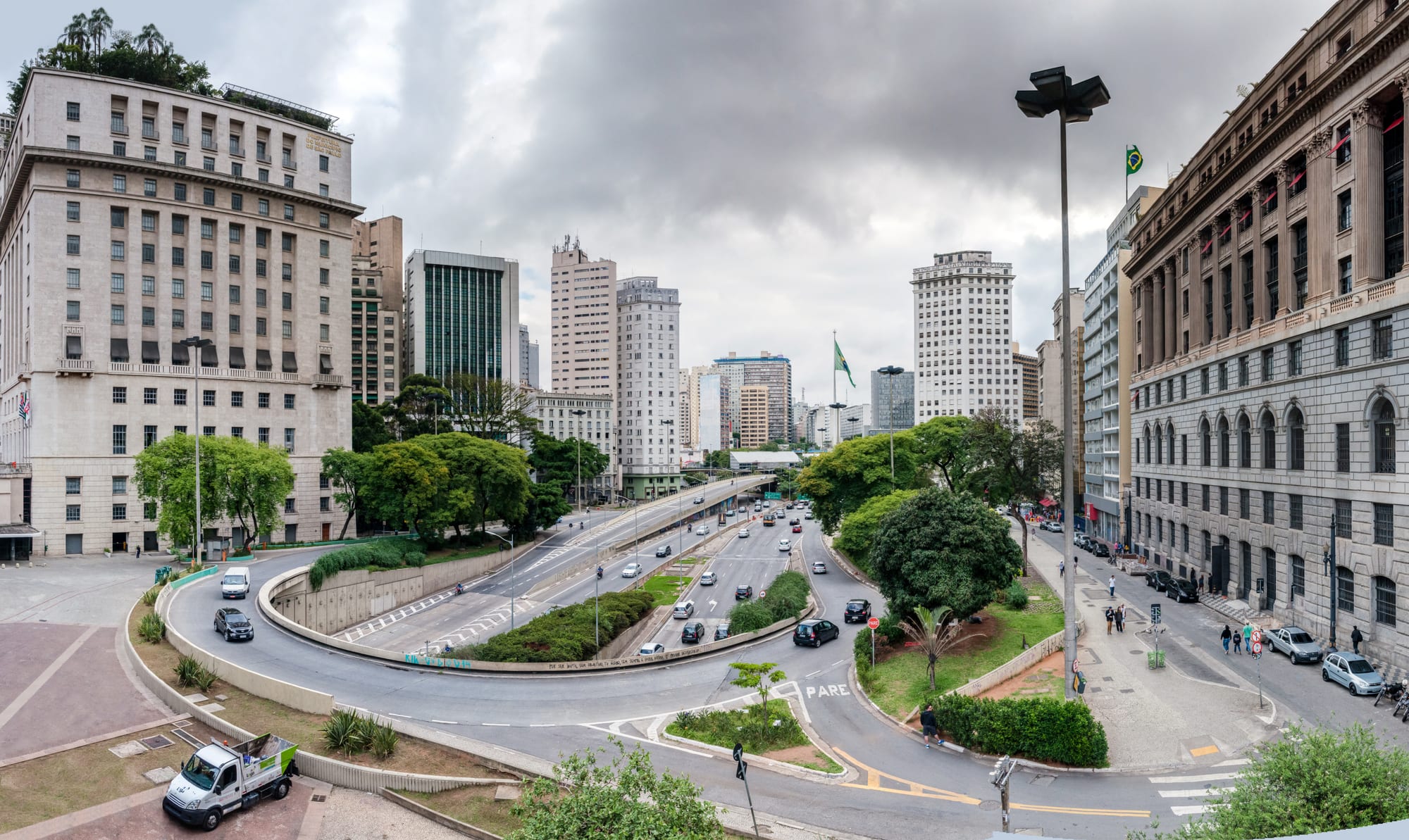
A curving avenue lined with trees running between stone office blocks and high-rises in central São Paulo under a grey sky

São Paulo, Brazil

São Paulo

The Anhangabaú valley and Avenida 23 de Maio seen from the Viaduto do Chá in central São Paulo. (Wilfredor / Wikimedia Commons · CC0)

Brazil's largest city, on a plateau above the Atlantic coast in the south-east — a Jesuit mission of 1554 that coffee money and mass immigration turned into Brazil's financial and industrial capital. Today it is a sprawling metropolis of more than 20 million, with major art museums, immigrant neighbourhoods such as Bixiga and Liberdade, a serious food culture and some of the country's sharpest inequality.

Neighbourhoods

  • Centro
    • Historic district
    • Architecture
    • Close to public transport

    The old city around the Praça da Sé, the Viaduto do Chá and the Anhangabaú valley, where the cathedral, the Theatro Municipal, the Martinelli and Copan buildings and the Municipal Market stand. It is busy and full of character by day, with a shabbier, emptier feel at night.

    Open in Maps
  • Avenida Paulista and Bela Vista
    • First-time visitors
    • Museums
    • Close to public transport

    The 2.8 km avenue on the city's ridge, lined with banks, cultural centres, shops and MASP, whose open plaza holds an antiques fair on Sundays. Many mid-range hotels are on or near it, and the metro runs beneath it, making it the easiest base for a first visit.

    Open in Maps
  • Liberdade
    • Best for food
    • Japanese culture
    • Close to public transport

    The district close to the old centre known as the city's Japantown, where Japanese immigrants settled from 1912. Rua Galvão Bueno is its best-known street, Chinese, Taiwanese and Korean immigrants have joined the Japanese, and a craft fair fills the Praça da Liberdade at weekends.

    Open in Maps
  • Vila Madalena and Pinheiros
    • Nightlife
    • Street art
    • Best for food

    West of Paulista, a hilly neighbourhood that has been the city's bohemian quarter since students moved there in the 1970s. Galleries, studios, bars and restaurants fill its streets, and the graffiti-covered lanes of Beco do Batman are at its heart.

    Open in Maps
  • Jardins
    • Upmarket shopping
    • Restaurants
    • Quiet and residential

    The leafy, upper-class districts on the southern side of Avenida Paulista, one of the city's most exclusive areas, home to museums such as the Museum of Image and Sound.

    Open in Maps
  • Bixiga
    • Best for food
    • Historic district
    • Local life

    A neighbourhood of the Bela Vista district between the centre and Paulista, historically a hub for Italian immigrants, known for its cantinas, the Vai-Vai samba school and the festival of Our Lady of Achiropita.

    Open in Maps

Things to do

Famous landmarks

  • São Paulo Cathedrallandmark

    The neo-Gothic Catedral da Sé on the city's central square, begun in 1913 and inaugurated in 1954 for the fourth centenary, with a dome inspired by Florence Cathedral.

    Open in Maps
  • Theatro Municipallandmark

    The ornate opera house where the Week of Modern Art of 1922 launched Brazilian modernism, now home to the municipal symphony orchestra, the lyric choir and the City Ballet.

    Open in Maps
  • Edifício Copanlandmark

    Oscar Niemeyer's wave-shaped apartment block of 1966 on Avenida Ipiranga, with 1,160 apartments and more than seventy commercial establishments.

    Open in Maps
  • Martinelli Buildinglandmark

    Brazil's first skyscraper, completed in 1929, which on opening was the tallest building in Latin America.

    Open in Maps
  • Edifício Itáliaviewpoint

    A 165-metre tower of 1965 in the República district, with a rooftop observation deck over the sea of high-rises.

    Open in Maps
  • Luz Stationtransit hub

    The British-designed railway station built between 1895 and 1901 for the line linking the port of Santos with the interior, still a busy commuter hub.

    Open in Maps

Museums

  • São Paulo Museum of Art (MASP)museum

    Lina Bo Bardi's 1968 concrete-and-glass building suspended over an open plaza on Avenida Paulista, holding one of the finest collections of European art in Latin America.

    Open in Maps
  • Pinacoteca de São Paulomuseum

    The city's oldest art museum, founded in 1905, devoted to Brazilian art from the 19th century to today, with a third building, Pina Contemporânea, opened in 2023 beside the Parque da Luz.

    Open in Maps
  • Museum of the Portuguese Languagemuseum

    An interactive museum of the Portuguese language, housed inside Luz Station.

    Open in Maps
  • Museu do Ipirangamuseum

    The palace-like history museum near the spot where Pedro I proclaimed independence, home to Pedro Américo's painting Independence or Death; it reopened in September 2022 after nine years of restoration.

    Open in Maps
  • Football Museummuseum

    The Museu do Futebol, opened in 2008 inside the Art Deco Pacaembu stadium of 1940, telling the story of Brazilian football.

    Open in Maps
  • Museu Afro Brasilmuseum

    A museum in Ibirapuera Park with around six thousand works and objects on the history, art and religion of Black people in Brazil.

    Open in Maps

Parks

  • Ibirapuera Parkpark

    The city's great park, opened in 1954 for the 400th anniversary, with lakes, lawns and a complex of buildings by Oscar Niemeyer that houses museums and the Bienal.

    Open in Maps
  • São Paulo Museum of Modern Artmuseum

    The modern art museum in Ibirapuera Park, founded in 1948, with more than 4,000 works by artists from Anita Malfatti and Alfredo Volpi to Picasso and Miró.

    Open in Maps
  • Cantareira State Parkpark

    A large area of Atlantic Forest on the city's northern edge, one of the largest urban forests in the world, protecting much of the metropolitan water supply.

    Open in Maps

Markets and street life

  • Municipal Marketmarket

    The Mercadão, opened in 1933 in the old centre, a hall of fruit, spice, meat and other food stalls under 72 stained-glass windows showing food production.

    Open in Maps
  • Beco do Batmanattraction

    Lanes in Vila Madalena covered from end to end in graffiti and murals, a popular destination for visitors.

    Open in Maps
  • Liberdade weekend fairmarket

    A weekly craft fair in the Praça da Liberdade that draws thousands of visitors every weekend to the heart of the Japanese district.

    Open in Maps

Sport and big events

  • Interlagosattraction

    The motor-racing circuit in the south of the city, opened in 1940, home of the Formula One Grand Prix since 1973 and of the local Lollapalooza festival.

    Open in Maps
  • Anhembi Sambadromeattraction

    The parade ground opened in 1991 where the city's samba schools compete at Carnival, also used for other large events.

    Open in Maps

Seasonal events

  • São Paulo CarnivalFebruary or early March

    Samba schools parade at the Anhembi Sambadrome, while street blocos fill neighbourhoods across the city.

  • Virada Culturalusually May

    A free 24-hour festival of concerts, theatre, film and art on stages across the city, begun in 2005.

  • São Paulo Pride ParadeMay or June

    Held on Avenida Paulista since 1997 and listed by Guinness World Records as the largest Pride parade in the world, with millions taking part.

  • São Paulo Art BiennialSeptember to December, in odd-numbered years since 2021

    One of the world's oldest art biennials, founded in 1951 and held since 1957 in Niemeyer's pavilion in Ibirapuera Park.

  • São Paulo Grand PrixNovember

    The Formula One race at Interlagos, held under contract until 2030.

Eat and drink

Long-standing places and food districts in São Paulo. Hours, ratings and directions come from your maps app, always current.

São Paulo classics

  • Mortadella sandwich at the Mercadãomarket

    Thick-cut mortadella piled into a pão francês roll — the speciality of the Municipal Market, sold at several of its bars.

    Open in Maps
  • Ponto Chicrestaurant

    The traditional eatery and student hangout where the bauru — roast beef, tomato, pickled cucumber and melted cheese in a hollowed roll — was created for a law student in 1934.

    Open in Maps

Food districts

  • Liberdadeneighborhood

    Japanese restaurants and shops, now joined by Chinese and Korean ones, in the city's Japanese district.

    Open in Maps
  • Bixiga cantinasneighborhood

    Old Italian cantinas in the former immigrant quarter between the centre and Paulista.

    Open in Maps
  • Vila Madalena barsneighborhood

    Bars and restaurants in the city's bohemian quarter, one of its main nightlife areas.

    Open in Maps

Experience São Paulo

History

São Paulo began on 25 January 1554, when Jesuit priests founded the Colégio de São Paulo de Piratininga on the plateau above the coast, and it is one of the oldest continuously inhabited cities in the Americas. For much of the colonial period it was a frontier town and the starting point of the bandeirantes, the expeditions that pushed Portuguese control deep into the interior. A law school opened in the Convent of São Francisco in 1827, but as late as 1880 the city had only about 32,000 people.

Coffee changed everything. Plantation wealth flowed into the city, the São Paulo Railway linked it with the port of Santos, and after abolition in 1888 large numbers of immigrants arrived — mainly Portuguese, Italians and Spaniards, and also Japanese and Arabs. In 1920 nearly 80 per cent of the population were immigrants or their descendants. Coffee barons built mansions along the new Avenida Paulista, opened in 1900; the second Luz Station rose at the turn of the century, the Martinelli Building became Brazil's first skyscraper in 1929, and the city passed its first million in 1928. When the world crisis hit coffee, planters invested in factories, and São Paulo became the country's largest industrial centre.

In 1932 the city rose against Getúlio Vargas in the Constitutionalist Revolution. The University of São Paulo was founded in 1934, and the fourth centenary in 1954 brought Ibirapuera Park and the inauguration of the cathedral. Migrants from the north-east poured in, the population reached 8.5 million by 1980, the metro opened in 1974, and the financial centre moved from the old centre to Avenida Paulista and later to Faria Lima and Berrini.

Culture & Customs

São Paulo is Brazil's cultural capital as much as its business one. The Week of Modern Art at the Theatro Municipal in 1922 launched Brazilian modernism, the Bienal, founded in 1951, is the third-oldest art biennial in the world, and MASP, the Pinacoteca and dozens of other museums make it the country's art centre. Lina Bo Bardi and Oscar Niemeyer left some of their best-known buildings here.

Immigration defines the city. More people of Italian descent live here than in any Italian city, it has the largest Japanese community outside Japan and one of the largest Arab diasporas, and people from more than 200 countries have settled here. Liberdade, Bixiga and Bom Retiro still carry the marks of those waves, while migrants from north-eastern Brazil have settled here since the 19th century. The city's own forms include samba paulista, Brazilian hip-hop and rock, and the caipira culture of the interior.

The city's major football clubs are Corinthians, Palmeiras and São Paulo. The LGBT Pride Parade on Avenida Paulista, held since 1997, is listed as the largest in the world and is one of the city's biggest events, alongside the Formula One Grand Prix, Carnival and the Virada Cultural. In 2026 funding for the parade was reported to have fallen by 60 per cent, largely because of conservative movements.

Daily Life

The municipality had about 11.45 million people in the 2022 census, and Greater São Paulo, 39 municipalities in all, more than 20 million — one of the most populous metropolitan areas in the world. The municipality covers more than 1,500 square kilometres, most of it built up, and still holds large forests such as Cantareira on its northern edge.

São Paulo produces around a tenth of Brazil's GDP. It is the headquarters of B3, Latin America's largest stock exchange, and its business districts run along Avenida Paulista, Faria Lima and Berrini. It is also one of Latin America's largest health-care hubs, home to the Hospital das Clínicas and major private hospitals, and a centre of industry, media, fashion and research.

Inequality is the city's defining issue. An estimated 2.1 million people in the metropolitan area live in favelas, while the wealthy live in gated towers and use the world's largest fleet of helicopters, based at Campo de Marte. Long commutes from the self-built periphery, heavy traffic, air pollution and water supply drawn from distant river basins are constant concerns, and summer storms regularly flood streets: on 25 January 2025 the city recorded one of its heaviest daily rainfalls on record. The working day starts early and evenings run late, in bars, restaurants and the growing number of cultural centres.

Food

São Paulo eats the food of its immigrants. Pizza is the city's passion: by one count six thousand pizzerias make about a million pizzas a day, from old Italian cantinas in Bixiga to neighbourhood delivery places. The city counts among its own creations the bauru, the beirute sandwich, calabresa sausage, coxinha (shredded chicken in a teardrop of fried dough), parmegiana and picanha, the prized cut of the Brazilian barbecue.

Sandwiches are a local art. The bauru — roast beef, tomato, pickled cucumber and cheese melted in a bain-marie, in a hollowed pão francês — was created at the Ponto Chic in 1934 for a law student nicknamed Bauru. At the Mercadão the speciality is a mortadella sandwich, thick slices piled into a pão francês roll. At the weekly street markets, the pastel de feira, a large fried pastry filled with cheese or meat, comes with caldo de cana, fresh sugar-cane juice.

Japanese food has been part of the city since the first immigrants arrived to work on the coffee farms; by the 1990s Japanese restaurants were found throughout the city, including the temakeria, a fast-food sushi bar unique to Brazil. Esfihas, open pastries topped with spiced meat brought by Arab immigrants from the Levant, are everyday snacks, and the day is punctuated by a small, strong cafezinho.

Planning tools

Budget

São Paulo has an enormous range. Top-end hotels and restaurants are among the most expensive in Brazil, but business hotels often drop their rates at weekends, and per-kilo lunches, bakeries, street markets and the metro keep daily costs down. Several museums are free on set days, and the Sunday antiques fair under MASP costs nothing to browse. Hotels fill and prices rise for Carnival, Pride, the Grand Prix and big trade fairs.

Daily Budget Midrange
USD 100–200 (hotel near Paulista, restaurant dinners, museum tickets, app taxis)
Daily Budget Shoestring
USD 35–60 (hostel bed, per-kilo lunches and pastéis, metro, free museum days)

Weekend stays are often cheaper than weekdays in the business districts; check the big event calendar before booking.

Best Time to Visit

The city works year-round. April to June and August to October are mild and avoid the heaviest summer storms. December to March is hot and wet, with afternoon downpours that flood streets, though the city empties a little over Christmas and New Year as residents head to the coast. June to August is cool and dry, with occasional cold fronts.

Suggested Number of Days

Three or four days give a good first sense of the city's main districts and museums. Allow six to eight to add the coast or the mountains of the state. Distances and traffic are large, so staying near a metro line saves a great deal of time.

First Visit
3–4 days
With Surroundings
6–8 days

Transportation

The metro has six lines and 104 km of track, and together with the suburban CPTM trains forms the largest metropolitan rail network in Latin America, with 184 stations. Buses cover the rest of the city, including two trolleybus systems. App taxis are cheap and widely used, but traffic is severe at rush hour, and a vehicle-rotation scheme restricts cars by number plate at peak times.

Use the metro rather than taxis in rush hour, and keep phones out of sight in cars stopped in traffic.

Airport & Station Connections

São Paulo/Guarulhos International Airport, the largest in Brazil and Latin America, is about 25 km north-east of the centre in the neighbouring city of Guarulhos, linked to the city by CPTM Line 13 and by road, which can take well over an hour in traffic. Congonhas Airport, in the Campo Belo district, handles domestic flights, including the frequent shuttle to Rio de Janeiro. Long-distance buses use the Tietê terminal.

Walkability

The city is far too big to cover on foot, but its districts are walkable. The old centre around the Sé, the Viaduto do Chá and the Mercadão can be explored in a few hours, Avenida Paulista is pleasant on foot, and Vila Madalena, Jardins and Liberdade suit wandering. Hills and wide roads separate them, so the metro links the walks.

Safety

Brazil has high rates of crime, including violent crime, and it is the main practical concern for visitors — though very unevenly distributed. São Paulo has lower homicide rates than many Brazilian cities, but robbery and theft remain a concern. The old centre around Luz station and the open drug scene known as Cracolândia need care, especially at night.

Keep phones and jewellery out of sight, use app taxis at night, avoid the centre's quieter streets after dark, and in summer watch for street flooding in storms. Check current official travel advice before travelling.

Climate

The city sits on a plateau at around 800 metres, so it is milder than the coast. Summer, December to February, is warm and wet, with heavy afternoon storms; winter is cool and dry, with occasional cold fronts from the south.

Summer
warm and wet, with frequent heavy storms; the record high is about 38°C
Winter
cool and dry, with chilly mornings; frost is only occasional, and the record low is −3.2°C, set in 1918

Local Customs

Paulistanos are known within Brazil for work, ambition and a certain reserve, but social life is warm and runs late — restaurants are busy after ten at night. A 10 per cent service charge is usually added to restaurant bills. Dress is more urban and less beachy than in Rio. Greetings among friends are a kiss on the cheek; a handshake suits business.

Dress modestly in churches and temples, ask before photographing people in poorer neighbourhoods, and do not wander into favelas without a local guide.

Common Payment Methods

The currency is the Brazilian real (R$). Cards, contactless payment and the instant Pix transfer system are accepted almost everywhere, from restaurants to street-market stalls. Cash is rarely needed beyond small amounts; use ATMs inside banks, malls or stations by day.