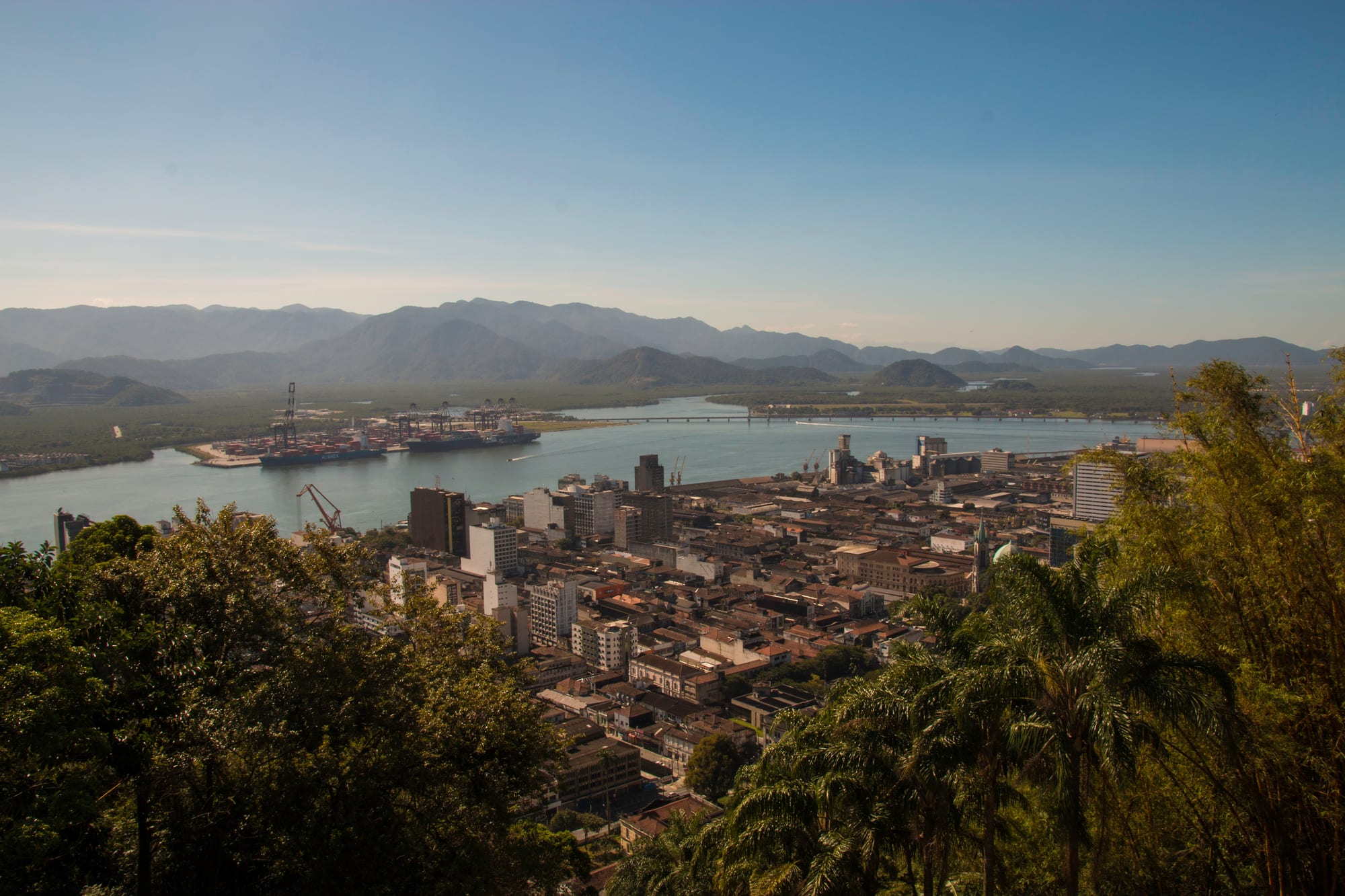
The low-rise centre of Santos and the port estuary with cargo terminals, backed by the forested Serra do Mar

São Paulo, Brazil

Santos

The historic centre of Santos and the port estuary, seen from Monte Serrat. (Eduardo Gatti / Wikimedia Commons · CC BY-SA 4.0)

A port city on the island of São Vicente, about 50 km from São Paulo, founded in 1546. Coffee exports made it rich, and its port still carries nearly 29 per cent of Brazil's trade flow. Today it pairs an old centre of coffee-era buildings with a long beachfront garden, canals and apartment blocks, and is the home of Pelé's club, Santos FC.

Neighbourhoods

  • Historic centre and Valongo
    • Historic district
    • Museums
    • Architecture

    The original town between the port and Monte Serrat, where coffee merchants once had their offices. The old Coffee Exchange, the Valongo railway station, churches, the funicular and the tourist tram are all here, and Rua XV de Novembro has bars and cafés in restored buildings. It is busy by day and quiet at night.

    Open in Maps
  • Gonzaga
    • First-time visitors
    • Beaches
    • Shops and services

    The busiest stretch of the seafront, around Praça Independência and its monument, with hotels, shops, restaurants and apartment towers facing the beach and the gardens.

    Open in Maps
  • Boqueirão and Embaré
    • Beaches
    • Quiet and residential

    Residential districts along the middle of the beach, crossed by the city's old drainage canals and anchored by the neo-Gothic Basilica of St Anthony in Embaré. They have a calmer, local feel and easy access to the garden promenade.

    Open in Maps
  • Ponta da Praia
    • Waterfront
    • Families
    • Ferries to Guarujá

    The eastern tip of the island at the mouth of the estuary, where container ships pass close to the shore. The aquarium, a fish market and the ferries and launches across to Guarujá are here.

    Open in Maps
  • Vila Belmiro
    • Football
    • Local life

    An inland neighbourhood between the beach and the centre that is home to Santos FC and its stadium, with ordinary streets of houses, bars and shops around it.

    Open in Maps

Things to do

Historic centre

  • Coffee Museummuseum

    The official Coffee Exchange of 1922, where much of Brazil's coffee export trade was negotiated, opened as a museum in 1998 on the history of coffee from plantation to cup, with a café.

    Open in Maps
  • Monte Serratviewpoint

    The hill above the centre, about 157 metres high, reached by a funicular built in 1923, with a view over the city, the port and Guarujá, a shrine to the city's patron saint and a former casino of 1927.

    Open in Maps
  • Historic tramattraction

    A tourist tram line opened in 2000 through the historic centre from Praça Mauá, using restored cars including one given by the city of Porto, in a city that ran trams from 1871 to 1971.

    Open in Maps
  • Santos Cathedrallandmark

    The seat of the Catholic diocese of Santos, in the city centre, begun in 1909 to a design by the German engineer Maximilian Emil Hehl.

    Open in Maps

Football

  • Vila Belmiroattraction

    Santos FC's home ground since 1916, where Pelé played most of his career and where his funeral was held in January 2023; the club's trophy memorial, the Memorial das Conquistas, is here.

    Open in Maps
  • Pelé Museummuseum

    A museum opened in 2014, telling the story of Pelé's childhood and career through trophies, objects and statistics.

    Open in Maps

Beaches and the waterfront

  • Beachfront gardenspark

    Gardens laid out from 1935 along about 5.3 km of seafront from José Menino to Ponta da Praia, listed by Guinness World Records as the world's largest beachfront garden, with a cycle path beside them.

    Open in Maps
  • Santos Aquariumattraction

    A public aquarium at Ponta da Praia, opened in 1945 and enlarged in 2006, showing the sea life of the Brazilian seas.

    Open in Maps
  • Port of Santoslandmark

    Brazil's leading container port, lining the estuary for kilometres; the ships and terminals are best seen from Ponta da Praia, the ferries or Monte Serrat.

    Open in Maps
  • Basilica of St Anthonylandmark

    A neo-Gothic church inaugurated in 1945 near the beach at Embaré, grown from a chapel built by the Baron of Embaré in 1874.

    Open in Maps
  • Orquidário Municipalpark

    A municipal zoobotanical park in José Menino near the São Vicente border, opened in 1945, with a greenhouse collection of orchids and some 500 animals.

    Open in Maps

Short trips from the city

  • Engenho dos Erasmoslandmark

    The ruins of a sugar mill built around 1534 on the island, one of the oldest in Brazil and now a national monument.

    Open in Maps
  • São Vicenteattraction

    The neighbouring city on the same island, founded in 1532 as the first permanent Portuguese settlement in Brazil, reached along the beach or by light rail.

    Open in Maps
  • Guarujáattraction

    The resort island across the estuary, reached by ferry from Ponta da Praia, with 27 beaches.

    Open in Maps
  • Laje de Santos Marine State Parkpark

    A rocky islet out at sea, the first marine park created by the state of São Paulo, known for diving among reefs and a deliberately sunk wreck.

    Open in Maps

Seasonal events

  • Feast of Our Lady of Monte SerratSeptember

    The day of the city's patron saint, whose cult dates from a legend linked to the attack by the English privateer Thomas Cavendish in 1591.

Eat and drink

Long-standing places and food districts in Santos. Hours, ratings and directions come from your maps app, always current.

Food districts and markets

  • Mercado Municipalmarket

    The city's public market in Vila Nova, near the historic centre, selling produce, fish and everyday food.

    Open in Maps
  • Fish market at Ponta da Praiamarket

    A fish market close to the Guarujá ferry, where fresh catch from the local boats is sold.

    Open in Maps
  • Rua XV de Novembroneighborhood

    The old street of the coffee merchants in the historic centre, now lined with bars and cafés in restored buildings.

    Open in Maps
  • Gonzaga seafrontneighborhood

    Restaurants, snack bars and pastel stands around the seafront and the streets behind it.

    Open in Maps

Experience Santos

History

Portuguese ships knew the island of São Vicente from the first years of the 16th century, and in 1532 Martim Afonso de Sousa founded the town of São Vicente on it. Around 1543 the nobleman Brás Cubas moved the harbour to a calmer site at Enguaguaçu, beside a chapel on a small hill dedicated to Saint Catherine, and built a hospital there, the Santa Casa de Misericórdia de Todos os Santos. The new port took the name of Santos, and became a town in 1546. In 1591 the English privateer Thomas Cavendish sacked it, damaging the young sugar economy of the captaincy.

For three centuries Santos was the outlet of the São Paulo plateau. In the 19th century coffee changed everything: a railway climbed the Serra do Mar, and Santos became Brazil's great coffee port. It was also called the "port of death" for its yellow fever, and in 1899 bubonic plague entered Brazil through it. Around the turn of the 20th century the port was modernised and the engineer Saturnino de Brito drained the island with a system of canals that still crosses the city. In 1922 the official Coffee Exchange opened on Rua XV de Novembro.

From the 1910s Santos also became a seaside resort, and the beachfront gardens were laid out from 1935. As coffee faded the port turned to soya, sugar, maize and containers, and in 2006 oil was found offshore in the Santos Basin. The Coffee Museum opened in 1998 and the Pelé Museum in 2014, part of a revival of the old centre.

Culture & Customs

Santos is a football city above all. Santos FC, founded in 1912, is one of Brazil's most successful clubs, with eight national titles and three Copa Libertadores, and its name is tied for ever to Pelé, who joined at fifteen and played most of his career for the club. When he died in December 2022, his funeral was held at the stadium. The club's trophy memorial and the Pelé Museum keep his story at the centre of the city's identity.

The city is proud of its history as well. José Bonifácio de Andrada e Silva, the "Patriarch of Independence", was born here, and the Andradas are remembered in a pantheon in the centre. Santos celebrates its patron saint, Our Lady of Monte Serrat, in September, a cult that grew from a legend about Cavendish's raid. The Coliseu theatre has been brought back into use, and the centre's tram and museums have become part of a cultural revival.

Daily culture revolves around the sea: the beach, the long garden promenade and the cycle path are where santistas walk, cycle, play football and meet. Most residents are Catholic — about three in five at the 2022 census — with smaller evangelical and spiritist communities, and the Basilica of St Anthony in Embaré is a local landmark. The neighbouring cities of São Vicente, Guarujá and Praia Grande have grown together with Santos into one coastal metropolis.

Daily Life

About 419,000 people lived in Santos at the 2022 census, nearly all of them on the urbanised part of the island; the larger mainland part of the municipality is mostly protected Atlantic Forest. Santos is the centre of the Baixada Santista metropolitan region, which has grown into one continuous urban area with São Vicente, Praia Grande and Guarujá.

The port dominates the economy. It handles nearly 29 per cent of Brazil's trade flow, exporting soya, sugar, maize and pulp and importing fertilisers, fuel and wheat, and it employs dockers, hauliers, customs agents and shipping firms across the city. Tourism, commerce and services follow, and offshore oil has brought new work. Average incomes are high by Brazilian standards.

Life is organised around the seafront: tall apartment blocks face the beach from José Menino to Ponta da Praia, while older houses and the port districts lie inland. The hills of the island are a different world, with informal housing at risk of landslides in the summer rains. Heavy trucks bound for the port and the weekend crowds from São Paulo strain the roads, and proposals for a bridge or tunnel to Guarujá are a recurring debate.

Food

Santos eats like a port on the sea. Fish and seafood are the basis of many menus, bought fresh at the fish market near the Guarujá ferry and served at restaurants along the seafront and around Ponta da Praia. The coastal caiçara tradition of São Paulo state contributes dishes such as azul-marinho, fish cooked with green bananas.

Everyday food is the food of the São Paulo coast: per-kilo lunch restaurants, bakeries, and the pastel, a large fried pastry with savoury fillings, often eaten with fresh sugar-cane juice. On the beach, vendors sell coconut water from the shell, snacks and cold drinks, and many families arrive with their own food and cool boxes. The Mercado Municipal in Vila Nova sells produce for home cooking.

Coffee is the city's heritage. The trade that built Santos is remembered at the Coffee Museum in the old exchange, which has its own café, and small strong coffees are drunk through the day as everywhere in Brazil. In the evenings the bars and cafés of Rua XV de Novembro and the seafront districts fill up.

Planning tools

Budget

Santos is cheaper than São Paulo for hotels and food, and many of its sights — the beach gardens, the seafront promenade, the historic streets — are free. The museums, the funicular and the tram charge modest fees. Prices rise in the summer holidays and at weekends, when paulistanos come down to the coast.

Daily Budget Midrange
USD 90–180 (beachfront hotel, seafood dinners, museum tickets, app taxis)
Daily Budget Shoestring
USD 35–60 (hostel or simple hotel, per-kilo lunches, buses and bike hire)

Visit midweek for lower hotel prices and emptier beaches; the beach gardens, cycle path and seafront cost nothing.

Best Time to Visit

The city is a year-round destination. Summer, December to March, is hot, humid and busy, with the beaches at their liveliest but also the heaviest rain. Winter, June to August, is cooler and somewhat drier, a good time for the museums and the old centre. Rain falls in every month.

Suggested Number of Days

Many visitors come from São Paulo for a day or a weekend, which covers the centre and the seafront. Allow three or four days to add the neighbouring island cities, the beaches across the estuary and a boat or diving trip. Heavy weekend traffic on the coast roads can shorten a short visit.

First Visit
1–2 days
With Surroundings
3–4 days

Transportation

Buses cover the whole island, and the light rail line runs from the city to neighbouring São Vicente. Taxis and app rides are widely used. The city is flat on the island side, and cycling is a good way to get around, with a long bike path along the beach. Ferries, launches and car ferries cross the estuary from Ponta da Praia to Guarujá.

Buses get crowded; keep an eye on bags and phones, and check that seats are dry, as many passengers board straight from the beach.

Airport & Station Connections

Santos is about 50 km from São Paulo, down the Serra do Mar by the Anchieta and Imigrantes highways. Buses from São Paulo's Jabaquara terminal run frequently and take about 1 hour 20 minutes, more in weekend traffic. International flights arrive at São Paulo's Guarulhos airport, from where buses and taxis run to the coast.

Walkability

The island part of the city is flat. The beach promenade and its gardens are a long, easy walk, and the historic centre is compact, though busier by day than in the evening. The distance from the beach to the centre is several kilometres, so most people take a bus, a taxi or the tram for that stretch.

Safety

Brazil has high rates of crime, including violent crime, and it is the main practical concern for visitors — though very unevenly distributed. In Santos the usual problems are phone theft and pickpocketing on crowded buses and beaches. The hillside neighbourhoods suffer frequent landslides, mainly from January to March, and the city's beaches are not known for clean water.

Keep phones out of sight, take app taxis at night, and check local signs on bathing water quality before swimming. Check current official travel advice before travelling.

Climate

Hot and humid, with no real dry season and about 2,000 mm of rain a year. Summer, December to February, is the hottest time of year, and January to March is the traditional rainy season. Winter, June to August, is milder.

Summer
hot and humid, with mean temperatures around 25°C, frequent heavy rain and record highs above 40°C
Winter
mild, with mean temperatures around 19°C

Local Customs

A service charge is usually added to restaurant bills. Beachwear stays on the beach; in the centre and in churches people dress casually but covered. Greetings are warm, often with a kiss on the cheek between friends. Football matters a great deal, and Santos FC is a point of local pride.

The legal drinking age in Brazil is 18, and alcohol is widely drunk on the beaches. Ask before photographing people.

Common Payment Methods

The currency is the Brazilian real (R$). Cards, contactless payment and the Pix instant transfer system are accepted almost everywhere, including by many beach vendors. Use ATMs inside banks or shopping centres during the day, and carry a little cash for buses and small purchases.