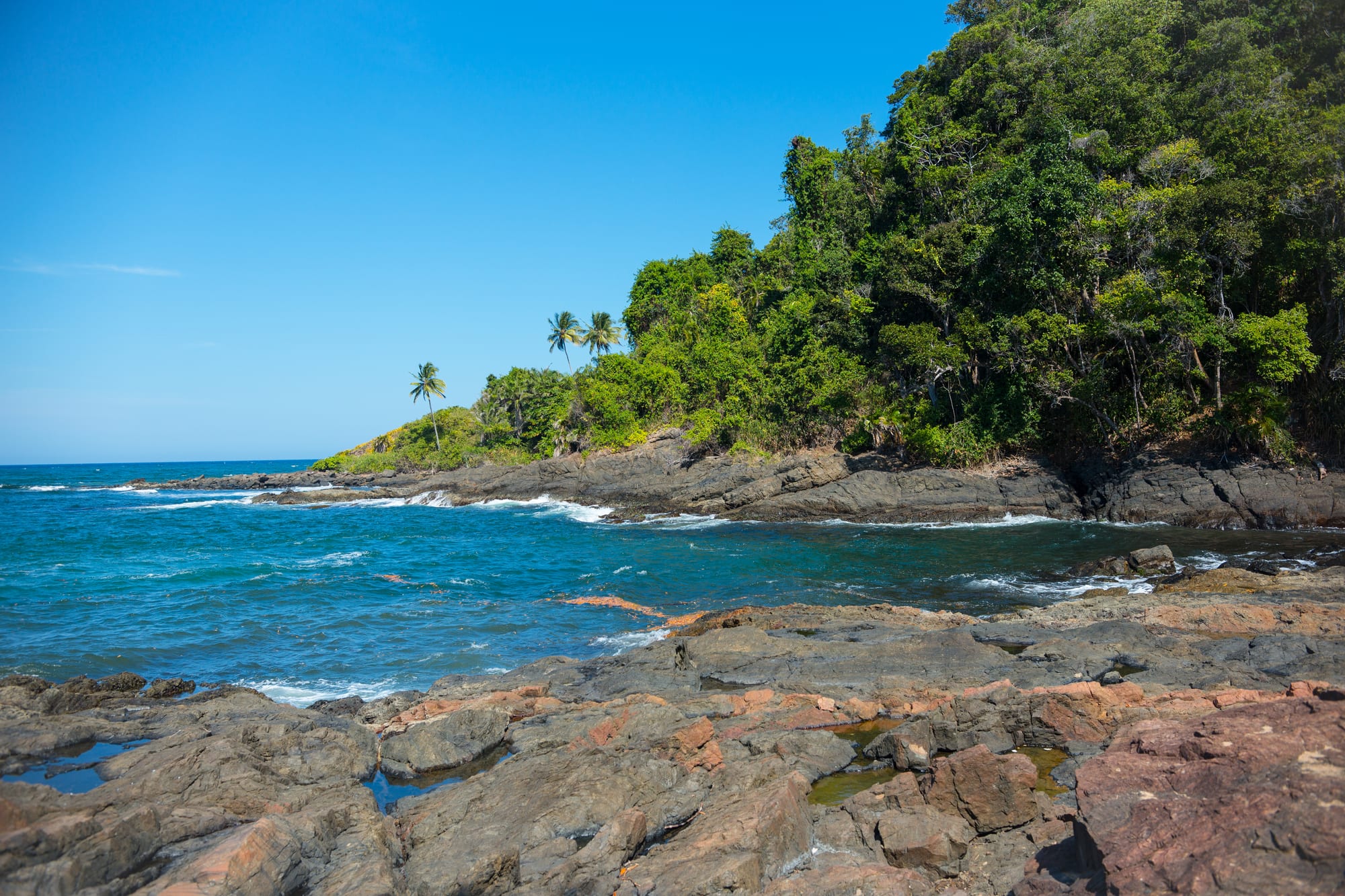
Dark rocks in the foreground and blue sea breaking against a rocky point covered in dense green forest and a few palms, under a clear sky

Brazil

Bahia

The rocky shore of Praia da Concha at Itacaré, on the Cocoa Coast of Bahia. (Márcio Filho, MTur Destinos / Wikimedia Commons · Public domain)

Brazil's largest north-eastern state and the centre of Afro-Brazilian culture — the colonial capital Salvador on the Bay of All Saints, Brazil's longest state coastline, palm-lined from Morro de São Paulo and Itacaré to Porto Seguro and Trancoso, and inland the table mountains of the Chapada Diamantina and the dry sertão.

Explore Bahia

History

Pataxó, Tupinambá and other peoples lived on this coast when Pedro Álvares Cabral's fleet anchored near Porto Seguro in April 1500, the first Portuguese landing in Brazil. In 1549 Tomé de Sousa founded Salvador on the Bay of All Saints as the capital of the colony, which it remained until 1763. Sugar plantations spread through the fertile Recôncavo around the bay, and Salvador became one of the great ports of the Atlantic slave trade, receiving enslaved people from West and Central Africa — many from the Bight of Benin — whose descendants make up most of the state's population. The Dutch held the city briefly in 1624–1625.

Resistance ran through Bahia's history: runaway communities, the quilombos, formed in the interior, and in 1835 enslaved African Muslims staged the Malê revolt in Salvador. Portuguese troops held the city after Brazil declared independence until they were forced out on 2 July 1823, still Bahia's great civic holiday. In the sertão, the army destroyed the religious settlement of Canudos in 1897 after a year of war.

Diamonds brought prospectors to the Chapada Diamantina from the 1840s, and cocoa made the south around Ilhéus rich in the early 20th century until a fungal disease ruined the plantations in the 1990s. Brazil's first oil was struck near Salvador in 1939, and the Camaçari petrochemical complex opened in 1978. Salvador's historic centre became a UNESCO World Heritage Site in 1985.

Culture & Customs

Bahia is the centre of Afro-Brazilian culture. Candomblé, a religion rooted in Yoruba and other West African traditions that honours the orixás, has some of its oldest temples, the terreiros, in Salvador, and many Bahians combine it with Catholic devotion. The Lavagem do Bonfim in January, when white-dressed baianas wash the steps of the Bonfim church, and the offerings to Iemanjá at Rio Vermelho on 2 February show that blend.

Capoeira was codified in Salvador in the 20th century by Mestre Bimba and Mestre Pastinha, and the capoeira circle is UNESCO intangible heritage, as is the samba de roda of the Recôncavo. Salvador's Carnival is among the largest street parties in the world, with trios elétricos, sound trucks carrying bands through the crowds, and blocos afro such as Ilê Aiyê and Olodum, whose drumming rhythms became internationally known. Bahia also gave Brazil Tropicália through Caetano Veloso and Gilberto Gil, the bossa nova of João Gilberto, axé music and the novels of Jorge Amado.

Catholic devotion is strong too: Irmã Dulce, a Salvador nun who worked with the poor, was canonised in 2019. Bahians are known across Brazil for an unhurried pace and warmth, and the Bonfim ribbons tied on wrists for luck are the state's best-known souvenir.

Daily Life

About 14 million people live in Bahia. Salvador has about 2.4 million, a large majority of them Black or of mixed African descent; Feira de Santana, the interior's commercial hub, has about 600,000, and Vitória da Conquista, Camaçari, Juazeiro and Ilhéus are other important towns.

The economy runs on petrochemicals at Camaçari, services and tourism in Salvador and on the coast, and farming: soya and cotton on the western plateau, irrigated grapes and mangoes along the São Francisco at Juazeiro, cocoa in the south, and cattle and goats in the sertão, where wind farms now line the ridges. Inequality is stark, with poverty widespread in the interior and in Salvador's peripheral neighbourhoods.

Life runs outdoors and late. Salvador's neighbourhoods fill in the evening with acarajé stalls, bars and music, and the summer festival season, from December to Carnival, sets the city's calendar. In the countryside the June festivals of São João, with bonfires, forró and corn dishes, rival Carnival in importance.

Food

Bahian cooking is the most African in Brazil, built on dendê palm oil, coconut milk, dried shrimp, peanuts and cashews, and hot malagueta pepper. Acarajé, a fritter of black-eyed pea dough fried in dendê, is split and filled with vatapá, a creamy paste of bread, shrimp, nuts and coconut milk, caruru, an okra stew, and shrimp; its steamed cousin wrapped in banana leaf is abará. The baianas who sell it in white dress from street stalls are a recognised part of the city's heritage.

Moqueca baiana is fish or shrimp stewed in coconut milk and dendê with peppers, tomato and coriander, served with rice and pirão, a thick fish gravy with cassava flour. Bobó de camarão is shrimp in a cassava purée, and xinxim de galinha is chicken with dried shrimp, peanuts and dendê. Sweets include cocada, coconut candy, and many are sold by the same street vendors.

Southern Bahia grows cocoa, and small producers around Ilhéus now make fine chocolate. Inland, the Chapada and the sertão eat carne de sol, salted sun-dried beef, and goat, and the Recôncavo makes cachaça and fruit liqueurs drunk at São João.

Attractions & Natural Wonders

Salvador's upper town, the Pelourinho, is the heart of any visit: the gilded church and convent of São Francisco, the cathedral, colonial squares and the Jorge Amado foundation. The Lacerda Elevator drops to the lower town and the Mercado Modelo; further out are the Bonfim church, the lighthouse fort at Barra, bohemian Rio Vermelho, and ferries across the bay to Itaparica. North of the city, Praia do Forte has a sea-turtle conservation centre, and the Recôncavo town of Cachoeira preserves its colonial riverfront.

Inland, the Chapada Diamantina National Park is reached from Lençóis: the view from Morro do Pai Inácio, the tall Fumaça waterfall, the blue-lit flooded caves of Poço Encantado and Poço Azul, and multi-day treks through the Vale do Pati.

South of Salvador, Morro de São Paulo on Tinharé island has beaches, a lighthouse and colonial fort ruins, with quieter Boipeba nearby. Itacaré combines surf beaches with Atlantic Forest trails and the Maraú peninsula to the north, and Ilhéus keeps Jorge Amado's cocoa-era town. On the Discovery Coast, Porto Seguro's hilltop historic centre overlooks busy beaches and Arraial d'Ajuda; Trancoso has its grassy Quadrado and cliff-backed beaches, with Caraíva and Monte Pascoal National Park beyond. Off the far south, Abrolhos Marine National Park protects coral reefs and humpback whale breeding grounds.

Cities in Bahia

Planning basics

Budget

Bahia is cheaper than Rio and São Paulo. Salvador has good-value pousadas and cheap street food, and Lençóis and the Chapada are inexpensive apart from guided treks. The coast varies widely: Porto Seguro and Morro de São Paulo have plenty of budget options, while Trancoso is one of the most expensive beach villages in Brazil. Prices jump at Carnival, New Year and in the July holidays.

Daily Budget Midrange
USD 80–180 (beach pousada, restaurant moquecas, guided Chapada treks, boat trips)
Daily Budget Shoestring
USD 30–55 (hostel or simple pousada, street food and per-kilo lunches, buses and ferries)

Book Carnival accommodation in Salvador months ahead, and hire a registered local guide for multi-day Chapada treks.

Safety

Bahia has had some of Brazil's highest homicide rates in recent years, with violence concentrated in the peripheral neighbourhoods of Salvador and other cities, away from the main tourist areas. Visitors mainly face robbery and phone theft, especially at night, on empty streets around the Pelourinho and on deserted beaches. Carnival crowds attract pickpockets. In the Chapada, flash floods in river canyons after rain are a real risk.

Use app taxis at night in Salvador rather than walking between districts, carry little to Carnival, and trek in the Chapada with a local guide. Check current official travel advice before travelling.

Climate

The coast is tropical and warm all year, around 24–30°C, with the most rain in Salvador between April and June rather than in summer. The Chapada Diamantina, at 500–1,000 metres and more, has cooler nights and a summer rainy season from about November to March. The sertão of the interior is semi-arid, hot and prone to drought.

Summer
hot and humid on the coast, 26–32°C, sunnier than winter; rainy and warm in the Chapada
Winter
warm on the coast, 22–28°C, with frequent showers in Salvador; dry with cool nights in the Chapada

Transportation

Salvador has the main airport, with further airports at Porto Seguro and Ilhéus. Morro de São Paulo is reached by catamaran from Salvador, or by road and boat via Valença. Buses run from Salvador to Lençóis. Itacaré is about 70 km by road from Ilhéus, and Trancoso is reached by road from Porto Seguro. Distances are large, and flights save days between the south coast and Salvador.

Take the Morro de São Paulo catamaran early in the day, when the sea is usually calmer, and avoid long drives at night.

Best Time to Visit

September to March is the sunniest time on the coast, with the summer festival season running from New Year through the Lavagem do Bonfim in January, Iemanjá on 2 February and Carnival. The Chapada is best in the drier months from April to October, when trails and rivers are safer, though waterfalls flow less. Humpback whales gather off the south coast to breed in the southern winter.