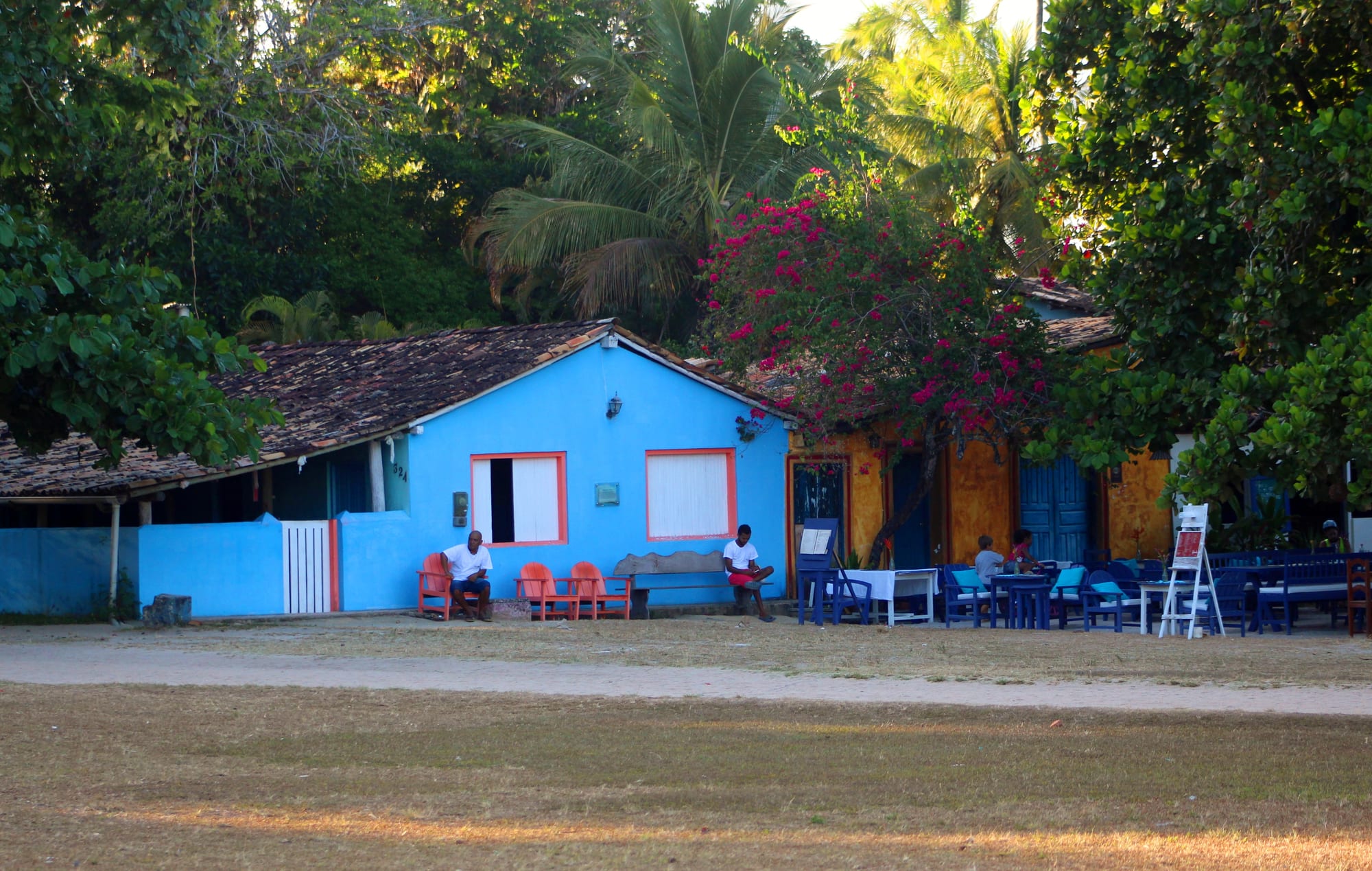
A bright blue single-storey house and a yellow one behind a grassy square, with tables, chairs, palms and a flowering bougainvillea

Bahia, Brazil

Trancoso

Painted houses and outdoor tables on the Quadrado, Trancoso's long grassy square. (Vilamir Azevedo / Wikimedia Commons · CC BY-SA 3.0)

A district of Porto Seguro on Bahia's Discovery Coast, built around the Quadrado, a long grassy square with a whitewashed church at its seaward end. Founded as a Jesuit mission village in the 1580s, it stayed a quiet fishing settlement until hippies arrived in the 1970s; since a road opened in 1999 it has become one of Brazil's most fashionable and expensive beach villages.

Neighbourhoods

  • The Quadrado
    • First-time visitors
    • Historic district
    • Best for food

    The historic centre on the bluff: a long grass square, officially Praça São João, lined with small colourful houses that now hold shops, restaurants and guest houses, with the white church of São João Batista at the far end looking out over the sea. It is quiet by day and busy with diners in the evening.

    Open in Maps
  • The beach below the village
    • Beaches
    • Families

    Paths lead down from the Quadrado to Praia dos Nativos and Praia dos Coqueiros, sheltered by reefs, with beach bars and hotels along the sand. Staying here means the sea at the door and a short climb to the village.

    Open in Maps
  • The coast to the south
    • Quiet and residential
    • Beaches

    Beyond Praia da Pedra Grande the beaches grow emptier towards Praia do Espelho on a winding dirt road. A car is needed to stay out here.

    Open in Maps

Things to do

The village

  • The Quadradolandmark

    The village's rectangular green, laid out around the Jesuit mission, which visitors in the 1970s found as little more than a ring of houses around a large lawn with a church at the end.

    Open in Maps
  • Igreja de São João Batistalandmark

    The small white church at the eastern end of the Quadrado, dating from the village's Jesuit beginnings in the 16th century and dedicated to Saint John the Baptist, with a view over the sea.

    Open in Maps

Beaches

  • Praia dos Nativosbeach

    The beach directly below the village, with beach bars and hotels behind the sand.

    Open in Maps
  • Praia dos Coqueirosbeach

    A small palm-lined beach with medium waves, sheltered most of the time by coral reefs, and the last beach with restaurants and bars as the coast runs south.

    Open in Maps
  • Praia da Pedra Grandebeach

    A narrower beach about a kilometre beyond Coqueiros, with fewer visitors; the more distant beaches beyond it are known for surfing.

    Open in Maps
  • Praia do Espelhobeach

    A beach of fine white sand about half an hour south on a dirt road passable in dry weather, where reefs create warm natural pools at low tide.

    Open in Maps

Short trips from the village

  • Arraial d'Ajudaattraction

    Another Porto Seguro district to the north, known for its beaches and architecture, across the Buranhém river by ferry from Porto Seguro town.

    Open in Maps
  • Porto Seguroattraction

    The municipal seat to the north, with its hilltop historic centre, its airport and busy beaches.

    Open in Maps
  • Monte Pascoal National Parkpark

    A national park covering parts of Porto Seguro and Prado, one of the eight protected areas of the Discovery Coast Atlantic Forest Reserves World Heritage Site.

    Open in Maps

Seasonal events

  • Festa de São Sebastião20 January

    A festival for Saint Sebastian on the Quadrado, when villagers sing and play drums and guitars.

  • Festival de Cinema de Trancosoonce a year, around a full moon

    A film festival held under the full moon at venues around the village, with the façade of the São João Batista church as one of its main screens.

Eat and drink

Long-standing places and food districts in Trancoso. Hours, ratings and directions come from your maps app, always current.

Trancoso classics

  • Restaurants on the Quadradoneighborhood

    Tables set out on the grass in front of the old houses, where much of the village eats in the evening.

    Open in Maps

Beach bars

  • Praia dos Coqueirosneighborhood

    Beach bars and restaurants on the sand, serving fried fish, seafood and drinks.

    Open in Maps
  • Praia dos Nativosneighborhood

    The closest beach bars to the village, below the bluff.

    Open in Maps

Experience Trancoso

History

Indigenous peoples lived on this stretch of coast when the Portuguese arrived. According to one historian of the Brazilian navy, the Rio dos Frades at Trancoso is where Pedro Álvares Cabral's fleet came ashore on 22 April 1500 and took possession of Brazil for Portugal, though the landing is more often placed near Porto Seguro. The present village grew from a Jesuit mission, São João Batista dos Índios, founded in the 1580s to settle and convert the Indigenous people of the coast; its church and the long green in front of it still shape the village.

For centuries Trancoso was a small and isolated fishing settlement. It was little known in the rest of Brazil until the late 1970s, when hippies found it: a group of houses around a large lawn, with a church at the far end and a wide view of the sea.

Tourism grew from the 1990s as roads and airports were built across the region, and in 1999 a highway linked the village to Porto Seguro. Trancoso drew international attention around 2000; hotel groups and wealthy buyers followed, property values rose, and the village became one of the most exclusive resorts in Brazil, even as its old square kept its original style.

Culture & Customs

The Quadrado is both the village's landmark and its living room. Its houses are small, single-storey and brightly painted, and the 16th-century church of São João Batista at the eastern end remains the focus of community life. On 20 January the square hosts the festival of Saint Sebastian, when residents sing his hymn to drums and guitars. Each year a film festival projects films under the full moon at venues around the village, using the church as one of its screens.

Solange Ferrarini's crochet bikini, first sold on Trancoso's beaches, was later copied worldwide. In recent years settlers from the rest of Brazil and from abroad — Italians, Portuguese, Dutch, Greeks, Israelis, Canadians and others — have bought houses and opened guest houses, restaurants and shops, and the result is a cosmopolitan population alongside the Bahian families who were here first.

That mix brings friction as well as trade. The pace of development and the arrival of large resorts have raised questions about the village's future, and the Caraíva-Trancoso Environmental Protection Area, which begins at the village, was created to limit tourist and economic growth along the coast to the south.

Daily Life

Trancoso is a district of the municipality of Porto Seguro, not a separate town. At the 2022 census it had about 18,600 people in around 6,700 occupied homes, up from about 11,000 in 2010. Most residents live from the visitors in one way or another, and the population has grown quickly as the village has become better known.

Tourism and real estate are the economy. Guest houses, restaurants, shops, building sites and the households of second-home owners employ much of the population, and incomes rise and fall with the high season.

The rhythm of the day is slow. Beaches fill from mid-morning, the Quadrado is quiet in the heat of the afternoon, and the tables on the grass fill in the evening. Nearby, federal authorities have been enlarging national parks and reserves to protect the remaining Atlantic Forest, and the balance between building and conservation is the defining local issue.

Food

Trancoso eats the food of the southern Bahia coast. Moqueca, fish or shrimp stewed in coconut milk and dendê palm oil with peppers, tomato and coriander, comes with rice and pirão, a thick fish gravy with cassava flour; acarajé, black-eyed pea fritters fried in dendê and filled with vatapá and shrimp, and cocada, a coconut sweet, are sold by vendors across the region.

The beach bars on Praia dos Nativos and Praia dos Coqueiros serve grilled and fried fish, shrimp and cold drinks on the sand. Up on the Quadrado the restaurants reflect the village's international population, serving both Bahian dishes and food from the newcomers' home countries.

Tropical fruits — cajá, graviola, mango, passion fruit — go into juices and caipirinhas, and coconut water is drunk straight from the nut on the beach. As elsewhere on this coast, fish and seafood are the basis of most menus, and the catch of the day sets much of what is served.

Planning tools

Budget

Trancoso is one of the most expensive beach villages in Brazil, with many upmarket guest houses, villas and restaurants, and prices well above neighbouring Arraial d'Ajuda or Porto Seguro town. Simpler rooms exist, but are scarce in high season, when rates jump around New Year, Carnival and the July holidays.

Daily Budget Midrange
USD 120–250 (pousada room, dinners on the Quadrado, taxis to the further beaches)
Daily Budget Shoestring
USD 45–80 (simple room or hostel bed, beach-bar meals, buses to Porto Seguro)

Staying in Arraial d'Ajuda or Porto Seguro and visiting for the day is a cheaper way to see the village.

Best Time to Visit

The coast is warm all year, and September to March is the sunniest period. The summer weeks from Christmas to Carnival are the busiest and most expensive; the southern autumn and spring are quieter, and the road to the southern beaches is easiest in dry weather.

Suggested Number of Days

Two or three days covers the village and its nearest beaches. Four to six days allows time for the further beaches and the rest of the Discovery Coast; dry-weather access to the southern beaches and the cost of a stay usually set the length.

First Visit
2–3 days
With Surroundings
4–6 days

Transportation

The village and its two nearest beaches are walkable. The further beaches to the south are reached by car, taxi or buggy along dirt roads, and buses and taxis run north to Arraial d'Ajuda and Porto Seguro.

Some southern beach roads become impassable after heavy rain, so check conditions before setting out.

Airport & Station Connections

Porto Seguro International Airport, about 2 km from downtown Porto Seguro, is about an hour away by car. A highway opened in 1999 links the village to Porto Seguro; on the way, Arraial d'Ajuda is connected to the town by a ferry across the mouth of the Buranhém river. By road, Salvador is about 725 km and roughly nine hours away.

Walkability

The Quadrado and the lanes around it are small and easy on foot, mostly on grass and sand rather than pavement. Paths lead down the bluff to the beach. Beyond Praia dos Coqueiros distances grow and transport is needed.

Safety

Brazil has high rates of crime, including violent crime, and it is the main practical concern for visitors — though very unevenly distributed. Trancoso is a small, relatively calm village, but theft from beaches and empty roads at night is the usual risk. Reef pools and surf beaches need care with tides and currents.

Leave valuables in the room, avoid empty beaches after dark and use taxis at night. Check current official travel advice before travelling.

Climate

Tropical and warm all year, with sea breezes and rain spread through the seasons. Seasons are southern-hemisphere — summer is December to February.

Summer
hot and humid, around 26–32°C, and sunnier than winter
Winter
warm, around 22–28°C, with more frequent showers

Local Customs

Trancoso mixes Bahian families with incomers from elsewhere in Brazil and from Europe, Canada and Israel who have bought houses, guest houses and shops here. The Quadrado and its church are the heart of the old community, and religious festivals are still held there. A service charge is usually added to restaurant bills.

Dress modestly inside the church, keep swimwear for the beach, and ask before photographing residents.

Common Payment Methods

The currency is the Brazilian real (R$). Cards and Pix are accepted in most restaurants and shops, but cash is useful for beach bars, taxis and small stalls. Porto Seguro has the nearest large choice of banks and ATMs; foreign cards do not work in every machine.