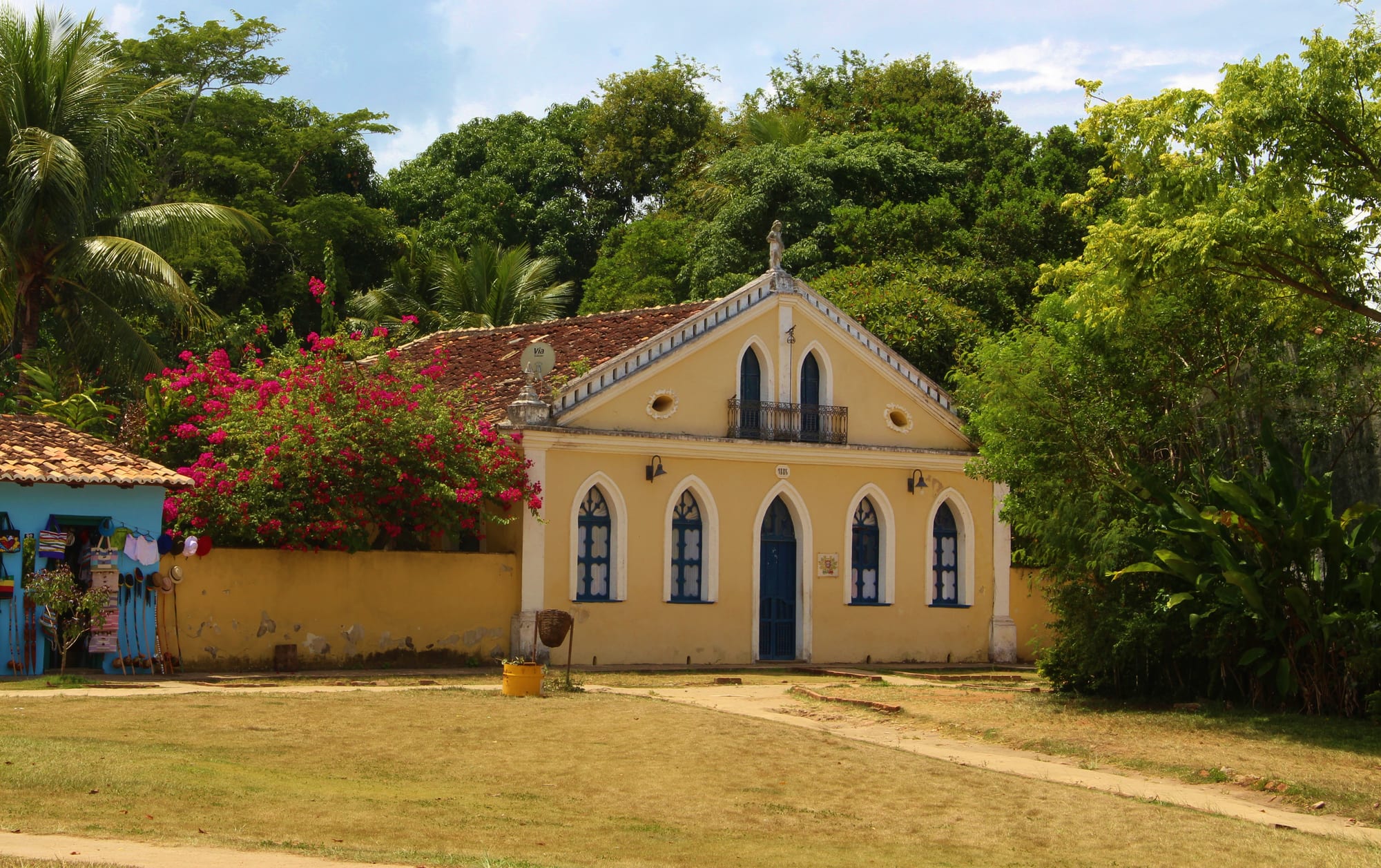
A small yellow colonial building with arched blue windows on a grassy square, beside a pink bougainvillea and a craft stall

Bahia, Brazil

Porto Seguro

Colonial buildings on the green of the Cidade Histórica, Porto Seguro's hilltop old town. (Vilamir Azevedo / Wikimedia Commons · CC BY-SA 3.0)

A resort city on the far southern coast of Bahia, at the mouth of the Buranhém river, near where Pedro Álvares Cabral's fleet reached Brazil in 1500. Its hilltop Cidade Alta is one of the oldest Portuguese settlements in the country; below it, a lower town of bars and a long run of beaches draw visitors from across Brazil and South America.

Neighbourhoods

  • Cidade Alta
    • Historic district
    • First-time visitors

    The historic upper town on the hill, listed as a national monument in 1973, with three churches, the old town hall and jail and around 40 restored buildings around grassy squares. It is quiet and green, with views over the coast, and is mostly visited by day; the bus station lies close by.

    Open in Maps
  • Centro
    • Nightlife
    • Best for food
    • Close to public transport

    The lower town along the Buranhém river, where the Passarela do Álcool, the traditional avenue of Carnival and evening life, runs past shops, bars and restaurants. Ferries cross from here to Arraial d'Ajuda, and building heights are kept low.

    Open in Maps
  • The northern beaches
    • Beaches
    • Families

    The coast road running north from the centre towards Coroa Vermelha and Santa Cruz Cabrália, lined with hotels, beach clubs and bars on a long sandy shore.

    Open in Maps
  • Arraial d'Ajuda
    • Beaches
    • Nightlife
    • Quiet and residential

    A separate district across the river mouth, reached by ferry and a short bus ride, known for its beaches and its old village centre. It is smaller and more relaxed than the town, with many guest houses and restaurants.

    Open in Maps

Things to do

The historic town

  • Cidade Históricaneighborhood

    The hilltop site of one of Brazil's first Portuguese settlements, reached by steps from the lower town, with the Marco do Descobrimento — a stone boundary pillar brought from Portugal in the early 16th century, carved with the cross of the Order of Aviz and the Portuguese arms.

    Open in Maps
  • Igreja Matriz de Nossa Senhora da Penalandmark

    The parish church of the Cidade Alta, which keeps sacred images of the 16th and 17th centuries, including a Saint Francis of Assisi said to be the first religious image brought from Portugal to Brazil.

    Open in Maps
  • Museu do Descobrimentomuseum

    The town museum, in the 18th-century Casa de Câmara e Cadeia, the former town hall and jail, one of the finest civil buildings of the colonial period.

    Open in Maps
  • Igreja de São Beneditolandmark

    A church built by the Jesuits in 1551, beside the ruins of their former residence and college.

    Open in Maps

Beaches and the sea

  • Coroa Vermelhabeach

    The cove north of town where the first mass in Brazil was celebrated by the priests of Cabral's fleet on 26 April 1500, now home to a Pataxó Indigenous reserve whose village sells handicrafts.

    Open in Maps
  • Recife de Forapark

    A reef offshore that is exposed at low tide, protected as a marine park, where boat trips go to see corals and fish; standing on the reef damages it.

    Open in Maps
  • Reserva Pataxó da Jaqueiraattraction

    A Pataxó reserve of about 827 hectares of Atlantic Forest north of town, where guided walks explain the community's crops, hunting, cooking and fishing.

    Open in Maps

Short trips from the town

  • Arraial d'Ajudaattraction

    The beach district across the river, reached by ferry across the mouth of the Buranhém.

    Open in Maps
  • Trancosoattraction

    A former Jesuit mission village to the south, set around a long grassy square with a whitewashed church above the sea.

    Open in Maps
  • Santa Cruz Cabráliaattraction

    The neighbouring municipality to the north, which shares with Porto Seguro the coast where the Portuguese arrived in 1500.

    Open in Maps
  • Monte Pascoal National Parkpark

    A national park created in 1961 around the rounded hill that Cabral's crew sighted on 22 April 1500, protecting Atlantic Forest and including Pataxó Indigenous land; it is part of the Discovery Coast World Heritage Site.

    Open in Maps

Seasonal events

  • CarnivalFebruary or early March

    One of the best-known Carnivals in Bahia, with sound trucks, blocos and street-dancing groups drawing thousands along the Passarela do Álcool and to the beach bars.

  • Festa de Nossa Senhora da Pena8 September

    The feast of the town's patron saint, centred on her church in the Cidade Alta.

Eat and drink

Long-standing places and food districts in Porto Seguro. Hours, ratings and directions come from your maps app, always current.

Porto Seguro classics

  • Passarela do Álcoolneighborhood

    The traditional avenue of the lower town, with bars and restaurants that fill in the evening.

    Open in Maps
  • Beach bars of the northern coastneighborhood

    Beach clubs and barracas along the sand north of the centre, serving fried fish, shrimp and drinks.

    Open in Maps

Across the river

  • Arraial d'Ajuda villageneighborhood

    The restaurants and cafés of the old village centre across the river.

    Open in Maps

Experience Porto Seguro

History

Tupiniquim people lived on this coast when the Portuguese arrived. On 22 April 1500 Pedro Álvares Cabral's fleet, a month out from the African coast, sighted Monte Pascoal, about 62 km to the south; the men went ashore the next day at a point historians still debate, and on 24 April the fleet anchored at Porto Seguro, "safe harbour". On 26 April the fleet's priests said the first mass in Brazil at Coroa Vermelha, a cove just to the north. A small fort was built in 1504 by Gonçalo Coelho.

In the 1530s, when Portugal turned to settling its new territory, the captaincy of Porto Seguro was granted to Pero do Campo Tourinho, and the village that became the town was founded in 1535, one of the oldest in the country. Jesuits arrived and built a church in 1551. The settlement on the hill, now the Cidade Alta, kept a stone pillar sent from Portugal in the early 16th century to mark the crown's claim, and colonial-era buildings such as the 18th-century town hall and jail still stand around its square.

For centuries the town remained small. In 1973 the hilltop site was declared a national monument by presidential decree, and its churches and houses were restored by the state government for the 500th anniversary of the landing in 2000. Since the airport opened in 1982 and was rebuilt in 1997, Porto Seguro has grown into one of the main beach destinations in Brazil.

Culture & Customs

Porto Seguro trades on being the place where Brazil began, and the story of 1500 is everywhere, from the Marco do Descobrimento to the national park around Monte Pascoal. The Pataxó, whose land includes parts of the coast and the national park, are a visible part of the town's life: at Coroa Vermelha and the Jaqueira reserve they sell crafts such as seed necklaces and show visitors their customs and dances.

The town's other identity is its party reputation. Its Carnival is one of the most famous in Bahia, with trios elétricos — trucks carrying sound systems and live bands — and blocos and cordões of dancers drawing thousands along the Passarela do Álcool and out to the beach bars, and the nightlife is one of the town's main attractions for young visitors.

Catholic tradition holds its place in the old town, where the patron saint, Nossa Senhora da Pena, is honoured on 8 September. Ties to Portugal are kept up through twinning with Setúbal, Fafe and Belmonte.

Daily Life

About 168,000 people lived in the municipality at the 2022 census, spread over some 2,290 square kilometres and five districts: Porto Seguro itself, Arraial d'Ajuda, Caraíva, Trancoso and Vale Verde.

Tourism drives the economy, with visitors from all over Brazil and from Argentina, Uruguay and Chile; hotels, beach clubs, restaurants, tour boats and transport employ much of the town. Beyond the coast, cashew and coconut farming, eucalyptus plantations and cattle are the other main activities, along with trade and services.

Daily life follows the tourist calendar: a rush from New Year to Carnival and in July, and quieter months in between. Rules keeping buildings to two storeys in the historic centre preserve its scale. The surrounding Atlantic Forest is protected in several reserves, including the Pau-Brasil Ecological Station and the Rio dos Frades Wildlife Refuge. Offshore, part of the Corumbau Marine Extractive Reserve, a protected fishing area, also lies within the municipality.

Food

Porto Seguro eats the food of the Bahian coast. Moqueca, fish or shrimp stewed in coconut milk and dendê palm oil with peppers, tomato and coriander, is served with rice and pirão, a fish gravy thickened with cassava flour; bobó de camarão is shrimp in a creamy cassava purée. Acarajé, black-eyed pea fritters fried in dendê and split to hold vatapá and shrimp, and cocada, the coconut sweet, are sold by street vendors.

On the beaches the barracas, beach shacks and clubs, serve fried fish, shrimp and cold beer, and coconut water is drunk straight from the nut. In the lower town, restaurants and bars along the riverfront and the Passarela do Álcool cater to the evening crowds.

The region grows cashews and coconuts, and their fruit goes into juices and sweets. Caipirinhas, made with cachaça, lime and sugar, and fruit cocktails are the drinks of the beach and the nightlife.

Planning tools

Budget

Porto Seguro is one of the cheaper beach destinations in Bahia, with hundreds of smaller hotels and pousadas as well as large resorts, and many visitors from the rest of Brazil and from Argentina. Prices rise steeply at New Year, Carnival and in the July holidays. Boat trips and beach clubs are the main extra costs.

Daily Budget Midrange
USD 80–160 (beach hotel or pousada, restaurant dinners, a boat or reef trip)
Daily Budget Shoestring
USD 30–55 (hostel or simple pousada, per-kilo lunches, local buses and the ferry)

Book well ahead for New Year and Carnival; outside the holidays, rates are often lower than the posted prices.

Best Time to Visit

The town is warm all year and the temperature changes little through the seasons. June to September has the least chance of rain; the summer holidays from Christmas to Carnival are the busiest, hottest and most expensive time, with the biggest parties.

Suggested Number of Days

Two or three days is enough for a first visit to the town. Five days to a week allows time for the other districts and the wider coast; travellers on a beach holiday often stay longer, and the high-season crowds can make everything take more time.

First Visit
2–3 days
With Surroundings
5–7 days

Transportation

Local buses and taxis run along the coast road and between the town and the Cidade Alta, and app taxis are available. Ferries carry passengers and cars across the Buranhém river to the road for Arraial d'Ajuda and Trancoso, with buses onward on the other side.

Allow extra time for the ferry queue for cars at weekends and in high season.

Airport & Station Connections

Porto Seguro Airport, about 2 km from downtown, has flights from the main Brazilian cities and it opened in 1982 and was rebuilt to take larger aircraft in 1997. Buses from Salvador take about twelve hours overnight.

Walkability

The lower town is flat and easy to walk, and steps climb from it to the Cidade Alta. The beaches to the north stretch for many kilometres along the coast road, so buses or taxis are needed between them and the centre.

Safety

Brazil has high rates of crime, including violent crime, and it is the main practical concern for visitors — though very unevenly distributed. In Porto Seguro the main risks are theft on beaches and in the crowds of Carnival and the busy evenings in the centre, and robbery on quiet streets at night.

Carry little to Carnival and the nightlife areas, use taxis at night, and stay off the reef at low tide. Check current official travel advice before travelling.

Climate

Warm and partly cloudy all year, with so little variation that hot and cold seasons barely exist; high humidity makes it feel hotter. Seasons are southern-hemisphere — summer is December to February.

Summer
hot and humid, with highs around 29°C and occasional peaks above 30°C
Winter
mild and drier, with lows around 19°C and rarely below 18°C

Local Customs

Porto Seguro is used to large numbers of holidaymakers, and the atmosphere on the beaches and in the centre is informal and lively. The Pataxó communities nearby welcome visitors to their reserves and sell crafts. A service charge is usually added to restaurant bills.

Dress modestly in the churches of the Cidade Alta, ask before photographing people in the Pataxó villages, and keep swimwear for the beach.

Common Payment Methods

The currency is the Brazilian real (R$). Cards and Pix are widely accepted, but cash helps at beach stalls, on the ferry and in small shops. Foreign cards do not work in every ATM; those inside banks or malls are the safest choice.