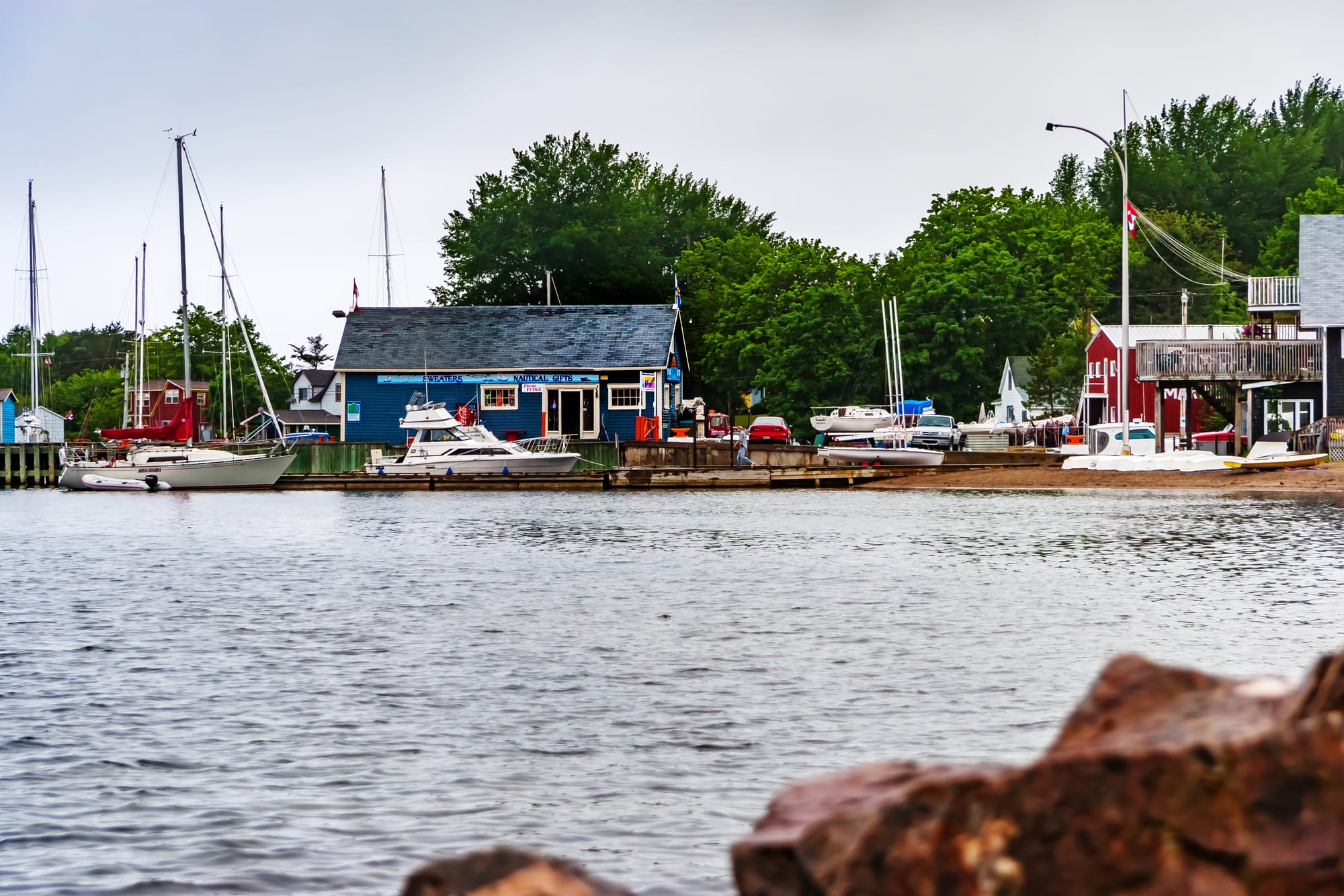
Sailboats and motor boats moored beside a blue wooden shop and a red building on a leafy lakeshore under a grey sky

The Maritimes, Canada

Baddeck

Boats and wooden buildings on the waterfront at Baddeck, on Bras d'Or Lake. (Michel Rathwell from Cornwall, Canada / Wikimedia Commons · CC BY 2.0)

A village of about 800 people on the shore of Bras d'Or Lake in the centre of Cape Breton Island, the county seat of Victoria County. Settled by Loyalists and Scottish Gaels on Mi'kmaq land, it became Alexander Graham Bell's summer home and is now a sailing and touring base at the start and end of the Cabot Trail.

Neighbourhoods

  • Chebucto Street
    • First-time visitors
    • Best for food
    • Historic buildings

    The village's main street, where most shops, cafés and restaurants stand alongside the old red sandstone post office of Grosvenor Hall, the 1889 Victoria County Court House and the Alexander Graham Bell site.

    Open in Maps
  • Shore Road and the waterfront
    • Harbour views
    • Sailing
    • Quiet stays

    The lakeside road and wharf facing Kidston Island, where boat tours leave in summer, the yacht club has its moorings and inns look out over Baddeck Bay.

    Open in Maps

Things to do

In the village

  • Alexander Graham Bell National Historic Sitemuseum

    A Parks Canada museum overlooking the Bras d'Or Lakes, holding the largest collection of artefacts and documents from Bell's years of experimental work in Baddeck.

    Open in Maps
  • Kidston Islandpark

    The island just offshore from the village, with a lighthouse of 1912, reached by a ferry in summer.

    Open in Maps

On the lake

  • Bras d'Or Lakeattraction

    The tidal, brackish inland sea at the centre of Cape Breton Island, a UNESCO biosphere region since 2011, with sailing and cruise tours from Baddeck's pier in summer.

    Open in Maps
  • Beinn Bhreaghviewpoint

    The peninsula across Baddeck Bay, about 3 km from the village, where Bell built his estate and laboratory; its name is Gaelic for 'beautiful mountain'.

    Open in Maps

Short trips from the village

  • Cabot Trailtrail

    The 298 km scenic road loop around northern Cape Breton, completed in 1932, following the coast and crossing the highlands, with Baddeck at its start and end.

    Open in Maps
  • The Gaelic Collegeattraction

    A school at St. Anns on the Cabot Trail, founded in 1938 to keep Highland Scottish Gaelic culture alive.

    Open in Maps
  • Cape Breton Highlands National Parkpark

    The first national park in Atlantic Canada, covering 948 square kilometres of mountains, valleys, waterfalls and rocky coast, with the highest point in Nova Scotia.

    Open in Maps

Seasonal events

  • Celtic Colours International FestivalOctober

    An island-wide Celtic music festival held since 1997 at the time of peak autumn colour, with Baddeck among its host communities.

  • Cabot Trail Relay Racespring

    A 298 km relay race around the Cabot Trail hosted by the village.

Eat and drink

Long-standing places and food districts in Baddeck. Hours, ratings and directions come from your maps app, always current.

Baddeck classics

  • Baddeck Lobster Suppersrestaurant

    A casual restaurant known for its lobster dinners with unlimited Cape Breton mussels, seafood chowder and homemade rolls.

    Open in Maps
  • Chebucto Street restaurants and cafésneighborhood

    Seafood restaurants known for chowder, small cafés and lakeside dining rooms along the main street and Shore Road.

    Open in Maps

Experience Baddeck

History

The Mi'kmaq were the first people of the area, and the village's name comes from their language: its original name, Apatakwitk, has been interpreted as "place with island near", probably a reference to Kidston Island, among other meanings. The French called it La Bedeque and Gaelic speakers Badaig. French Jesuits settled at nearby St. Anns in 1629, and British settlement followed after France ceded the territory, with United Empire Loyalists and Scottish Gaels arriving in the late 18th and early 19th centuries. James Duffus, a retired naval officer from Halifax, set up a home and store on Kidston Island in 1819.

In 1841 Charles James Campbell opened a store and a shipbuilding business and developed coal mining nearby, and when Victoria County was created in 1851 Baddeck became its shire town, with a jail, court house and municipal offices. The village grew as a service and shipping centre for the mining, trapping, fishing, forestry and farming around it. Charles Dudley Warner's 1874 travel book Baddeck, And That Sort of Thing made it famous.

Alexander Graham Bell's family first holidayed here in 1885. Bell bought land on the peninsula across the bay and built Beinn Bhreagh, an estate and laboratory where he spent more and more of each year. Experiments there included the AEA Silver Dart, which made the first controlled powered flight in Canada in 1909, and from 1885 to 1928 the Bell Boatyard built experimental and traditional boats. The Cabot Trail, completed in 1932, began and ended in the village, and tourism grew further.

Culture & Customs

Baddeck's culture is that of Cape Breton: Scottish Gaelic heritage, fiddle music, step dancing and ceilidhs, carried on alongside Mi'kmaq traditions. The village is one of the host communities of Celtic Colours, the island-wide festival held each October since 1997, which brings musicians from Scotland, Ireland, Brittany and across North America to dozens of concerts around the island at the time of peak autumn colour. Nearby St. Anns has the Gaelic College, founded in 1938 to keep Highland Gaelic culture alive.

Bell remains part of the village's identity. The Parks Canada site devoted to him, a National Historic Site since 1952, tells the story of his years of experiment here, from flying machines to boats, and the Silver Dart's flight from the ice of Baddeck Bay is a point of local pride. Sailing is the other tradition: the Bras d'Or Yacht Club is based in the village, and boats fill the harbour in summer.

Each spring the village hosts the Cabot Trail Relay Race, a 298 km relay around the whole loop. Historic buildings line the main street — Grosvenor Hall, a red sandstone post office and custom house of 1886, the 1889 Victoria County Court House and the 1883 Gothic Revival church of Saint Peter's and Saint John's.

Daily Life

Baddeck had 818 people at the 2021 census, almost unchanged from 2016, on just over 2 square kilometres. As the shire town it is the administrative centre of Victoria County, with an elected village commission responsible for water, sewers, side streets and some bylaws, and it serves as the shopping and service centre for a sparsely populated county.

The economy now depends on services, cultural activities and tourism. Summer transforms the village: hotels hold hundreds of rooms, far more than its households, and the wharf, restaurants and the Bell site are busy with travellers setting out on or returning from the Cabot Trail. Baddeck Academy teaches pupils from pre-primary to grade 12 from the village and surrounding communities.

Outside the tourist season life is quiet, with many seasonal businesses closed and local life centred on the school, the churches and community clubs. As across the Maritimes, the cost of heating in winter and access to doctors are everyday concerns.

Food

Seafood suppers are the village's best-known meal. Lobster comes with unlimited helpings of Cape Breton mussels, seafood chowder, potato salad, coleslaw and homemade rolls and biscuits at the lobster supper restaurant in the centre. Seafood restaurants on Chebucto Street are known for their chowder and homemade oatmeal bread.

Small cafés serve soups, sandwiches and pastries for travellers heading out on the Cabot Trail. Cape Breton's Scottish heritage shows in the drinks: at least one village bar is known for its whisky list, and Glenora on the island's west coast makes a Cape Breton single malt. Nova Scotian dishes such as hodge podge, a summer stew of new vegetables in cream, and blueberry grunt, wild berries stewed under steamed dumplings, appear on home tables and some menus in season. The lake and the sea supply the rest: mussels, Atlantic lobster in season and seafood chowder are the staples of village menus, while groceries for picnics on the Cabot Trail come from the small shops on Shore Road and Chebucto Street.

Planning tools

Budget

Baddeck has hundreds of hotel rooms for a village of about 800 people, but prices rise in July, August and during Celtic Colours in October. Lobster and mussels are good value by national standards. A hire car is essential for the Cabot Trail, and it is the main extra cost.

Daily Budget Midrange
USD 160–280 (lakeside inn, lobster supper, museum ticket, hire car and park fees)
Daily Budget Shoestring
USD 80–120 (campground or budget motel, groceries and chowder, own car shared)

Book rooms ahead for summer and for the autumn colour season; many rural places along the Cabot Trail close outside the summer and autumn seasons.

Best Time to Visit

July and August bring the warmest weather, sailing on the lake and the full range of tours. Late September and early October are the best time for the Cabot Trail, when the Cape Breton forests turn colour and Celtic Colours runs. June is quieter but often cool and foggy, and many businesses close in winter.

Suggested Number of Days

The village itself takes a day or two. Three or four days allow time for the surrounding highlands and coast without rushing; the weather and how much walking is planned change the number.

First Visit
1–2 days
With Surroundings
3–4 days

Transportation

Everything in the village lies along Shore Road and Chebucto Street and can be reached on foot. Beyond it a car is needed: public transport on Cape Breton Island is very limited, and the Cabot Trail is a road loop best driven at leisure.

Fill up with fuel before setting out on the Cabot Trail and watch for moose on the highland roads, especially at dusk.

Airport & Station Connections

Baddeck lies on Highway 105, the Trans-Canada Highway, about halfway between the Canso Causeway to the mainland and Sydney, roughly five hours' drive from Halifax. The nearest airport with scheduled flights is JA Douglas McCurdy Sydney Airport at Reserve Mines, near Sydney; Halifax Stanfield is the main gateway for most visitors.

Walkability

Small and easy on foot: the village stretches along two streets beside the water, and the Bell site, the wharf and the restaurants are within a short walk of each other.

Safety

Canada is a safe country with low levels of violent crime. Baddeck is a quiet village; the risks are on the water and the road — sudden weather on the lake, fog, and moose and deer on the highways at dusk.

Wear a life jacket on small boats, check the forecast before sailing, and drive the Cabot Trail's steep sections slowly. Check current official travel advice before travelling.

Climate

A humid continental climate tempered by the lake and the sea. Summers are mild to warm, autumn brings bright colour to the hills, and winters are cold, with snow, freezing rain and storms.

Summer
mild to warm, around 20–26°C across the Maritimes, cooler and foggier by the water
Winter
cold and changeable, around -10 to 0°C across the Maritimes, with snow, freezing rain and storms

Local Customs

Tipping of 15–20 per cent is expected in restaurants, and sales tax is added at the till. Cape Breton is proud of its Scottish Gaelic, fiddle and step-dance traditions, and the Mi'kmaq are the original people of the island; their communities and sacred places deserve respect.

Alcohol is sold in provincial liquor stores; drinking on the street or wharves is not allowed.

Common Payment Methods

The currency is the Canadian dollar. Cards and contactless payment are widely accepted, but some small seasonal businesses and rural places along the Cabot Trail prefer cash, so a little is useful. Cash totals are rounded to the nearest five cents.