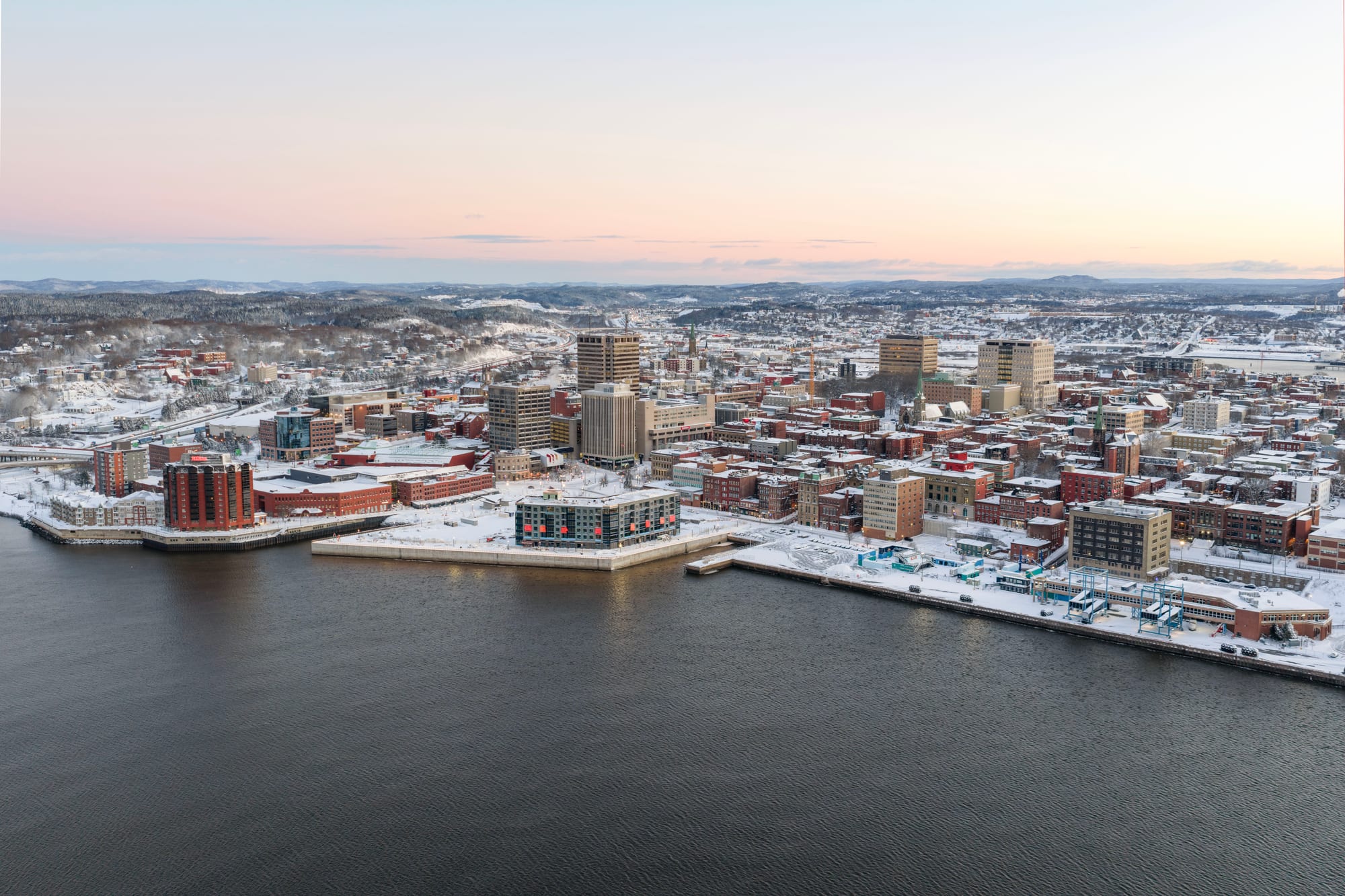
An aerial view of uptown Saint John's brick buildings and office towers covered in snow beside dark harbour water at dusk

The Maritimes, Canada

Saint John

The skyline of Uptown Saint John beside its harbour. (Quintin Soloviev / Wikimedia Commons · CC BY 4.0)

New Brunswick's port city at the mouth of the Saint John River on the Bay of Fundy, chartered in 1785 as Canada's first incorporated city after the arrival of thousands of Loyalist refugees. Rebuilt in brick and stone after the Great Fire of 1877, it is an industrial and shipping city of Victorian streets, a historic market and the tide-driven Reversing Falls.

Neighbourhoods

  • Uptown
    • First-time visitors
    • Historic district
    • Best for food

    The central business district and the Trinity Royal Heritage Conservation Area, rebuilt after the 1877 fire in Victorian, Romanesque Revival and Second Empire styles. The City Market, King's Square, the Imperial Theatre and Market Square are here, linked in part by indoor pedways.

    Open in Maps
  • South End
    • Quiet and residential
    • Historic streets

    The streets south of Uptown around Queen Square, Germain Street, Broad Street and Orange Street, once part of Lower Cove, where a farmers' market fills the square in summer.

    Open in Maps
  • North End
    • Local life
    • Parks

    Largely the former city of Portland, where much of Saint John's Black community settled in the early years, now a mix of older streets and suburbs reaching up to Rockwood Park. The Harbour Passage path links it with Uptown along the water.

    Open in Maps
  • West Side
    • Views
    • Quiet and residential

    The former Carleton across the river, one of the two communities united in 1785, with the Carleton Martello Tower on its hill, the port's west side terminals and the Irving Nature Park at its edge.

    Open in Maps

Things to do

Uptown landmarks

  • Saint John City Marketmarket

    The oldest continuously operated farmers' market in Canada, with a charter dating from 1785; its 1876 hall has a roof that resembles an inverted ship's keel.

    Open in Maps
  • Trinity Anglican Churchlandmark

    The Gothic Revival stone church completed in 1880 to replace the Loyalist-era church lost in the Great Fire, home to the city's first established congregation.

    Open in Maps
  • Loyalist Housemuseum

    A house museum and National Historic Site on Union Street, home of the Merritt family from its completion in 1817 until 1958.

    Open in Maps
  • Imperial Theatreattraction

    An Italian Renaissance-style vaudeville theatre on King's Square, opened in 1913, now staging plays and concerts.

    Open in Maps
  • New Brunswick Museummuseum

    Canada's oldest continuing museum, tracing its lineage to the collections of Abraham Gesner in 1842.

    Open in Maps

Forts and the harbour

  • Reversing Fallsviewpoint

    A series of rapids in a narrow gorge where the Saint John River meets the Bay of Fundy; at high tide the sea forces the river's flow to reverse.

    Open in Maps
  • Carleton Martello Towermuseum

    One of nine surviving Martello towers in Canada, built in the War of 1812 era, with a restored powder magazine and barracks room and views over the city and harbour from its roof.

    Open in Maps
  • Fort Howeviewpoint

    The hilltop site of the British fort built during the American Revolution to protect the city from further American raids, with a replica blockhouse nearby.

    Open in Maps
  • Partridge Islandlandmark

    The island in the inner harbour that was the first quarantine station in North America, through which thousands of Irish famine immigrants passed, a National Historic Site since 1974.

    Open in Maps

Parks and nature

  • Rockwood Parkpark

    One of Canada's largest urban parks, in the north of the city, with paths that wind around natural and man-made lakes.

    Open in Maps
  • Irving Nature Parkpark

    A 243-hectare park between a salt marsh and the Bay of Fundy on the city's western outskirts, the first designated Urban Star Park in Canada.

    Open in Maps

Short trips from the city

  • St. Martinsattraction

    A Bay of Fundy village founded by Loyalist soldiers in 1783 that became the third most productive shipbuilding town in the Maritimes, now living mainly from tourism.

    Open in Maps
  • Fundy Trail Parkwaytrail

    A 30 km scenic parkway along the Bay of Fundy with more than 20 lookouts, beaches, waterfalls, a walking and cycling trail and the Big Salmon River Suspension Bridge.

    Open in Maps

Seasonal events

  • Area 506 FestivalNew Brunswick Day long weekend, early August

    A music festival on the harbourfront by Water Street, set among shipping containers holding vendors from New Brunswick businesses, with many bands from the Saint John scene.

  • Queen Square farmers' marketsummer

    An outdoor farmers' market held each summer in Queen Square in the South End.

Eat and drink

Long-standing places and food districts in Saint John. Hours, ratings and directions come from your maps app, always current.

Food districts and markets

  • Saint John City Marketmarket

    Fruit and vegetables, fresh seafood, local coffee and stalls selling salads, sandwiches and local fare in Canada's oldest continuously operated farmers' market.

    Open in Maps
  • Market Squareneighborhood

    A waterfront complex in Uptown with a range of places to eat.

    Open in Maps
  • Uptown restaurants and pubsneighborhood

    Brewpubs, Thai and Indian restaurants and seafood kitchens in the Victorian streets around King Street, Germain Street and Prince William Street.

    Open in Maps

Experience Saint John

History

The Wolastoqiyik lived along the river they called Wolastoq and still live in and around the city; they called the harbour area Menahkwesk, and the Mi'kmaq came to the coast to hunt seals. Samuel de Champlain landed at the harbour on 24 June 1604, the feast of St. John the Baptist, and named the river after him. Under the French the harbour was a centre of trade and defence for Acadia, and Fort La Tour was a battleground in the Acadian Civil War. After a century of disputes the British deported the Acadians in 1755, rebuilding the French Fort Menagoueche as Fort Frederick, and after American privateers burned it they built Fort Howe above the harbour.

From May 1783 more than 10,000 Loyalist refugees arrived within months, with more than 3,300 Black Loyalists among them. On 18 May 1785 a royal charter united Parr-town and Carleton on opposite sides of the harbour as the City of Saint John, the first incorporated city in what is now Canada. Black residents faced restrictions on trade, fishing and voting, and most settled in Portland, the north end. Immigration made Partridge Island North America's first quarantine station; in 1847, the worst year of the Irish famine, some 16,000 immigrants, most of them Irish, arrived there.

Between 1840 and 1860 sectarian violence brought some of the worst urban riots in Canadian history, cholera killed more than 1,500 people in 1854, and in 1877 the Great Fire destroyed 40 per cent of the city and left 13,000 homeless. The city was rebuilt in brick and stone. In the 20th century the Irving family built an industrial empire here; the shipyard closed in 2003, and in 2016 Moncton overtook Saint John as New Brunswick's largest city.

Culture & Customs

Saint John was founded by Loyalists, but the Irish who came through Partridge Island in the famine years left an equally deep mark on its people and culture. Its museums range from the New Brunswick Museum, Canada's oldest continuing museum, to the Loyalist House, the Saint John Jewish Historical Museum and the New Brunswick Black History Society's heritage centre in Brunswick Square, which tells the story of the Black Loyalists and their descendants.

The arts play a large part in the city's economy. The Imperial Theatre on King's Square, a vaudeville house of 1913 where one of Canada's first comedy troupes, the Dumbbells, staged early shows, hosts plays and concerts. Music festivals have long been part of the scene, from the provincial music festival held here each spring in the early 20th century to the Area 506 festival on the harbour and the Quality Block Party, which puts independent New Brunswick musicians in small Uptown venues. Films and series have been shot in the city.

Junior hockey is the main spectator sport: the Saint John Sea Dogs of the Quebec Maritimes Junior Hockey League play at TD Station in Uptown. Brewing is part of the city's identity, from Moosehead, founded in 1867, to newer craft breweries such as Picaroon's and Big Tide.

Daily Life

Saint John had about 70,000 people at the 2021 census, spread over a large municipal area of about 316 square kilometres, and about 131,000 in its metropolitan area. Uptown is the most densely populated part; the North End, South End, West Side and East Side spread out around the harbour and the rivers.

Industry still sets the tone. The east side has Canada's largest oil refinery and the country's largest dry dock, and Irving companies remain the dominant employers, with a deepwater oil terminal, pulp, paper and tissue mills, and stakes in forestry, shipbuilding, media and transport. The port is Canada's third-largest by tonnage and receives around 80 cruise ships a year. More than 80 per cent of the refinery's exports go to the United States, which made the US tariffs of 2025 a local concern; Irving announced that tariff costs on its oil would be absorbed by US customers.

Salmon aquaculture has become a major regional employer as wild fisheries declined. The Saint John campus of the University of New Brunswick, Dalhousie Medicine New Brunswick and the community college add students and health workers, and Uptown's offices, market and pubs keep the centre busy on weekdays.

Food

The City Market is the heart of eating in Saint John: under its ship's-keel roof traders sell fruit and vegetables, fresh seafood and local coffee, and its side aisles serve salads, sandwiches and local fare to Uptown office workers. Fundy seafood — lobster, scallops and salmon from the region's fish farms — appears on restaurant menus, and dulse, a seaweed harvested on Grand Manan and eaten in the Maritimes, is a well-known snack.

New Brunswick cooking also brings fiddleheads, young curled fern shoots picked in spring, and Acadian dishes such as fricot, a stew of potatoes, onions and meat topped with dumplings, from the province's French-speaking communities. Ganong chocolates have been made in St Stephen, near the US border, since the 19th century.

Beer is the city's drink. Moosehead, founded in 1867 and still run by the Oland family, is Canada's oldest independent brewery, and craft brewers such as Big Tide and Picaroon's continue a long local tradition. Uptown's restaurants include brewpubs, Thai and Indian kitchens and seafood places, and Market Square gathers several dining rooms by the harbour.

Planning tools

Budget

Saint John is one of the cheaper cities in the Maritimes, with lower hotel prices than Halifax outside the summer cruise season. Seafood is good value by national standards. Uptown is walkable, but a car helps for the Fundy coast and the parks on the city's edges.

Daily Budget Midrange
USD 160–270 (Uptown hotel, seafood dinners, museum tickets, hire car for the Fundy coast)
Daily Budget Shoestring
USD 80–120 (budget hotel or motel, City Market lunches, pub meals, walking and local buses)

Many of the best things — the City Market, the Reversing Falls lookout, Rockwood Park and the Harbour Passage walk — cost little or nothing.

Best Time to Visit

June to early October. Summer is warm, with festivals, the Queen Square market and cruise ships in port, though onshore winds off the cold bay can bring fog and cooler days. Autumn is often clearer. Winters are cold, with snow and coastal storms.

Suggested Number of Days

One or two days cover the city. Three or four allow time for the Fundy coast east and west of it as well; tide times and fog can change how much is possible on a given day.

First Visit
1–2 days
With Surroundings
3–4 days

Transportation

Uptown can be crossed on foot, partly indoors through pedway connections between the City Market, Brunswick Square, Market Square and the arena. City buses serve the rest of Saint John, and taxis are easy to call. A car is the usual way to reach the parks on the edges of the city and the Fundy coast.

Plan visits to the Reversing Falls around the tide table; the reversal of the river's flow happens at high tide.

Airport & Station Connections

Saint John Airport lies about 15 km east-north-east of Uptown, a short drive by taxi or hire car; by road, Halifax is about 424 km away and the US border at Calais, Maine, about 107 km. Cruise ships call at the port in season.

Walkability

Uptown is compact but hilly, built on the city's central peninsula beside the harbour. The Harbour Passage path along the waterfront makes for easy walking towards the North End. Other districts are separated by the river and highways, and pavements can be icy in winter.

Safety

Canada is a safe country with low levels of violent crime. Saint John's Uptown and waterfront are generally calm; the natural dangers are the Bay of Fundy's fast-rising tides, which can cut off walkers on the shore, coastal fog and winter storms.

Keep track of the tide on Fundy beaches, stay well back from the water at the Reversing Falls, and take normal care Uptown late at night. Check current official travel advice before travelling.

Climate

The Bay of Fundy never fully freezes, which moderates winter, but westerly winds from the land keep it cold. Summers are usually warm, and onshore winds off the cold bay often bring fog and cooler spells.

Summer
usually warm, with daytime temperatures often above 25°C, broken by foggy, cooler days
Winter
cold — January averages about -8°C, with snow and coastal storms

Local Customs

Tipping of 15–20 per cent is expected in restaurants and taxis, and sales tax is added at the till. New Brunswick is Canada's only officially bilingual province. People are proud of the city's Loyalist and Irish heritage and its working-port character.

Alcohol is sold in provincial liquor stores; drinking in public places is not allowed.

Common Payment Methods

The currency is the Canadian dollar. Cards and contactless payment are accepted almost everywhere, including at most City Market stalls, and ATMs are easy to find. Cash totals are rounded to the nearest five cents.