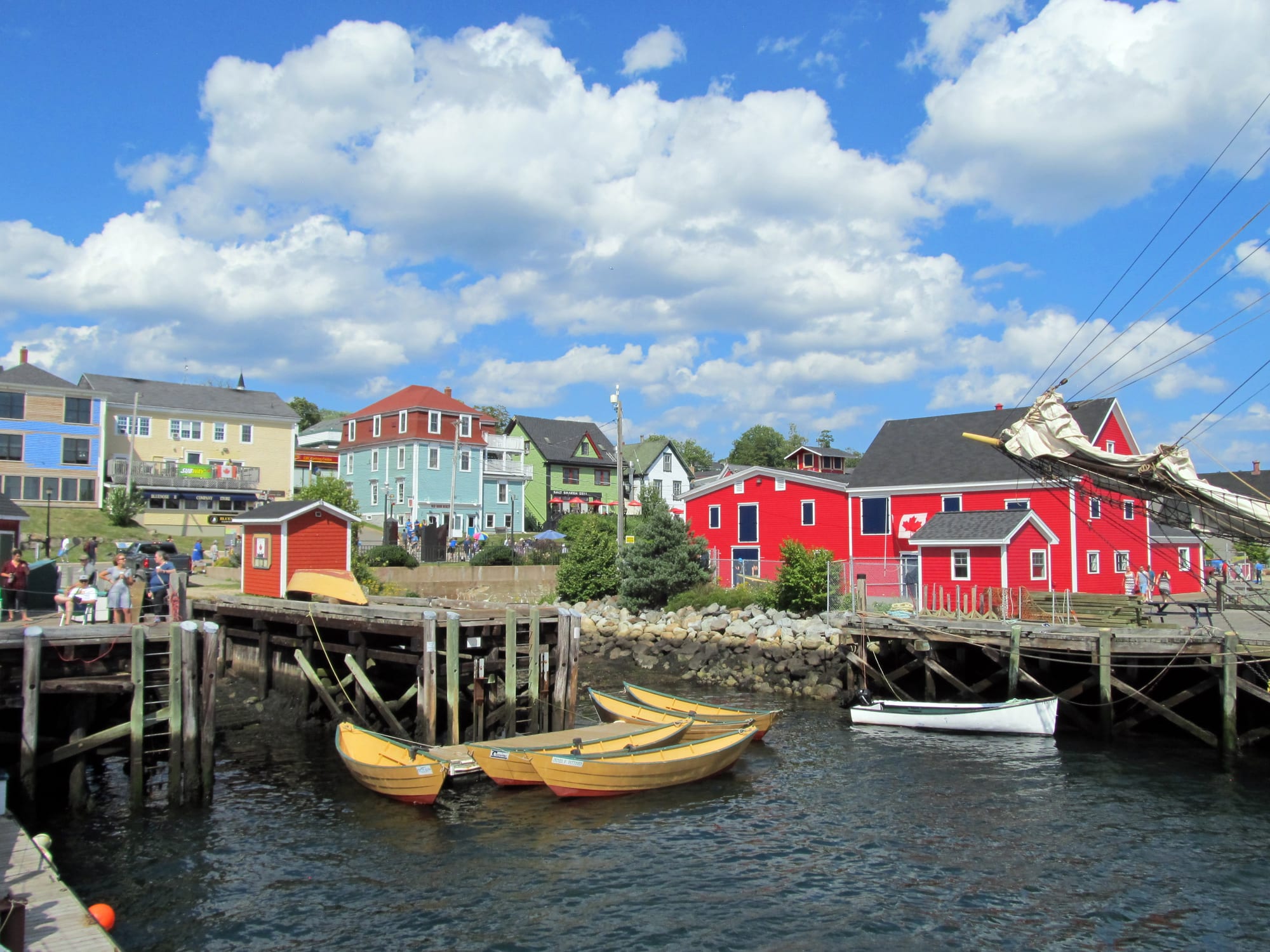
Yellow wooden dories moored at old timber wharves below bright red, blue and green wooden buildings on a sunny day

The Maritimes, Canada

Lunenburg

The painted buildings of Lunenburg's waterfront. (daryl_mitchell / Wikimedia Commons · CC BY-SA 2.0)

A small port town on Nova Scotia's South Shore, founded by the British in 1753 for Foreign Protestant settlers and laid out on a grid that survives almost unchanged. The offshore fishery and its shipyards, which built the schooner Bluenose, made it prosperous; its painted wooden old town has been a UNESCO World Heritage Site since 1995.

Neighbourhoods

  • The Old Town
    • First-time visitors
    • Historic district
    • Architecture

    The original 1753 grid of steep streets climbing from the harbour, lined with brightly painted wooden houses, churches and shops, many from the prosperous late 1800s. It is the core of the UNESCO World Heritage Site and a National Historic Site of Canada.

    Open in Maps
  • The waterfront
    • Museums
    • Harbour views
    • Best for food

    The working harbour front below the Old Town, with the red buildings and wharves of the Fisheries Museum of the Atlantic, the former Smith & Rhuland shipyard site, now a marina, inshore fishing wharves and restaurants facing the water.

    Open in Maps
  • The New Town
    • Quiet and residential

    The streets that grew beyond the original boundaries in the 1800s as shipping, fishing, farming and shipbuilding brought prosperity, including the hilltop Lunenburg Academy.

    Open in Maps

Things to do

Old Town landmarks

  • St. John's Anglican Churchlandmark

    The town's first church, established in 1753 and the second oldest continuous Protestant church in Canada, restored and rededicated in 2005 after a fire in 2001.

    Open in Maps
  • Lunenburg Academylandmark

    A large Second Empire school building of 1895 on the hill above the town, a National Historic Site that served as a school until 2012.

    Open in Maps

The harbour and the sea

  • Fisheries Museum of the Atlanticmuseum

    A seasonal museum of Atlantic Canada's fishing heritage in red waterfront buildings, with an aquarium of local species, a working boat-building shop, vessels at the wharf and retired fishermen among its interpreters.

    Open in Maps
  • Bluenose IIattraction

    The 1963 replica of the champion racing and fishing schooner Bluenose, built in Lunenburg like the original and sailing as Nova Scotia's ambassador, often berthed at the town's waterfront in season.

    Open in Maps

Short trips from the town

  • Blue Rocksattraction

    A fishing village just east of Lunenburg, popular with artists and photographers since the 1940s and known as one of the best kayaking spots on the South Shore.

    Open in Maps
  • The Ovens Natural Parkpark

    A privately owned reserve of coastal forest at the meeting point of Lunenburg and Rose Bay.

    Open in Maps
  • Mahone Bayattraction

    A neighbouring town settled by the same Foreign Protestants, with a view across the harbour to three prominent churches — St James' Anglican, St John's Evangelical Lutheran and Trinity United.

    Open in Maps

Eat and drink

Long-standing places and food districts in Lunenburg. Hours, ratings and directions come from your maps app, always current.

Lunenburg classics

  • Waterfront seafood restaurantsneighborhood

    Lobster, scallops and other local seafood served along the harbour front and the Old Town streets above it.

    Open in Maps
  • Old Town cafésneighborhood

    Small cafés and bakeries in the painted buildings of the Old Town grid.

    Open in Maps

Experience Lunenburg

History

The Mi'kmaq lived across the land from present-day Lunenburg to Mahone Bay, with as many as 300 people at the site in summer; an early Mi'kmaq name for it meant "clam-land". Acadians settled among them, and the place they called Mirliguèche, a French spelling of a Mi'kmaq name, was home to Acadian and Mi'kmaw families living together when Governor Edward Cornwallis visited in 1749.

In 1753 the British moved more than 1,400 Foreign Protestants — mostly artisans and farmers recruited in Europe, many of them frustrated at not receiving promised land in Halifax — to found a new town, named after the Duke of Brunswick-Lüneburg, who had become King George II. The settlers spent their first summer building shelters and had to be supplied from Halifax. Mi'kmaq and Maliseet raiders devastated the town in 1756, and hostilities ended around 1760.

The town then turned from coastal trade and mixed fishing to the offshore fishery. In the 1800s shipping, fishing, farming and shipbuilding brought prosperity, and much of the architecture dates from that time. The Smith & Rhuland yard built the schooner Bluenose in 1921 and its replica Bluenose II in 1963; after the Second World War the yards switched from schooners to trawlers. UNESCO listed the Old Town in 1995 as the best example of planned British colonial settlement in North America, and in 2005 the province bought 17 waterfront buildings to preserve them.

Culture & Customs

Lunenburg's identity is tied to the sea. Bluenose, the racing and fishing schooner built here in 1921, became a provincial icon and a national symbol in the 1930s, and still appears on the Canadian dime; its replica, Bluenose II, sails as Nova Scotia's ambassador and does not officially race, in honour of the original's record. The Fisheries Museum of the Atlantic, with retired fishermen among its interpreters, keeps the story of the offshore fishery alive.

The first settlers were German, Swiss and Montbéliardais Protestants, and the town's churches reflect that start; St. John's Anglican, founded in 1753, is the second oldest continuous Protestant church in Canada. The Mi'kmaq remain the original people of the land. The town has a strong arts and music life for its size: the musician Bill Plaskett founded the Lunenburg Folk Harbour Festival, and the nearby fishing village of Blue Rocks has drawn painters and photographers since the 1940s.

UNESCO's listing came with a warning that the town needs protection because the future of the Atlantic fishery that built it is uncertain. In 2025 a tree from Lunenburg was sent to Boston as the city's Christmas tree.

Daily Life

Lunenburg had about 2,400 people at the 2021 census, up almost 6 per cent from 2016, living on just 4 square kilometres around the harbour. It is a separately incorporated town, like nearby Bridgewater and Mahone Bay, within Lunenburg County, which has no government of its own. Most residents are English-speaking.

The economy still has industrial weight for so small a place. High Liner Foods runs Canada's largest secondary fish-processing plant in the town, ABCO Industries builds welded aluminium vessels, the Lunenburg Shipyard is still working, and there are wharves for the inshore fishery. Sales and services, much of it tied to tourism, are the most common occupations. The Lunenburg Academy, which closed as a school in 2012, now houses a library and a music school.

The year has two rhythms. In summer the waterfront fills with visitors and boat tours, and the Old Town's inns and restaurants are busy; from autumn to spring many businesses close and the town returns to its fishing, boatbuilding and local routines.

Food

Seafood comes first in a town built on the fishery. Lobster is eaten boiled with melted butter or in rolls, scallops and other local catches appear on the menus of the waterfront restaurants, and the town hosts Canada's largest secondary fish-processing plant. Nova Scotian home cooking adds hodge podge, a summer stew of new vegetables in cream, and blueberry grunt, wild berries stewed under steamed dumplings. Digby scallops from the Fundy shore and Malpeque oysters from Prince Edward Island are well known across Canada. Solomon Gundy, pickled herring, is another Nova Scotian dish, and the Fisheries Museum of the Atlantic on the waterfront has its own restaurant.

The town's restaurants and cafés are mostly in the Old Town's painted buildings and along the harbour front, and many open only from late spring to autumn. Like the rest of the province, Lunenburg drinks Nova Scotian beer, from Alexander Keith's to small craft breweries, and wines from the Annapolis Valley.

Planning tools

Budget

Lunenburg is a small tourist town, and inns, bed and breakfasts and restaurants charge summer prices from June to September. Seafood in the Maritimes is not much cheaper than elsewhere, mussels apart. A hire car is the main extra cost, since public transport on the South Shore is limited.

Daily Budget Midrange
USD 160–280 (inn or bed and breakfast, seafood dinners, museum tickets, hire car)
Daily Budget Shoestring
USD 80–120 (budget room or campground nearby, takeaway seafood and groceries)

Book summer rooms ahead; many rural places along the South Shore close from October to May.

Best Time to Visit

June to early October, when the Fisheries Museum is open, the harbour is busy and boat trips run. July and August are warmest and busiest; September is quieter. Winter is cold and stormy, and much of the tourist trade closes.

Suggested Number of Days

The town itself can be seen in a day or two. Three or four days allow time for the neighbouring South Shore villages and coast, which need a car or a boat.

First Visit
1–2 days
With Surroundings
3–4 days

Transportation

The Old Town is small enough to walk everywhere, though the streets climb steeply from the harbour. A car is the usual way to reach the nearby villages and coast; local buses are scarce, and intercity coaches on the South Shore are infrequent.

Parking near the waterfront fills in summer; leaving the car at the edge of the Old Town and walking down is easier.

Airport & Station Connections

Lunenburg lies about 100 km south-west of downtown Halifax, normally reached by car along the South Shore highways. Halifax Stanfield International Airport is the nearest major airport, and intercity coach services along the South Shore have stopped at Chester and Bridgewater on the way.

Walkability

Very walkable: the Old Town is a compact grid on a slope above the harbour, and the whole town covers only about 4 square kilometres. The hills are steep, and pavements can be icy in winter.

Safety

Canada is a safe country with low levels of violent crime. Lunenburg is a quiet small town; the risks are those of the coast — wet wharves, cold water, fog and winter storms.

Take care on wharves and slipways, wear a life jacket on small boats, and watch the forecast before going out on the water. Check current official travel advice before travelling.

Climate

The sea moderates the climate: summers are milder and winters less severe than inland Canada, but fog is common on the Atlantic shore and the remains of hurricanes sometimes arrive in late summer and autumn.

Summer
mild to warm — around 20–26°C across the Maritimes, cooler and foggier on the coast
Winter
cold and changeable — around -10 to 0°C across the Maritimes, with snow, freezing rain and storms

Local Customs

Tipping of 15–20 per cent is expected in restaurants, and sales tax is added at the till. The town is proud of its fishing and shipbuilding past, and memorials to fishermen lost at sea are treated with respect. Many houses in the Old Town are private homes: photograph them from the street and do not walk into gardens.

Alcohol is sold in provincial liquor stores, and drinking on the street or wharves is not allowed.

Common Payment Methods

The currency is the Canadian dollar. Cards and contactless payment are accepted almost everywhere, and the town has ATMs. Cash totals are rounded to the nearest five cents.