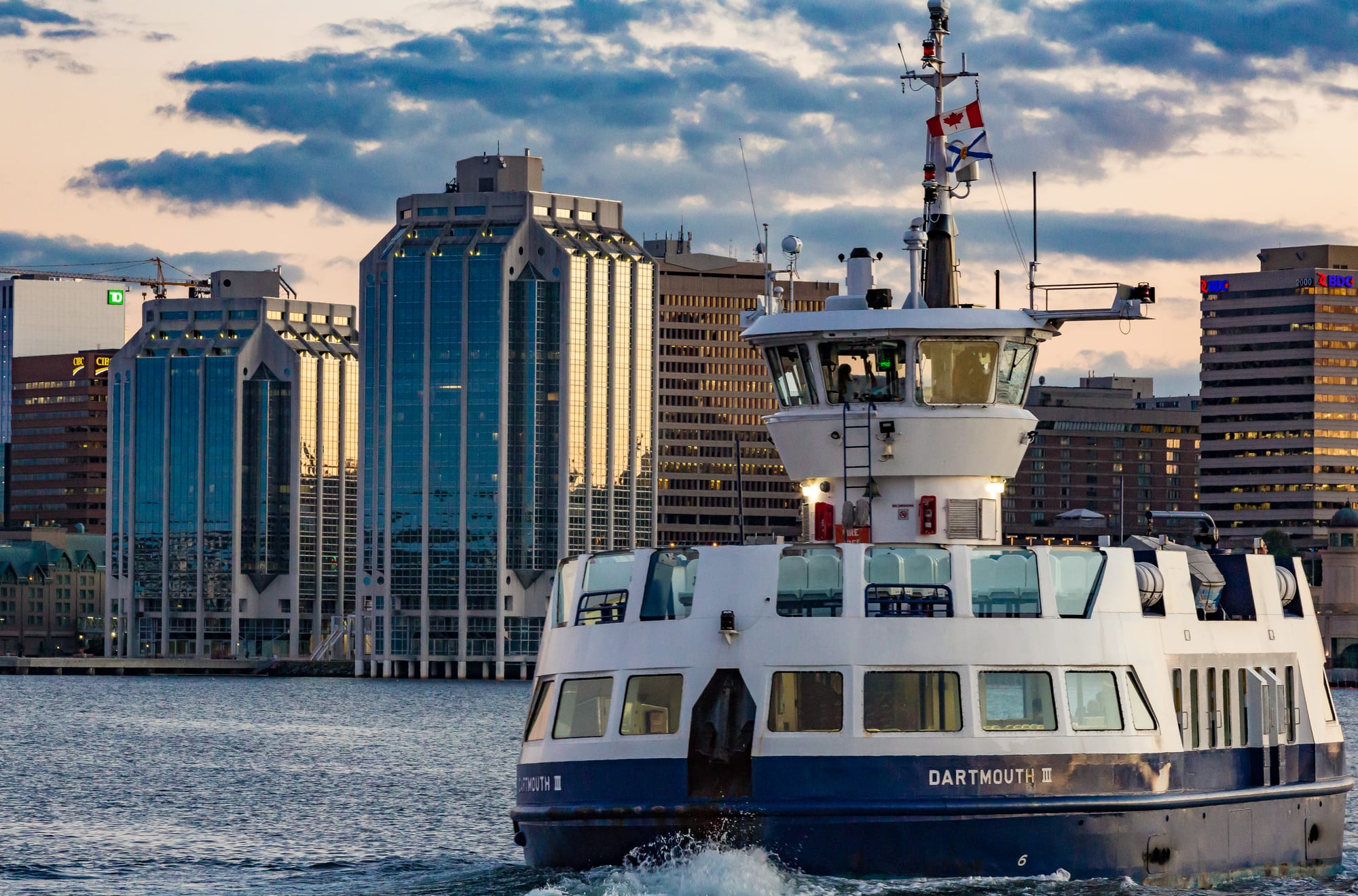
A blue and white harbour ferry crossing in front of downtown Halifax's glass office towers at dusk

The Maritimes, Canada

Halifax

The Halifax–Dartmouth ferry Dartmouth III crossing Halifax Harbour in front of the downtown towers. (Tony Webster from San Francisco, California / Wikimedia Commons · CC BY-SA 2.0)

Nova Scotia's capital and the largest city in Atlantic Canada, founded by the British in 1749 beside one of the largest and deepest ice-free natural harbours in the world. A naval base, a port and a university town at once, it pairs a hilltop citadel and a long waterfront boardwalk with the memory of the 1917 explosion, Pier 21 and the Titanic.

Neighbourhoods

  • Downtown and the waterfront
    • First-time visitors
    • Museums
    • Nightlife

    The business district on the harbour side of the peninsula, climbing from the boardwalk up to Citadel Hill. Province House, the Grand Parade, the Maritime Museum, the ferry terminal and most of the city's hotels, pubs and restaurants are within a few blocks of each other.

    Open in Maps
  • Spring Garden Road
    • Shopping
    • Cafés and pubs
    • Close to the sights

    A busy commercial street running west from Barrington Street past the Old Burying Ground, the Central Library and the Public Gardens. Pubs, coffee shops and boutiques keep it busy by day and at night, and Dalhousie's Sexton Campus is here.

    Open in Maps
  • North End
    • Local life
    • Best for food
    • History

    The northern part of the peninsula, much of it destroyed in 1917 by the Halifax Explosion and rebuilt in part as the Hydrostone, a planned district of row houses on tree-lined boulevards. Gottingen Street was for much of the 20th century the centre of Black business in Nova Scotia.

    Open in Maps
  • South End
    • Quiet and residential
    • Parks
    • Students

    A leafy residential area south of downtown, home to Dalhousie and Saint Mary's universities, and ending at the forested Point Pleasant Park at the tip of the peninsula.

    Open in Maps
  • Quinpool District
    • Local life
    • Best for food

    A commercial strip on Quinpool Road west of the Halifax Common, with the former Oxford Theatre and a mix of local businesses, including Chinese and Greek restaurants. It marks the line between the working-class North End and the wealthier South End.

    Open in Maps
  • Dartmouth
    • Quiet and residential
    • Harbour views
    • Close to the ferry

    The former city across the harbour, with about 72,000 residents in 2021, reached by the oldest continuously running saltwater ferry in North America. A waterfront trail, the Dartmouth Commons and the lakes around Sullivan's Pond give it an easier pace than downtown Halifax.

    Open in Maps

Things to do

Famous landmarks

  • Halifax Citadellandmark

    The concrete star fort on the hill above downtown, the fourth fortification on the site since 1749, run by Parks Canada and restored to its Victorian appearance.

    Open in Maps
  • Halifax Town Clocklandmark

    A clock tower on the slope of Citadel Hill, running since October 1803 and stopped only once, by the Halifax Explosion.

    Open in Maps
  • Province Houselandmark

    The Palladian building where the Nova Scotia House of Assembly has met every year since 1819, Canada's oldest house of government.

    Open in Maps
  • Old Burying Groundlandmark

    The historic cemetery of St. Paul's Church at the corner of Barrington Street and Spring Garden Road.

    Open in Maps
  • Halifax Central Librarylandmark

    The glass library on Spring Garden Road, opened in 2014, with a cantilevered top floor and an atrium crossed by staircases; it won a Governor General's Medal in Architecture.

    Open in Maps

Museums

  • Canadian Museum of Immigration at Pier 21museum

    Canada's national museum of immigration, in the ocean liner terminal through which immigrants arrived from 1928 to 1971 — often compared to Ellis Island.

    Open in Maps
  • Maritime Museum of the Atlanticmuseum

    The oldest and largest maritime museum in Canada, with a large Titanic exhibit, galleries on the Halifax Explosion, some 70 small craft and the steamship CSS Acadia at its wharf.

    Open in Maps
  • HMCS Sackvillemuseum

    The last surviving Flower-class corvette, a Second World War escort ship that serves in summer as a museum ship beside the Maritime Museum, in the care of the Canadian Naval Memorial Trust.

    Open in Maps
  • Art Gallery of Nova Scotiamuseum

    The provincial art museum downtown, founded in 1908, with a collection of more than 18,000 works by Nova Scotian, Canadian and international artists.

    Open in Maps

Parks and the waterfront

  • Halifax Waterfront Boardwalktrail

    A timber boardwalk of about 3 km along the harbour from the Seaport and Pier 21 to Casino Nova Scotia, passing the Historic Properties, the ferry terminal and the museum ships.

    Open in Maps
  • Halifax Public Gardenspark

    Victorian public gardens formally established in 1867 near Spring Garden Road, a National Historic Site of Canada.

    Open in Maps
  • Point Pleasant Parkpark

    A large forested park at the southern tip of the peninsula, with old artillery batteries, the Prince of Wales Tower of 1796 and Shakespeare by the Sea performances in summer.

    Open in Maps
  • Halifax–Dartmouth ferrytransit hub

    The public ferry across the harbour, running since 1752 and the oldest continuously running saltwater ferry service in North America, with skyline views on the way.

    Open in Maps
  • McNabs Islandpark

    The largest island in Halifax Harbour, once central to the harbour's defences and now a provincial park.

    Open in Maps

Memory and heritage

  • Fairview Lawn Cemeterylandmark

    A city cemetery best known as the resting place of more than a hundred victims of the sinking of the Titanic.

    Open in Maps
  • Africvillelandmark

    The site on the Bedford Basin of the African Nova Scotian community razed by the city in the 1960s, now a commemorative site with a museum.

    Open in Maps
  • Hydrostoneneighborhood

    A National Historic Site of row houses on grassy boulevards, built to rehouse working-class families displaced by the 1917 explosion.

    Open in Maps

Sport and nights out

  • Scotiabank Centreattraction

    The largest multi-purpose arena in Atlantic Canada, at the foot of Citadel Hill, home ice of the Halifax Mooseheads junior hockey team.

    Open in Maps

Short trips from the city

  • Peggys Coveattraction

    A small rural community on the eastern shore of St. Margarets Bay, whose first lighthouse was built in 1868; the lighthouse is one of the busiest tourist attractions in Nova Scotia.

    Open in Maps

Seasonal events

  • Royal Nova Scotia International TattooJuly

    A show of military bands and display teams, held every year since 1979 at the Scotiabank Centre.

  • Halifax Busker Festivallate July to early August, over the Natal Day long weekend

    Six days of street performers from around the world on the waterfront.

Eat and drink

Long-standing places and food districts in Halifax. Hours, ratings and directions come from your maps app, always current.

Food districts and markets

  • Halifax Seaport Farmers' Marketmarket

    The oldest continuously operating farmers' market in North America, founded in 1750 and now in a building at the Seaport near Pier 21, selling local produce, bread, meat and prepared foods.

    Open in Maps
  • Spring Garden Roadneighborhood

    Pubs, coffee shops and many of the city's cheap eats, busy from morning to late at night.

    Open in Maps
  • Quinpool Roadneighborhood

    A neighbourhood strip known for its Chinese and Greek restaurants and local businesses.

    Open in Maps

Halifax classics

  • Donair shops and pizzeriasrestaurant

    The places that serve the Halifax donair — spiced beef in pita with sweet garlic sauce — along with garlic fingers, much of it eaten after the bars close.

    Open in Maps
  • Seafood on the waterfrontneighborhood

    Restaurants along the boardwalk and downtown serve mussels, scallops, seafood chowder, fish and chips and lobster.

    Open in Maps

Experience Halifax

History

The Mi'kmaq called the area Chebucto, and knew the hillside where the town would stand by a name recorded as meaning "place of many pines". In 1749 King George II ordered Edward Cornwallis to establish a new capital, and on 21 June that year Cornwallis landed with 1,176 settlers on what is now the Halifax Peninsula, naming the town after the Earl of Halifax. Forts went up on Citadel Hill and around the harbour to protect the Protestant settlement from Mi'kmaw, Acadian and French attack, and through the 18th and 19th centuries Halifax grew as a centre of government, military power, trade and shipbuilding, with the Royal Navy's dockyard at its heart. The Citadel that stands today, the fourth on the hill, was never attacked.

On 6 December 1917 the French munitions ship Mont-Blanc collided with the Imo in the harbour, caught fire and exploded. The blast, the largest human-made explosion of its time, devastated the Richmond district of the North End and killed at least 1,782 people, and a tsunami it raised wiped out a Mi'kmaw community at Tufts Cove. Earlier the city had become linked with the Titanic: more than a hundred of its victims are buried in Fairview Lawn Cemetery. From 1928 to 1971 Pier 21 received about 1.5 million immigrants arriving by ocean liner.

The 20th century also brought the destruction of Africville, a Black community founded on the Bedford Basin in 1848 by refugees of the War of 1812; neglected by the city for decades, it was condemned and its residents relocated in the 1960s, and it has become a symbol of the struggle against racism. In 1996 Halifax, Dartmouth, Bedford and Halifax County were merged into today's regional municipality.

Culture & Customs

Halifax keeps its maritime and military traditions close. The Royal Canadian Navy and the Coast Guard have major bases on both sides of the harbour, HMCS Sackville is kept as a museum ship by the Canadian Naval Memorial Trust, and the Royal Nova Scotia International Tattoo, a show of military bands and display teams held every year since 1979, fills the Scotiabank Centre each summer. Several universities — Dalhousie, Saint Mary's, King's and Mount Saint Vincent among them — give the city a large student population that shapes its bars, music and cultural life. In the 1990s the city's music scene sent bands such as Sloan to international labels, and the Halifax Pop Explosion festival was founded in 1993.

The arts are anchored by the Art Gallery of Nova Scotia, Symphony Nova Scotia and the Neptune Theatre, while Shakespeare by the Sea plays outdoors in Point Pleasant Park in summer and buskers from around the world take over the waterfront for the Busker Festival. Sport means junior hockey above all: the Halifax Mooseheads, the first Atlantic Canadian team in the Quebec Maritimes Junior Hockey League, won the Memorial Cup in 2013, and the Halifax Tides began play in the new professional women's soccer league in 2025.

African Nova Scotians are one of the city's long-established communities, and the history of Africville and of Gottingen Street, once the centre of Black enterprise in the province, is part of Halifax's identity. The Mi'kmaq are the original people of the land, and a growing immigrant population from India, China, the Philippines, Syria and Nigeria, among others, is changing the city's character.

Daily Life

The Halifax Regional Municipality had about 440,000 people at the 2021 census, and the wider metropolitan area was estimated at about 530,000 in 2024 — the largest population in Atlantic Canada. The municipality is huge, at about 5,500 square kilometres, but most people live in the urban area around the harbour: Halifax on the peninsula, Dartmouth across the water and Bedford at the head of the Bedford Basin, with suburbs spreading beyond them and fishing villages and farms in the rural parts.

The economy is led by the Department of National Defence, the Port of Halifax — one of Canada's top four container ports — Irving's shipyard, the provincial health authority, government, banks and the universities. Cruise ships bring hundreds of thousands of passengers a year, and in 2024 the port welcomed 201 calls. The city grew by more than 9 per cent between 2016 and 2021, and immigrants made up about one in eight residents at the last census.

Daily life is relaxed by big-city standards, with short commutes for many and students setting the pace in the South End. The ferry carries commuters across the harbour, Spring Garden Road and the downtown pubs stay busy into the night, and weekends in summer are spent in the parks, on the water or at the beaches outside the city.

Food

Seafood is the foundation. Mussels are cheap and good, Nova Scotia scallops are prized, and seafood chowder, fish and chips and lobster appear on menus across the city; in the warmer months churches and community groups hold lobster dinners. The Halifax Seaport Farmers' Market, which traces its history to 1750 and is the oldest continuously operating farmers' market in North America, sells local produce, meat, bread and prepared food near Pier 21.

The city's own invention is the donair, a variation of the döner kebab created in Halifax in the early 1970s: spiced ground beef sliced from a rotating cone, wrapped in a soft pita with onion and tomato and a sweet sauce of condensed milk, sugar, vinegar and garlic. Halifax claims it as its official food, and it turns up as donair pizza, donair egg rolls and donair poutine. Garlic fingers, pizza dough topped with garlic butter, parsley and cheese, are the usual companion, often dipped in donair sauce.

Late-night queues at pizzerias after the bars close on Fridays and Saturdays are a local ritual. Alexander Keith's, founded in Halifax in 1820, whose original brewery offers tours with guides in period dress, is the best-known local beer, and Quinpool Road adds Chinese and Greek restaurants to the mix.

Planning tools

Budget

Halifax is cheaper than Toronto or Vancouver but hotels are pricey in summer, when cruise ships and festivals fill the city. Seafood is not much cheaper than elsewhere, except mussels, which are cheap, and lobster in a restaurant is expensive. The centre can be seen on foot, by bus and by ferry; a hire car is only needed for the coast beyond the city.

Daily Budget Midrange
USD 170–290 (downtown hotel, seafood dinners, museum tickets, a hire car for a day trip)
Daily Budget Shoestring
USD 80–120 (hostel bed, market lunches, donairs and fish and chips, buses and the ferry)

Many of the best things — the boardwalk, the Public Gardens, Point Pleasant Park, the views from Citadel Hill and the harbour ferry — cost little or nothing.

Best Time to Visit

June to early October. July and August are warmest and busiest, with the Tattoo, the Busker Festival, patios and the most harbour tours; September and early October are calmer and still mild. Winters are cold, wet and stormy, but hockey, theatre and the city's bars and restaurants carry on.

Suggested Number of Days

Two or three days cover the city itself. Four or five allow time for the fishing villages of the nearby coast as well, which are easiest by hire car or tour.

First Visit
2–3 days
With Surroundings
4–5 days

Transportation

Halifax Transit runs buses across the municipality, regional express buses and the ferry from downtown to two terminals in Dartmouth. Downtown, the waterfront, Spring Garden Road and the North End are close enough to walk between. Taxis and ride-hailing fill the gaps, and a hire car is the usual way to reach the coast outside the city.

The harbour ferry doubles as a cheap sightseeing trip, with views of the downtown skyline from the water.

Airport & Station Connections

Halifax Stanfield International Airport, the region's main airport and Canada's eighth busiest, is at Goffs in the rural part of the municipality, north of the city; the MetroX 320 express bus links it to downtown, as do taxis and hire cars. VIA Rail's Ocean runs between Halifax and Montreal a few times a week, and cruise ships call at the Seaport.

Walkability

The peninsula is compact and very walkable, though downtown streets climb steeply from the harbour to Citadel Hill. The boardwalk runs for about 3 km along the water, and Spring Garden Road, the Public Gardens and the North End are all within walking distance of the centre. Pavements can be icy in winter.

Safety

Canada is a safe country with low levels of violent crime. Halifax is generally calm, and the busy downtown and waterfront are well used day and night. The natural dangers are those of the coast: storms, fog and, outside the city, large waves on the rocks at Peggys Cove.

Stay off the dark, wet rocks at Peggys Cove, take normal care in the bar district late at night, and watch the forecast in hurricane season. Check current official travel advice before travelling.

Climate

A maritime climate moderated by the Atlantic. Summers are mild and often foggy on the coast, winters are cold and changeable with snow, freezing rain and strong storms, and the remains of hurricanes sometimes arrive in late summer and autumn.

Summer
mild to warm, August is the warmest month; days rarely pass 28°C and only about three a year go above 30°C
Winter
cold and changeable — January is the coldest month, with an average high just below 0°C, plus snow, freezing rain and coastal storms

Local Customs

Tipping of 15–20 per cent is expected in restaurants and taxis, and sales tax is added at the till rather than shown on the shelf price. People are informal and friendly, and the city is proud of its naval and maritime traditions; memorials to the 1917 explosion and to those lost at sea are treated with respect. Locals call themselves Haligonians.

Alcohol for private consumption is sold through the provincially owned liquor stores of the NSLC.

Common Payment Methods

The currency is the Canadian dollar. Cards and contactless payment are accepted almost everywhere, including at most market stalls and on buses with a fare card, and ATMs are easy to find. Cash totals are rounded to the nearest five cents.