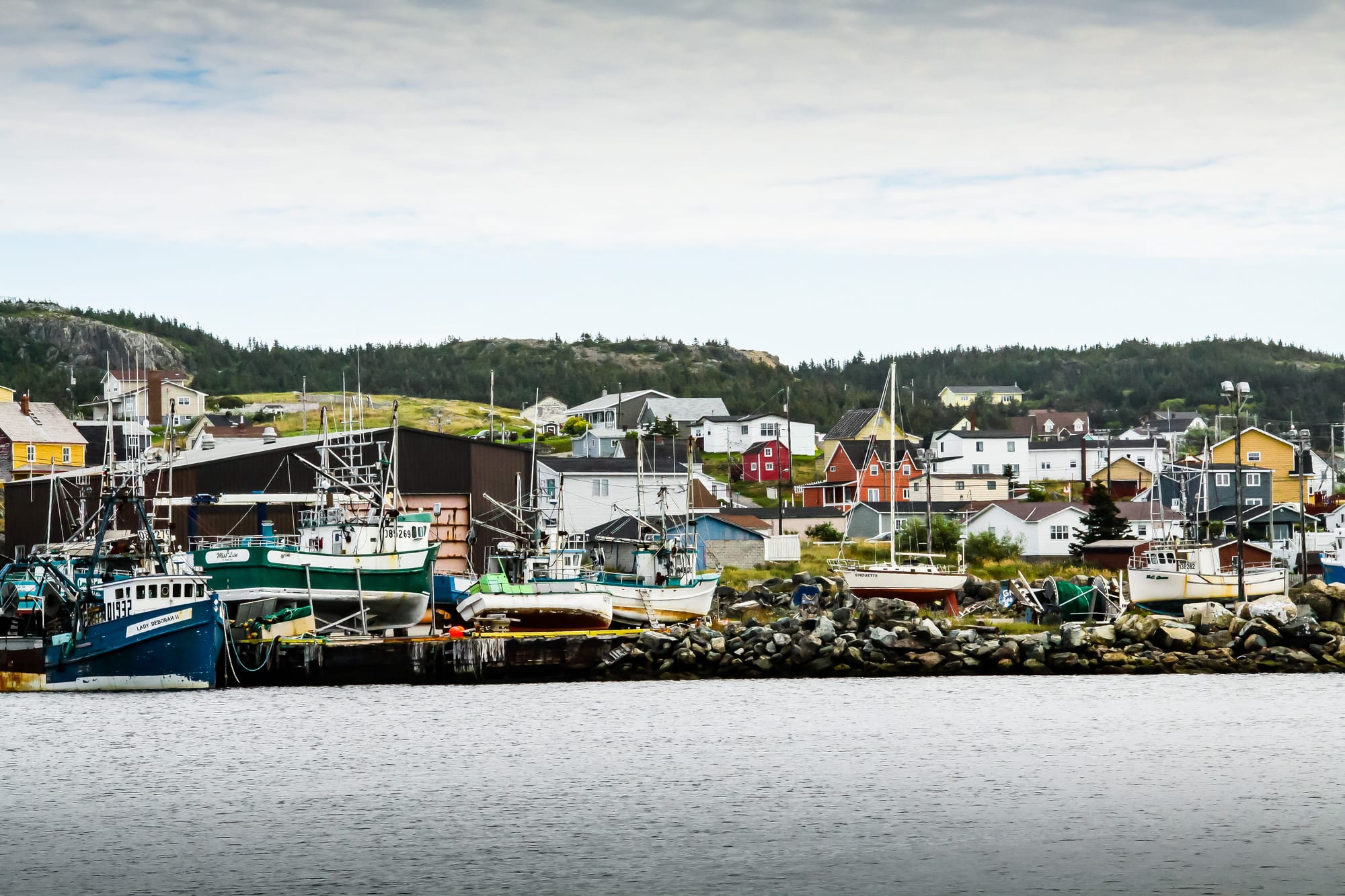
Fishing boats hauled out on a rocky waterfront in Bonavista, with red, yellow and white houses on the green hillside behind

Newfoundland & Labrador, Canada

Bonavista

Fishing boats and houses around the harbour in Bonavista, Newfoundland. (Sallyledrew / Wikimedia Commons · CC BY-SA 4.0)

A town near the tip of the Bonavista Peninsula, about 300 km by road from St. John's, linked by tradition to John Cabot's landfall of 1497. Built on an open plain rather than in a steep cove, it was for centuries one of Newfoundland's most important fishing towns; today its painted houses, merchant premises and lighthouse draw tens of thousands of summer visitors.

Neighbourhoods

  • The Harbour and Church Street
    • First-time visitors
    • Historic district
    • Best for food

    The central part of town, around the inner harbour and Church Street, where the Ryan Premises, the Matthew replica, the old courthouse, churches, restaurants and the boat-tour offices are within a short walk. The ground is gentle and easy to explore on foot or by bicycle.

    Open in Maps
  • Mockbeggar and the road to the cape
    • Quiet and residential
    • Coastal walks

    Old sections of town with names such as Mockbeggar, Canaille and Red Point spread north towards Cape Bonavista, its lighthouse and the clifftop trails, with open views of the sea and, in season, icebergs.

    Open in Maps

Things to do

Historic Bonavista

  • Ryan Premisesmuseum

    The restored buildings of the fishing and retail company James Ryan Ltd. — merchant's house, shops, fish store and salt store — a National Historic Site preserved as an example of a large outport merchant operation, now holding museum and art displays.

    Open in Maps
  • Matthew Legacymuseum

    A building on the inner harbour holding a museum about Cabot's era and a replica of his ship, the Matthew, built in 1997 for the 500th anniversary of the voyage.

    Open in Maps
  • Bonavista Orange Halllandmark

    A large wooden hall of 1907 with a domed tower, once a landmark for the fishing fleet, where the Fishermen's Protective Union met in 1912 to adopt the Bonavista Platform.

    Open in Maps
  • Garrick Theatreattraction

    The town's historic theatre, opened in 1945.

    Open in Maps

The cape and the coast

  • Cape Bonavista Lightmuseum

    A lighthouse in use from 1843 to 1962, now a provincial museum showing life in a lighthouse in the 1870s, on a headland with trails, views and, in season, a puffin colony.

    Open in Maps
  • Dungeon Provincial Parkpark

    A day-use park on the coast near the cape, part of the Discovery UNESCO Global Geopark.

    Open in Maps
  • Whale and iceberg boat toursattraction

    Several companies run trips from the harbour to look for whales, seabirds and icebergs, which are most numerous offshore in May and June.

    Open in Maps

Short trips from the town

  • Elliston puffin viewing siteviewpoint

    A clifftop site beyond the fishing town of Elliston offering some of the closest shore-based views of a puffin nesting colony, popular from May to September.

    Open in Maps
  • Port Unionattraction

    The town William Coaker founded in 1916 as the base of the Fishermen's Protective Union, said to be the only union-built town in North America and now a National Historic Site.

    Open in Maps

Seasonal events

  • Church Street Festivalearly August

    A summer street festival in the centre of town, featuring Bonavista's mummers' parade of disguised revellers.

Eat and drink

Long-standing places and food districts in Bonavista. Hours, ratings and directions come from your maps app, always current.

Bonavista classics

  • Restaurants on Church Streetneighborhood

    Most of the town's restaurants, cafés, bakeries and pubs are in the centre; many open only in the summer season, serving seafood and Newfoundland dishes such as fried cod tongues.

    Open in Maps
  • The inner harbourneighborhood

    Places to eat near the waterfront look over the fishing boats of the inner harbour.

    Open in Maps

Experience Bonavista

History

According to tradition, John Cabot, the Italian explorer sailing for Henry VII of England in the Matthew from Bristol, made his landfall here in 1497, and on first sighting land reputedly cried "O buon vista" — "Oh, happy sight!" — giving its name to the town and to Cape Bonavista. Cabot's men went ashore, raised banners and found signs that the land was inhabited: a trail inland, the remains of a fire and a carved, painted stick.

Through the 16th century Spanish, Portuguese, Dutch, French and English fishermen worked off Cape Bonavista, and the French and English came to dominate. The harbour was poor and needed breakwaters, but nearness to rich fishing and sealing grounds made Bonavista one of Newfoundland's most important towns. The French tried and failed to burn it in 1704, and from 1713 it marked the eastern end of the French Shore. The first school in Newfoundland was built here in 1722. In the busiest years, 1891 to 1901, about 20,000 people lived on the peninsula, with Bonavista at its centre, and merchant firms such as James Ryan Ltd. ran the trade in salt fish.

The early 20th century made the town a centre of the Fishermen's Protective Union; in 1912 its convention in the Orange Hall adopted William Coaker's Bonavista Platform, calling for sweeping reform of the fishery. A cold-storage fish plant took over as salt-fish markets declined, and the town was incorporated in 1964. Over the 20th century the economy turned towards tourism.

Culture & Customs

Bonavista's identity rests on the sea and on history. The Cabot landfall tradition is central to how the town presents itself: a replica of the Matthew was built for the 500th anniversary in 1997, when Queen Elizabeth II visited, and a silo on the town's highest point was painted with a blue mural for the occasion.

The town was long a Protestant merchant and fishing centre. Its Orange Lodge grew into the largest in British North America, with more than 470 members by the early 1900s, acting as a mutual-aid society that supported the families of fishermen lost at sea. Its domed hall of 1907 is believed to be the largest wooden gathering hall ever built in Canada.

Old customs are kept alive in summer. The Church Street Festival in early August includes a mummers' parade, reviving the Newfoundland Christmas tradition of disguised visitors, and the Garrick Theatre dates from 1945. Historic churches — Memorial United, completed in 1923, and St Joseph's Catholic, completed in 1842 — still hold services, and the old courthouse keeps its whipping post and stocks. Nearby Elliston is known as the root cellar capital of the world.

Daily Life

About 3,200 people lived in Bonavista at the 2021 census, a fall of 7.5 per cent since 2016. The town covers more than 31 square kilometres, unusually large for an outport, because it spread across an open plain rather than being squeezed into a cove.

The closure of the cod fishery in 1992 hit hard, and the population shrank sharply. A snow crab fishery provides work, but tourism now drives the economy: in 2023 up to 80,000 people were reported to visit each summer. More than 120 houses had been turned into holiday rentals by 2023, so a town that twenty years earlier had many empty houses now has a housing shortage, and a freeze on new rental conversions was declared.

Life follows the seasons. Summer brings visitors, boat tours, festivals and icebergs off the cape; winter, from December to April, brings heavy snow, wind and a much quieter town, with most restaurants closed. A plan discussed in 2010 to merge with neighbouring Elliston did not go ahead, and the two remain separate towns.

Food

Bonavista eats like a Newfoundland fishing town. Cod is the staple — as fish and chips, in chowder and as fried cod tongues — and snow crab from the local fishery is served in season. Fresh local crab, lobster and mussels are also sold in town.

Traditional dishes from the salt-fish economy remain home cooking. Fish and brewis combines salt cod with hard bread softened in water, topped with scrunchions, small pieces of fried pork fat. Toutons, fried bread dough, are eaten with molasses, and Jiggs dinner — salt beef boiled with cabbage, potatoes, carrot and turnip — is a traditional Sunday meal. Nearby Elliston is known for its root cellars, 135 of which exist in the community.

Wild berries go into jams, pies and sauces, including bakeapples, the local name for cloudberries, and partridgeberries. Most of the town's restaurants, bakeries and pubs are on or near Church Street and the harbour, and many open only for the summer season.

Planning tools

Budget

Prices are close to the Canadian average. Bonavista has become a busy summer destination, and holiday rentals and B&Bs fill up in July and August; most restaurants open only in the tourist season. A hire car is needed to get here, and boat tours and museum tickets are the main extras, while the trails and puffin site are free.

Daily Budget Midrange
USD 160–300 (B&B or holiday rental, restaurant meals, hire car, a boat tour)
Daily Budget Shoestring
USD 80–120 (simple room or shared rental, groceries and fish and chips)

Book summer accommodation well ahead; a freeze on new holiday rentals since 2023 limits the supply.

Best Time to Visit

Late spring to late summer. Icebergs are most numerous in May and June, when dozens can be seen from shore; puffins are at Elliston from about May to September and are best seen at the cape in the evening; whale tours run through the summer. Winter lasts from December to April, and most restaurants open only in summer.

Suggested Number of Days

One or two days are enough for the town and its cape. Three or four allow time for the rest of the peninsula and its other historic outports. Fog and wind can cancel boat tours, so a spare day helps.

First Visit
1–2 days
With Surroundings
3–4 days

Transportation

A car is needed to reach Bonavista and the peninsula. Within the town the ground is gentle, traffic is light and sights are seldom more than a few kilometres apart, so walking and cycling work well. A network of roads and lanes links the harbour and Church Street with the outlying parts of town.

Slow down at dusk for moose on the peninsula's roads.

Airport & Station Connections

Bonavista is about 300 km by road from St. John's, roughly three and a half hours from the capital's international airport, and about three hours from Gander, which has regional flights. Drivers leave the Trans-Canada Highway at Port Blandford or Clarenville and follow the peninsula north.

Walkability

Good. Unlike most Newfoundland outports, Bonavista sits on an open, fairly flat plain, so the harbour, Church Street and the historic buildings are an easy walk apart, and a coastal trail of about 3.5 km leads out to the lighthouse. Wind is the main discomfort.

Safety

Canada is a safe country with low levels of violent crime. Bonavista is one of the windiest places in Canada, and the hazards are natural: strong wind and fog on exposed cliffs, cold water and rough seas at the coastal viewpoints, and moose on the roads.

Stay back from cliff edges at the cape, the Dungeon and the puffin site, carry warm and windproof layers even in summer, and slow down at dusk for moose. Check current official travel advice before travelling.

Climate

Cold and windy for its latitude, because of the cold sea around it — the climate is classed as subarctic, and the average wind speed is among the highest in Canada. Winters are relatively mild by Canadian standards but snowy.

Summer
cool — the mean June temperature stays below 10°C, and fog and wind are common
Winter
December to April, with heavy snowfall and frequent cold days; for comparison, around −8 to 0°C in St. John's

Local Customs

Bonavista has deep Protestant and fishing traditions; the Orange Lodge was once the largest in British North America. Mummering survives in the Church Street Festival parade.

Tip 15–20 per cent in restaurants; sales tax is added at the till.

Common Payment Methods

The currency is the Canadian dollar. Cards and contactless payment are widely accepted, and a little cash is useful for small purchases. Cash totals are rounded to the nearest five cents.