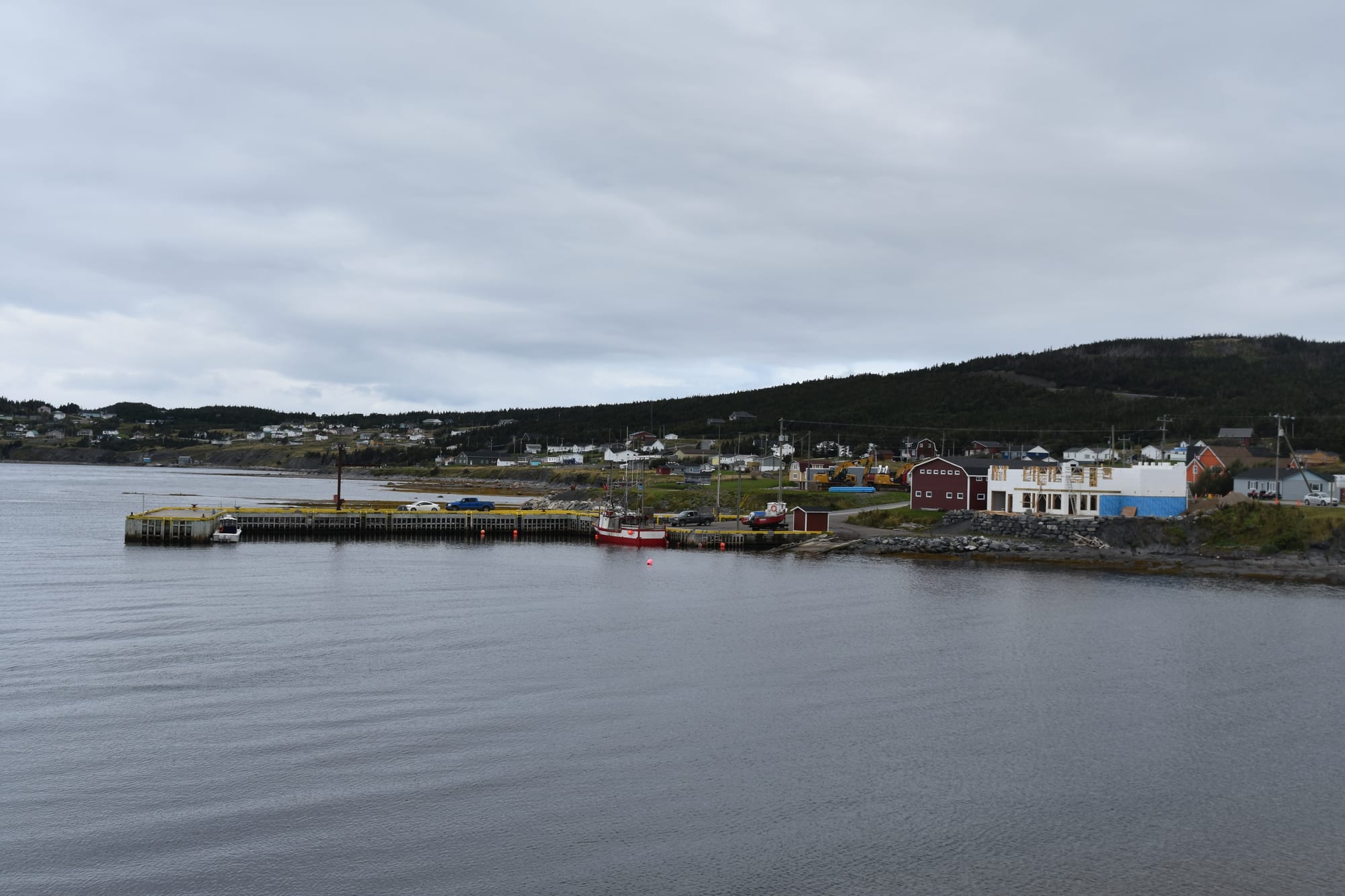
A long wharf and red and white buildings on the calm grey water of Rocky Harbour, with houses spread along a wooded hillside

Newfoundland & Labrador, Canada

Rocky Harbour

The wharf and waterfront of Rocky Harbour on Newfoundland's west coast. (Adavyd / Wikimedia Commons · CC BY-SA 4.0)

A small town on Newfoundland's west coast near the entrance to Bonne Bay, once a stop for French fishermen on the French Shore. Since Gros Morne National Park was created around it in 1973 it has become the park's main service town, with its visitor centre close by and fjords, mountains and the bare Tablelands within reach.

Neighbourhoods

  • Rocky Harbour
    • First-time visitors
    • Close to the park
    • Harbour views

    The town spreads around its harbour near the mouth of Bonne Bay, with a wharf, B&Bs and restaurants, and gift shops and craft galleries along Main Street. The Gros Morne visitor centre is just outside town, and the Lobster Cove Head lighthouse can be seen across the harbour.

    Open in Maps
  • Norris Point
    • Quiet and residential
    • Bay views

    A neighbouring community on the northern side of Bonne Bay, about ten minutes south of Rocky Harbour, with a marine biology centre and aquarium, a health centre and a handful of businesses beside the national park.

    Open in Maps

Things to do

In and around town

  • Lobster Cove Head lighthouselandmark

    The lighthouse in neighbouring Lobster Cove, beside Route 430 and visible across the harbour from the town, a fine sight at sunset.

    Open in Maps
  • Bonne Bay Marine Stationmuseum

    A marine research and teaching station run by Memorial University in Norris Point, opened in 2002, whose aquarium is open to visitors.

    Open in Maps
  • Bonne Bayviewpoint

    A two-armed fjord carved by glaciers about 10,000 years ago, separating the Great Northern Peninsula from the rest of the island; boat tours look for eagles, moose, whales and seabirds.

    Open in Maps

Gros Morne National Park

  • Gros Morne National Parkpark

    A national park of 1,805 square kilometres, a UNESCO World Heritage Site since 1987 as a rare example of continental drift, where deep ocean crust and the rocks of the Earth's mantle lie exposed.

    Open in Maps
  • Gros Morne mountaintrail

    At 806 metres the second-highest peak on the island, climbed on one of the park's most demanding day hikes, about 16 km long.

    Open in Maps
  • Western Brook Pondattraction

    A landlocked fjord between rock walls 600 metres high, reached by an easy 3 km trail across bogs and limestone ridges, with tour boats on the lake from June to mid-October.

    Open in Maps
  • Woody Pointattraction

    A small town across Bonne Bay whose downtown is a registered heritage district, close to the Tablelands.

    Open in Maps
  • Tablelandstrail

    Bare, desert-like hills between Woody Point and Trout River made of peridotite, rock thought to come from the Earth's mantle and forced up during a plate collision several hundred million years ago.

    Open in Maps
  • Trout Riverattraction

    A fishing village on the park's southern edge near the Tablelands, known for its boardwalk, sunsets and the 14 km Trout River Pond Trail.

    Open in Maps

Eat and drink

Long-standing places and food districts in Rocky Harbour. Hours, ratings and directions come from your maps app, always current.

Rocky Harbour and the bay

  • Restaurants in Rocky Harbourneighborhood

    The town has the widest choice of places to eat in the park, mostly serving seafood and traditional Newfoundland dishes.

    Open in Maps
  • Woody Point and Trout Riverneighborhood

    The two communities on the south side of Bonne Bay also have restaurants, handy on a day at the Tablelands.

    Open in Maps

Experience Rocky Harbour

History

Arrowheads found in the area show that the Mi'kmaw once lived here. In the 18th and 19th centuries the harbour, then known as Small Bay or Little Harbour, was used by French fishermen working the French Shore, the stretch of coast where France kept fishing rights. Permanent settlement came slowly: Rocky Harbour first appeared in the census in 1874, with 35 people. A post office opened in 1900, and by 1921 the population had reached 357.

For most of the 20th century it remained a small community. It became a local government community in April 1966. The great change came in 1973, when the Gros Morne National Park Reserve was established around Bonne Bay. The town's population grew, and services such as a police detachment were added as Rocky Harbour became the park's main base.

The park itself was recognised as a UNESCO World Heritage Site in 1987 because its rocks show continental drift so clearly — the Tablelands south of Bonne Bay are made of rock thought to come from the Earth's mantle, forced up during a plate collision several hundred million years ago. Gros Morne became a full national park on 1 October 2005. Today Rocky Harbour sits halfway through the park on the Viking Trail, and it is a key tourist town for the park.

Culture & Customs

Rocky Harbour shares the culture of Newfoundland's outports: a close community, a dialect of English with roots in Ireland and the English West Country, and music at the heart of social life, from fiddle and accordion tunes to kitchen parties. Gift shops and craft galleries in town sell local crafts.

The park gives the area an unusually busy summer arts calendar for its size. The Gros Morne Theatre Festival, Writers at Woody Point, Gros Morne Summer Music and Trails, Tales and Tunes all take place in and around the park, bringing plays, readings and concerts to small halls in the surrounding communities.

Life is tied to the outdoors. Families fish, hunt moose, pick berries and cut wood as people in rural Newfoundland have long done, and the national park, with its trails, campgrounds and boat tours, is part of daily life as well as the reason most visitors come. The rocks of the park have a scientific fame of their own: geologists come to Gros Morne to see oceanic crust and mantle rock exposed at the surface.

Daily Life

About 940 people lived in Rocky Harbour at the 2021 census, a slight fall from 2016; the neighbouring communities of Norris Point and Neddie's Harbour lie close by. The town covers a land area of about 12 square kilometres. The town's only school, Gros Morne Academy, also houses the public library.

The town is a key tourist base for the national park. In summer, when accommodation fills quickly, the town's B&Bs, campground, restaurants, gift shops and boat tours serve visitors to the park, whose visitor centre stands just outside town.

Winters are long and quiet. The park stays open, with some winter activities, and the nearest airport is at Deer Lake, about 71 km away. Moose are part of everyday life: the animals, introduced to Newfoundland from the Maritimes around 1900, are found in the park at five to twenty times the density of comparable areas elsewhere in Canada, and they are a constant hazard on the roads.

Food

Food in Rocky Harbour is the cooking of rural Newfoundland, served in a handful of restaurants in town and more across Bonne Bay in Woody Point and Trout River. Cod is the staple, most often as fish and chips, and other seafood from the surrounding waters appears on most menus in season.

Traditional island dishes are common. Fish and brewis combines salt cod with hard bread softened in water and topped with scrunchions, small pieces of fried pork fat. Toutons are fried bread dough eaten with molasses, and Jiggs dinner — salt beef boiled with cabbage, potatoes, carrot and turnip and served with pease pudding — is the Sunday meal in many homes. Moose meat, from the island's large herds, is hunted and eaten locally.

Wild berries are part of the late-summer table: bakeapples, the local name for cloudberries, and partridgeberries go into jams, pies and sauces, and figgy duff, a boiled raisin pudding, is a traditional dessert.

Planning tools

Budget

Prices are close to the Canadian average, but getting here adds cost: flights to Deer Lake, a hire car that is essential and books out in summer, and fuel for long drives. Rocky Harbour has B&Bs and a campground, and Parks Canada runs five campgrounds in the park. A park pass, boat tours and meals out are the other main costs.

Daily Budget Midrange
USD 160–300 (B&B, restaurant meals, hire car, park pass and a boat tour)
Daily Budget Shoestring
USD 80–120 (park campground, groceries and fish and chips, shared hire car)

Accommodation fills quickly in summer, so book well ahead, along with the hire car.

Best Time to Visit

Summer is the main season, when the Western Brook Pond boats run, the trails are clear and the arts festivals are on; whales may be offshore during the capelin season in early summer. September brings autumn colour and fewer visitors. The park stays open in winter, with some winter activities.

Suggested Number of Days

Two or three days give a first look at the park from Rocky Harbour. Four to six suit anyone planning the longer hikes or the far side of the bay as well. Fog, rain and wind can cancel boat tours and close summits, so a spare day helps.

First Visit
2–3 days
With Surroundings
4–6 days

Transportation

A car is essential. Route 430, the Viking Trail, runs through the park past Rocky Harbour, and Route 431 leads round Bonne Bay to Woody Point and Trout River. Distances between trailheads are long.

Moose are common on the park's roads and most active at dawn and dusk, when collisions are most likely; avoid driving at night.

Airport & Station Connections

The nearest airport is Deer Lake Regional Airport, about 71 km south-east, with direct flights to Toronto, Montreal and St. John's; most visitors hire a car there, roughly an hour's drive from the park. Others drive from the car ferry at Port aux Basques, about four hours from the park's southern boundary. Buses also run from the town of Deer Lake to Gros Morne.

Walkability

The town itself is small enough to walk, and the lighthouse is close by, but everything else needs a car. The park has about 20 marked day hikes, from short, easy walks to the climb of Gros Morne mountain.

Safety

Canada is a safe country with low levels of violent crime. The real hazards are the land and the weather: moose on the roads, black bears and other large animals in the park, fog and sudden changes of weather on exposed summits, cold water and long trails with no phone signal.

Carry warm and waterproof layers even in summer, leave word of the planned route before a long hike, keep a respectful distance from moose and bears, and slow down at dusk on the roads. Check current official travel advice before travelling.

Climate

The climate is on the cool side of temperate, with changeable weather, fog along the coast and long, snowy winters.

Summer
cool to mild, with daytime highs around 20°C in the Gros Morne area
Winter
cold and snowy, with daytime highs around −5°C in the Gros Morne area

Local Customs

Rocky Harbour is a small community as well as a tourist base, and people are friendly and ready to talk. Speech is the distinctive English of Newfoundland. The island keeps its own time zone, half an hour ahead of Atlantic time.

Tip 15–20 per cent in restaurants; sales tax is added at the till. Stay on marked trails and respect the park's protected landscapes.

Common Payment Methods

The currency is the Canadian dollar. Cards and contactless payment are widely accepted, but carry some cash for small businesses, and withdraw it in town before heading to remoter parts of the park. Cash totals are rounded to the nearest five cents.