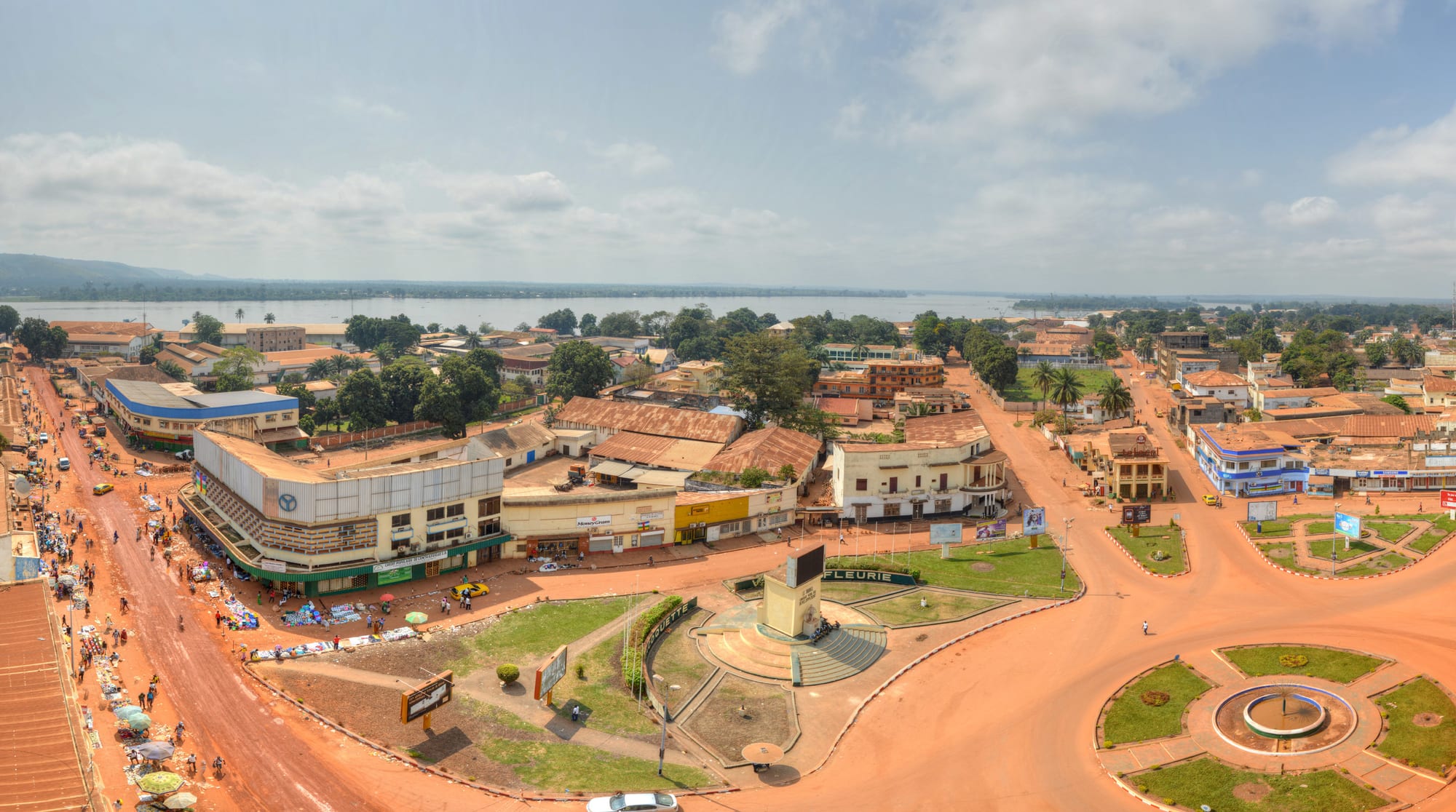
Aerial view of a city centre of low red-roofed buildings around a monument and a roundabout, with a wide river behind

Bangui & the Southwest, Central African Republic

Bangui

The centre of Bangui around the PK0 roundabout, with the Ubangi river and the Democratic Republic of the Congo beyond. (Alllexxxis / Wikimedia Commons · CC BY-SA 4.0)

The capital of the Central African Republic, founded as a French river post in 1889 where the Ubangi turns west below a line of rapids, with the Congolese town of Zongo on the far bank. It holds most of the country's administration, trade and aid work, and its markets, cathedral and museum sit within a short walk of the river. This page is written to explain the city, not to encourage travel.

Neighbourhoods

  • The city centre
    • First-time visitors
    • Administration and offices
    • Historic buildings

    The colonial-era grid between the river and the Avenue des Martyrs, laid out around the PK0 roundabout, the city's kilometre-zero point. Ministries, banks, the main hotels, the cathedral and the Boganda museum stand within a few blocks of one another.

    Open in Maps
  • The riverfront and the port
    • River views
    • Markets
    • Local life

    The strip along the Ubangi below the centre, where pirogues are drawn up on the sand, fishing camps work the channels and the ferry crosses to Zongo in the Democratic Republic of the Congo. Grilled fish is sold along the bank in the evening.

    Open in Maps
  • PK5
    • Markets
    • Trade and commerce

    The district at the fifth kilometre point on the western road, long the centre of Muslim business life in the capital and of its wholesale trade. It was at the heart of the violence that followed 2013 and remains a busy commercial quarter.

    Open in Maps
  • The northern and western quarters
    • Quiet and residential
    • Close to the airport

    Residential neighbourhoods of single-storey compounds spreading inland towards M'Poko airport and the road west, with the university campus, army barracks and the suburb of Bimbo among them. Unpaved streets, small shops and market stalls set the tone.

    Open in Maps

Things to do

Landmarks and institutions

  • Cathédrale Notre-Damelandmark

    The red-brick Roman Catholic cathedral of central Bangui, built in 1937 and the seat of the archdiocese, where Jean-Bédel Bokassa held his coronation mass in 1977.

    Open in Maps
  • Boganda National Museummuseum

    The national ethnographic museum, founded in the 1960s and named after Barthélemy Boganda, the country's first prime minister. Its collections of musical instruments, weapons, pottery and hunting and household tools were looted during the civil war, and most of what remains is boxed up.

    Open in Maps

Sport and learning

  • Barthélemy Boganda Stadiumattraction

    The 35,000-capacity national stadium, handed over in 2006 and named after the independence leader. Pope Francis said Mass here in November 2015; FIFA ruled in 2020 that the ground no longer met international standards, and it has held no match since.

    Open in Maps
  • University of Banguiattraction

    The country's main public university, founded under Bokassa and open since 1970, its campus in the north of the city the centre of higher education in the Central African Republic.

    Open in Maps

Short trips from the city

  • Boali and its fallsattraction

    A town on the Mbali river north-west of Bangui, where the falls drop some 50 metres beside the hydroelectric stations that supply the capital.

    Open in Maps
  • Zongoattraction

    The Congolese town directly across the Ubangi, linked to Bangui by ferry and canoe and long tied to the capital by trade and family.

    Open in Maps

Eat and drink

Long-standing places and food districts in Bangui. Hours, ratings and directions come from your maps app, always current.

Markets and food streets

  • Marché Centralmarket

    The main market in the centre of the city, where cassava flour, koko leaves, smoked fish, forest caterpillars in season, peppers and palm oil are sold alongside cloth and household goods.

    Open in Maps
  • The PK5 marketmarket

    The wholesale and retail market of the PK5 district, historically the trading heart of the capital and the place where imported goods have reached the city's shops.

    Open in Maps
  • The riverside fish grillsneighborhood

    Stalls along the Ubangi where the day's catch is grilled over charcoal and eaten with cassava paste and hot pepper sauce, the closest thing the city has to an eating-out tradition.

    Open in Maps

Experience Bangui

History

Bangui was founded in 1889 as a French post on the north bank of the Ubangi, at the foot of the rapids that stop river boats coming up from the Congo. The site was chosen for that break in navigation, and the town grew as the transfer point between steamers and porters. It became the capital of the colony of Ubangi-Shari and the administrative centre from which the concession companies, notorious for forcing villagers to gather wild rubber, were run. A grid of avenues, brick offices and the red-brick cathedral of 1937 gave the centre the look it still has, and the city was known as 'la Coquette' in the 1970s.

After independence in 1960 the city was the stage for the country's political upheavals. David Dacko was overthrown in the Saint-Sylvestre coup of 1 January 1966 by Jean-Bédel Bokassa, who crowned himself emperor in Bangui in 1977 in a ceremony whose cost the country could not bear; protests by schoolchildren and the killings that followed helped bring about his overthrow in a French-backed coup in September 1979. Coups and short-lived governments recurred through the 1990s and 2000s, often beginning in the army barracks of the capital.

In March 2013 the Séléka coalition took Bangui, and anti-balaka militias formed against it. The city saw heavy sectarian violence, and by early 2014 some 500,000 people, close to half the city's population, had fled their homes; French troops and then the United Nations mission deployed. Pope Francis visited in November 2015. The capital has been calmer since, and rebuilding, aid operations and government have concentrated here.

Culture & Customs

Bangui is where Sango, the river trade language that became the national tongue, is most completely at home: it is the everyday speech of the streets and markets, with French kept for administration, schooling and the press. The city draws people from every part of the country, so Gbaya, Banda, Ngbaka, Yakoma and many other communities live side by side, and family ties reach back to villages that city households still support.

Churches shape the week. Catholic and Protestant congregations fill Sunday mornings with choirs and drumming, and church compounds have repeatedly served as places of refuge in times of violence. The Muslim community, long concentrated in PK5 and prominent in trade, keeps its own rhythm of prayer and market days. Rebuilding trust between these communities after the violence that began in 2013 is a live and openly discussed matter in the capital.

Music is the city's strongest cultural export. Congolese rumba and soukous crossed the river long ago and mixed with local styles, and bars along the Ubangi are the centre of evening life when conditions allow. Football is followed closely, dance and drumming are part of weddings and funerals, and the Boganda museum holds what survived the looting of its collections of instruments, weapons and tools.

Daily Life

Bangui had an estimated 889,231 residents in 2020, by far the largest concentration in the country and a population swollen over the past decade by families displaced from the interior. Households spread out from the colonial centre into quarters of single-storey compounds with courtyards, mango trees and unpaved lanes; Bimbo, on the western edge, has grown into a town in its own right.

The economy is government, trade and aid. Ministries, the United Nations mission and international agencies are among the few large employers, and most other work is informal: market trading, transport, repairs, construction, brewing and selling food. Goods reach the city along the road from Cameroon, and when that route is cut or insecure prices rise sharply in the markets within days.

The day starts early, before the heat, with markets busy from dawn and children walking to school in uniform. Electricity supply is intermittent even in the centre, generators are common in offices and shops, and many households draw water from standpipes or wells. Evening comes quickly near the equator, and movement drops after dark. Flooding along the Ubangi and its creeks affects low-lying quarters in the rainy season.

Food

The everyday meal in Bangui is gozo, a stiff paste of cassava flour eaten by hand and pinched off to scoop up a sauce. The most common sauce is ngoundja, cassava leaves pounded and cooked with palm oil and groundnut paste; okra, sorrel-leaf and plain groundnut sauces are almost as usual. Fufu of pounded cassava and foutou of pounded plantain appear alongside gozo on many tables.

Fish is the capital's advantage. Captain fish, catfish and tilapia come out of the Ubangi and are grilled whole over charcoal along the riverfront or smoked for keeping and sale inland. Grilled meat and brochettes are sold at roadside stalls, chicken and goat go into sauces for special occasions, and forest foods reach the markets in season: koko, the finely sliced leaves of a forest vine, wild mushrooms and edible caterpillars, fried or dried.

Fried doughnuts and beignets, roasted groundnuts, mangoes, papaya and bananas are the street snacks. Sweet tea and coffee taken with canned evaporated milk are the morning drinks. Palm wine is brought in from the villages of the Lobaye, a strong spirit is distilled locally, and beer brewed in the city is the usual drink in the riverside bars.

Planning tools

Budget

Bangui is expensive for what it offers. The small number of hotels that international visitors use are priced for diplomats, contractors and aid staff, vehicles and drivers cost far more than the distances suggest, and imported food and fuel are dear. Market food, local transport and everyday goods, by contrast, are very cheap.

Daily Budget Midrange
USD 230–450 (hotel, driver and security arrangements, before flights)
Daily Budget Shoestring
USD 50–90 (basic local guesthouse, market food, shared taxis — rarely a realistic option given the security situation)

Costs are driven by logistics and security rather than by hotels and meals, and anything arranged at short notice is dearer.

Best Time to Visit

December to February is the driest and easiest time, with firmer roads and less mud in the unpaved quarters, though the Harmattan leaves a dusty haze. The rains from about April to October bring heavy afternoon storms. In practice the security situation, not the season, decides whether travel is possible at all.

Suggested Number of Days

The centre is small and a day or two covers it. Adding the river crossing or the falls north-west of the city takes three or four. Journeys in and out of the country are infrequent, so stays are usually set by flight schedules rather than by the city itself.

First Visit
1–2 days
With Surroundings
3–4 days

Transportation

Shared taxis and minibuses run along the main avenues, and motorcycle taxis cover the unpaved streets. Most foreign visitors move by arranged vehicle with a driver. Few roads outside the centre are surfaced, and rain turns many of them to mud. Pirogues and a ferry cross the Ubangi to Zongo.

Movement after dark is generally avoided, and roads out of the city are a different question entirely from travel within it.

Airport & Station Connections

Bangui M'Poko International Airport lies about seven kilometres north-west of the centre and is the country's international airport, with a small number of services flown by a handful of African and North African airlines. Roads reach the city from the Cameroon border in the west and from the north and east, but they are long, largely unpaved and often unsafe. River traffic on the Ubangi connects Bangui with the Congo.

Walkability

The colonial-era centre is flat, compact and walkable in principle, with the river, the cathedral, the museum and the main market within a few blocks of each other. Beyond it, pavements give out, distances grow and most people take a shared taxi or a motorcycle. Walking after dark is not usual.

Safety

Bangui is the most secure part of the country, with national forces, the United Nations peacekeeping mission and Russian-linked security personnel all present, but armed robbery, theft and periodic unrest occur, and some districts have seen clashes in past years. Most governments advise against all travel to the whole country, including the capital.

Globeway covers the Central African Republic so it can be understood, not to encourage travel there now. Any visit would be arranged through a specialist operator with current security information. Check current official travel advice before travelling.

Climate

Hot and humid all year, with a long rainy season and a short drier one. Temperatures vary little between months; rainfall is what changes. Storms in the wet season are heavy and brief, and humidity stays high.

Summer
the rains, roughly April to October, about 22–31°C with heavy afternoon downpours
Winter
the drier months, December to February, about 20–34°C, dusty and hazy with the Harmattan

Local Customs

Sango is the language of the street and French that of offices and schooling. Greetings matter and are unhurried; the right hand is used for giving, receiving and eating. Dress is modest, and more so in the Muslim quarters. Church and mosque attendance shapes the week for most families.

Photography of government buildings, the airport, bridges, soldiers and police is not permitted, and people should be asked before being photographed. Tipping is not customary, though small sums for services are appreciated.

Common Payment Methods

The currency is the Central African CFA franc (XAF), pegged to the euro. Cash is used for nearly everything, and euros are the most useful foreign currency to change. Card acceptance and cash machines are limited to a handful of hotels and banks in the centre, and cannot be relied on.