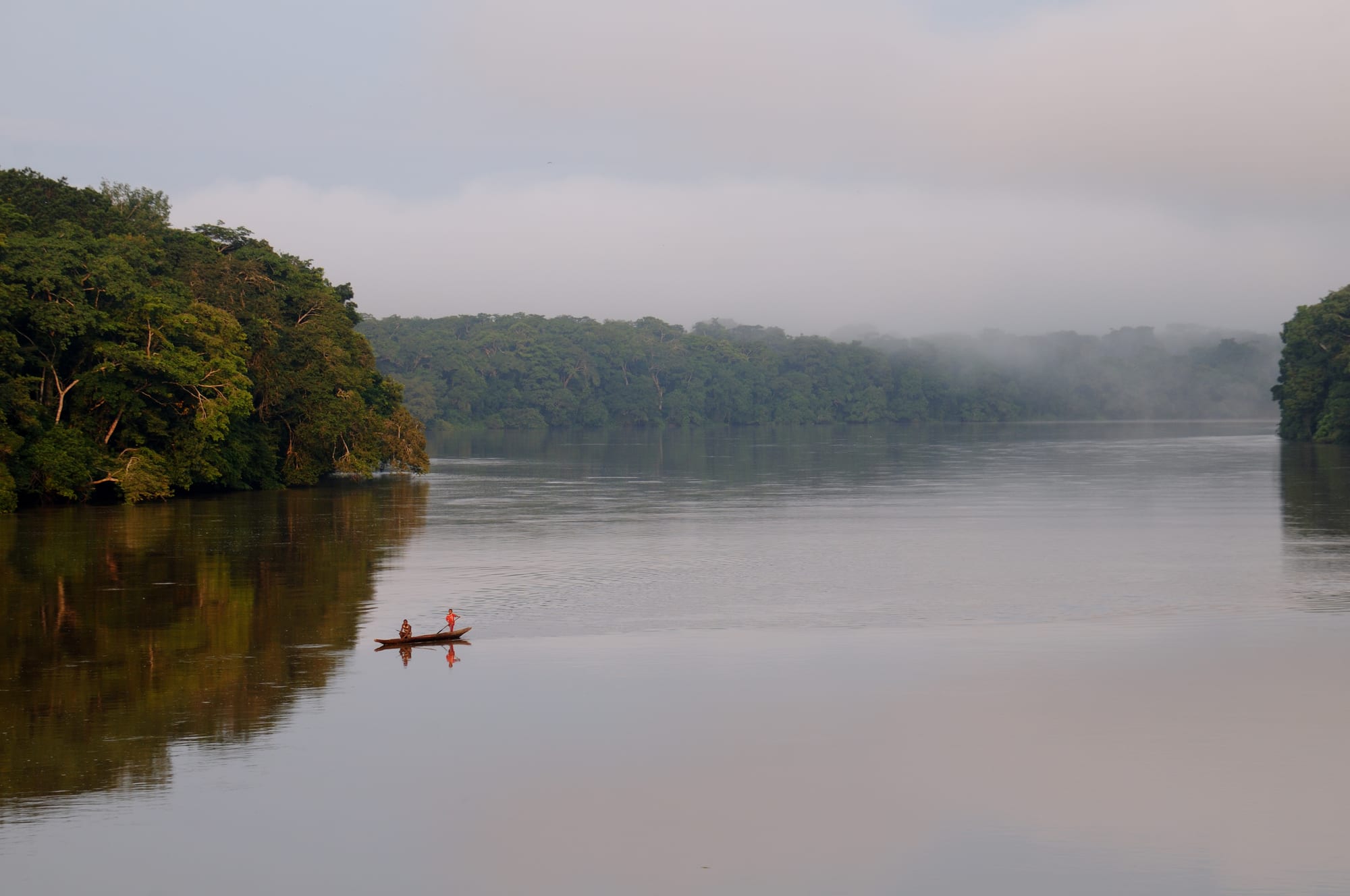
A lone dugout canoe with two paddlers crossing a broad, glassy river between walls of rainforest, with morning mist hanging over the far treeline

Central African Republic

Morning mist over the Sangha River near Bayanga, where a dugout canoe crosses between rainforest banks. (JosepMGracia / Wikimedia Commons · CC BY-SA 4.0)

A landlocked country at the heart of the continent — rich in diamonds, gold, and rainforest, among the poorest and least developed nations on Earth, and fractured by more than a decade of armed conflict.

Explore Central African Republic

History

The area between the Ubangi and Chari rivers was a crossroads for savanna and forest peoples and, from the sixteenth century, a hunting ground for slave raiders working the Saharan and Nile slave routes. France took control in the 1890s and ran it as the colony of Ubangi-Shari, notorious for the abuses of the rubber and cotton concession companies.

Independence came on 13 August 1960. The early leader Barthélemy Boganda died in a plane crash in March 1959, before it, and his cousin David Dacko became the first president, only to be overthrown at the end of 1965 by his own cousin Jean-Bédel Bokassa. Bokassa declared himself Emperor of the Central African Empire in 1976 and crowned himself in a ruinously expensive ceremony a year later; France overthrew him in September 1979, months after schoolchildren arrested during protests were killed, and restored Dacko. Coups and short-lived governments followed.

In 2013 a mainly Muslim rebel coalition, Séléka, seized Bangui; a mostly Christian militia movement, the anti-balaka, formed in response, and the country collapsed into civil war along sectarian lines. A 2016 election and a 2019 peace deal did not end the fighting. Faustin-Archange Touadéra has been president since March 2016, backed from about 2017 by Russian support; government forces, Russian-linked paramilitaries and Rwandan troops have pushed the rebels back since 2021, and in July 2025 the two largest remaining rebel groups disarmed and dissolved under a peace agreement, though other armed groups remain active. A referendum in 2023 removed presidential term limits, and after the election of 28 December 2025 the Constitutional Court declared Touadéra the winner of a third term with 77.9 per cent of the vote, a result his main rivals disputed.

  • Central African Republic: The Empty Quarter — A landlocked, sparsely peopled country hollowed out by the slave trade, a French rubber colony run by concession companies, a self-crowned emperor, and decades of coups and rebellion

Culture & Customs

The population is a patchwork of some eighty peoples — the Gbaya and Banda, who between them are slightly over half the country, with the Mandja, Sara, Ngbandi, Yakoma and Zande among the rest, and the Aka and Baka of the southwestern rainforest, forest hunter-gatherers; the oral traditions of the Aka, famed for their polyphonic singing, were proclaimed by UNESCO a Masterpiece of the Oral and Intangible Heritage of Humanity in 2003.

Most Central Africans are Christian, with a Muslim minority concentrated in the north and among traders, and traditional beliefs widely held alongside. The 2013–14 conflict deliberately pitted these communities against each other, and rebuilding trust between them is a central challenge.

Music, dance, and oral storytelling are strong, and the sanza thumb piano and water-drumming of the forest peoples are distinctive. Everyday social life, where it can function normally, runs on the extended family, the village, the church or mosque, and the market.

Daily Life

The Central African Republic consistently ranks near the bottom of global measures of income, health, and education. Most people live by subsistence farming — cassava, plantain, groundnuts, maize — supplemented by fishing on the rivers, hunting, and gathering forest products, with cotton, coffee, and above all diamonds and gold as the cash economy.

Years of conflict have displaced a large share of the population, inside the country and into neighbouring countries, and have left much of the interior without functioning schools, clinics, or administration. Aid agencies provide many basic services. Bangui, on the Ubangi River facing the DR Congo, is the one substantial city and the centre of what economy there is.

Food

Central African cooking is simple and starch-based. The staple is a stiff cassava or sometimes maize porridge — gozo, made from cassava flour, with fufu of pounded cassava and foutou of pounded plantain alongside it — eaten by hand with a sauce of greens, okra, or groundnut, and, when available, fish, bushmeat, or chicken. Wild leaves and tubers are widely used, and the wild koko leaf, sold in Bangui's markets with caterpillars and other forest foods, is another.

Fish from the Ubangi and other rivers goes into many dishes, and grilled meat is part of the everyday diet in Bangui. Palm oil, chilli, onion and garlic season many dishes.

Palm wine and banana wine are the traditional drinks; tea and coffee, taken sweet and with canned evaporated milk, and, in Bangui, imported soft drinks and beer are common.

Attractions & Natural Wonders

In a country at peace, the Central African Republic's draw would be its wildlife. The Dzanga-Sangha reserve, in the southwestern rainforest where the country meets Cameroon and the Republic of the Congo, protects the Dzanga Bai — a large forest clearing where large numbers of forest elephants, along with bongo and forest buffalo, gather to feed on the mineral-rich soils. Habituated western lowland gorillas can be tracked from the Bai Hokou site, where the programme works with the local Aka, and the reserve forms part of the Sangha Trinational, inscribed as a UNESCO World Heritage Site in 2012 together with neighbouring parks in Cameroon and the Republic of the Congo.

In the north, the Manovo-Gounda St. Floris National Park was once one of the richest savanna reserves in Central Africa, with elephant, lion, and vast antelope herds, but poaching by heavily armed hunters, said to have taken as much as 80 per cent of its wildlife, has devastated it; the western black rhinoceros that lived there was declared extinct in 2011. Inscribed by UNESCO in 1988, the park has since been placed on the List of World Heritage in Danger.

Elsewhere, the Chutes de Boali, about 250 metres wide and 50 metres high on the Mbali river some 100 kilometres northwest of Bangui, and the Ubangi River itself are the sights closest to the capital. For now, access to nearly all of this is limited by the security situation.

Planning basics

Budget

There is effectively no tourism economy. What little travel happens is expensive: charter flights or long escorted road transfers, security arrangements, and the specialist lodge at Dzanga-Sangha. Bangui has a handful of hotels priced for aid workers and diplomats. Cash only, in CFA francs and euros.

Source
Very limited data — verify everything against current advice before relying on it.
Daily Budget Midrange
USD 200–400+ per day for the few operating options, before flights
Daily Budget Shoestring
Not realistically applicable given the security situation

Any visit is arranged through a specialist operator with security and logistics built in.

Source: Very limited data — verify everything against current advice before relying on it.

Visa Requirements

Almost all visitors need a visa, obtained in advance from a Central African or French diplomatic mission. Check the current health requirements, including vaccination certificates, when you apply.

Typical Validity
Set by the issuing mission; confirm when you apply

Many governments advise against all travel, so consular support in an emergency is minimal to none.

Safety

This is the decisive fact about the Central African Republic. The country has been in armed conflict since 2013. Government forces, supported by Russian-linked paramilitaries and Rwandan troops, have regained ground since 2021, and in July 2025 the two largest remaining rebel groups, the UPC and 3R, signed disarmament agreements and dissolved; other armed groups remain active, there were further clashes in January 2026, and violence against civilians, kidnapping, and banditry are widespread. MINUSCA, the United Nations peacekeeping mission, has been deployed since 2014. Many governments advise against all travel to the entire country; the UK advises against all travel outside Bangui and all but essential travel to the capital itself.

Source
US Department of State, UK FCDO, and French diplomatic advisories — check for the latest wording.

Worldlore covers the Central African Republic so it can be understood, not to encourage travel there now. The one partial exception cited by some operators is the far southwestern Dzanga-Sangha area, reached by air; even that should only be attempted through a specialist with current knowledge.

Source: US Department of State, UK FCDO, and French diplomatic advisories — check for the latest wording.

Climate

Tropical. The south is equatorial and forested, hot and humid with a long wet season from about May to October. The centre and north are savanna with a shorter wet season, about June to September in the north, and a dry season the rest of the year, when the dusty Harmattan wind can reach the north.

North
wet about June–September, otherwise dry, with dusty Harmattan winds
South
hot, humid, wet about May–October

Transportation

Bangui M'Poko is the only international airport, with limited regional flights. There is no railway. Roads outside the capital are poor, often impassable in the rains, and many are controlled by armed groups or subject to banditry. Reaching Dzanga-Sangha usually means a charter flight to Bayanga.

Overland travel around the country is dangerous and, on most routes, not advised at all.

Best Time to Visit

In principle the drier months, December to March, offer the best road access and wildlife viewing at Dzanga-Sangha. In practice the security situation, not the season, determines whether and where travel is possible.

Currency

The currency is the Central African CFA franc (XAF), shared with Cameroon, Chad, the Republic of the Congo, Equatorial Guinea and Gabon and pegged to the euro at 655.957 francs to the euro.

Symbol
FCFA
Cash To Bring
Euros in cash
Currency Code
XAF — Central African CFA franc

Language

French and Sango are both official. French is the language of government and education; Sango, a creole built on the Ngbandi language that grew into an inter-ethnic lingua franca, is the national language and is used as a lingua franca across the country. Many other local languages are spoken by particular groups.

English
Very rarely spoken
National Language
Sango
Official Language
French and Sango