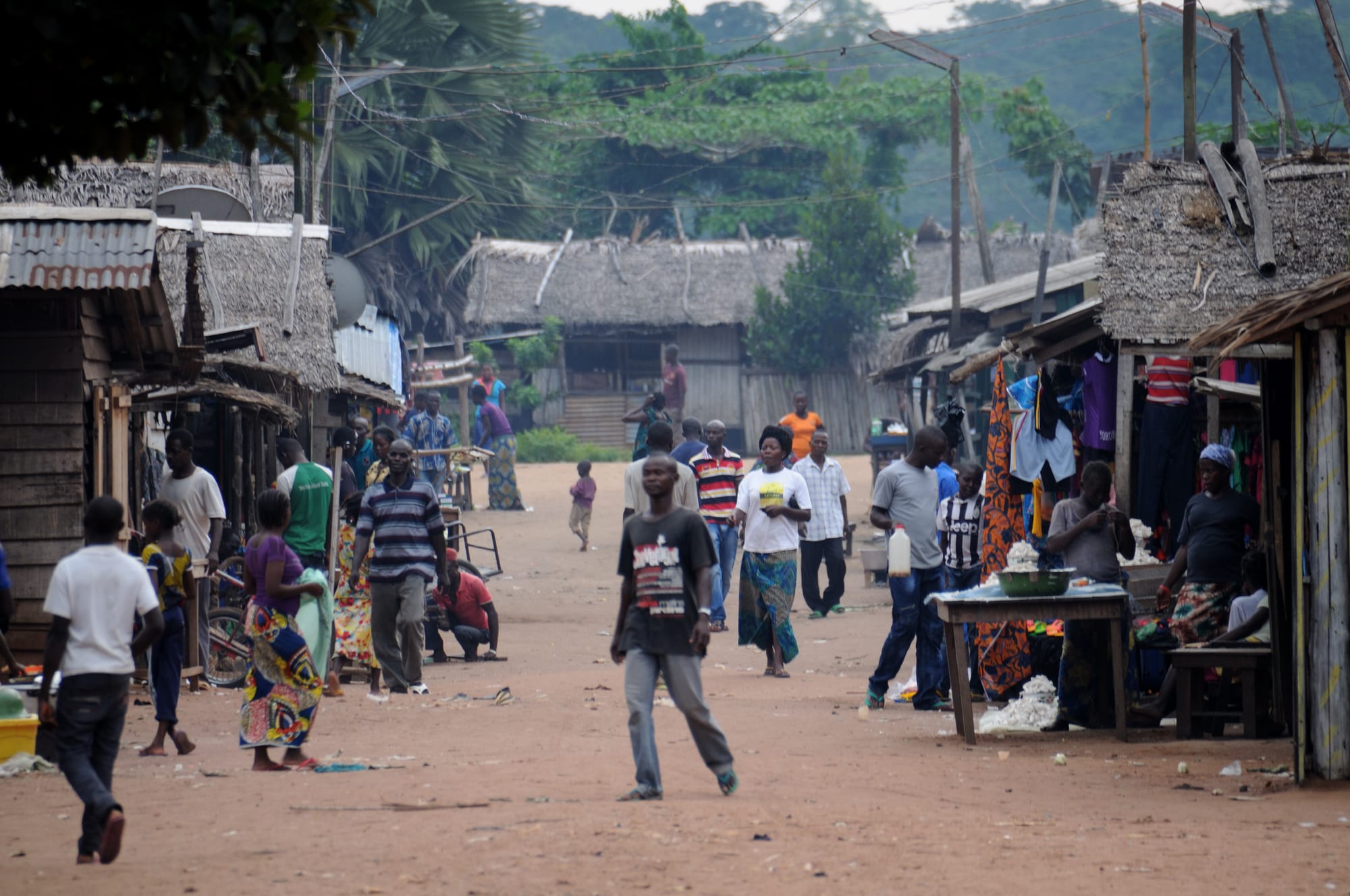
A wide red-earth street lined with timber and thatch stalls and shops, with people walking and trading under tall forest trees

Bangui & the Southwest, Central African Republic

Bayanga

The commercial street through the centre of Bayanga, in the south-western rainforest of the Central African Republic. (JosepMGracia / Wikimedia Commons · CC BY-SA 4.0)

A small town on the left bank of the Sangha river in the far south-west of the Central African Republic, grown up around timber cutting and now the gateway to the Dzanga-Sangha protected areas. It is the base for visits to the forest elephants of Dzanga Bai and for gorilla tracking with Aka guides. This page is written to explain the town, not to encourage travel.

Neighbourhoods

  • The main street and market
    • First-time visitors
    • Markets
    • Local life

    The red-earth street through the centre, lined with timber-and-thatch stalls, small shops and drinking places. Almost everything sold in the town passes along it, and it is where people gather in the evening.

    Open in Maps
  • The Sangha riverside
    • River views
    • Fishing and canoes
    • Quiet

    The bank below the town, where dugout canoes are drawn up and fishermen work the channels. The Republic of the Congo and Cameroon lie downstream, and the river is the old highway of this corner of the country.

    Open in Maps
  • The conservation quarter
    • Wildlife trips
    • Research and conservation

    The offices, staff housing and visitor accommodation of the Dzanga-Sangha protected areas on the edge of the town, from which trips into the forest are organised and where much of the local paid employment is based.

    Open in Maps
  • The Aka settlements
    • Forest culture
    • Guided walks

    Communities of Aka forest people live in and around Bayanga and in villages along the road. Aka trackers and guides work with the reserve, and their knowledge of the forest underpins the gorilla habituation programme.

    Open in Maps

Things to do

The reserve

  • Dzanga-Sangha Special Reservepark

    A protected area of some 6,800 square kilometres of Congo Basin rainforest established in 1990, which surrounds the national park and is managed together with it.

    Open in Maps
  • Dzanga Baiattraction

    A mineral-rich forest clearing within the reserve where African forest elephants gather in numbers, watched from a raised platform; buffalo, sitatunga and bongo also come to it.

    Open in Maps

The national park and the World Heritage Site

  • Dzanga-Ndoki National Parkpark

    A national park of about 1,143 square kilometres in two separate sectors, Dzanga and Ndoki, established in 1990; the Dzanga sector holds one of the highest densities of western lowland gorillas ever recorded.

    Open in Maps
  • Sangha Trinationalpark

    The transboundary forest inscribed as a UNESCO World Heritage Site in 2012, joining Dzanga-Ndoki with Lobéké in Cameroon and Nouabalé-Ndoki in the Republic of the Congo.

    Open in Maps

Short trips from the town

  • Nolaattraction

    A town at the meeting of the Mambéré and Kadéï rivers, where the Sangha is formed, and the administrative centre for this corner of the south-west.

    Open in Maps

Eat and drink

Long-standing places and food districts in Bayanga. Hours, ratings and directions come from your maps app, always current.

Market and local food

  • The Bayanga market streetmarket

    Cassava, plantain, koko leaves, smoked fish from the Sangha, palm oil, groundnuts and small quantities of imported rice, sugar and tinned goods brought in by road or river.

    Open in Maps
  • Riverside fishneighborhood

    Fish taken from the Sangha, grilled fresh or smoked over slow fires for keeping, is the town's staple protein and the food most associated with the river.

    Open in Maps
  • Forest foods in seasonmarket

    Wild yams, mushrooms, honey and edible caterpillars come out of the forest with the seasons and are sold in small heaps at the roadside and in the market.

    Open in Maps

Experience Bayanga

History

Bayanga sits on ground that Aka forest people and neighbouring farming communities have used for far longer than any settlement records. It began as a small Sangha fishing village, and was made a town in the 1970s by a sawmill that turned it into the main logging centre of the south-west, drawing workers, traders, missionaries and foreign businesses and setting off a period of rapid growth.

Conservation then came to sit alongside the timber trade. In 1990 the Central African government established the Dzanga-Sangha Special Reserve and the Dzanga-Ndoki National Park in the forest around Bayanga, and the town became the administrative and logistical base for both. Researchers began long-term work at Dzanga Bai in the same year, identifying individual forest elephants and recording their behaviour over decades, and a gorilla habituation programme was built up with Aka trackers whose knowledge of the forest made it possible.

In 2012 the parks on the Central African, Cameroonian and Congolese sides of the Sangha were inscribed together by UNESCO as the Sangha Trinational World Heritage Site. The crisis that engulfed the country from 2013 reached the area as well, and many residents left, among them migrant workers from the logging industry; conservation and tourism resumed gradually in the years that followed and the town recovered its role as the gateway to the reserve, though poaching pressure and the collapse of the national economy have weighed on it.

Culture & Customs

Two ways of life meet in Bayanga. The Aka, forest hunter-gatherers of the Sangha and Lobaye forests, have lived by hunting, gathering honey and wild yams, and moving through the forest in small camps; their polyphonic singing, in which voices interlock without a leader, was recognised by UNESCO as intangible heritage in 2003, and their water-drumming and dances belong to the same tradition. Alongside them live Bantu-speaking farming and fishing communities and workers who came for the sawmill from other parts of the country.

That meeting is not an equal one, and the reserve's programmes have tried to give Aka trackers and guides a formal place in conservation work and in the income it brings. Guiding, tracking and forest teaching are now among the few paid occupations in the town, and visits to Aka communities are arranged through the programme rather than independently.

Sango is the shared language of the market and the street, with the Aka speaking their own language among themselves and French used in offices. Christianity has a presence through mission churches, held alongside older beliefs about the forest and its spirits. Social life turns on the market street, the football ground, the river and the long evenings after the working day.

Daily Life

Bayanga is small: a 2021 estimate put the sub-prefecture at 8,421 people, and the town is a single main street with quarters spreading behind it. Houses are of timber, mud brick and thatch or corrugated iron, and the forest begins immediately beyond the last of them.

Work comes from three sources. The protected areas employ guides, trackers, rangers, drivers and staff, and account for most of the regular wages in the town. Fishing on the Sangha and farming small clearings of cassava, plantain and groundnuts feed most households. Beyond that there is trading, transport and whatever the forest yields. Timber, which built the town in the 1970s and still employed several hundred people in the 2000s, remains part of its economy, but conservation and tourism have grown up beside it.

Services are thin. Electricity comes from generators, water from wells and the river, and the nearest hospital of any size is a long journey away. Goods arrive by road from Nola when the tracks allow, and prices reflect the distance. The day begins before dawn with the river mist and the first canoes, and the forest sets the rhythm of the rest of it: rain in the afternoon, dark by seven, and the sound of the trees at night.

Food

The kitchen here is that of the Central African forest. Gozo, a stiff cassava paste, is the staple, eaten by hand with a sauce of pounded cassava leaves cooked in palm oil and groundnut paste. Plantain, boiled or pounded, and yams and maize fill out the starch, and rice appears when it can be brought in.

Fish from the Sangha is the everyday protein: grilled fresh over charcoal, or smoked over slow fires so that it keeps for weeks and can be traded inland. Groundnut and okra sauces carry chicken or goat on better days. Koko, the finely sliced leaves of a forest vine, is cooked with palm oil and is as much a local signature here as anywhere in the country.

The forest supplies the rest in season. Wild honey, taken from high in the trees, is prized by the Aka and traded in the town; caterpillars are collected, fried and dried; mushrooms, wild yams and forest fruits come and go with the months. Hunting of protected animals is illegal and the reserve enforces it. Palm wine is tapped in the villages, a strong spirit is distilled locally, and sweet tea and coffee with evaporated milk begin the morning.

Planning tools

Budget

Costs here are not the town's but the journey's. Reaching Bayanga means either a charter flight or a long drive from Bangui, and visits to the protected areas carry park, guiding and tracking fees. Accommodation is limited and priced for the small number of specialist visitors. Food and goods in the market are cheap but supply is irregular.

Daily Budget Midrange
USD 250–500 (lodge accommodation, park and guiding fees, before flights or the road transfer)
Daily Budget Shoestring
USD 60–110 (very basic local lodging and market food, before any transport to the town or park fees)

Everything is arranged in advance through the protected-area authority or a specialist operator; there is no walk-up tourism.

Best Time to Visit

December to February is the driest stretch and the easiest for forest walking and for the road from Nola, though rain falls in most months in this part of the country. Elephants visit Dzanga Bai all year. Security, not the season, is what decides whether a visit is possible.

Suggested Number of Days

Visits are usually measured in several days because of the difficulty of getting here: forest walking is slow, wildlife viewing depends on conditions, and transport in and out is infrequent. Longer stays allow for weather and for time with the Aka guides.

First Visit
3–4 days
With Surroundings
5–7 days

Transportation

There is no public transport worth the name. Movement is on foot in the town, by four-wheel-drive vehicle on the forest tracks to the bais and the tracking sites, and by dugout canoe on the Sangha. Journeys within the reserve are arranged by its staff.

Forest tracks become slow or impassable in heavy rain, and vehicles travel with fuel and spares carried from further afield.

Airport & Station Connections

Bayanga lies about 520 kilometres west of Bangui, a journey of a day or more that passes through Nola, some 102 kilometres to the north. Most international visitors have arrived instead by charter flight to the airstrip near the town. The Sangha carries local traffic but is not a practical route in.

Walkability

The town itself is walked end to end in a few minutes, along one main street of packed red earth. The forest is a different matter: the bais and the gorilla tracking sites are reached by vehicle and then on foot, often through wet ground, and are led by guides.

Safety

The far south-west has stayed calmer than most of the country, and Dzanga-Sangha is the one area some specialist operators have continued to visit. Even so, most governments advise against all travel to the whole of the Central African Republic, the region is remote, and medical help is many hours away. Forest walking carries its own risks around large wildlife.

Globeway covers the Central African Republic so it can be understood, not to encourage travel there now. Any visit should be made only through a specialist with current knowledge of the area. Check current official travel advice before travelling.

Climate

Equatorial rainforest climate: hot, humid and wet for most of the year, with no real dry season. Temperatures change little from month to month, and mornings often begin with mist over the river before the heat builds.

Summer
the wettest months, roughly April to November, about 21–31°C with frequent heavy rain
Winter
the drier stretch, December to February, about 20–32°C, still humid with occasional storms

Local Customs

Sango is the common language, with French used in administration and conservation work. Aka communities have their own language and customs, and visits to them are arranged through the reserve rather than independently. Modest dress and unhurried greetings are expected.

People should be asked before being photographed, and photographs of Aka communities are arranged through the guides; paying for photographs is discouraged by the conservation programme.

Common Payment Methods

The currency is the Central African CFA franc (XAF). There are no banking services or cash machines in the town, and cards are not used. All money needed, including park and guiding fees, is carried in cash, usually in CFA francs or euros.