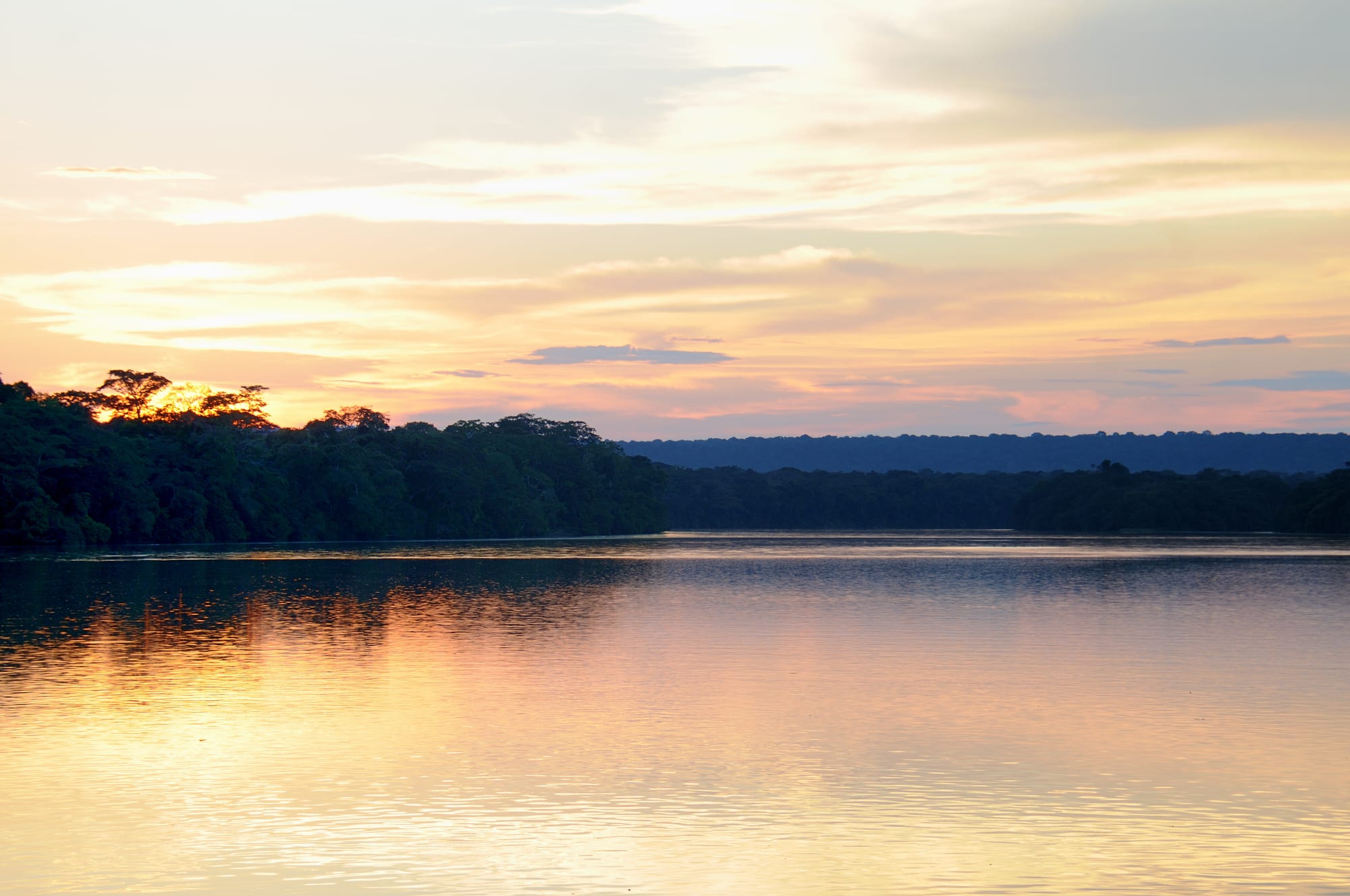
A wide, calm river reflecting a golden sunset sky, with dark rainforest lining both banks

Central African Republic

Bangui & the Southwest

Sunset on the Sangha River near Bayanga, in the far southwest of the Central African Republic. (JosepMGracia / Wikimedia Commons · CC BY-SA 4.0)

The south-western part of the Central African Republic, from the capital Bangui on the Ubangi river west through the forests of Lobaye and the diamond country around Berbérati to Bouar and the Cameroon border, and south to the Dzanga-Sangha rainforest — the country's most populated and connected region, and the part most often visited.

Explore Bangui & the Southwest

History

The forests of the south-west have been home for millennia to forest peoples such as the Aka, joined over the centuries by farming peoples who spoke Ubangian and Bantu languages and settled along the rivers. In the 19th century the region was drained by slave raids reaching it from the north and from the Atlantic trade routes. Around Bouar, groups of standing stones known as tazunu were raised by an earlier population whose identity is still uncertain.

France founded Bangui in 1889 as a post on the Ubangi, and it became the capital of the colony of Ubangi-Shari. The colonial state handed much of the territory to concession companies, which forced people to gather wild rubber, and the Congo–Ocean railway, built far to the south, took thousands of forced labourers from the colony. Barthélemy Boganda, born in the Lobaye and ordained the colony's first local Catholic priest, led the movement for independence, but died in a plane crash in 1959, a year before it was won.

Independence in 1960 was followed by a series of coups. Jean-Bédel Bokassa, also from the Lobaye, seized power in 1966, crowned himself emperor in Bangui in 1977 and was overthrown in 1979. In 2013 the Séléka coalition, formed mainly in the north, took Bangui, and anti-balaka militias rose against it; the capital saw heavy sectarian violence before French troops and then the United Nations mission deployed. In early 2021 a rebel coalition attacked towns along the road to Cameroon and advanced towards Bangui before being pushed back.

Culture & Customs

Sango, which grew up as a trade language on the Ubangi, is the everyday language of Bangui and is understood across the region, with French for government and schooling. The main peoples include the Ngbaka and Mbaka of the Lobaye, the Gbaya in the west around Berbérati and Bouar, and the riverine peoples of the Ubangi. The Aka, or BaAka, forest people of the Lobaye and the Sangha are known for their complex polyphonic singing, recognised by UNESCO as intangible heritage, and for their knowledge of the forest.

Christianity, both Catholic and Protestant, is the majority religion, and a Muslim minority, many of them traders, has long been prominent in commerce; Bangui's PK5 district is the centre of Muslim business life. Churches, choirs and Sunday services shape social life, alongside traditional beliefs about healing and sorcery. Music in Bangui mixes Congolese rumba with local styles, and bars along the river are the centre of evening life when security allows.

Daily Life

Bangui is by far the largest city, with more than a million people in the city and its suburbs such as Bimbo; Berbérati, Bouar and Carnot are the main towns further west. The capital concentrates government, aid agencies and most paid jobs, while most people outside it live by farming cassava, maize and groundnuts, fishing, hunting and gathering forest produce.

The south-west holds most of the country's commercial wealth. Diamonds are dug by hand from riverbeds around Berbérati and Carnot, timber companies log the forests of the Lobaye and the Sangha. Much of this trade leaves along the road to Cameroon, whose closure or insecurity quickly raises prices in Bangui. Electricity and running water are limited, most roads are unpaved, and many families rely on humanitarian aid, remittances and the informal market.

Food

The staple is gozo, a stiff paste of cassava flour eaten by hand with a sauce. The most common is ngoundja, pounded cassava leaves cooked with palm oil and groundnut paste. Koko, the finely sliced leaves of a forest vine, is another favourite, as are okra and groundnut sauces with chicken, goat or fish from the Ubangi.

Forest foods are important in the Lobaye and the Sangha: edible caterpillars, collected in season and fried or dried, termites, mushrooms, wild yams and bushmeat, although hunting of protected animals is illegal. Bangui's street food includes grilled fish, brochettes and fried doughnuts. Palm wine is tapped in the villages, a strong spirit is distilled locally, and beer is brewed in the capital.

Attractions & Natural Wonders

Bangui spreads along the northern bank of the Ubangi, facing the Congolese town of Zongo across the river. Its landmarks include the PK0 roundabout at the centre of the city, the Notre-Dame cathedral, the Barthélemy Boganda museum with its collections of instruments and crafts, the markets, and the riverside with its pirogues and fishing camps. North-west of the city in Ombella-Mpoko, the Boali falls drop about 50 metres on the Mbali river, at their fullest in the rainy season, beside the hydroelectric stations that power the capital.

The Dzanga-Sangha protected area in the far south-west is the region's great natural sight and part of the Sangha Trinational UNESCO World Heritage Site shared with Cameroon and Congo. From the village of Bayanga, visitors have walked to Dzanga Bai, a sandy clearing where forest elephants gather in large numbers, and tracked habituated western lowland gorillas at Bai Hokou with BaAka trackers, who also lead forest walks.

To the west, Berbérati, capital of Mambéré-Kadéï, is a diamond-trading town with a large cathedral, and Carnot to its north is another mining centre. In the uplands around Bouar, near the Cameroon border, stand the megaliths, lines and clusters of granite stones set upright on low mounds.

Cities in Bangui & the Southwest

Planning basics

Budget

Bangui is expensive for what it offers: its few reliable hotels are priced for aid workers, diplomats and contractors, and security, drivers and fuel add heavily to costs. A stay at Dzanga-Sangha means a charter flight or a long escorted road journey plus lodge, park and guiding fees. Markets and local food are cheap, but there is no budget-travel infrastructure.

Daily Budget Midrange
USD 230–450 (Bangui hotel, driver and security arrangements, before flights; Dzanga-Sangha packages cost more)
Daily Budget Shoestring
Not realistically applicable given the security situation

Bring euros in cash; card payments and cash machines are very limited even in Bangui.

Safety

Bangui is more secure than much of the country, with a heavy presence of the United Nations peacekeeping mission, national forces and Russian-linked security personnel, but crime, armed robbery and periodic unrest occur, and clashes have broken out in some districts in past years. Outside the capital, armed groups and bandits operate along roads in the west and around mining areas. Dzanga-Sangha has remained relatively calm and is the one area some specialist operators still visit.

Globeway covers the Central African Republic so it can be understood, not to encourage travel there now. Most governments advise against all travel to the country, including Bangui; any visit to Dzanga-Sangha should only be made through a specialist with current knowledge. Check current official travel advice before travelling.

Climate

The south-west is the wettest and most forested part of the country. Bangui has a long rainy season from roughly April to October and a hot, drier season from December to February. Further south in the Sangha forests, rain falls in most months and humidity stays high all year, while the Bouar uplands near Cameroon are a little cooler.

Summer
the rainy season, 22–32°C, heavy afternoon storms and flooded tracks
Winter
the dry season, December to February, 20–34°C, dusty and hazy with the Harmattan

Transportation

Bangui M'Poko is the country's international airport. The main road west from Bangui through Bossembélé, Bouar and Baboua to the Cameroon border is the country's supply lifeline, busy with lorries from Douala and escorted convoys. Dzanga-Sangha is usually reached by charter flight to Bayanga or by a long drive of a day or more. Pirogues and ferries cross the Ubangi from Bangui to Zongo in the Democratic Republic of the Congo.

Do not travel overland outside Bangui without a specialist operator and current security information.

Best Time to Visit

December to March is the driest period, with the best access by road and the easiest walking in the Dzanga-Sangha forest, although elephants visit Dzanga Bai all year. The rains from about May to October make forest roads slow or impassable. In practice security, not the season, decides whether travel is possible.