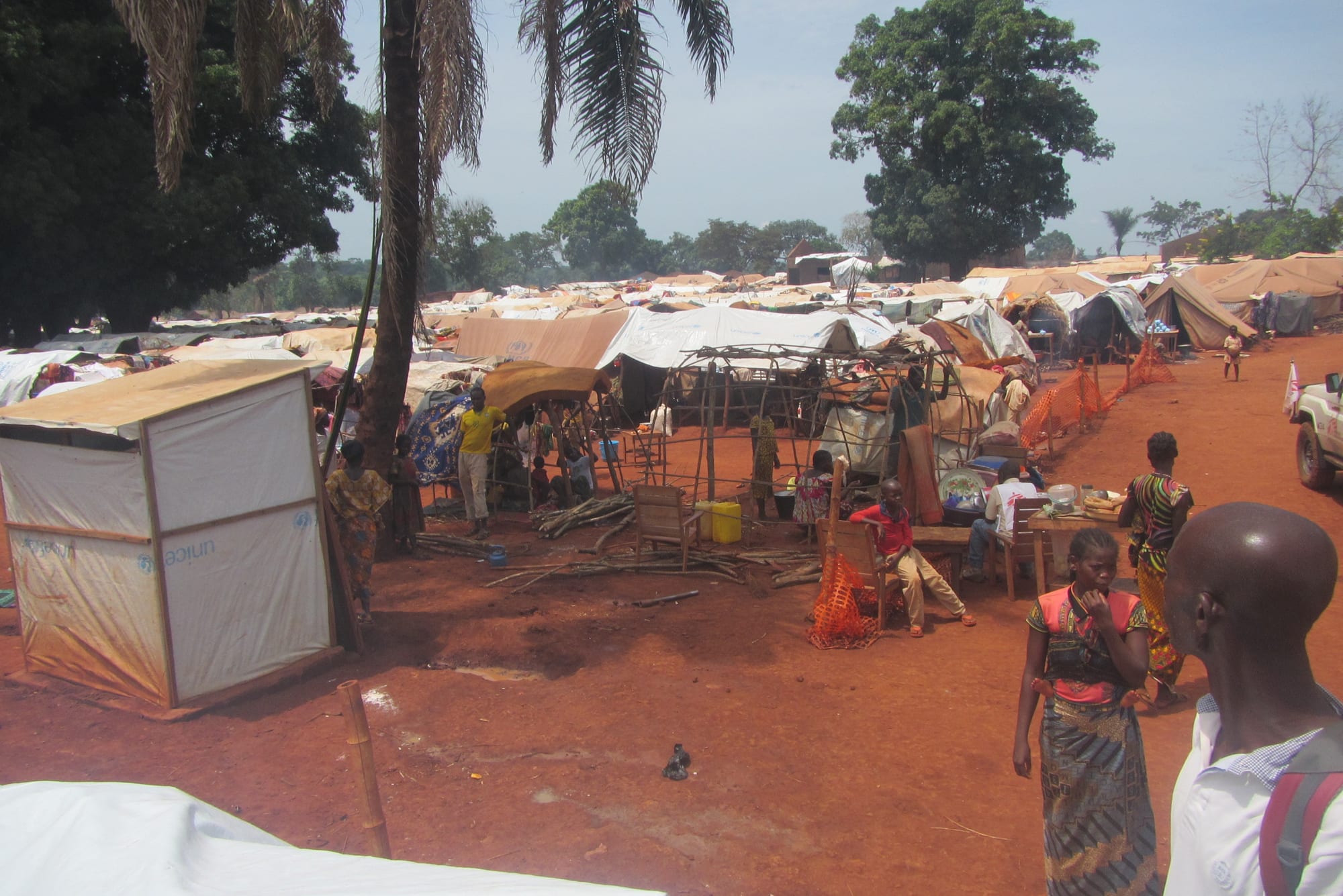
Rows of tarpaulin and thatch shelters spread across red earth under palms and trees, with people among them

Bangassou & the East, Central African Republic

Bria

The PK3 displacement site on the edge of Bria, photographed in 2018. (Freeman Sipila / Wikimedia Commons · Public domain)

The capital of the Haute-Kotto prefecture, on the Kotto river in the eastern savanna of the Central African Republic, about 610 kilometres north-east of Bangui by road. Diamond and gold digging built the town and still shape it, and since 2013 a large displacement site has stood on its edge. This page is written to explain the town, not to encourage travel.

Neighbourhoods

  • The town centre
    • First-time visitors
    • Markets
    • Administration

    The prefecture offices, the market and the shops stand along the main road through Bria. Diamond buying, trading and the little formal business the town does are concentrated here.

    Open in Maps
  • The riverside quarters
    • River views
    • Fishing
    • Local life

    Houses run down towards the Kotto, which flows past the town on its long course south-west towards the Ubangi. Water is drawn and clothes washed at the bank, and gardens are worked on the damp ground beside it.

    Open in Maps
  • PK3
    • Local life

    The site at the third kilometre point outside the centre, which since 2013 has held a large concentration of displaced people, supported by humanitarian agencies. It has at times held more people than the town itself.

    Open in Maps
  • The mining outskirts
    • Local life
    • Quiet and residential

    Compounds spread out along the roads towards the digging sites in the savanna, where pits and gravel washing are worked by hand. Settlements come and go with the ground being worked.

    Open in Maps

Things to do

In the town

  • Bria Airporttransit hub

    The airstrip in the southern part of the town, the practical way in and out of Haute-Kotto.

    Open in Maps

The river

  • The Kotto riverattraction

    A tributary of the Ubangi rising near the Sudanese border and running past Bria through rapids on its way south-west, and the river that names two prefectures.

    Open in Maps

Short trips from the town

  • Ippyattraction

    A town in the neighbouring Ouaka prefecture, a market stop on the road that links the diamond country with the centre of the country.

    Open in Maps
  • Yalingaattraction

    A remote settlement in the eastern savanna of Haute-Kotto, in country associated with gold and diamond digging.

    Open in Maps

Eat and drink

Long-standing places and food districts in Bria. Hours, ratings and directions come from your maps app, always current.

The market and local food

  • Bria marketmarket

    The town's market, where cassava and cassava flour, groundnuts, maize, okra, peppers, palm oil and dried fish are sold alongside soap, salt and other goods brought in by road or air.

    Open in Maps
  • Roadside grillsneighborhood

    Charcoal stalls near the market selling skewers of beef or goat and fried dough, the usual food bought ready-cooked in a town with no restaurant trade.

    Open in Maps
  • Fish from the Kottoneighborhood

    Fish taken from the river is sold fresh at the bank or smoked over slow fires for keeping, and is the protein most households can rely on.

    Open in Maps

Experience Bria

History

Bria grew as a colonial post and then on what lies under the ground around it. The French established themselves in the Haute-Kotto in country inhabited by Banda communities that had been raided for captives from the north in the nineteenth century, and in 1930 the Comouna cotton company built a ginning factory in the town. The alluvial diamond and gold workings of the Haute-Kotto, dug by hand from the river gravels, later made Bria the administrative and trading centre of a mining district, and diggers, buyers and traders came from across the country and beyond.

After independence in 1960 Bria remained a mining town and prefecture capital, its economy running on pits and gravel washing worked by hand and on the buyers who moved stones towards Bangui. Distance defined it: the road from the capital runs for hundreds of kilometres and fails for months of each year, so the town has always been supplied irregularly and expensively.

The crisis that began in 2013 hit the east hard, and control of the mining areas was part of what armed groups fought over. In 2013 the Kimberley Process, which regulates the trade in rough diamonds, suspended the Central African Republic from exporting them, cutting the legal market on which the town depended; a partial resumption from approved areas was allowed from 2015. Fighting in and around Bria repeatedly drove people from their homes, and the PK3 site on the edge of town grew into a large displacement site, supported by humanitarian agencies alongside a United Nations peacekeeping base.

Culture & Customs

The savanna around Bria is Banda country, and Banda communities — among the largest of the Central African peoples — make up much of the town, with Runga, Gula and other groups whose ties run north-east towards Chad and Sudan, and traders from elsewhere drawn by the diamonds. Sango is the shared language, with French for administration and local languages at home.

Bria is more religiously mixed than most towns of the south: a long-established Muslim community, many of them traders and cattle keepers, lives alongside Catholic and Protestant congregations, and the town has mosques as well as churches. That mixture was one of the fault lines of the violence after 2013, and the separation of quarters that followed is part of the town's present reality.

Mining shapes the culture as much as religion does. Digging is seasonal and collective, organised around teams and financed by buyers, and it draws young men from far away; the language of stones, licences and buyers is part of everyday talk. Music, drumming and dance mark weddings and funerals as elsewhere in the country, football is played on cleared ground, and radio — including stations run by humanitarian and peacebuilding organisations — is the medium that reaches furthest.

Daily Life

The 2003 census counted about 35,000 people in Bria. Since 2013 the population in and around the town has fluctuated sharply with displacement, and the PK3 site has at times held thousands of people in shelters of tarpaulin, thatch and timber.

Most households combine farming with digging. Cassava is the staple crop, with maize, groundnuts, sesame and vegetables, and fishing in the Kotto adds to it. Alluvial diamond and gold digging in the surrounding savanna is the cash economy, worked by hand with shovels, sieves and washing frames, and it remains unpredictable and dangerous work. Trade, transport and employment with aid agencies account for most of the rest.

Services are provided largely by others: agency clinics, water points and school feeding, with a hospital that depends on external support. Electricity comes from generators. Goods arrive by air or over the long road, so prices are high and supply irregular. The day begins early, before the heat, and ends soon after dark, and what people can do in a given week depends on the security of the roads and the mining areas.

Food

Bria eats the food of the eastern savanna. Gozo, the stiff cassava paste, is the staple, eaten by hand with a sauce; maize and sorghum porridge appear alongside it, and rice is an expensive import that arrives by road or air.

Sauces are made from pounded cassava leaves, okra, sorrel leaves, groundnut paste and sesame, cooked with palm oil and hot pepper. Fish from the Kotto, fresh or smoked, is the usual protein, and beef and goat are more common here than in the forest south because of the herds moved through the region; grilled skewers are sold near the market, and sweet tea is drunk in the Muslim quarters.

Wild foods matter in the lean months between harvests: caterpillars gathered when they swarm and fried or dried, mushrooms after the first rains, wild honey, and leaves and fruits from the bush. Mangoes grow around the compounds. Palm wine and home-brewed maize or sorghum beers are the village drinks. For families in the displacement site, distributions of maize, beans and oil have been a regular part of what is eaten.

Planning tools

Budget

Bria has no visitor economy. What a stay costs is what reaching and supporting it costs: humanitarian or charter flights, vehicles, fuel carried in, and security arrangements. Local produce in the market is cheap, but imported goods are expensive because everything arrives by air or over a very long road.

Daily Budget Midrange
USD 200–400 (compound or guesthouse accommodation with a vehicle and driver; flights and security arrangements cost far more)
Daily Budget Shoestring
USD 40–80 (basic local lodging and market food only, excluding any transport to the town)

There are no banking services in Haute-Kotto; all funds are carried in cash.

Best Time to Visit

November to mid-March is the dry season, the only period when the roads towards Bambari and Bangui are usable. The long rains from about mid-March to October cut them for months at a time. In practice the security situation, not the season, rules out travel to the east.

Suggested Number of Days

The town can be seen in a day. People who come for work stay longer because flights in and out are infrequent and have to be arranged, and because any movement in the prefecture is slow and planned around security.

First Visit
1 day
With Surroundings
2–3 days

Transportation

People walk, cycle or take motorcycle taxis in the town. Beyond it, the unpaved road runs west through Ippy to Bambari and on to Bangui, and tracks lead east and north into the savanna; all are slow, subject to roadblocks and banditry, and impassable in the rains. The airstrip is the reliable link.

Road journeys in Haute-Kotto are arranged with an organisation or not at all, and are not made after dark.

Airport & Station Connections

Bria lies roughly 610 kilometres north-east of Bangui by the national road through Bambari and Ippy, a journey of several days when it is possible. Most outsiders arrive by air at Bria Airport in the south of the town, on flights arranged through an agency or operator.

Walkability

The town is small and flat enough to cross on foot, with the market, the offices and the airstrip within a short distance of one another. Streets are of packed red earth, dusty in the dry months and muddy in the rains, and there is no street lighting after dark.

Safety

Bria has been repeatedly contested since 2013 by armed groups competing over the town and the mining areas around it, and the violence has driven large numbers of people into the displacement site outside the centre. A United Nations peacekeeping presence is based in the town. Most governments advise against all travel to the whole country, and the east is among its most remote and dangerous areas.

Globeway covers the Central African Republic so it can be understood, not to encourage travel there now. Any presence in Haute-Kotto is organised through an agency or specialist operator with current information. Check current official travel advice before travelling.

Climate

Tropical savanna, wetter than the far north and drier than the forest south. Rain falls in heavy storms through a long wet season, and the short dry season brings Harmattan haze and hot afternoons.

Summer
the long rains, roughly mid-March to October, about 21–31°C, humid with storms and roads cut
Winter
the dry season, November to mid-March, hot days of 32–35°C, hazy with dust, and cooler nights

Local Customs

Sango is the shared language and French is used in administration. Banda communities live across the savanna around the town, and Bria has a long-established Muslim minority, many of them traders. Greetings are formal, dress is modest, and religious observance shapes the week.

Photographing peacekeepers, soldiers, checkpoints, mining sites and the displacement site is not acceptable, and permission is asked before photographing anyone.

Common Payment Methods

The currency is the Central African CFA franc (XAF). Everything is paid for in cash, in small denominations; there are no cash machines and cards are not used. Diamond trading has long moved large sums in cash through the town.