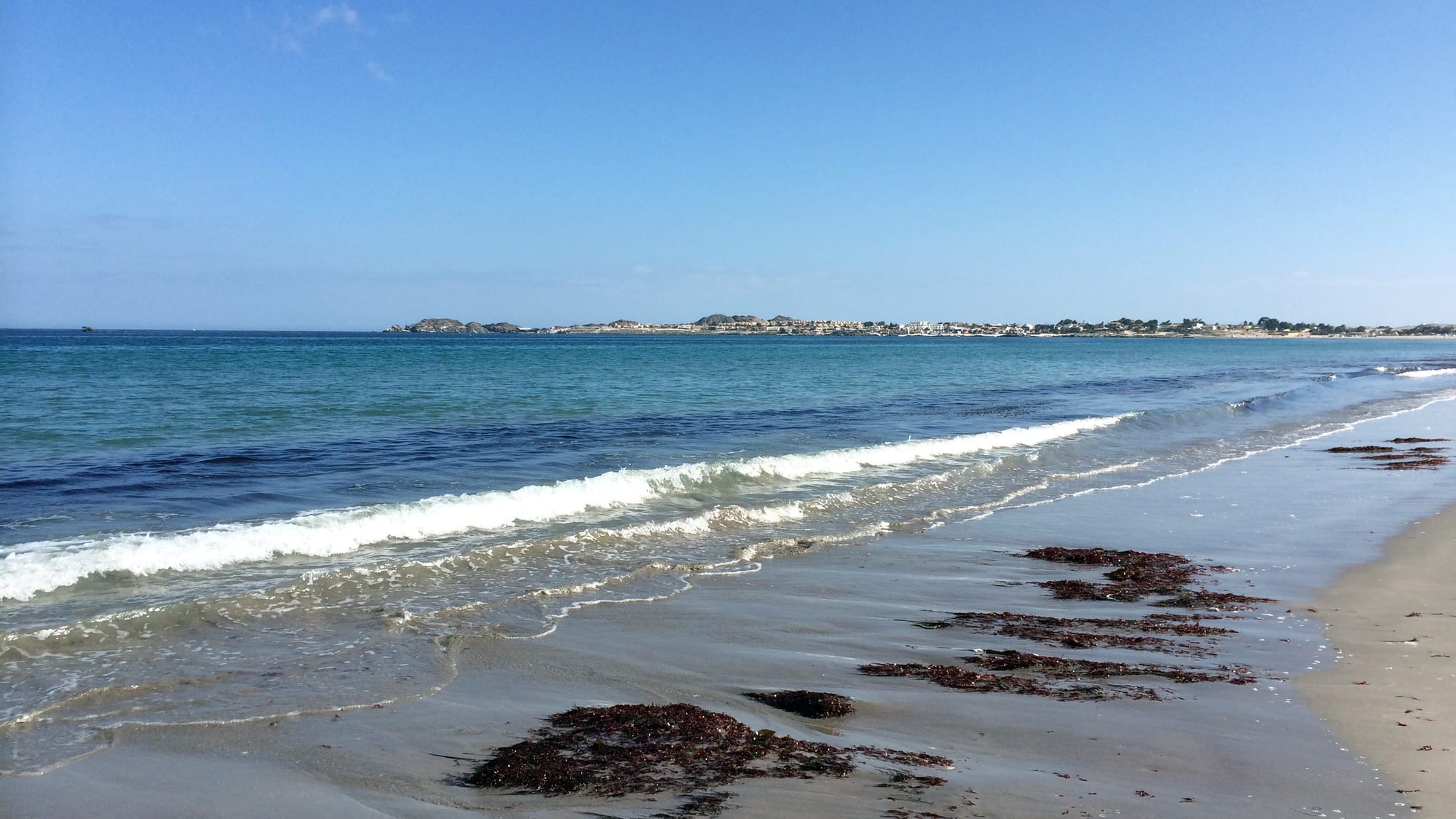
Small waves breaking on a wide sandy beach with seaweed, the low white houses of Bahía Inglesa far off across turquoise water

San Pedro de Atacama & the North, Chile

Bahía Inglesa

Bahía Inglesa seen across the bay from Las Machas beach to the south. (Sports Cars Fan / Wikimedia Commons · CC BY 2.0)

A small beach village on the Atacama Desert coast, about 6 km south of the port of Caldera, named after an English privateer's visit in 1687. Long ignored as a desolate fishing cove, it is now the best-known resort on this stretch of coast, with white shell-sand beaches, clear turquoise water, farmed scallops and fossil beds in the desert behind it.

Neighbourhoods

  • The village and seafront
    • First-time visitors
    • Beaches
    • Best for food

    The compact resort itself, a few streets of holiday houses, campsites and small hotels behind the main beach. Restaurants and bars along the waterfront road face the bay, and the calm, clear water in front of them is the reason most people come.

    Open in Maps
  • Las Machas and the southern beaches
    • Beaches
    • Quiet and residential
    • Camping

    South of the village the sand runs on for several kilometres towards Las Machas, a long beach with a view back across the bay to the village. Further along the shore lie the dark rocks of Rocas Negras and the fossil country of Los Dedos.

    Open in Maps
  • Caldera
    • Local life
    • Historic district
    • Close to public transport

    The port town 6 km to the north, with the main square, banks, shops and bus offices that the resort lacks. Its 19th-century railway station, wooden church and old cemetery recall the years when it shipped the silver and copper of the Copiapó mines.

    Open in Maps

Things to do

Beaches

  • Playa Bahía Inglesabeach

    The village's main beach of white sand made of broken shell, with clear, sheltered turquoise water that has made it one of the best-regarded beaches in Chile.

    Open in Maps
  • Playa Las Machasbeach

    A long, open beach to the south of the village, with a view back along the coast to the resort.

    Open in Maps
  • Rocas Negrasbeach

    A stretch of black rocks set in shell sand about 3 km south of the village along the beach, where large scallop shells wash up.

    Open in Maps

Fossils and the desert

  • Los Dedos fossil siteattraction

    An outdoor palaeontology park in the desert south of the village, showing fossils from the Bahía Inglesa Formation, a coastal rock layer rich in the remains of whales, sharks, penguins and other marine animals.

    Open in Maps
  • Cerro Ballenaattraction

    A fossil site beside the Pan-American Highway north of Caldera, excavated in 2011–12, where the skeletons of more than 40 whales were found, probably poisoned by toxic algae millions of years ago.

    Open in Maps

Caldera next door

  • Calderaneighborhood

    The port town to the north, terminus of the Caldera–Copiapó railway of 1851, with its old station building, the wooden Church of San Vicente de Paul of 1862 and Chile's first secular cemetery.

    Open in Maps

Short trips from the village

  • Copiapóattraction

    The capital of the Atacama Region, inland in the Copiapó valley, with the region's shops, services and long-distance buses.

    Open in Maps
  • Pan de Azúcar National Parkpark

    A national park on the desert coast north of Chañaral, created in 1985, where cactus-covered hills meet the sea and the offshore island of Pan de Azúcar is home to Humboldt penguins.

    Open in Maps

Eat and drink

Long-standing places and food districts in Bahía Inglesa. Hours, ratings and directions come from your maps app, always current.

Bahía Inglesa classics

  • Scallops and seafood on the seafrontneighborhood

    The waterfront restaurants and bars of the village serve the ostiones — scallops farmed in the bays around Caldera — along with fish and other shellfish from the Atacama coast.

    Open in Maps
  • Caldera's waterfrontneighborhood

    The port town next door has more everyday places to eat, including seafood restaurants and long-established empanada shops.

    Open in Maps

Experience Bahía Inglesa

History

The bay takes its name from a visit by the English privateer Edward Davis and his ship in 1687, after which it was known as the Puerto del Inglés, the Englishman's port. For more than two centuries little else happened here. Luis Risopatrón's geographical dictionary of Chile, published in 1924, described a deep bay with a sandy beach and a good landing for boats, used only by fishermen and opening onto completely desolate country without water or any other resource.

The history of the area belongs to Caldera, 6 km to the north. The port was founded in 1850 to serve the silver and copper mines inland, and the railway from Caldera to Copiapó, opened in 1851 with the backing of the American businessman William Wheelwright, was the first in Chile. Copper smelters worked in the port in the 1850s and again from the 1880s into the 20th century, and the coast was struck by earthquakes and tsunamis in 1868, 1877 and 1922.

Since then the fishing cove has become a beach resort, with campsites, hotels, restaurants and holiday houses. The 2017 census counted 535 residents and 1,234 dwellings. The desert behind the bay has also become known to science: the Bahía Inglesa Formation is one of the richest fossil beds in Chile, and at Cerro Ballena north of Caldera the skeletons of more than 40 whales were excavated in 2011–12.

Culture & Customs

Bahía Inglesa is above all a summer place. Its white beaches of crushed shell and its clear water are counted among the best in Chile, and in January and February families fill the holiday houses and campsites. Out of season it is a quiet village, with many houses shut.

Food has become part of its identity. For about a decade the beaches have hosted the Festival Internacional de Gastronomía Bahía Inglesa, Cocinas del Pacífico, which brings together cooking from countries around the Pacific; the eleventh edition, in 2025, invited China, Japan, South Korea, Thailand, Ecuador and Peru. Local identity is also tied to the sea's produce — scallops are farmed along this coast — and to the fossils of the surrounding desert, which give Caldera and Bahía Inglesa a place in Chilean palaeontology.

Caldera supplies the history: its wooden Church of San Vicente de Paul, built in 1862, holds an image of the Virgin of Sorrows brought from Peru after the War of the Pacific, and its municipal cemetery, opened in 1876, was the first secular cemetery in Chile, with cast-iron tombs made by English craftsmen. Manners are relaxed and informal, in the style of a Chilean beach town.

Daily Life

Bahía Inglesa is classed as a rural village, and the 2017 census counted about 540 permanent residents, along with 1,234 dwellings, many of them used only in summer. Most services — the bank, supermarkets, schools, bus offices — are in Caldera, the commune's town, and shared taxis run between the two.

The local economy is shared with Caldera. Copper mining and citrus growing inland supply the port, which exports minerals and fruit, and the Candelaria copper and gold mine ships its ore through the mechanised port of Punta Padrones. Fishing and tourism are the other mainstays, and in Bahía Inglesa itself tourism is almost everything: restaurants, cabañas, campsites and summer rentals.

The rhythm follows the seasons. In summer the beach and the seafront road are crowded from late morning until long after dark, while in winter the sea fog lingers, many businesses close and the village is left to its residents. Water, in one of the driest places on Earth, is a constant concern across the Atacama Region.

Food

The seafood of the Atacama coast is the basis of eating here. Ostiones, scallops farmed in the bays around Caldera and Bahía Inglesa, are the local speciality, eaten raw with lemon, grilled, or baked with grated parmesan cheese in the Chilean style known as a la parmesana. Machas (surf clams), locos (the Chilean abalone, in fact a large sea snail), fried fish and ceviche fill out the menus of the seafront restaurants.

Empanadas are the everyday food of the beach — baked empanadas de pino filled with minced beef, onion, egg and olive, or fried ones filled with cheese or seafood. Caldera has long-established empanada shops and simple seafood restaurants, and its markets and supermarkets supply the holiday houses and campsites.

To drink there is pisco, the grape brandy of northern Chile, served as a pisco sour or with cola as a piscola, along with Chilean beer and wine. The village's Pacific cooking festival, Cocinas del Pacífico, adds chefs and dishes from Asia and the rest of Latin America to the local repertoire for its duration.

Planning tools

Budget

Bahía Inglesa is cheaper than San Pedro de Atacama, but prices follow the Chilean holidays: January and February are the busiest and dearest months, when families fill the holiday houses and campsites. Outside summer rooms are easier to find and cheaper. Caldera has the banks, supermarkets and cheaper everyday food.

Daily Budget Midrange
USD 110–220 (cabaña or small hotel by the beach, seafood dinners, a hire car or taxis)
Daily Budget Shoestring
USD 45–80 (campsite or simple cabaña, supermarket food and empanadas, shared taxis to Caldera)

Stock up on cash and groceries in Caldera; the village itself has few services outside the summer season.

Best Time to Visit

The sea is the attraction, so the warmer months from December to March are the main season, with January and February the busiest. Spring and autumn are quieter and still mild, and the coast is dry all year. In years of unusual rain the flowering desert can appear inland in the Atacama Region in spring.

Suggested Number of Days

Two or three days are enough for the beaches and the town next door. Four or five allow time for the fossil sites, the national park to the north and the regional capital inland. A hire car makes the longer stay far easier.

First Visit
2–3 days
With Surroundings
4–5 days

Transportation

The village and its main beach are small enough to cover on foot. Shared taxis (colectivos) link it with Caldera in about 20 minutes. The fossil sites, the southern beaches beyond walking range and the national park need a car or a tour, as public transport does not reach them.

Drive the desert highways in daylight and carry water; distances between towns are long and services are few.

Airport & Station Connections

The nearest airport is Desierto de Atacama Airport, in the desert north of the Copiapó River about 16 km inland from the coast, with flights from Santiago; taxis and transfers run to Caldera and Bahía Inglesa. Long-distance buses on Route 5 stop at Caldera, and Copiapó is about 75 km inland by road.

Walkability

The village is a few streets deep and easily walked, and the beaches to the south can be followed on foot along the shore. The sun is strong and shade is scarce. Caldera is too far to walk comfortably and is reached by shared taxi or car.

Safety

Chile is one of the safer countries in South America, but petty and opportunistic crime has risen, especially in Santiago and Valparaíso — pickpocketing, bag-snatching, phone theft, and distraction scams in tourist areas, markets, and on transport. Violent crime against tourists is uncommon. Bahía Inglesa is a quiet resort; the main risks are theft from tents and parked cars on busy summer beaches, strong sun, and the earthquakes and tsunamis that have struck this coast several times.

Keep valuables out of sight on the beach and in cars, use sun protection, and follow the tsunami evacuation signs. Check current official travel advice before travelling.

Climate

A desert coast climate: mild all year and extremely dry, with the heat moderated by the cold ocean current. Morning sea fog is common, and wind often picks up on the open beaches.

Summer
December to February is warm, sunny and the main beach season; inland Copiapó averages about 22°C in January, and the cold sea keeps the coast from getting hot
Winter
June to August is cooler, often grey in the mornings and almost rainless; inland Copiapó reaches about 19°C by day in July, with nights around 7°C

Local Customs

A tip of about ten per cent is usual in restaurants and is often suggested on the bill. Swimwear belongs on the beach rather than in the streets or shops. Chileans greet acquaintances with a kiss on the cheek and strangers with a handshake. Drinking alcohol in public places is not allowed.

Ask before photographing people, and keep the beaches clean; the shell sand and clear water are what the village lives on.

Common Payment Methods

The currency is the Chilean peso (CLP). Cards are taken in most hotels and larger restaurants, but cash is useful for small shops, campsites and shared taxis. The nearest cash machines and bank are in Caldera.