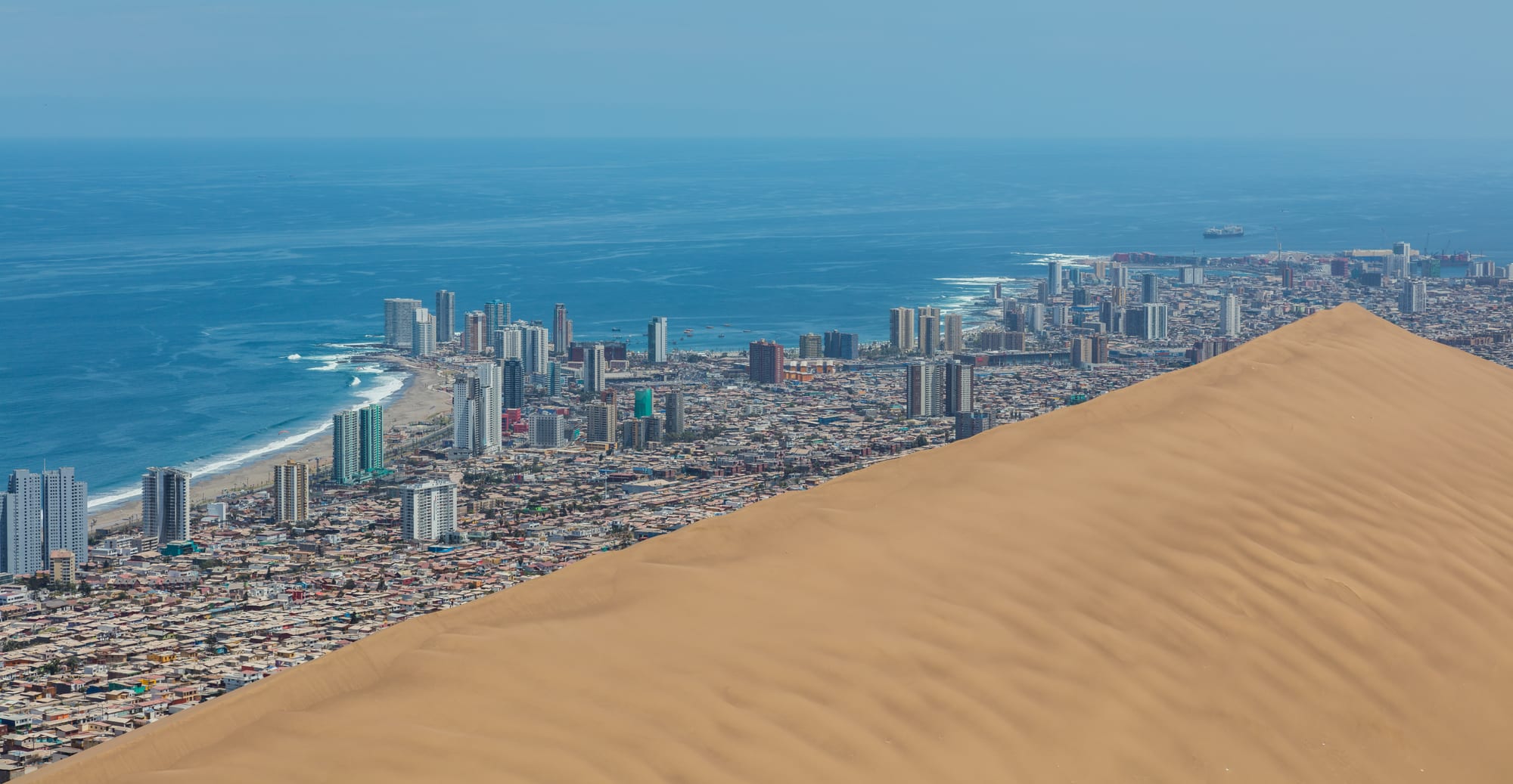
The ridge of a huge sand dune in the foreground, with Iquique's high-rise towers and the blue Pacific below

Arica, Iquique & the Far North, Chile

Iquique

Iquique and its beaches seen from the Cerro Dragón dune above the city. (Diego Delso / Wikimedia Commons · CC BY-SA 4.0)

The capital of the Tarapacá Region, a port squeezed between the Pacific and a steep desert escarpment, beside a vast dune. Nitrate made it rich in the 19th century, and Chile took it from Peru in the War of the Pacific; today it is a free port of high-rise beachfronts, timber nitrate-era mansions and a busy duty-free zone.

Neighbourhoods

  • Old quarter and Baquedano Street
    • First-time visitors
    • Historic district
    • Museums

    The heart of the nitrate-era city, around Plaza Arturo Prat with its clock tower and Municipal Theatre. Baquedano Street, a protected pedestrian avenue of timber mansions in Georgian and Victorian styles, runs from the square for almost fifteen blocks.

    Open in Maps
  • Cavancha
    • Beaches
    • Restaurants
    • Nightlife

    A peninsula and beach district a short way from the old quarter, lined with high-rise flats and hotels. Cavancha beach, sheltered by the peninsula, is the city's main place to swim, and the seafront promenade is busy into the evening.

    Open in Maps
  • Playa Brava and the southern coast
    • Surfing
    • Quiet and residential

    Further south the shore opens onto exposed beaches with strong undertow, backed by towers and parks, with newer residential districts such as Bajo Molle beyond the city limits.

    Open in Maps
  • ZOFRI and the north
    • Shopping
    • Close to public transport

    The port, warehouses and the duty-free zone on the north side of the city, where shoppers from across Chile, Bolivia and Peru come for cars, electronics and household goods. City buses link it to the centre.

    Open in Maps

Things to do

Historic Iquique

  • Baquedano Streetneighborhood

    A long avenue of the old quarter, now a pedestrian street and protected 'typical zone', lined with the timber houses of the nitrate era and their deep verandas.

    Open in Maps
  • Clock Towerlandmark

    A tower built in 1878, while Iquique was still Peruvian, with a mechanism imported from England, standing in Plaza Arturo Prat among the Municipal Theatre, the Spanish Casino and the Croatian Club.

    Open in Maps

Museums

  • Corbeta Esmeralda museummuseum

    A full-size replica of the corvette Esmeralda, sunk in the bay at the Battle of Iquique in 1879, opened as a museum in 2011.

    Open in Maps
  • Naval Museummuseum

    The Navy's museum, opened in 1983, displays objects recovered from the wreck of the Esmeralda and from other ships of the War of the Pacific.

    Open in Maps

Beaches and the desert edge

  • Cavancha beachbeach

    The city's main beach, sheltered by the Cavancha peninsula and safe for swimming, and the venue of the 2014 world bodyboarding championship.

    Open in Maps
  • Playa Bravabeach

    A long exposed beach south of Cavancha, where strong undertow makes swimming dangerous.

    Open in Maps
  • Cerro Dragónviewpoint

    The great dune rising behind the city, formed about 20,000 years ago by coastal winds and protected as a nature sanctuary since 2005.

    Open in Maps

Shopping

  • ZOFRImarket

    The free-trade zone's mall, where goods are sold without Chile's 19 per cent VAT, drawing shoppers for electronics, perfume and alcohol.

    Open in Maps

Short trips from the city

  • Humberstone and Santa Laura Saltpeter Workslandmark

    Two abandoned nitrate refineries and company towns in the desert, a UNESCO World Heritage Site since 2005, taken off the danger list in 2019 after conservation work.

    Open in Maps
  • La Tiranaattraction

    An oasis village on the Pampa del Tamarugal that holds the most important religious feast of the Norte Grande each July.

    Open in Maps
  • Alto Hospicioneighborhood

    The fast-growing commune on the heights above Iquique, part of Greater Iquique.

    Open in Maps

Seasonal events

  • Navy Day21 May

    The national holiday marking the Battle of Iquique, commemorated with special ceremony in the city off whose harbour it was fought.

  • Fiesta de La Tiranamid-July

    The feast of Our Lady of Mount Carmel in the oasis village inland, when costumed dance troupes and brass bands perform for days.

  • Christmas floatsDecember

    Decorated floats, many with live brass bands of the kind heard at La Tirana, tour the streets of Iquique and Alto Hospicio before Christmas.

Eat and drink

Long-standing places and food districts in Iquique. Hours, ratings and directions come from your maps app, always current.

Iquique classics

  • Chumbequecafe

    A sweet of Chile's far north, created in the region by a Cantonese immigrant and his wife in the nitrate era: layers of thin fried pastry filled with fruit-flavoured caramel.

    Open in Maps
  • Pisco sour with Pica limescafe

    The local version of the pisco sour is made with the small, sharp limes of the Pica oasis inland.

    Open in Maps

Food districts and markets

  • Chinatown around the central marketneighborhood

    The streets around the market are the city's Chinatown, full of chifa restaurants serving Chinese-Peruvian food, with cheaper sandwich bars between them.

    Open in Maps
  • Cavancha seafrontneighborhood

    Seafood restaurants and bars along the beachfront promenade and peninsula.

    Open in Maps

Experience Iquique

History

The Chango people fished this coast as early as 7000 BC, and the Incas later incorporated the area into their empire. Under Spain and then independent Peru, Iquique was little more than a landing place; when Charles Darwin called in 1834 he found a town short of water and firewood, both brought from far away. Guano and, above all, the nitrate deposits of the Atacama Desert inland turned it into a boom port in the mid-19th century, and its clock tower was built in 1878.

Territorial disputes between Bolivia and Chile led to the War of the Pacific. On 21 May 1879 the Peruvian ironclad Huáscar sank the Chilean corvette Esmeralda in the harbour, and Captain Arturo Prat, killed boarding the ironclad, became Chile's naval hero; the date is now Navy Day. The war gave Iquique to Chile, and the nitrate trade drew migrants from the rest of the country and from Europe and Asia, who built the timber mansions and clubs of the old quarter.

The boom had a brutal side. In December 1907 the army opened fire on thousands of striking nitrate workers and their families gathered at the Santa María school; the number killed is undetermined, with estimates from 500 to more than 2,000. Synthetic nitrate, made possible by the Haber–Bosch process, later ruined the trade. Revival came with industrial fishing from the 1950s, the free zone, ZOFRI, and large copper mines in the Andes. Earthquakes have repeatedly struck the city, including in 1868, 1877, 2005 and a magnitude 8.2 earthquake on 1 April 2014.

Culture & Customs

The nitrate era left Iquique with a cosmopolitan inheritance. Croatian, Italian, Greek, Chinese, Arab, British and French families settled here, and the Spanish Casino and the Croatian Club stand on Plaza Arturo Prat beside the Municipal Theatre, with the Chinese Club another landmark of the period. Many Peruvians and Bolivians live in the city, and about a thousand workers from British India arrived in the 1910s and 1920s, their descendants now part of the local population.

The Santa María massacre remains central to the city's memory and to the Chilean labour movement; the folk group Quilapayún's Cantata Santa María de Iquique of 1970, one of the group's most acclaimed recordings, tells its story, and a week of events marked its centenary in 2007. Unions of port, free-zone and mining workers are still influential.

Religious festivals bring the Andean world to the coast. Brass bands of the kind heard at La Tirana's July feast play on many of the floats that tour Iquique and Alto Hospicio before Christmas. Sport is part of daily life: Deportes Iquique is the football club, and Cavancha hosted the world bodyboarding championship in 2014.

Daily Life

The 2024 census counted about 200,000 people in the commune of Iquique, and Alto Hospicio on the plateau above has grown into a separate city that, with Iquique, forms Greater Iquique. Squeezed between sea and escarpment, the city has little flat land, so it has grown upwards: towers of more than 25 floors line Cavancha and Playa Brava, while new residential districts spread south towards Bajo Molle.

ZOFRI, the free zone, and the port are the backbone of the economy, alongside copper mines such as Collahuasi in the Andes, salt from the Salar Grande, fishing and tourism. Iquique is Chile's largest fishing port, mostly for anchovy and jack mackerel turned into fishmeal and fish oil, and its port handles much of the country's imports of used clothing.

Life is lived outdoors on the seafront, with surfing, bodyboarding and evening walks. The shortage of buildable land inside the city limits, which pushes new housing into towers or beyond the urban boundary, is a recurring concern.

Food

Iquique's food mixes the Pacific with the legacy of its Chinese community. The area around the central market is the city's Chinatown, and chifa — the Chinese-Peruvian cooking of stir-fried rice, noodles and meats — is everyday food. The chumbeque, a sweet of the far north, was created in the region by a Cantonese immigrant and his wife: thin layers of fried pastry filled with fruit-flavoured caramel.

The sea supplies ceviche, fried fish and seafood dishes in restaurants along Cavancha and around the port, as elsewhere on the northern coast, although most of the catch landed at Chile's largest fishing port is turned into fishmeal and oil rather than eaten. Inland oases add fruit: the small, sharp limes of Pica give the local pisco sour its character, and Pica and Matilla are known for fruit desserts, above all alfajores, biscuits sandwiched with sweet filling.

Empanada shops in the centre serve turnovers for a quick lunch, and the malls have the usual fast-food chains.

Planning tools

Budget

Iquique is a little more expensive than Arica but still moderate by Chilean standards, with set lunches, chifa restaurants and hostels near the beaches. Duty-free shopping in ZOFRI can save money on electronics and alcohol. Hotels on the seafront cost more, and trips inland to the nitrate works and oases add tour or car-hire costs.

Daily Budget Midrange
USD 95–180 (seafront hotel, restaurant dinners, a guided tour inland or a hire car)
Daily Budget Shoestring
USD 40–70 (hostel bed, set lunches and chifa, city buses and shared taxis)

Baquedano Street, the clock tower and the beaches cost nothing; ZOFRI has a per-person spending limit on duty-free purchases.

Best Time to Visit

Iquique is mild and dry all year. Summer, December to February, is the busiest beach season, when Chilean holidaymakers arrive; winter is cooler and often grey with morning cloud. July brings the La Tirana festival inland, and 21 May the Navy Day ceremonies.

Suggested Number of Days

Two or three days are enough for the old quarter, the museums and the beaches. Allow four or five to include the desert inland, where distances are long and most visits are made by tour or hire car.

First Visit
2–3 days
With Surroundings
4–5 days

Transportation

City buses run along the main streets and link the centre with ZOFRI, and shared taxis on fixed routes are faster. The beaches are within walking distance of the centre. A tour or hire car is the usual way to reach the nitrate works, La Tirana and the oases.

Long-distance buses use several terminals, including a main one north of the centre; check which one a ticket names.

Airport & Station Connections

Diego Aracena International Airport lies on the coast about 48 kilometres south of the city, with frequent flights from Santiago and some from Peru, Bolivia and Argentina. Buses run from Arica in about five hours, and from Antofagasta, Calama and Santiago, about a day away by road, as well as from La Paz and Oruro in Bolivia.

Walkability

The old quarter is compact and flat, and Baquedano Street is pedestrian. Cavancha and the beaches are a walk south from the centre along the seafront. ZOFRI and the bus terminals are further, and Alto Hospicio and the dune need transport.

Safety

Chile is one of the safer countries in South America, but petty and opportunistic crime has risen, especially in Santiago and Valparaíso — pickpocketing, bag-snatching, phone theft, and distraction scams in tourist areas, markets, and on transport. Iquique also lies in a zone of strong earthquakes, the most recent major one in 2014, and some beaches have dangerous currents.

Swim only at sheltered beaches such as Cavancha, learn the tsunami evacuation routes, and carry water and sun protection on desert trips. Check current official travel advice before travelling.

Climate

A mild desert climate with little change through the year, frequent cloud and almost no rain; completely dry years are common. Summer is December to February.

Summer
warm and sunny, roughly 20–28°C by day
Winter
mild and often overcast in the mornings, roughly 14–20°C by day

Local Customs

A tip of about ten per cent is usual in restaurants. Iquique is proud of its part in the War of the Pacific and of Arturo Prat, and the 21 May commemorations are serious occasions. Nitrate-era communities left clubs such as the Spanish Casino and the Croatian Club on the main square.

Ask before photographing dancers and pilgrims at La Tirana, and dress modestly in churches.

Common Payment Methods

The currency is the Chilean peso. Cards are widely accepted in shops, malls and restaurants, and cash machines are common in the centre. Cash is useful for shared taxis, market stalls and small shops inland.