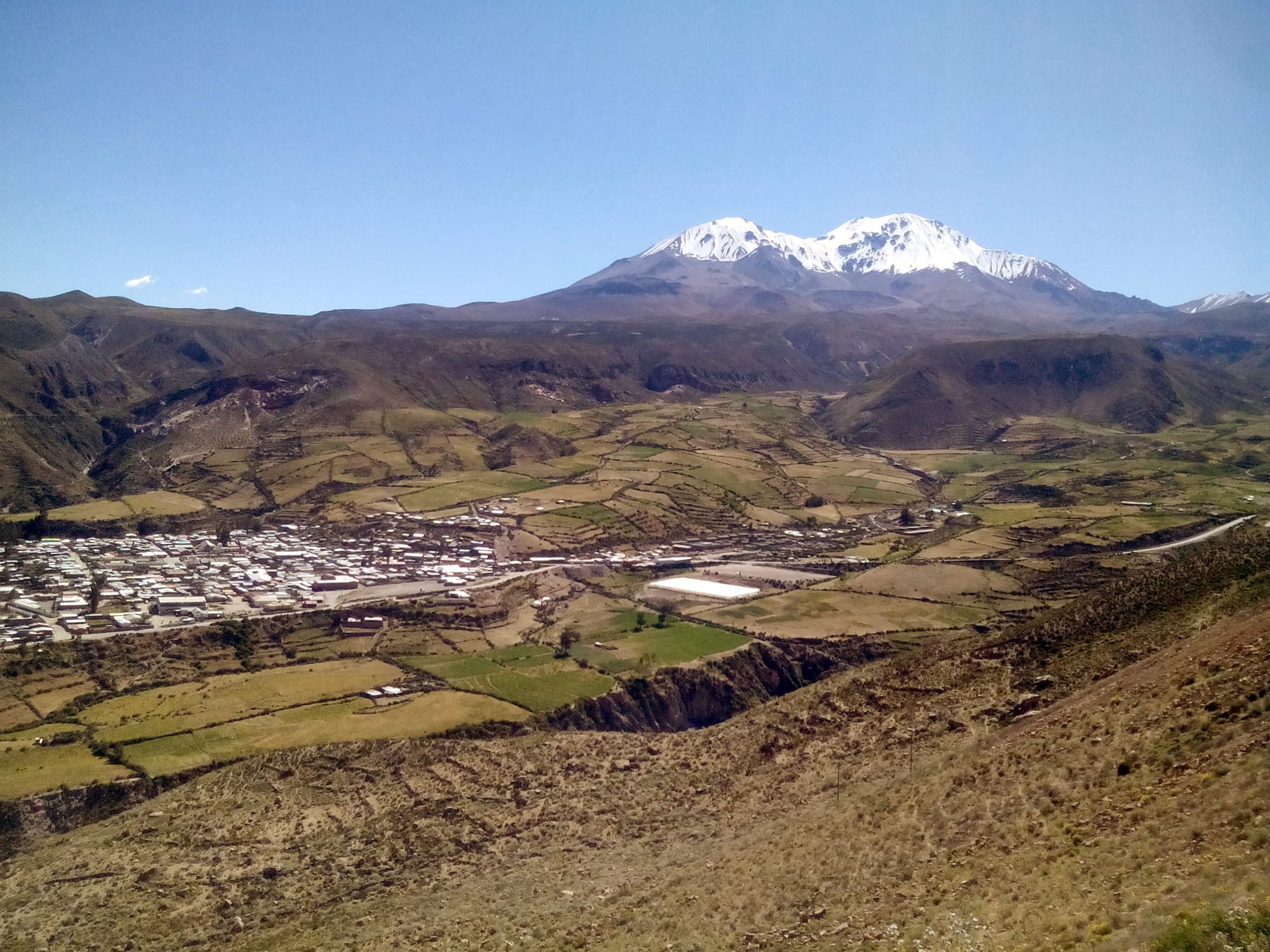
A small town of white and tin roofs among green terraced fields, with a snow-capped volcano behind under a blue sky

Arica, Iquique & the Far North, Chile

Putre

Putre and the Taapaca volcano seen from a lookout on Route 11 above the village. (WeHaKa / Wikimedia Commons · CC BY-SA 4.0)

An Aymara village at about 3,500 metres in the Andes east of Arica, set among farming terraces below the snow-capped Taapaca volcano. Once a rest stop on the Inca road to the silver of Potosí, it is now the capital of Parinacota Province and the place where travellers spend a night adjusting to the altitude before Lauca National Park.

Neighbourhoods

  • The village centre
    • First-time visitors
    • Historic district

    A small grid of stone and adobe houses around a tree-shaded square with the church, the municipality and the parish house. Calle O'Higgins, the oldest street, has a water channel down the middle crossed by stone bridges with benches, and many doorways keep carved 17th-century stone frames.

    Open in Maps
  • The terraces and the edge of town
    • Walks
    • Countryside

    Below and around the village, terraced fields in the ravine of the Chilcacahua river grow alfalfa, oregano, potatoes and vegetables, and llama and alpaca corrals stand at the entrance to town. Route 11 and the Alto Putre junction lie above.

    Open in Maps

Things to do

In the village

  • Church of San Ildefonsolandmark

    An adobe church first recorded in 1618 and rebuilt after an earthquake, largely of the late 19th century, with a carved stone doorway inscribed 1871, a free-standing bell tower and a pale blue painted stone altarpiece of the 1890s; it is a National Monument.

    Open in Maps
  • Calle O'Higginsneighborhood

    The village's oldest street, with its central water channel, stone footbridges and houses reusing carved colonial stonework.

    Open in Maps
  • Taapacaviewpoint

    The volcanic complex of lava domes whose snowy summit rises directly above the village; its last eruption is dated to about 320 BC.

    Open in Maps

Short trips from the village

  • Lauca National Parkpark

    A park of 1,379 square kilometres of altiplano and huge volcanoes on the Bolivian border, with vicuñas, vizcachas, flamingos and Andean geese.

    Open in Maps
  • Chungará Lakeviewpoint

    One of the world's highest lakes, at 4,517 metres, formed when the collapse of the Parinacota volcano dammed the Lauca River; the volcano rises north of the lake.

    Open in Maps
  • Cotacotani Lakeviewpoint

    A lake scattered with islands of old lava close to Chungará, which can be reached on foot by a long walk between the lagoons and Parinacota village.

    Open in Maps
  • Parinacotaattraction

    An Aymara hamlet in the national park with a whitewashed colonial church about four centuries old.

    Open in Maps
  • Socoromaattraction

    An old Aymara village off Route 11 below Putre, with a church restored in 2012 under a traditional roof of timber bound with leather, and terraces known for their oregano.

    Open in Maps

Seasonal events

  • Carnaval de PutreFebruary

    The village carnival, one of the main festivals of the church year in Putre.

  • Virgen de la Asunta15 August

    The patron-saint feast, with dances in the streets of the village.

  • Pachayampeearly November

    The potato festival, which in the villages of the area honours the Pachamama, water and seeds.

  • Feria Regional Andinalate November

    A fair of altiplano livestock, crafts, folk music and tourism, held alongside a festival of Andean song.

Eat and drink

Long-standing places and food districts in Putre. Hours, ratings and directions come from your maps app, always current.

Putre classics

  • Alpaca and llaitarestaurant

    Alpaca meat and llaita, a freshwater alga, are the village's local specialities, served alongside set menus of soup and Chilean home cooking.

    Open in Maps
  • Coca and chachacoma teacafe

    Mate de coca and mate de chachacoma, herbal teas drunk to ease the symptoms of altitude sickness, sometimes mixed together.

    Open in Maps

Experience Putre

History

Putre's Aymara name, Putiri, means "murmur of waters". When the Spanish arrived it was a busy tambo, a rest house on the Inca road that led to the mines of Potosí and linked the villages of the foothills. During the colonial mining boom it became a centre of farming and a resting place on the way to the mines; Spanish and mestizo families from southern Peru and Bolivia settled from about 1580. A church built in 1670 replaced one destroyed by an earthquake that chroniclers described as covered in gold and silver; the present building is largely of the late 19th century.

With Peruvian independence and the decline of Potosí, many Spanish settlers left. A census of 1750 recorded 233 Aymara inhabitants, and the Peruvian census of 1879 found the population entirely Aymara. During the War of the Pacific the Peruvian army kept oxen here and in the Lluta valley to supply its garrisons at Tacna and Arica. After the peace of 1883, in the years of Chilenisation, Putre was a centre of Peruvian cultural resistance, led by villagers who kept up their campaign into the 1920s.

In the 20th century Putre became the capital of Parinacota Province, created in 1979, and the gateway to Lauca National Park. A deep earthquake of magnitude 6.2 in March 2011 caused only minor damage, and in 2020 solar panels were installed on fifty village houses that were not connected to the power grid.

Culture & Customs

Putre's history and culture are bound up with the Aymara people, and many families keep fields, llamas and alpacas. The church of San Ildefonso, a National Monument, anchors the calendar: the carnival in February, the feast of the Virgen de la Asunta on 15 August with dances in the streets, and Pachayampe, the potato festival, in early November.

Late November brings the Feria Regional Andina, a fair of livestock, crafts, folk music and tourism from across the altiplano, together with a festival of Andean song. Goods of alpaca wool are sold in the village. The feast of Cristo Rey is marked with a procession to a grotto in the La Barranca ravine, and the village's Aymara name, Putiri, means 'murmur of waters'.

The village is small and close-knit, and visitors are noticed. Travellers on their way to the national park are a familiar sight. A quiet, unhurried manner fits the place, and so does the altitude, which slows everyone down.

Daily Life

The 2024 census counted about 1,500 people in the whole commune of Putre, which covers almost 6,000 square kilometres of mountains and altiplano and includes villages such as Socoroma, Belén, Parinacota and Caquena. The town is the main urban centre of the region's highlands, home to the provincial government, the municipality and the local radio station around the square.

The economy rests on livestock, commerce and tourism. Terraces in the ravine below the village grow alfalfa, oregano, potatoes and vegetables, and llamas and alpacas are raised in corrals at the edge of town, many of them for export. Route 11, which passes above the village on its way to the Bolivian border at Chungará, is the main road link between Arica and Bolivia.

Daily life follows the strong sun and cold nights of the mountains. Mobile and internet connections exist but are slow. Depopulation is the long-running concern: the commune lost nearly a third of its people between the 1992 and 2002 censuses, and has kept shrinking since.

Food

Highland food in Putre is simple and filling. Alpaca meat is a local speciality, and llaita, a freshwater alga gathered in the highlands, is another. The village restaurants serve set menus of Chilean home cooking that begin with soup.

Potatoes are central: the region grows many varieties, and chuño, potatoes freeze-dried by exposing them to the frost of the winter nights and the strong sun by day, is a traditional technique of the Andes. Oregano grown on the terraces of Putre and nearby Socoroma is a distinctive crop of the area; the terraces of the Chilcacahua ravine below the village also grow potatoes, alfalfa and other vegetables. Maize from Socoroma is prized for its sweetness.

The drinks are as much medicine as refreshment: mate de coca, made from coca leaves, and mate de chachacoma, from an Andean plant, are drunk to ease the headaches and breathlessness of altitude sickness, sometimes mixed together.

Planning tools

Budget

Putre has a handful of simple guesthouses, lodges and set-menu restaurants. The main costs are getting there and touring Lauca National Park, which most visitors do with a local tour operator or a hire car from Arica; there is little public transport beyond the village.

Daily Budget Midrange
USD 95–180 (heated lodge or bungalow, restaurant meals, a guided tour of Lauca or a hire car)
Daily Budget Shoestring
USD 40–70 (simple guesthouse room, set-menu meals, the bus from Arica)

Bring enough cash from Arica, and warm clothes: rooms in simpler guesthouses are often unheated.

Best Time to Visit

The village can be visited all year. Rain falls mostly between December and March, when storms can affect roads on the altiplano; April to November is drier and clearer, with cold nights. August's patron-saint feast and the November fairs and harvest festival bring the village to life.

Suggested Number of Days

One night is the minimum, since its purpose is to adjust to the altitude before going higher. Two or three more allow a slower look at the national park and the surrounding villages; storms in the wet season and roadworks can add time.

First Visit
1–2 days
With Surroundings
3–4 days

Transportation

The village itself is walkable. Beyond it, Route 11, the main road between Arica and Bolivia, passes above the village; local tour operators run trips into Lauca National Park and to the Salar de Surire, and some visitors drive themselves.

There are no filling stations on Route 11 beyond Arica, so fill the tank there.

Airport & Station Connections

Putre is about 130 kilometres east of Arica, roughly two and a half hours by car on Route 11, though roadworks often add delays. A daily bus runs from Arica and back, and international buses between Arica and La Paz stop at the Alto Putre junction, about 5 kilometres uphill from the village. Arica's Chacalluta airport is the nearest.

Walkability

The village is small enough to cross on foot in a few minutes, and paths lead out to the terraces. At this altitude walking uphill is tiring, so it is best to go slowly after arrival.

Safety

Chile is one of the safer countries in South America, but petty and opportunistic crime has risen, especially in Santiago and Valparaíso — pickpocketing, bag-snatching, phone theft, and distraction scams in tourist areas, markets, and on transport. In Putre the real hazards are natural: altitude sickness, strong sun and cold, and minefields in border areas.

Spend a night in Putre before going higher, take it easy on arrival, and before hiking off the beaten track discuss the route with local people or the authorities. Check current official travel advice before travelling.

Climate

A high-mountain climate: sunny, dry and cool for most of the year, with rain concentrated between December and March. Summer is December to February.

Summer
the wet season, with afternoon showers; temperatures rarely reach 20°C
Winter
the dry season, with clear skies and cold nights; in Lauca National Park above the village, days average 12–20°C and nights −3 to −10°C

Local Customs

Putre is an Aymara village, and the church and its feast days are at the centre of community life. Visitors are welcome at festivals but should behave as guests. Tipping of about ten per cent is usual in restaurants.

Ask before photographing people, their houses or their animals, and dress modestly in the church.

Common Payment Methods

The currency is the Chilean peso. Cards are not always accepted in a village this small, so carry enough cash from Arica for lodging, meals and tours.