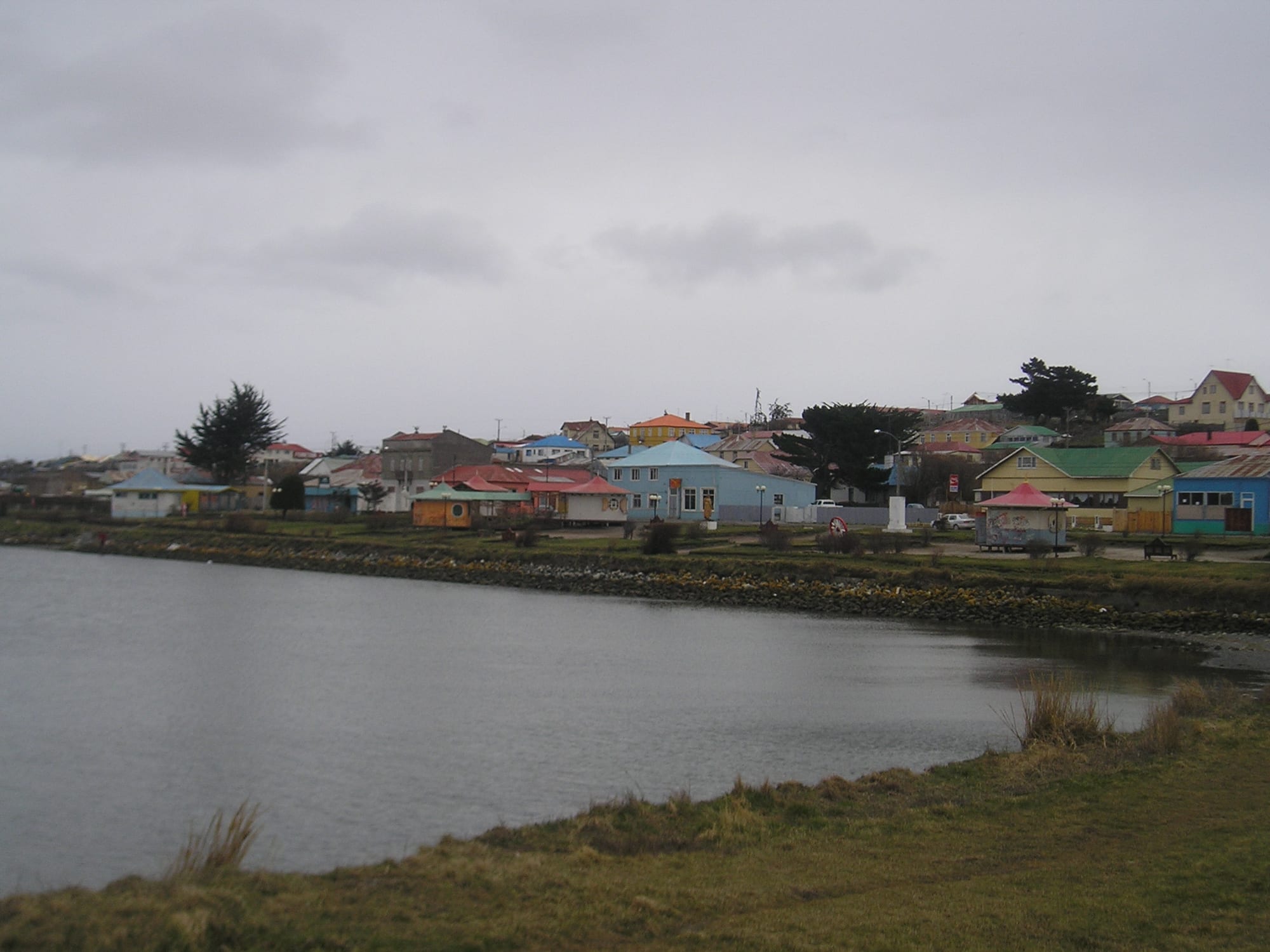
Colourful wooden houses with red, blue and green roofs along the grassy shore of a calm bay under a grey sky

Torres del Paine & Magallanes, Chile

Porvenir

The waterfront of Porvenir on the bay of the same name, Tierra del Fuego. (Heretiq / Wikimedia Commons · CC BY-SA 2.5)

The capital of the Chilean province of Tierra del Fuego and the largest settlement on the Chilean half of the island, facing Punta Arenas across the Strait of Magellan. Porvenir grew out of the gold rush of the 1880s and the sheep boom that followed; today it is a quiet town of painted wooden houses, a regiment and small fishing boats, and the base for trips onto the Fuegian steppe.

Neighbourhoods

  • The waterfront (Costanera)
    • First-time visitors
    • Birdwatching
    • Walks

    The shore road around Porvenir Bay, lined with old houses, small parks and monuments to the town's pioneers and Croatian settlers. Flamingos and black-necked swans feed along the water's edge, and the road curves south around the bay to a lookout over the whole town.

    Open in Maps
  • Town centre
    • Close to services
    • Museums
    • Historic buildings

    The few streets of shops, restaurants, hotels and the bank behind the bay, with the provincial museum and the old Salesian church. Everything is within a short walk.

    Open in Maps
  • Upper town
    • Quiet and residential
    • Views

    The higher ground above the centre, where houses spread up the slope towards the army base. It is residential and quiet, with wide views over the bay and the strait.

    Open in Maps

Things to do

In town

  • Fernando Cordero Rusque Provincial Museummuseum

    The provincial museum, created in 1980, with photographs and archaeological material on the Selk'nam and displays on the discovery and mining of gold on the island.

    Open in Maps
  • Church of San Francisco de Saleslandmark

    A Salesian church opened in 1904 through the efforts of the Italian missionary priest José Fagnano, now kept as a historic complex and museum.

    Open in Maps
  • Parque del Recuerdopark

    A small park on the waterfront displaying machinery once used by the region's pioneers, near the Croatian park and the monument to the pioneers.

    Open in Maps
  • The Miradorviewpoint

    The lookout at the southern end of the shore road around the bay, from which the whole town can be seen.

    Open in Maps

Nature near town

  • Laguna de los Cisnes Natural Monumentpark

    A protected brackish lagoon about 6 km north of town, with seven islets, black-necked swans, Chilean flamingos and migratory shorebirds, and one of the few places in South America where stromatolites can be seen.

    Open in Maps

Short trips from the town

  • King Penguin Park, Inútil Baypark

    A privately run reserve on the eastern shore of Inútil Bay where a small colony of king penguins lives all year, watched from designated viewing areas with limited visitor numbers.

    Open in Maps
  • Cerro Sombreroattraction

    A village founded in 1958 by the state oil company ENAP as a services centre for its oilfields, built with its own gym, cinema, church and botanical garden.

    Open in Maps

Eat and drink

Long-standing places and food districts in Porvenir. Hours, ratings and directions come from your maps app, always current.

Eating in Porvenir

  • Town-centre restaurantsneighborhood

    A handful of restaurants in the centre, where the region's lamb and seafood from the strait are the usual fare.

    Open in Maps
  • Shops and supermarketsmarket

    Several small stores and supermarkets around town supply picnics and self-catering for trips out onto the island, where services are few.

    Open in Maps

Experience Porvenir

History

Before settlers arrived, the land around Porvenir had no permanent villages but lay within the traditional territories of the Selk'nam and Haush peoples, who moved across the steppe according to family ties. Its modern story began with gold. A police post was set up in 1883 during the gold rush on Tierra del Fuego, and immigrants from Croatia and Chiloé came to work the deposits; the wider rush that followed, from 1884 to 1906, drew Chilean, Argentine and Dalmatian miners to the island. The early settlement was rough: by 1894 it consisted of five houses, two of them liquor stores and a third a brothel.

Porvenir — Spanish for "hereafter", literally "yet to come" — was officially founded by presidential decree on 20 June 1894, at the request of the governor, Manuel Señoret, as Chile colonised the island and handed it to sheep estancias. The gold rush and the ranches together drove the Selk'nam genocide, in which the Selk'nam population fell from about 4,000 in the 1880s to a few hundred by the early 1900s; many survivors were sent to Salesian missions on Dawson Island. The Salesians later extended their work to Porvenir, opening the church of San Francisco de Sales in 1904.

As the gold ran out, most miners left, and those who stayed turned to sheep farming and fishing during the wool boom that made Tierra del Fuego a major producer. The town became the capital of the Chilean province of Tierra del Fuego, and it remains the island's administrative centre, with an army regiment and a high-security prison alongside its farms and fishing boats.

Culture & Customs

Porvenir's identity rests on its pioneers. Croatian families were among the first settlers, and the waterfront keeps a Croatian park and a monument to the pioneers, along with a park of machinery once used by the region's pioneers. Many local families trace their roots to Chiloé as well, and the mix of Croatian and Chilote heritage runs through the town's surnames and its pride in having built a community at the edge of the continent.

The Selk'nam are remembered above all in the Fernando Cordero Rusque Provincial Museum, created in 1980, whose photographs and archaeological collections are displayed beside the story of the gold discoveries. The old Salesian church, kept as a historic complex and museum, recalls the missions that played a contested part in that history.

Each year Porvenir and Río Grande, in Argentina, take turns as the start or finish of the Gran Premio de la Hermandad Argentino-Chilena, a car rally across the island. Football is organised through a local association of three clubs, and matches are played at the municipal stadium on synthetic grass because of the climate. Life is informal and practical, shaped by wind, long winter nights and the crossing to Punta Arenas.

Daily Life

Porvenir is a small place of about 6,800 people (2017), and it is the most populous settlement in the Chilean part of the island. It is the capital of both its commune and the province of Tierra del Fuego, and it is home to an army regiment and a high-security prison.

The economy rests on sheep farming, small-scale fishing and the processing of frozen fish and seafood. Wrecks in the bay keep large ships from mooring, so fishing boats are small. An abattoir works for only short periods of the year, some gold is still mined commercially, and tourism is growing slowly, though many visitors pass through on their way elsewhere on the island. The town has a small hospital, with more serious cases sent to Punta Arenas, three schools, a fire brigade dating from 1928 and a crowd of local radio stations.

Daily rhythms follow the ferry and the weather. Supplies and visitors come across the strait from Punta Arenas, patients needing more complex care are sent there, and wind can delay the crossing. Summer brings very long days and birdwatchers on the lagoons; winter brings frost, snow and only a few hours of light.

Food

Porvenir eats in the style of Magallanes as a whole. Cordero magallánico, lamb raised on the Fuegian and Patagonian steppe and roasted for hours beside an open fire, is the dish of estancias and family gatherings, and sheep farming still surrounds the town. The cold waters of the strait supply centolla, southern king crab, as well as centollón, a smaller crab, sea urchins, mussels and southern hake, and the processing of frozen fish and shellfish is one of the town's main industries.

Calafate, the dark blue berry of a thorny Patagonian shrub, flavours jams and ice cream across the region, with the local legend that whoever eats it will return. Across Magallanes, Croatian and German settlers brought cakes and pastries. Everyday Chilean staples such as empanadas, cazuela stew and the loaded Chilean hot dog are eaten across the country, Porvenir has several restaurants, and the small stores and supermarkets stock the supplies for picnics on trips out across the island, where services are scarce.

Planning tools

Budget

Porvenir is cheaper than Torres del Paine but has the far-south prices of the rest of Magallanes. Accommodation is limited to a few hotels and guesthouses, and the largest costs are the crossing from Punta Arenas and the excursions to the penguins and the south of the island, which need a tour or a hire car.

Daily Budget Midrange
USD 150–290 (hotel, restaurant meals, a day excursion or a hire car)
Daily Budget Shoestring
USD 55–95 (guesthouse room, supermarket food, the ferry crossing)

Services across Chilean Tierra del Fuego are sparse, so fuel, food and cash are worth arranging in Porvenir before heading out.

Best Time to Visit

October to April, when days are long and excursions run, with December to February the warmest months. The king penguins live at Inútil Bay all year. Winter brings short days, frost and snow, and fewer visitors.

Suggested Number of Days

The town itself needs a day or less. Allow three or four days to reach the far sights of the island by tour or hire car, and extra time in case wind delays the crossing back to Punta Arenas.

First Visit
1–2 days
With Surroundings
3–4 days

Transportation

The town is small enough to cover on foot. Buses and radio taxis meet the ferry at Bahía Chilota, outside town. Beyond Porvenir the island is reached by gravel and paved roads across open steppe, by hire car or on day excursions that can be booked in town.

Distances on the island are long and fuel stations are few; drive slowly on gravel and allow for strong side winds.

Airport & Station Connections

Ferries run by Transbordadora Austral Broom cross the Strait of Magellan from the Tres Puentes terminal, at the northern end of Punta Arenas, to the Bahía Chilota terminal about 5 km from Porvenir, carrying cars and foot passengers. Small planes fly from Punta Arenas to Capitán Fuentes Martínez Airport, 5 km north-east of town. By road, Porvenir is reached from the Argentine side of the island or from the northern ferry crossing between Punta Delgada and Bahía Azul.

Walkability

Porvenir is compact and easy to walk: the centre, the museum and the shore road around the bay are all close together. Wind and cold, rather than distance, are the limits, and anything beyond the town needs wheels.

Safety

Porvenir is a small, quiet town, and the main hazards are natural: wind, cold, sudden changes in the weather and long empty roads with few services.

Chile is one of the safer countries in South America, but petty and opportunistic crime has risen, especially in Santiago and Valparaíso — pickpocketing, bag-snatching, phone theft, and distraction scams in tourist areas, markets, and on transport. Carry warm, windproof layers even in summer and tell someone the route before driving into the south of the island. Check current official travel advice before travelling.

Climate

A cold subpolar oceanic climate. Summer is December to February. Frost can occur in any month, snow can fall even in midsummer, and winter temperatures can stay below freezing for long periods. Day length swings from about seven hours of sunlight in winter to around twenty in summer.

Summer
cool — January and February average about 11°C, with long days; the record high is 32.2°C, set in February 2019
Winter
cold — the coolest month averages about 2°C, with frost, snow and short days

Local Customs

Porvenir is a small, close-knit town with Croatian and Chilote roots, a regiment and a strong pioneer identity. Greetings are friendly and informal, and dress is practical for the weather.

Ask before photographing people or military installations, and treat the Selk'nam material in the museum with respect.

Common Payment Methods

The currency is the Chilean peso (CLP). Cards are widely accepted in Chile, but cash is useful in small towns and remote areas; Porvenir has a bank, and cash is worth carrying before heading out onto the island.