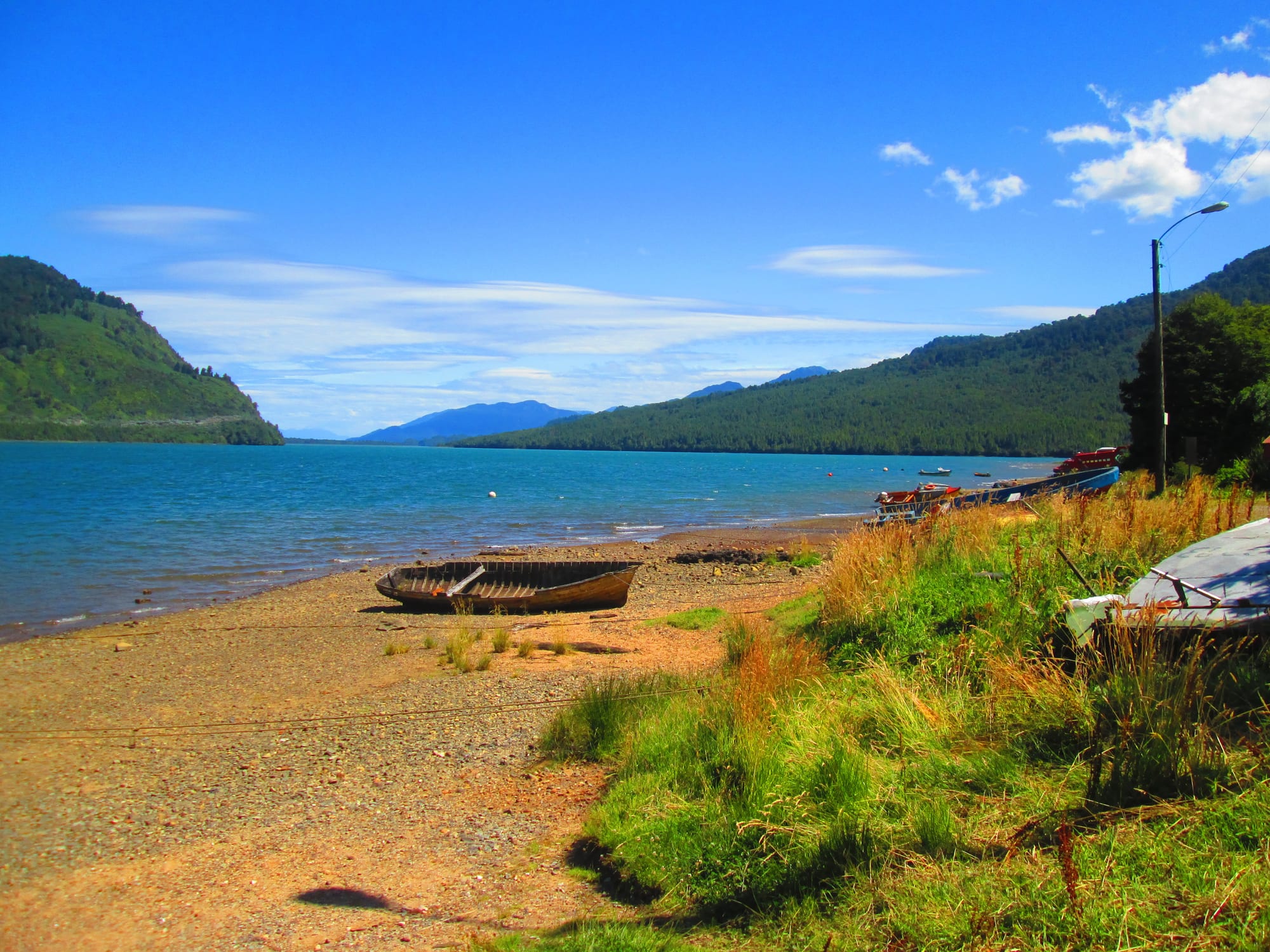
Wooden rowing boats on a pebble shore beside a blue fjord, between forested mountains under a clear sky

Aysén & the Carretera Austral, Chile

Puyuhuapi

The Puyuhuapi fjord seen from the shore of the village. (Manxuc / Wikimedia Commons · CC BY-SA 4.0)

A small village at the head of the Puyuhuapi fjord on the Carretera Austral in northern Aysén, founded in 1935 by Sudeten German settlers who were joined by workers from Chiloé. Shingled houses and flower gardens line the shore beneath rainforest-covered mountains, and it is the base for Queulat National Park's hanging glacier and the hot springs along the fjord.

Neighbourhoods

  • The village and waterfront
    • First-time visitors
    • Historic houses
    • Fjord views

    A handful of streets at the head of the fjord, with shingle-clad wooden houses in a Central European style, flowering gardens, a jetty and a small marina. Guesthouses, cafés and the few shops are all within a few minutes' walk.

    Open in Maps
  • The fjord shore south of the village
    • Hot springs
    • Nature

    South of the village the Carretera Austral follows the forested shore of the fjord towards Queulat National Park; the hot springs lie on the water about 16 km away.

    Open in Maps

Things to do

In and around the village

  • Puyuhuapi Channelviewpoint

    The long fjord at whose head the village stands, framed by forested mountains and used by fishing boats and yachts.

    Open in Maps
  • Puyuhuapi hot springsattraction

    Thermal pools on the fjord shore about 16 km south of the village, set in native forest and known as the Termas de Puyuhuapi.

    Open in Maps

Queulat National Park

  • Queulat National Parkpark

    A national park of 1,541 square kilometres of glacier-capped mountains and virgin evergreen rainforest, founded in 1983, with the Carretera Austral running through the middle of it.

    Open in Maps
  • Ventisquero Colganteviewpoint

    The park's main attraction: a glacier tongue hanging over a sheer rock face, from which a waterfall plunges towards the Témpanos River; trails through rainforest lead to viewpoints.

    Open in Maps
  • Laguna Témpanospark

    An intensely green glacial lagoon below the hanging glacier, with an information centre and several short walks around its shore.

    Open in Maps
  • Padre García Waterfallattraction

    A 30-metre waterfall in the forest at the northern foot of the Queulat Pass, essentially a roadside stop on the Carretera Austral.

    Open in Maps

Short trips from the village

  • Bosque Encantadotrail

    The 'Enchanted Forest', a rustic forest hike of about three hours to another glacial lagoon, starting near the Queulat Pass.

    Open in Maps

Eat and drink

Long-standing places and food districts in Puyuhuapi. Hours, ratings and directions come from your maps app, always current.

Puyuhuapi classics

  • Cafés and restaurants in the villageneighborhood

    A few family-run places in the village serve cooking that blends German recipes with the seafood of the fjord, alongside cakes and Chilean set meals.

    Open in Maps
  • Fjord seafoodneighborhood

    Small-scale fishing has long supported the village, and fish and shellfish from the fjord appear on local menus.

    Open in Maps

Experience Puyuhuapi

History

Puyuhuapi was founded in 1935 by a small group of young Sudeten Germans from the town of Rossbach, now Hranice in the Czech Republic and then part of Czechoslovakia. Otto Uebel, Karl Bächler, Walter Hopperdietzel and Ernesto Ludwig left Europe out of a spirit of adventure and fear of war, and in Chile they met the German explorer Augusto Grosse, who had been engaged by the Chilean government to encourage German immigration and helped them settle at the head of the fjord. Each took on a role: Uebel ran the farm, Ludwig the sawmill and the building of boats and houses, and Bächler supply and trade.

The founders hoped to bring many more families, but the Second World War ended those plans. After the war their relatives were forced out of Rossbach and reached Puyuhuapi in 1947. From the start the settlement depended on workers from the Chiloé archipelago, many of Mapuche descent, who came as seasonal labourers and then settled with their families; their skills as carpenters and boat builders were essential, and their families gave rise to a population of mixed descent.

In 1945 Walter Hopperdietzel, a textile engineer, set up a factory making cloth and carpets, which employed women from the Chilote families and became the village's economic mainstay and symbol for much of the 20th century; it closed in 2018. The arrival of the Carretera Austral connected the village by road, and tourism, drawn by the fjord, the hot springs and Queulat National Park, has grown since.

Culture & Customs

The village is a rare meeting of two traditions. Its Central European houses, with steep roofs and shingle cladding, its carefully kept flower gardens and its German recipes come from the founders; the carpentry, boat-building and the seasonal rhythms of fishing and farming come from Chiloé. Local people describe their identity as a blend of the two, visible in the architecture, the food and the village's festivities.

Weaving is part of that identity. For decades the carpet factory employed local women and kept alive weaving techniques brought by the German settlers, and hand-made jerseys and other woven goods remain the village's best-known crafts.

The name itself is uncertain. One explanation derives it from Mapudungun words for a kind of flower and for island; another reads it as "nest" or "place of puyes", the puye being a small fish no more than 5 cm long. The village has become a familiar stop for travellers on the Carretera Austral and has appeared on television, including Top Gear's Patagonia special in 2014.

Daily Life

Puyuhuapi is a very small place: it had 535 people at the 2002 census and had grown to about 830 by 2007. It belongs to the commune of Cisnes and has its own airstrip, jetty, marina and local radio station.

The economy has long rested on small-scale fishing, carpentry and textiles, and now increasingly on tourism, with guesthouses, cabins, restaurants and craft sales that serve visitors all year, though summer is by far the busiest season. Regional sustainable-tourism programmes have backed the village's development.

Life follows the weather and the road. Rain keeps everything green and falls heavily in winter, buses link the village with Chaitén and Coyhaique, and for anything beyond basic services residents travel to the larger towns; Entel and Movistar provide 5G mobile coverage.

Many families descend from the two founding groups, the Sudeten Germans and the Chilotes, and many still live in the shingled wooden houses with gardens that line the few streets by the shore. Fishing boats are pulled up on the pebble beach in front of the village, and in summer the waterfront fills with cyclists, drivers and backpackers stopping on their way along the road.

Food

Puyuhuapi's cooking is a fusion of German recipes and the seafood of the fjord. Cakes and baked goods from the settlers' tradition sit beside the fish and shellfish landed by local boats. Small-scale fishing has long been one of the village's livelihoods, alongside carpentry and weaving.

Like the rest of Aysén, the village shares in Patagonian ranch food. Lamb roasted on an iron cross beside an open fire, cordero al palo, is the dish of celebrations, and mate, the bitter herbal infusion drunk from a shared gourd through a metal straw, is common. Merluza austral, the southern hake, and mussels come from the coast, and trout and salmon from the rivers and lakes.

Calafate, the dark blue berry of a thorny Patagonian shrub, is made into jams and sweets; legend says that whoever eats it will return to Patagonia. Eating out means a few family-run cafés and restaurants in the village, where cakes and seafood are the local specialities.

Planning tools

Budget

Puyuhuapi is small and remote, so prices are above those of Coyhaique: most supplies come a long way by road, the choice of lodging is limited to guesthouses, cabins and a few lodges, and the hot springs and park entry add to the bill. Camping in the national park and self-catering keep costs down.

Daily Budget Midrange
USD 130–260 (cabin or lodge, restaurant meals, hot springs, park entry and a hire car)
Daily Budget Shoestring
USD 45–80 (camping or a guesthouse, self-catering, buses and hitchhiking)

Bring cash from a larger town; services in the village are limited, and fuel and cash machines are far apart on the Carretera Austral.

Best Time to Visit

December to February are the warmest and sunniest months, when buses along the Carretera Austral run most often and lodging is open. Winter, especially June to August, is cold and very rainy, though snow is rare at sea level, and services are reduced.

Suggested Number of Days

The village itself needs only a short stay. The time needed depends on how many walks in the surrounding forest and national park are added, on the weather, and on infrequent bus connections along the Carretera Austral.

First Visit
1–2 days
With Surroundings
2–4 days

Transportation

The Carretera Austral, unpaved through this section of Queulat, is the main route. Intercity buses link the village with Chaitén to the north and Coyhaique to the south, and can drop passengers at the park's attractions along the road. Many travellers drive, cycle or hitchhike.

Gravel, rain and narrow bends make the road through Queulat slow; drive carefully and allow extra time.

Airport & Station Connections

Most visitors arrive by road on the Carretera Austral, by bus or car from Coyhaique or Chaitén. The village also has an unpaved airstrip, Puyuhuapi Airport, a jetty for larger boats and a small marina, so it can be reached by air and by sea as well.

Walkability

The village is tiny and entirely walkable, with the fjord shore a few steps from any guesthouse. The hot springs and the national park lie along the road to the south and need a car, a bus or a tour.

Safety

Chile is one of the safer countries in South America, but petty and opportunistic crime has risen, especially in Santiago and Valparaíso — pickpocketing, bag-snatching, phone theft, and distraction scams in tourist areas, markets, and on transport. Around Puyuhuapi the risks are natural: heavy rain, slippery forest trails, cold water and falling ice near the hanging glacier, and long gaps between services on the road.

Keep to marked trails in Queulat, carry waterproof clothing in every season, and drive slowly on the gravel. Check current official travel advice before travelling.

Climate

A temperate oceanic climate with abundant rain, which keeps the village and the forest around it green all year. December to February are the warmest and sunniest months; winter is cold and very rainy.

Summer
December to February is summer — the warmest and sunniest season; across Aysén summer days are cool to mild, around 12–22°C
Winter
June to August is cold and very wet; snow is rare at sea level, unlike inland Aysén, where temperatures often fall below 0°C

Local Customs

Puyuhuapi's identity blends the heritage of its Sudeten German founders with that of the Chilote families who came to work and stayed, seen in its shingled houses, gardens, crafts and food. Hand-knitted jerseys and woven goods are the local handicrafts. Dress is practical and waterproof.

Ask before photographing people or private gardens and houses, and keep to paths in the national park.

Common Payment Methods

The currency is the Chilean peso (CLP). Some guesthouses and the hot springs take cards, but small shops and cafés may want cash, and cash machines are scarce along this part of the Carretera Austral, so bring enough pesos.