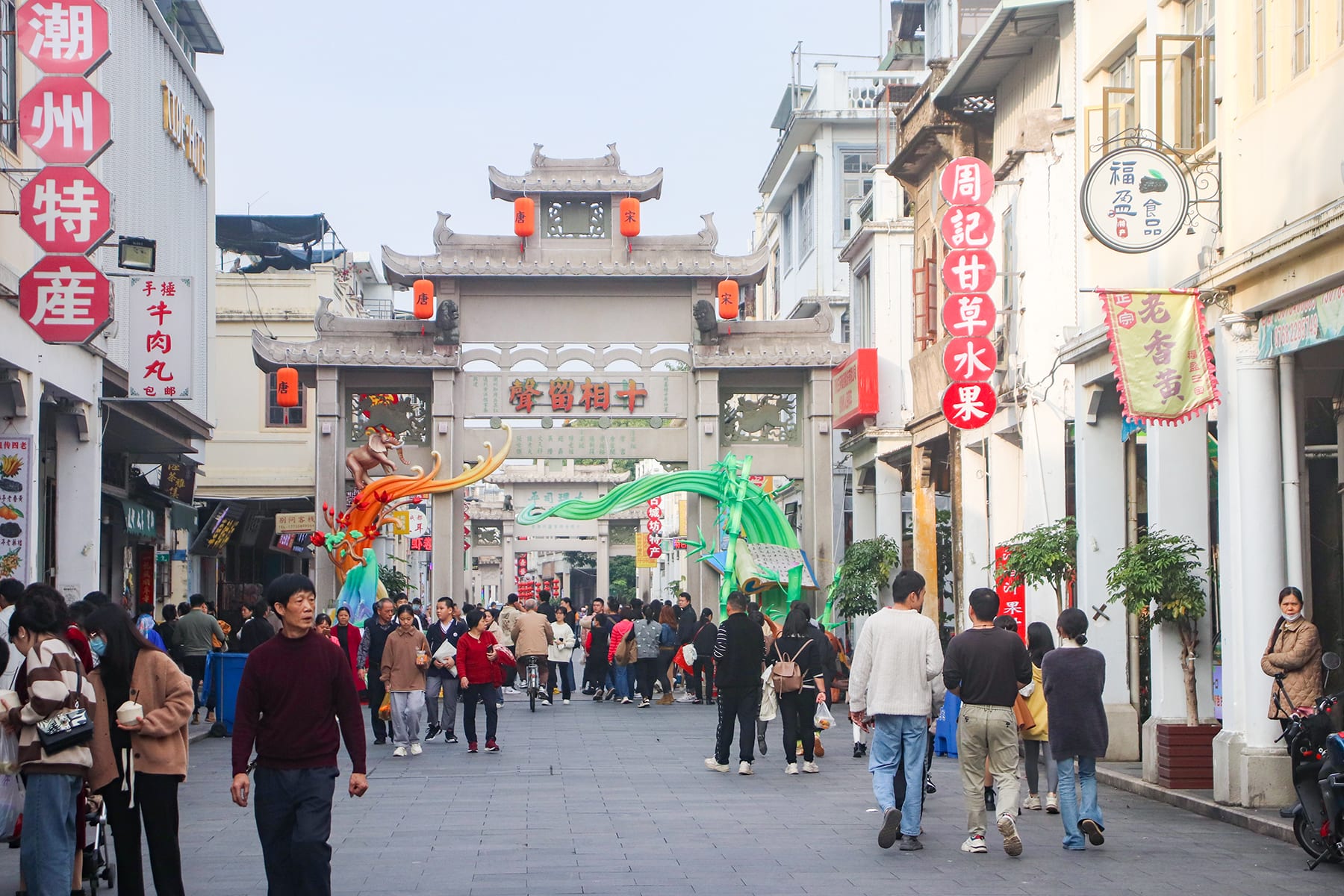
A pedestrian street lined with arcaded shophouses and crowds, with tall carved stone memorial arches spanning the roadway

Guangdong, Fujian & the Southeast Coast, China

Chaozhou

Stone memorial arches over Taiping Road, the Paifang Street of Chaozhou's old city. (Windmemories / Wikimedia Commons · CC BY-SA 4.0)

A small city on the Han River in eastern Guangdong, near the Fujian border, and the cultural capital of the Teochew people. Its walled old quarter keeps stone memorial arches, a Tang-founded temple and the Guangji Bridge of stone piers and linked boats, while Teochew opera, gongfu tea and a celebrated local cuisine carry far beyond the city through a large overseas diaspora.

Neighbourhoods

  • The walled old city
    • First-time visitors
    • Historic district
    • Best for food

    The compact grid of lanes on the west bank of the Han River, behind surviving stretches of Ming city wall and its river gates. Almost everything a short visit takes in is here, from courtyard mansions and ancestral halls to teahouses and snack stalls, and most guesthouses are within a few minutes' walk of each other.

    Open in Maps
  • Paifang Street
    • First-time visitors
    • Street food
    • Shopping

    Taiping Road, the old city's main axis, rebuilt with a long line of stone memorial arches over the roadway and arcaded shophouses to either side. It is the busiest place in Chaozhou in the evening, lined with tea shops, sweet stalls, embroidery and woodcarving sellers and small restaurants.

    Open in Maps
  • The Han River banks
    • Walks and views
    • Quiet and residential
    • Photography

    The riverside promenades either side of the Guangji Bridge, with the old wall on one bank and low hills on the other. Locals walk, exercise and fish here early and late, and the bridge lights up after dark.

    Open in Maps
  • Chao'an
    • Local life
    • Close to public transport
    • Day trips

    The district surrounding the old centre, taking in market towns, ceramics workshops and the road out towards the tea hills. The high-speed railway station serving Chaozhou lies in this direction, and it is where most residents actually live and work.

    Open in Maps

Things to do

The old city

  • Guangji Bridgelandmark

    A bridge first built in the 12th century, unusual in combining fixed stone piers carrying pavilions with a central floating section of linked wooden boats that can be opened for river traffic.

    Open in Maps
  • Kaiyuan Templelandmark

    A Buddhist temple founded in the Tang dynasty in the heart of the old city, with successive halls, old stone pillars and carved beams typical of Teochew craftsmanship.

    Open in Maps
  • Paifang Streetneighborhood

    A pedestrian street carrying a long line of rebuilt stone memorial arches, each commemorating a local official or scholar, above arcaded shophouses.

    Open in Maps
  • The old city wall and river gateslandmark

    The Ming city wall, about 2.6 kilometres long, runs along the riverfront, pierced by gate towers that look out across the Han River.

    Open in Maps

Parks, views and the river

  • The Han River embankmentsviewpoint

    Riverside walkways on both banks give the standard view of the bridge, the old wall and the hills behind, and fill with walkers early and late.

    Open in Maps
  • West Lakepark

    An artificial lake and hillside park just west of the old city, with paths, pavilions and rock inscriptions cut into the slope above the water.

    Open in Maps

Short trips from the city

  • Shantouneighborhood

    The port city an hour south, opened to foreign trade in 1860 and later a Special Economic Zone, with a decaying but striking arcaded old quarter.

    Open in Maps
  • Nan'ao Islandbeach

    Guangdong's only island county, reached since 2015 by a cross-sea bridge from Chenghai on the Shantou side, with beaches, fishing harbours and wind turbines along its ridges.

    Open in Maps

Seasonal events

  • Spring Festival and the yingge dancelate January or February

    The Lunar New Year is the biggest event of the Teochew year, when relatives return from Southeast Asia and abroad, temples fill, and troupes from across the Chaoshan area perform the drumming, face-painted yingge dance in the streets.

  • Dragon Boat Festivalfifth day of the fifth lunar month, usually June

    Crews race on the Han River below the old wall, and households eat rice dumplings wrapped in leaves.

  • Mid-Autumn Festivaleighth lunar month, September or October

    Families gather on rooftops and riverbanks with mooncakes, fruit and pots of strong tea under the full moon.

Eat and drink

Long-standing places and food districts in Chaozhou. Hours, ratings and directions come from your maps app, always current.

Chaozhou classics

  • Beef hotpot housesrestaurant

    Chaoshan beef hotpot is cut to order by part of the animal and dipped for seconds in a clear broth, served with hand-beaten beef balls and a sand-tea dipping sauce.

    Open in Maps
  • Braised goose shopsrestaurant

    Whole geese simmered in a dark master stock of soy, galangal and spices, sliced cold to order and sold with beancurd and eggs cooked in the same liquid.

    Open in Maps
  • Teochew porridge stallsrestaurant

    Loose rice porridge eaten with a spread of small cold dishes — salted vegetables, preserved radish, braised fish and shellfish — a Chaoshan meal at any hour.

    Open in Maps

Streets and teahouses

  • Paifang Street stallsneighborhood

    Oyster omelettes, rice noodle rolls, fish balls, sweet taro and syrup drinks are sold from small shopfronts along the arch-covered street and the lanes off it.

    Open in Maps
  • Gongfu tea housescafe

    Chaozhou is the home of gongfu tea, brewed strong in a tiny clay pot and poured into thimble cups; shops in the old city sell and serve dancong oolong from the hills north of the city.

    Open in Maps
  • Old city marketsmarket

    Morning markets in the lanes sell river fish, shellfish, preserved vegetables and the pickles that anchor Teochew cooking.

    Open in Maps

Experience Chaozhou

History

The Han River delta was settled long before it was Chinese-administered, and the area was governed as Chaozhou prefecture from the late 6th century, when the lowlands were still a frontier of the empire. Its defining episode came in 819, when the Tang scholar-official Han Yu was banished here after criticising the imperial reception of a Buddhist relic. He governed for only a matter of months, but promoted schooling and left such a mark that the river, the hills opposite and a temple on their slope were all renamed for him — an act of civic gratitude without much parallel in China.

Under the Song the prefecture grew rich on rice, salt and river trade, and work began in 1170 on the crossing that became the Guangji Bridge, at first a floating bridge of linked boats and rebuilt in stages over centuries into a hybrid of fixed stone piers and a floating middle section. Ming walls enclosed the city, ancestral halls multiplied, and a distinct Teochew identity — its own speech, opera, carving and cooking — hardened in the coastal plain between the mountains and the sea.

From the 18th century onward Teochew men left in great numbers for Siam, Malaya, Singapore, Indochina and the Dutch East Indies, and their remittances built mansions in villages across the plain. The opening of Shantou as a treaty port in 1860 moved the region's commerce downstream to the coast, and Chaozhou settled into the role of the cultural and ceremonial centre rather than the economic one. It became a prefecture-level city in its own right in 1991, and restoration of the bridge, the wall and the arch street since the 2000s has turned the old core into a destination for Chinese travellers.

Culture & Customs

Chaozhou is the reference point for Teochew culture, which is carried by tens of millions of people in Guangdong and across Southeast Asia. Teochew is a Southern Min language, not mutually intelligible with Cantonese or Mandarin, and it keeps features of older Chinese that make it valued by linguists and impenetrable to other Chinese speakers. Chaozhou opera, or Chaoju, is sung in it, accompanied by the gongs and drums and the string ensembles that also play at temple festivals.

The crafts are unusually concentrated. Chaozhou woodcarving, gilded and cut in multiple openwork layers, fills temple beams and ancestral halls; Chaozhou embroidery works in raised padded stitches; and the city and its surrounding district are a major centre of porcelain and ceramic production. Gongfu tea is the daily social ritual rather than a performance for visitors: a small pot, a handful of dancong oolong, and three cups refilled around a table in shops, offices and doorways all day.

Clan and ancestor worship remain strong, expressed in ancestral halls, lineage associations and the temple processions of the lunar calendar, and the diaspora is woven into this: overseas families fund temple repairs and return for New Year. Chaozhou people have a reputation across China for commercial skill and for close-knit networks — the businessman Li Ka-shing, born in the city in 1928, is the best-known example — and hospitality here is practical, generous and conducted over tea.

Daily Life

The prefecture-level city of Chaozhou has about 2.5 million residents, of whom only a few hundred thousand live in the old urban core on the west bank; the rest are spread through Chao'an district and the county towns of the plain. Migration has long run both ways: families with relatives in Bangkok or Singapore are commonplace, while younger residents leave for jobs in Shenzhen and Guangzhou.

The local economy rests on ceramics and sanitary ware, food processing, clothing and embroidery workshops, tea growing in the hills to the north, and, more recently, tourism to the restored old city. Much production happens in small family firms in the towns around the centre rather than in large plants.

Days start early with porridge or noodles and a first round of tea, and the old city becomes busiest in the evening, when the arch street fills and families eat out. Weekend crowds from Shantou and Guangzhou have grown quickly since the high-speed line opened, and the pressures that come with that — rising rents in the old lanes, shops turning over to souvenirs, conservation of the timber houses — are the current local arguments.

Food

Teochew cooking is one of China's most distinctive regional kitchens, built on seafood, restraint and an obsession with texture. Beef hotpot is the modern emblem: beef is cut to order by muscle, from the fattier near the brisket to the lean, and swirled in clear broth for a few seconds, with hand-beaten beef balls that bounce, and shacha, a sand-tea sauce of peanut, garlic and dried seafood, for dipping. Braised goose, lu e, is simmered in a dark stock of soy, galangal and spices and served sliced and cool with the eggs and beancurd cooked alongside it.

Everyday eating runs on moi, loose rice porridge, taken with a counter of small salty dishes — preserved radish, salted vegetables, braised fish, pickled shellfish. The snack repertoire is long: oyster omelette fried crisp at the edges, fish balls and fish-paste dumplings, kway teow rice noodles, steamed rice cakes stuffed with chives or taro, and sweet pastes of taro and water chestnut. Street stalls sell sugar-coated taro chunks and cooling herbal drinks.

Tea sits over all of it. Phoenix dancong, a single-bush oolong grown on the mountain slopes north of the city, is brewed gongfu style — a small clay pot packed tight with leaf, poured fast and repeatedly into little cups, and drunk strong before, between and after meals rather than with them.

Planning tools

Budget

Chaozhou is one of the cheaper places to stay in Guangdong. Guesthouses in converted old-city houses are modest in price, street food is inexpensive, and the main sights charge little or nothing. Costs rise sharply around Lunar New Year, when returning families fill the town.

Daily Budget Midrange
USD 55–110 (old-town boutique guesthouse or mid-range hotel, hotpot and goose dinners, taxis and a driver for the tea hills)
Daily Budget Shoestring
USD 25–45 (guesthouse or budget hotel, street food and porridge stalls, buses and shared taxis)

Walking the old city, the wall and the riverbank costs nothing; the bridge, the temples and the tea shops are the main small expenses.

Best Time to Visit

October to December is the most comfortable season, dry and warm. Spring is damp and misty, and summer is hot, humid and exposed to typhoons between July and September. Lunar New Year is the most atmospheric time to visit and also the most crowded and expensive.

Suggested Number of Days

The old city is small and a day and a half covers it comfortably. Allow three or four days to take in the surrounding plain, the tea hills and the coast. Eating well here takes time, and that is the main reason people stay longer.

First Visit
1–2 days
With Surroundings
3–4 days

Transportation

The old city is walked, not driven — most of it is closed or hostile to cars. Beyond it, city buses and ride-hailing cover the districts cheaply, and taxis are easy to find at the gates and the stations. Hiring a car with a driver is the usual way to reach the tea terraces in the hills.

Ride-hailing apps work in Chinese and are far easier than explaining an address, so save destination names in characters.

Airport & Station Connections

Chaoshan Railway Station, out in Chao'an District, is the high-speed stop, on the Xiamen–Shenzhen line and the terminus of the line from Meizhou, with fast trains along the coast towards Shenzhen and Xiamen. Jieyang Chaoshan International Airport, shared with Shantou and Jieyang, serves domestic routes and a few regional international ones. Buses and taxis link both to the centre in well under an hour.

Walkability

Excellent inside the walls. The old city is only a few hundred metres across, flat, and laid out on a grid of narrow lanes, and the riverbank and the bridge are at its eastern edge. Surfaces are uneven stone in places and scooters use the lanes freely. The outer districts are modern, spread out and less pleasant on foot.

Safety

Chaozhou is a safe, low-crime city, and visitors are a novelty rather than a target. The realistic hazards are heat and humidity in summer, typhoons and heavy rain between July and September, slippery stone lanes after rain, and traffic from scooters in the old town.

Follow typhoon and rainstorm warnings in summer, take care on wet stone steps by the river, and confirm prices by weight before ordering seafood. Check current official travel advice before travelling.

Climate

Humid subtropical, with a long hot season and most rain falling between May and September. Winters are mild and mostly dry, and the tea hills inland are a few degrees cooler than the riverside city.

Summer
hot and very humid, typically 28–35°C, with downpours and occasional typhoons
Winter
mild, typically 12–20°C, dry and often sunny

Local Customs

Tipping is not expected anywhere. Tea is the basic gesture of hospitality: a host will brew gongfu tea in a small pot and refill the cups constantly, and taking the cup offered is the polite response. Ancestral halls and temples are active places of worship, so keep back from ceremonies and ask before photographing people at prayer. Teochew, not Mandarin, is the language of the street among older residents.

Dress modestly in temples, receive a teacup with both hands if offered, and ask before photographing inside ancestral halls or family courtyards.

Common Payment Methods

The currency is the renminbi, counted in yuan. Daily life runs on QR-code payments through Alipay and WeChat Pay, which now let foreign visitors link an overseas card; setting one up before arrival makes everything easier. Foreign cards are accepted at larger hotels but rarely in small shops, so carry some cash as a backup and use bank ATMs for withdrawals.