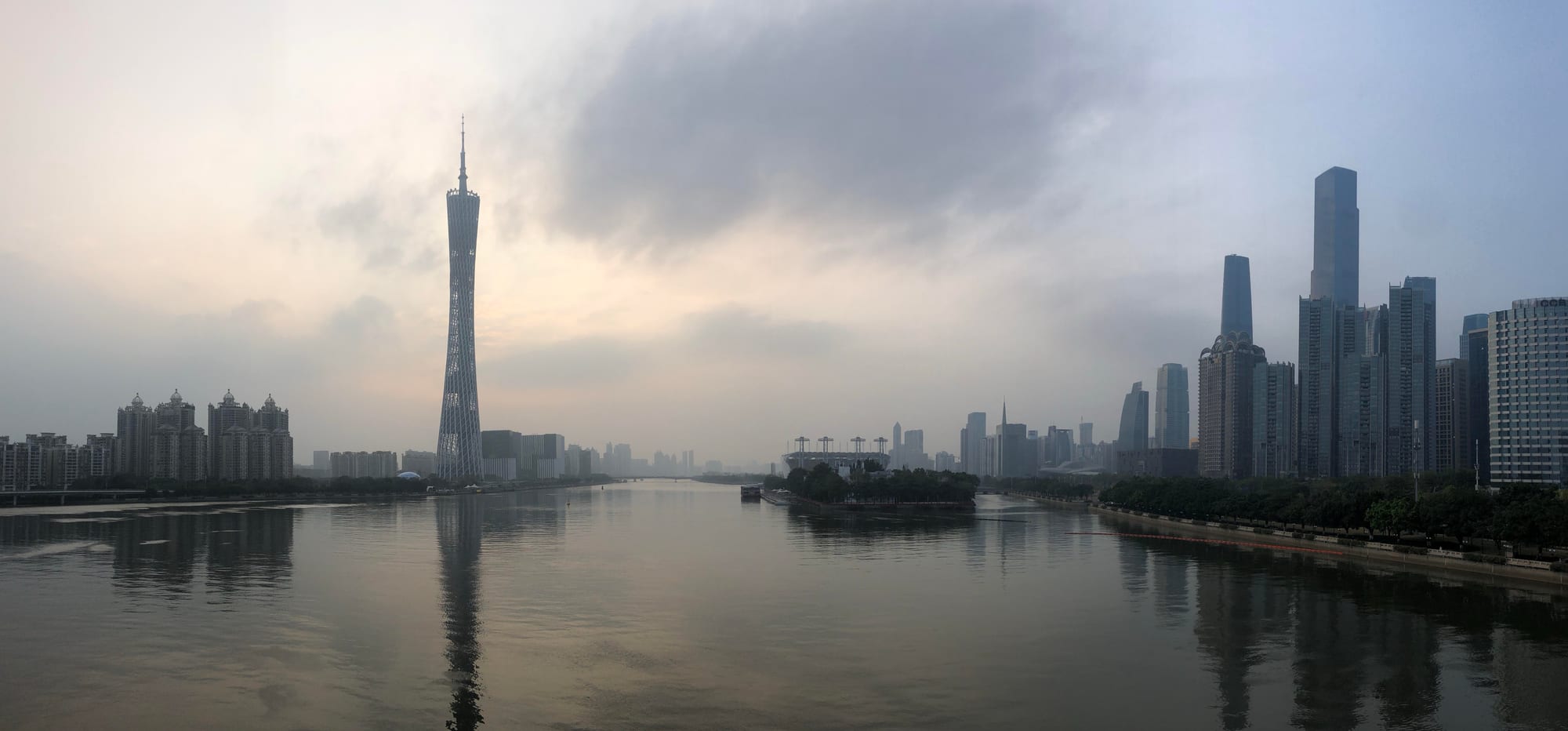
The Canton Tower and high-rise towers on both banks of the wide Pearl River under a hazy grey sky

Guangdong, Fujian & the Southeast Coast, China

Guangzhou

The Pearl River in Guangzhou, with the Canton Tower on the left bank and the Tianhe business district on the right. (Josephua / Wikimedia Commons · CC BY-SA 4.0)

The old Canton, a port on the Pearl River about 130 kilometres upstream from the South China Sea and the capital of Guangdong province. Two thousand years of foreign trade made it China's gateway to the world, and it remains a commercial city of trade fairs, Cantonese speech and Cantonese cooking, with tower-filled Tianhe facing the temples and lanes of the older western districts.

Neighbourhoods

  • Yuexiu
    • First-time visitors
    • Historic district
    • Temples

    The historic core on the north bank, where the Nanyue kings and later governors had their seat. Beijing Road's shopping street, the old temples and mosque, Yuexiu Park and the Sun Yat-sen Memorial Hall are all here, and the metro makes it an easy base.

    Open in Maps
  • Liwan and Xiguan
    • Best for food
    • Old Guangzhou
    • Walking

    The western district of the old merchant city, known as Xiguan. Arcaded shopping streets, grey-brick Xiguan houses, Shangxiajiu's crowds and the Qingping herb market sit beside canals and Liwan Lake Park, and this is where much of the city's most traditional food is eaten.

    Open in Maps
  • Shamian Island
    • Quiet and residential
    • Architecture
    • Photography

    A small sandbank in the Pearl River, leased as a foreign concession after the Second Opium War and built up with banks, consulates and churches. Traffic is largely kept out, and its shaded avenues of European buildings make the calmest corner of central Guangzhou.

    Open in Maps
  • Tianhe
    • Shopping
    • Modern architecture
    • Close to public transport

    The new business centre east of the old city, laid out along an axis from the East railway station to the river. Zhujiang New Town holds the tallest towers, the Guangdong Museum and the Opera House, alongside large malls and much of the city's international hotel stock.

    Open in Maps
  • Haizhu
    • Riverside walks
    • Families
    • Trade fairs

    The island district on the south bank, reached by bridges and metro. The Canton Tower stands at its northern tip, the Canton Fair complex at Pazhou fills the east, and the wetlands of Haizhu Lake and the old orchards give the district more greenery than most of the city.

    Open in Maps
  • Panyu
    • Families
    • Theme parks
    • Quiet and residential

    A formerly separate county town absorbed into southern Guangzhou, about 25 kilometres from the centre and linked by metro. It holds the Chimelong resort's theme parks and animal attractions, the Lingnan Impression Park and university campuses among newer housing.

    Open in Maps

Things to do

Famous landmarks

  • Canton Towerlandmark

    A slender 600-metre lattice tower of 2010 on the south bank, with observation decks and a rooftop ride, and the clearest view of the city.

    Open in Maps
  • Chen Clan Ancestral Halllandmark

    An 1894 clan academy built by Chen families across Guangdong, covered in Lingnan wood, brick, stone and ceramic carving, and now a folk art museum.

    Open in Maps
  • Sun Yat-sen Memorial Halllandmark

    An octagonal blue-tiled auditorium completed in 1931 on the site of the presidential palace Sun Yat-sen's Guangzhou government used, still in use for concerts and ceremonies.

    Open in Maps
  • Zhenhai Towerlandmark

    A five-storey Ming watchtower of 1380 on the old city wall in Yuexiu Park, now housing the Guangzhou Museum.

    Open in Maps
  • Guangzhou Opera Houselandmark

    Zaha Hadid's angular twin-boulder concert building of 2010 in Zhujiang New Town, the city's main stage for opera and orchestral music.

    Open in Maps

Temples, mosques and churches

  • Temple of the Six Banyan Treeslandmark

    A Buddhist temple founded in 537, named after a poem by Su Shi, with the Flower Pagoda of 1097 rising above the old city.

    Open in Maps
  • Guangxiao Templelandmark

    One of the oldest Buddhist temples in the city, where the Chan patriarch Huineng gave his first public Chan lecture and was ordained.

    Open in Maps
  • Huaisheng Mosquelandmark

    A mosque traditionally traced to the earliest Arab traders in Canton, whose plain 36-metre minaret, the Guangta, is also read as a lighthouse tower.

    Open in Maps
  • Sacred Heart Cathedrallandmark

    A twin-spired granite Gothic Revival cathedral built by French missionaries between 1863 and 1888, known locally as the Stone House.

    Open in Maps

Museums

  • Museum of the Mausoleum of the Nanyue Kingmuseum

    Built over the rock-cut tomb of the second king of Nanyue, found in 1983, showing the jade burial suit and bronzes buried with him in the second century BC.

    Open in Maps
  • Guangdong Museummuseum

    The provincial museum in Zhujiang New Town, moved here from the old city, covering Guangdong history, natural history and Chaozhou woodcarving.

    Open in Maps

Parks, streets and views

  • Yuexiu Parkpark

    The best-known park in the centre, on and around Yuexiu Hill, with lakes, remnants of the Ming city wall and the Five Rams sculpture that is the city's emblem.

    Open in Maps
  • Baiyun Mountainpark

    A wooded range on the northern edge of the city, rising to 427 metres and laced with walking paths.

    Open in Maps
  • Shangxiajiu Pedestrian Streetattraction

    A long arcaded shopping street in Liwan, lined with early 20th-century qilou buildings, snack shops and old restaurants.

    Open in Maps

Short trips from the city

  • Chimelong Paradiseattraction

    A large amusement park in Panyu, part of a resort complex that also includes a safari park and water park, about 15 kilometres south of the centre.

    Open in Maps
  • Foshan Ancestral Templelandmark

    A Taoist temple in neighbouring Foshan, first built in the Song dynasty and dedicated to Xuan Wu, with halls honouring the Foshan-born martial artists Wong Fei-hung and Ip Man.

    Open in Maps

Seasonal events

  • Canton FairApril–May and October–November

    The oldest and largest trade fair in China, held every spring and autumn since 1957 and now at the Pazhou exhibition centre; hotel rooms across the city are scarce and expensive while it runs.

  • Lunar New Year flower marketsthe days before Lunar New Year, January or February

    Street markets of peach blossom, kumquat trees and narcissus set up in every district, a Guangzhou institution followed by a flower parade and temple crowds.

  • Dragon boat racesDuanwu festival, May or June

    Villages along the Pearl River and its creeks race long wooden boats and visit one another's ancestral halls in a season of feasts.

  • Mid-Autumn FestivalSeptember or October

    Lanterns in the parks and Cantonese-style mooncakes filled with lotus seed paste and salted egg yolk, many of them made by the city's old restaurants.

Eat and drink

Long-standing places and food districts in Guangzhou. Hours, ratings and directions come from your maps app, always current.

Guangzhou classics

  • Guangzhou Restaurantrestaurant

    A large Cantonese house in Xiguan, known for banquet dishes, dim sum and its mooncakes at Mid-Autumn.

    Open in Maps
  • Taotao Jurestaurant

    A teahouse near Shangxiajiu that has served yum cha since the 19th century, one of the places Cantonese morning tea is most associated with.

    Open in Maps

Food districts and markets

  • Shangxiajiu and Xiguanneighborhood

    The old western streets are the home of Guangzhou snacks — wonton noodles, rice rolls, double-skin milk pudding and sesame paste sweets — sold in small shops between the arcades.

    Open in Maps
  • Qingping Marketmarket

    Dried seafood, herbs, bark and roots sold by weight, the supply room for the slow-simmered soups that Cantonese households drink daily.

    Open in Maps
  • Beijing Road and Yuexiuneighborhood

    Roast-meat shops, congee counters and late-night stalls fill the lanes off the shopping street in the old city centre.

    Open in Maps

Experience Guangzhou

History

Guangzhou began as Panyu, founded in 214 BC when Qin armies reached the far south, and it became the capital of the kingdom of Nanyue under Zhao Tuo before the Han empire absorbed it in 111 BC. Its position near the mouth of the Pearl River made it China's southern window on the sea. Under the Tang dynasty a large community of Arab and Persian merchants lived in the city, which had an office of maritime trade, and the mosque and the oldest temples date their foundation to those centuries.

From 1757 the Qing confined all Western trade with China to Guangzhou under the system Europeans called the Canton System, conducted through a guild of licensed merchants at the Thirteen Factories on the riverbank. The tea trade flowed out and opium flowed in, and after Lin Zexu destroyed confiscated opium at Humen in 1839 the First Opium War followed. Defeat opened other ports and cost Guangzhou its monopoly; after the Second Opium War the sandbank of Shamian was leased to Britain and France as a foreign concession.

The city then became a centre of revolution. Hong Xiuquan of the Taiping was born in a Hakka village in what is now the city's Huadu District, Sun Yat-sen studied and organised here, and in the 1920s Guangzhou was the base of the Nationalist government, home to the Whampoa Military Academy and to the failed uprising of 1927. Industry and population grew after 1949, but the transformation came with the reforms launched in 1978, when Guangdong's proximity to Hong Kong made it China's export workshop. The Canton Fair, running since 1957, kept the old trading role alive, and since 2000 the city has spread east into Tianhe and south across the river.

Culture & Customs

Guangzhou is the cultural capital of the Cantonese world. Cantonese is the language of the street, the market and the tea house, although Mandarin is the language of schools and offices and of the millions of migrants from inland provinces. Cantonese opera, with its high singing, painted faces and martial acrobatics, is listed by UNESCO as intangible heritage and is still performed in parks and private clubs as well as theatres; amateur singers gather most mornings beside the lakes of Liwan.

Lingnan culture — the term for the region south of the mountain ranges — has its own architecture and art. Grey-brick Xiguan townhouses with carved wooden screens and coloured glass, arcaded qilou shophouses built for rain and sun, ceramic figures crowding temple ridgelines, and the Lingnan School of painting all belong to the city. So does a long history of leaving: emigrants from Guangdong built Chinese communities across Southeast Asia, North America and Australia, and many clan halls were funded from abroad.

Daily manners are practical and commercial. Guangzhou people have a reputation in China for caring more about business and food than about politics, for superstition about lucky numbers and words, and for keeping festivals thoroughly: flower markets before the Lunar New Year, dragon boat visits between villages at Duanwu, and mooncakes ordered weeks in advance for Mid-Autumn. Ancestral halls and household shrines remain in ordinary use, and lion dances open new shops.

Daily Life

About 18.7 million people live in the city's administrative area, which stretches from the hills of Conghua in the north to the delta flats of Nansha. It is the capital of Guangdong, China's most populous province, and sits within a nearly continuous urban belt that also takes in Foshan, Dongguan and Shenzhen. A large share of residents were born elsewhere: factory and service workers from Hunan, Guangxi, Sichuan and further inland, and a long-established African and Middle Eastern trading community around the wholesale markets of Xiaobei and Sanyuanli.

The economy runs on trade, logistics, cars, chemicals, and increasingly on finance, software and design in Tianhe. Wholesale markets remain a defining industry, selling clothing, leather, electronics, tea and dried goods in whole streets devoted to one trade. The port has moved downstream to Nansha, and the old riverside warehouses have become restaurants and creative quarters.

The day starts early with tea houses filling by seven, moves indoors during the hot afternoons, and comes alive again after dark, when riverside promenades, night markets and outdoor tables are busiest. Housing costs, long commutes from the outer districts and the summer risk of typhoon flooding are the everyday concerns, along with the school places and residence registration that determine what services migrant families can use.

Food

Guangzhou is where Cantonese cooking is at home, and its guiding idea is that the flavour of a fresh ingredient should be tasted rather than covered. The daily ritual is yum cha, morning tea, which begins early and can last for hours: pots of oolong or pu'er with dim sum brought in bamboo steamers — har gow shrimp dumplings in translucent wrappers, siu mai, cha siu bao barbecued pork buns, cheung fun rice rolls, chicken feet in black bean sauce and egg tarts.

Roast-meat shops hang char siu, crisp-skinned roast pork and soy-marinated geese in their windows, sliced over rice at lunch. Wonton noodles in a clear prawn-roe broth, congee simmered smooth with fish or preserved egg, steamed fish with ginger and spring onion, and clay-pot rice cooked to a crust are the everyday dishes. Every household has its slow-boiled soups, with herbs and dried ingredients bought by weight at markets such as Qingping, prescribed according to the season and the weather.

Sweets and snacks are their own tradition: double-skin milk pudding from Shunde just downstream, sesame paste, water chestnut cake, ginger-milk curd and the lotus seed mooncakes the old restaurants sell at Mid-Autumn. The city's famous saying that Cantonese eat anything with four legs except a table is a joke about variety, but it points at a real appetite for unusual ingredients and for freshness above all else. Tea remains the drink, with Phoenix oolong from the hills near Chaozhou and Anxi Tieguanyin widely served.

Planning tools

Budget

Guangzhou is one of China's more expensive cities for hotels, and room rates rise sharply during the two Canton Fair seasons and around Lunar New Year. Food is the compensation: morning tea, noodle shops and canteens are cheap for the quality, and the metro costs little.

Daily Budget Midrange
USD 90–190 (mid-range hotel, restaurant dinners, museum and tower tickets, taxis or ride-hailing)
Daily Budget Shoestring
USD 35–65 (hostel or budget hotel, yum cha and noodle shops, metro travel)

Avoid the Canton Fair weeks in spring and autumn if hotel cost matters; a morning yum cha is the cheapest good meal in the city.

Best Time to Visit

October to December is the most comfortable season — dry, sunny and warm. Spring is mild but damp, with a clammy spell of fog and condensation known as huinantian, and summer is hot, wet and exposed to typhoons. The Lunar New Year flower markets are a reason to accept the winter crowds.

Suggested Number of Days

Two to three days suit a first visit. Four or five allow for the outer districts and the wider Pearl River Delta. Anyone here for the Canton Fair should add time, as the city is at its busiest and distances are long.

First Visit
2–3 days
With Surroundings
4–5 days

Transportation

The metro is extensive, cheap and signed in English, and reaches the airport, the main railway stations and Panyu. Buses and ride-hailing fill the gaps, and ferries cross the Pearl River. High-speed trains reach Shenzhen and Hong Kong in well under an hour from Guangzhou South.

Buy a transport card or use a QR code in a payment app rather than queuing for single tickets, and allow extra time in the rush hours, when interchange stations are very crowded.

Airport & Station Connections

Guangzhou Baiyun International Airport lies about 30 kilometres north of the centre and is a major hub for flights across Asia and beyond, linked by metro in around an hour. Most domestic arrivals come by high-speed rail into Guangzhou South station in Panyu, with frequent services to Shenzhen, Hong Kong, Changsha, Wuhan and Beijing.

Walkability

The old districts are walkable: Shamian Island, the Shangxiajiu arcades and the lanes of Yuexiu are best seen on foot, and the riverside promenades run for kilometres. Tianhe and Zhujiang New Town are built to a much larger scale, with wide roads and long blocks, so the metro is the sensible way between districts. Heat and humidity slow walking from May to September.

Safety

Guangzhou has little violent crime and is generally safe at all hours. The realistic problems are pickpocketing and phone snatching in crowded markets, stations and shopping streets, overcharging by unlicensed taxis, and summer typhoons and flash floods.

Bags are best kept closed and phones out of sight in crowds; use metered taxis or a ride-hailing app, follow typhoon warnings in summer, and carry a passport at all times. Check current official travel advice before travelling.

Climate

Humid subtropical, with a long hot season and most rain between May and September. Typhoons are most likely from July to September. Winter is short and mild, and the spring damp season brings fog and condensation on walls and floors.

Summer
hot and humid, 28–35°C, with heavy downpours and occasional typhoons
Winter
mild and mostly dry, 10–20°C, with a few colder damp spells

Local Customs

Cantonese is the everyday language, although Mandarin is universally understood and signs are in standard characters. Morning tea is a social institution, taken slowly and often with family; tapping two fingers on the table thanks whoever pours the tea. Dishes are shared, and the host usually pays for the whole table.

Tipping is not expected. Dress is informal but cover shoulders and knees in temples and mosques, do not photograph worshippers, and avoid photographing police, soldiers or military sites.

Common Payment Methods

The currency is the renminbi, counted in yuan. Almost everything is paid by QR code through Alipay or WeChat Pay, which now allow foreign visitors to link an overseas card; setting one up before arrival makes the city far easier. Foreign cards work in hotels and large stores, cash is accepted but less common, and ATMs are widespread.