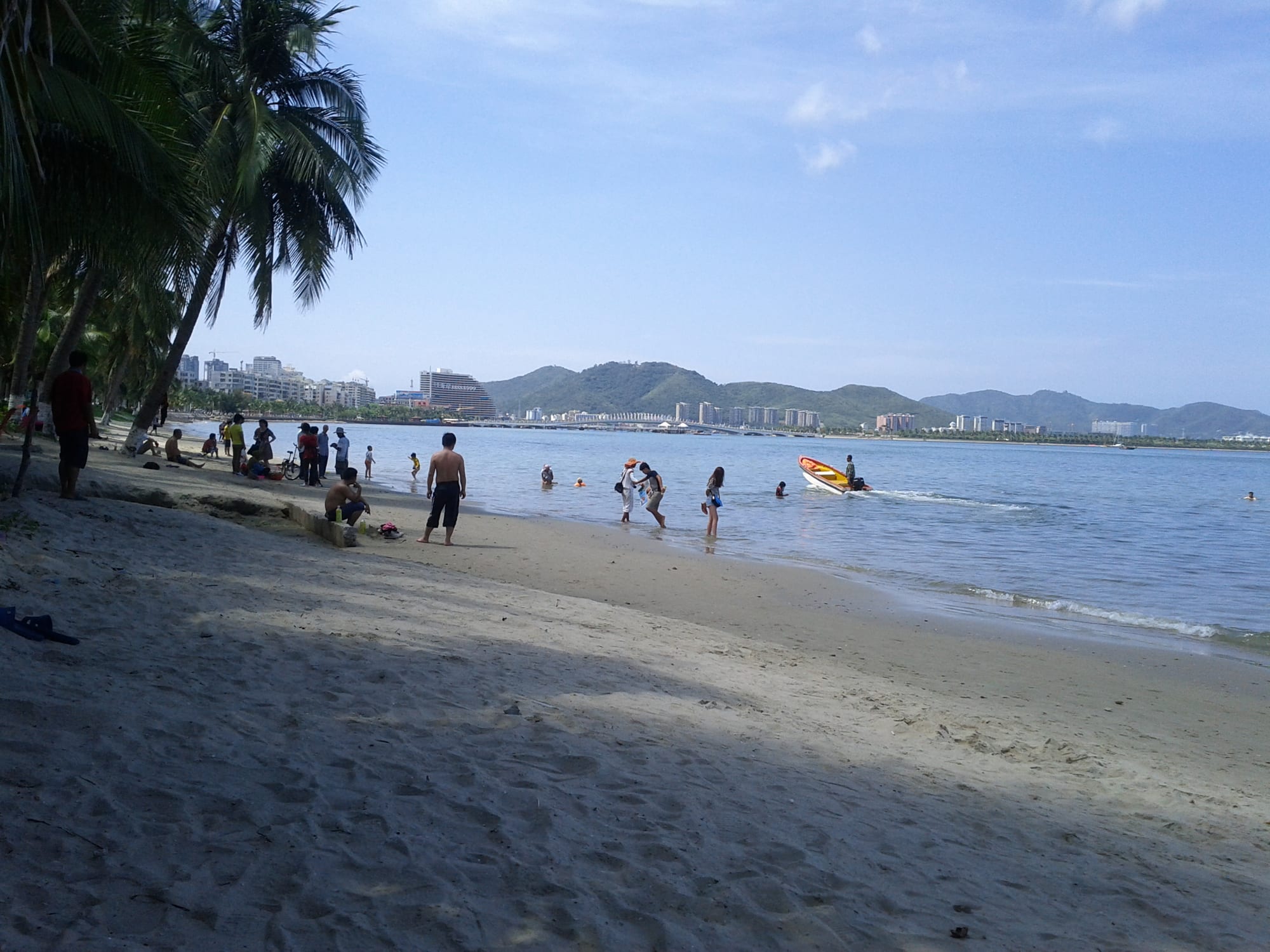
A curving sandy beach with palm trees, bathers in shallow water and green hills behind hotel blocks across the bay

Guangdong, Fujian & the Southeast Coast, China

Sanya

A beach on the shore at Sanya, with the hills of southern Hainan behind the bay. (Huangdan2060 / Wikimedia Commons · CC0)

A city at the southern tip of Hainan, the island province in the South China Sea, set between forested hills and a run of sheltered bays. Once a remote fishing port and a place of official exile, it became China's main tropical beach resort from the 1990s, and its winter warmth, duty-free malls and long sands draw visitors from across the country.

Neighbourhoods

  • Sanya city centre
    • First-time visitors
    • Best for food
    • Markets

    The working town on the Sanya River, with markets, seafood restaurants, the night streets around Jiefang Road and the main bus and rail connections. Rooms cost far less here than in the resort bays, and the beach at Sanya Bay is a short ride away.

    Open in Maps
  • Dadonghai
    • Beaches
    • Nightlife
    • Families

    A compact bay just east of the centre, backed by hotels, restaurants and bars within a few streets of the sand. It is the most walkable beach area in the city and the one most used by independent travellers rather than package guests.

    Open in Maps
  • Yalong Bay
    • Beaches
    • Resorts
    • Quiet and residential

    A wide crescent of pale sand about 17 kilometres east of the centre, lined with large international resorts set back behind gardens. The water is clear and calm, the strip is quiet in the evenings, and almost everything is inside the hotels.

    Open in Maps
  • Haitang Bay
    • Resorts
    • Shopping
    • Families

    The newest resort district, about 25 kilometres north-east of the centre, built around the largest duty-free shopping complex in China and a line of hotels and theme attractions. It is spread out and designed around cars and shuttle buses.

    Open in Maps
  • Sanya Bay
    • Long walks
    • Budget stays
    • Local life

    A long straight beach running west from the centre past a coconut-palm promenade, with apartment blocks, mid-range hotels and local families rather than resort compounds. Many northern Chinese who spend winters in Sanya stay along this shore.

    Open in Maps

Things to do

Beaches and bays

  • Yalong Baybeach

    The best known of Sanya's bays, a 7.5-kilometre arc of fine sand and clear water backed by resorts and a forest park in the hills behind.

    Open in Maps
  • Dadonghaibeach

    The city's most accessible beach, a sheltered bay between headlands with swimming, water sports and a line of restaurants across the road.

    Open in Maps
  • Haitang Baybeach

    The newest resort bay north-east of the city, a long beach beside the largest duty-free shopping centre in China.

    Open in Maps
  • Wuzhizhou Islandattraction

    A small island in Haitang Bay about 30 kilometres north-east of the centre, reached by boat and known for clear water, snorkelling and diving.

    Open in Maps

Temples and landmarks

  • Guanyin of Nanshanlandmark

    A 108-metre statue of the bodhisattva Guanyin completed in 2005, standing on an islet linked to the shore in the Nanshan cultural park west of the city.

    Open in Maps
  • Tianya Haijiaolandmark

    A shore of huge granite boulders carved with inscriptions, whose name means the edge of the sky and the corner of the sea, long a symbol of China's southern limit.

    Open in Maps

Parks and the interior

  • Yalong Bay Forest Park Glass Bridgeattraction

    A 400-metre glass walkway in the Yalong Bay Tropical Paradise Forest Park, standing as much as 100 metres above the ground and looking down over the bay.

    Open in Maps

Seasonal events

  • Winter high seasonNovember–March

    The city's busiest months, when warm dry weather draws visitors escaping the northern Chinese winter and hotel prices reach their peak.

  • Lunar New YearJanuary or February

    The single busiest week of the year in Sanya, with families filling the resorts and flights and rooms at their most expensive.

  • Double Third festivalthird day of the third lunar month, usually April

    A spring festival kept across southern China, an occasion for singing, dancing and courtship customs in the villages inland from the city.

Eat and drink

Long-standing places and food districts in Sanya. Hours, ratings and directions come from your maps app, always current.

Seafood and markets

  • Sanya seafood marketsmarket

    Tanks of live fish, prawns, crab and shellfish sold by weight, with kitchens alongside that cook a chosen catch for a fee — the standard way of eating seafood here.

    Open in Maps
  • Dadonghai restaurantsneighborhood

    Streets of seafood houses, coconut chicken hotpot and Hainanese cafés a block back from the beach, plus the city's main cluster of bars.

    Open in Maps
  • Sanya city centre night streetsneighborhood

    Stalls and small restaurants in the older streets near the river serving Hainan noodles, grilled squid, tropical fruit and coconut drinks.

    Open in Maps

Hainan classics

  • Wenchang chickenrestaurant

    Poached free-range chicken served cool with ginger and a dipping sauce, the island dish that became Hainanese chicken rice across Southeast Asia.

    Open in Maps
  • Coconut chicken hotpotrestaurant

    Chicken simmered at the table in the water of green coconuts, a light, sweet broth that is the most common shared meal in the city.

    Open in Maps

Experience Sanya

History

The far south of Hainan was for most of Chinese history a frontier, known as Yazhou and settled around the mouth of the Sanya River. The Li people, the island's earliest inhabitants, lived in the hills and along the rivers long before Han settlement, and Hui Muslim communities descended from sea traders settled on the coast from the Song period onwards. Successive dynasties used the island as a place of exile for disgraced officials; the Tang monk Jianzhen was blown ashore on Hainan on one of his attempts to reach Japan, and the Buddhist complex west of the city takes its theme from that story.

Under the Ming and Qing, Yazhou was a small walled administrative town with a fishing and salt economy, far from the centres of power. It gained strategic value in the 20th century for its deep, sheltered harbours; Japanese forces occupied the island from 1939 to 1945 and developed the port. After 1949 the area remained a quiet naval and fishing district of Guangdong province.

The change came at the end of the 1980s. Sanya was made a city in 1987, and in 1988 Hainan was separated from Guangdong to become a province and a special economic zone; the bays were opened to resort development, first at Dadonghai and then on a much larger scale at Yalong Bay in the 1990s and Haitang Bay in the 2010s. Tourism, a free-trade port scheme announced in 2020 and generous duty-free shopping allowances for domestic visitors have made this one of the fastest-growing cities in China, with the airport, the island rail loop and cruise berths all expanded to match.

Culture & Customs

Sanya's population is a mixture of very different communities. The Li, who make up about 15 per cent of Hainan's population, are the island's indigenous inhabitants and keep their own language, brocade weaving, bamboo-beating dances and the March the Third spring festival; Li villages and theme parks inland from the city are where most visitors encounter that culture. The Miao, who arrived from the mainland centuries ago, live in similar hill districts. The Hui, known as the Utsul, are Muslim, speak a language unrelated to any other in mainland China, and run much of the local fishing and market trade.

Over them lies a large migrant layer: hotel and construction workers from inland provinces, and northern retirees who spend the winter here in rented flats, a migration large enough to change the accent of whole neighbourhoods between seasons. The result is a city where Mandarin dominates, where Hainanese, Li and Hui speech are all heard, and where much of the year's rhythm is set by visitors.

The culture of the place is accordingly relaxed and commercial rather than ceremonial. Life happens outdoors and late: tea and card games under the palms, seafront exercise groups at dawn, and the beach promenades busy until midnight in the warm months. Coconuts, sea and tropical colour dominate local imagery, and the city markets itself to the rest of China as the country's own tropics.

Daily Life

About 1.1 million people live in the municipality, which stretches from the coastal bays back into hill districts of rubber, mango and betel nut. Resident numbers swing sharply with the seasons, rising by hundreds of thousands in winter when retirees from the north arrive, and many flats along Sanya Bay stand empty for half the year. Property prices rose so fast in the 2010s that the provincial government restricted purchases by non-residents.

Tourism is the economy: hotels, restaurants, boat operators, duty-free retail, wedding photography and the trades that serve them. Fishing continues from the harbour on the Sanya River, tropical agriculture supplies out-of-season fruit and vegetables to the rest of China, and a deep-sea research and space-related presence has grown along the coast. The free-trade port scheme has brought construction and new bonded shopping.

Daily life follows the heat. Markets and building sites work early, afternoons are slow, and evenings fill the promenades, night markets and hotpot restaurants. Summer brings typhoon preparation, and the wet months are the local off season, when many businesses close for repairs. Water supply, traffic between the bays, the cost of housing and the seasonality of work are the everyday concerns.

Food

Hainan cooking is light, fresh and built on seafood, chicken, coconut and tropical fruit, and Sanya's version leans hard on the sea. The usual arrangement is to choose live fish, prawns, crab, abalone or clams from tanks at a market or restaurant, have them weighed, and pay a kitchen to steam, grill or stir-fry them with garlic. Hele crab from the island's east coast is among the four dishes Hainan is famous for, alongside Wenchang chicken, Jiaji duck and Dongshan goat, and all four appear on menus here.

Wenchang chicken, poached and served cool with ginger and citrus dipping sauce, is the ancestor of the Hainanese chicken rice found across Southeast Asia. Coconut chicken hotpot simmers the bird in the water of green coconuts at the table. Hainan's noodle traditions are distinct: Hainan rice noodles dressed with peanuts, pickles and a little broth, and the sour, spicy soups of the south. Betel nut is chewed locally, and coconut appears in everything from rice cakes to sweets and the ubiquitous chilled drinking nuts.

Fruit is the other pleasure — mango, dragon fruit, lychee, longan, jackfruit, coconut and pineapple, sold from barrows and markets and at their best in spring and early summer. Hui restaurants near the fishing harbours serve halal seafood and lamb, and the resort bays add international restaurants and hotel buffets to the mix. Coffee culture, brought back from Southeast Asia by returning emigrants, is strong on Hainan, and the island's own coffee is served thick and sweet.

Planning tools

Budget

Sanya is a resort city, and prices follow the season closely. Rooms in the bays multiply in the winter high season and again at Lunar New Year, while the same hotels are cheap in the wet summer. Food is affordable in the city centre and expensive inside the resorts, and seafood ordered by weight is where visitors most often overspend.

Daily Budget Midrange
USD 90–190 (mid-range or beach hotel outside peak season, restaurant meals, boat trips and entry tickets, taxis)
Daily Budget Shoestring
USD 35–65 (guesthouse in the centre or Dadonghai, market seafood and noodle shops, buses)

Travel outside Lunar New Year and the October holiday week for far lower room rates, and confirm seafood prices by weight before it is cooked.

Best Time to Visit

November to March is the peak season: warm, dry and sunny, and the reason the city exists in its present form. April and May are hotter but still mostly dry. From June to October it is hot, humid and wet, with the typhoon risk at its highest between August and October, although rain often falls in short heavy bursts rather than all day.

Suggested Number of Days

Three or four days suit a beach stay with a few excursions. Five to seven allow for the island's interior and east coast as well. Many domestic visitors stay far longer, wintering in rented flats along the shore.

First Visit
3–4 days
With Surroundings
5–7 days

Transportation

Distances are large: the bays lie up to 30 kilometres apart along the coast. City buses and tourist shuttle routes connect the centre with Dadonghai, Yalong Bay and Haitang Bay, taxis and ride-hailing are cheap and plentiful, and a high-speed rail loop around the island has several stations in the municipality.

Agree on a metered fare or use a ride-hailing app rather than accepting a fixed price from a driver at the airport or beach.

Airport & Station Connections

Sanya Phoenix International Airport lies about 15 kilometres north-west of the centre and handles flights from cities across China and parts of Asia. The high-speed rail loop around Hainan reaches Haikou in the north in roughly an hour and a half, and Haikou is linked to the mainland by train ferry across the Qiongzhou Strait.

Walkability

Each area is walkable in itself — Dadonghai's few streets, the promenade along Sanya Bay, the old centre's markets — but the city as a whole is not. Moving between the bays means a bus, taxi or shuttle. Shade is scarce on the newer roads, and the heat and humidity make long midday walks uncomfortable for most of the year.

Safety

Sanya is a safe city with little violent crime. The practical risks are strong currents and jellyfish on some beaches, sunburn and heat, typhoons and heavy rain in late summer, and commercial problems: overpriced seafood, pressure from tour touts and unlicensed taxis.

Swim only on patrolled beaches and heed flag warnings, confirm seafood prices by weight before ordering, use licensed taxis or an app, and follow typhoon alerts. Check current official travel advice before travelling.

Climate

Tropical monsoon. The year divides into a dry season from November to April, which is the reason for the city's tourist trade, and a hot wet season from May to October with heavy showers and the risk of typhoons. Sea temperatures stay warm enough for swimming all year.

Summer
hot and humid, 28–34°C, with heavy showers and a typhoon risk from August to October
Winter
warm and dry, 20–27°C, the peak season for visitors

Local Customs

Mandarin is the working language; Hainanese, a Minnan dialect, is spoken by many local families, and Li and Hui communities have their own languages in the districts inland and west of the city. Dress is informal and beachwear is normal on the sand, but covering up is expected in temples, shops and restaurants away from the beach.

Tipping is not expected. Cover shoulders and knees at Nanshan and other temples, ask before photographing people in Li or Hui villages, and respect fishing communities' working areas at the harbour.

Common Payment Methods

The currency is the renminbi, counted in yuan. Alipay and WeChat Pay QR codes are used for almost everything, and both allow foreign visitors to link an overseas card. Resort hotels and the duty-free malls accept foreign cards; markets and small restaurants prefer the apps or cash, and ATMs are easy to find.