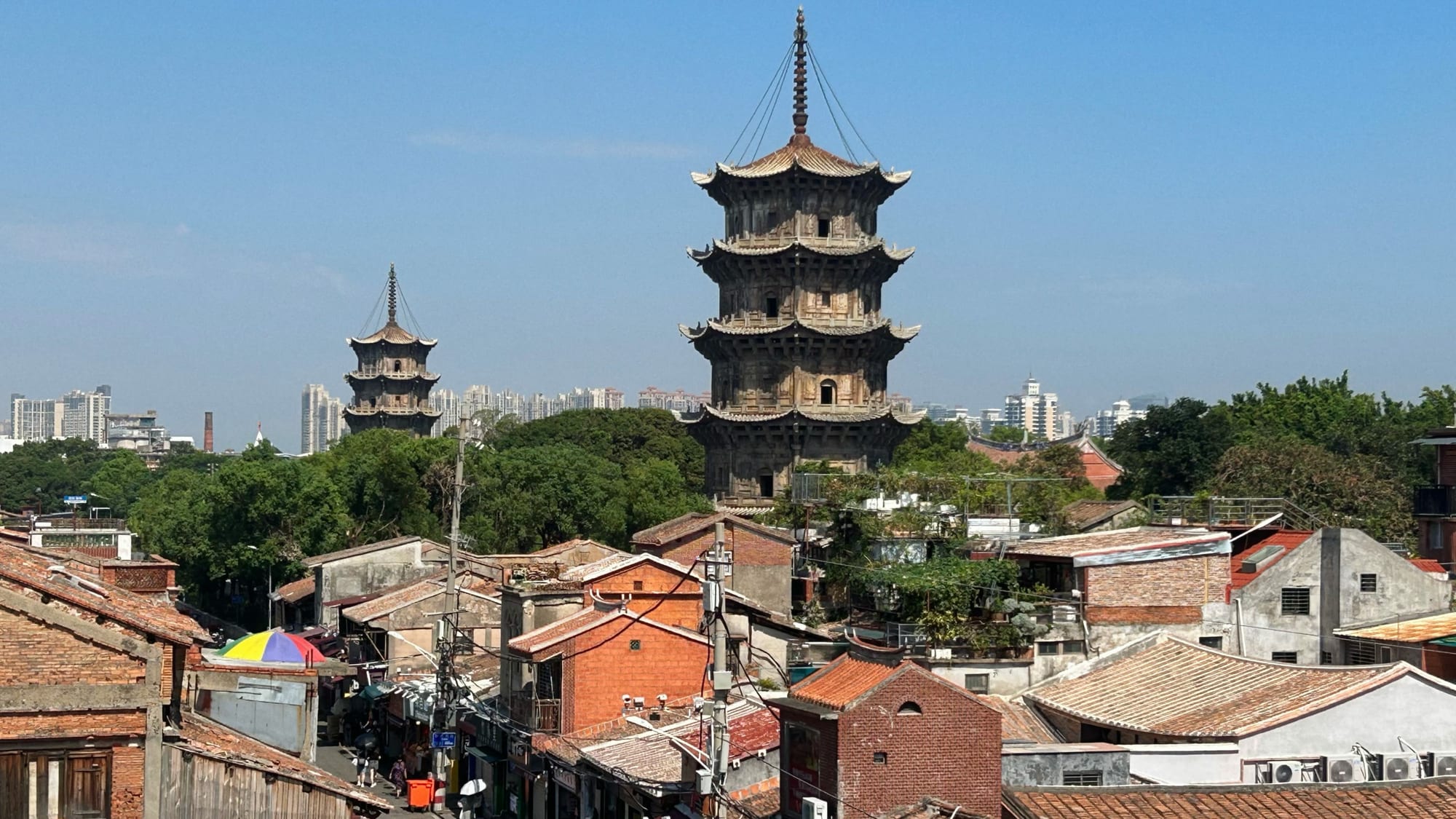
Two tall stone pagodas rising above the tiled and brick rooftops of an old street under a clear blue sky

Guangdong, Fujian & the Southeast Coast, China

Quanzhou

The twin stone pagodas of Kaiyuan Temple above the rooftops of West Street in Quanzhou. (HMGiovanniV / Wikimedia Commons · CC BY-SA 4.0)

A port city on the Fujian coast at the mouth of the Jin River, known to medieval traders as Zayton and described by Marco Polo and Ibn Battuta as one of the great harbours of the world. Its Song and Yuan trading sites were listed by UNESCO in 2021, and temples, mosques and stone carvings from several religions still stand among the lanes of the old city.

Neighbourhoods

  • Licheng and the old city
    • First-time visitors
    • Historic district
    • Best for food

    The walled city of the Song period, now a grid of lanes around West Street and Zhongshan Road, with arcaded shophouses, red-brick Minnan houses, small temples on street corners and most of the city's guesthouses and snack shops.

    Open in Maps
  • Fengze
    • Close to public transport
    • Modern city
    • Business travellers

    The newer district east of the old centre, holding the main hotels, shopping centres, university campuses and the road out to Luoyang Bridge and the coast. Most long-distance buses and the links to the high-speed station run through here.

    Open in Maps
  • Jinjiang
    • Local life
    • Short trips
    • Historic sites

    A separate city across the river, about 15 kilometres south, whose shoe and sportswear factories made the area wealthy. The Anping Bridge, the Cao'an temple and a string of coastal villages lie within its boundaries.

    Open in Maps
  • The coast at Chongwu and Xunpu
    • Coastal walks
    • Traditions
    • Photography

    The fishing coast north-east and east of the city, where the walled Ming town of Chongwu stands above the sea and the village women of Hui'an and Xunpu still wear distinctive dress and flower headdresses.

    Open in Maps

Things to do

Temples, mosques and shrines

  • Kaiyuan Templelandmark

    The city's great Buddhist monastery, founded in 685 or 686, with twin pagodas rebuilt in stone in the 13th century, their storeys carved with relief figures, and a hall whose columns include Hindu carvings from an earlier temple.

    Open in Maps
  • Qingjing Mosquelandmark

    A mosque of stone founded in 1009 or 1010, among the oldest in China, of which the gateway, walls and prayer-hall ruins survive on Tumen Street.

    Open in Maps
  • Cao'anlandmark

    A small hillside hall south of the city, long regarded as the only Manichaean temple in China to survive intact, with a stone carving of Mani in the form of a Buddha.

    Open in Maps
  • Islamic tombs of Lingshanlandmark

    Stone tombs on a hillside east of the old city, traditionally said to hold two Arab missionaries who reached China in the seventh century, an attribution historians have questioned.

    Open in Maps

Bridges and stone

  • Luoyang Bridgelandmark

    A stone beam bridge across a tidal estuary north-east of the city, built between 1053 and 1059 on oyster-covered foundations, an engineering landmark of the Song period.

    Open in Maps
  • Anping Bridgelandmark

    A stone beam bridge completed in 1151, running 2,070 metres across what was a tidal estuary between Anhai and Shuitou, and the longest bridge in China until 1905.

    Open in Maps
  • Qingyuan Mountainpark

    The hill park on the city's northern edge, with springs, Buddhist and Taoist grottoes and a Song-period stone statue of Laozi carved from a boulder.

    Open in Maps

Museums and the old city

  • Quanzhou Maritime Museummuseum

    A museum of the port's overseas trade, established in 1959, with a hall of religious stone carvings left by foreign merchants and, in its older section on the Kaiyuan Temple grounds, ancient boats including a Song-period seagoing ship unearthed in 1974.

    Open in Maps
  • West Streetattraction

    The main street of the old city, running past the gates of Kaiyuan Temple between arcaded shops, snack stalls and lanes of red-brick houses.

    Open in Maps

Short trips from the city

  • Chongwulandmark

    A coastal town on a peninsula about 25 kilometres east, whose walled fortress dates from the late 14th century, with lanes of granite houses, a sculpture park and a rocky shore.

    Open in Maps

Seasonal events

  • Lantern Festivalfifteenth day of the first lunar month, February or March

    Quanzhou's best-known celebration, when lantern displays fill the temples and old streets and crowds walk between them through the night.

  • Mazu festivalsspring, on the goddess's birthday in the third lunar month

    Processions, opera and offerings at coastal temples, with the women of Xunpu carrying flowers and images through the village.

  • Puppet and nanyin performancesyear-round, most often at festivals

    Marionette and hand-puppet theatre and the slow chamber music called nanyin, which UNESCO added to its intangible cultural heritage list in 2009, performed at temple fairs and city venues.

  • Lunar New YearJanuary or February

    Family reunions, temple crowds and returning relatives from Southeast Asia and Taiwan, followed by two weeks of visiting and offerings.

Eat and drink

Long-standing places and food districts in Quanzhou. Hours, ratings and directions come from your maps app, always current.

Food streets and markets

  • West Street and the old city lanesneighborhood

    Snack shops and small kitchens selling oyster omelette, beef soup, rice noodles and glutinous rice dumplings within a few minutes of Kaiyuan Temple.

    Open in Maps
  • Zhongshan Road arcadesneighborhood

    The arcaded main street of the early 20th-century city, lined with old shops, tea houses and stalls frying sweet potato and taro snacks.

    Open in Maps
  • Xunpu fishing villageneighborhood

    An oyster-farming village east of the city where houses are built with oyster shells set into the walls and seafood is sold straight from the boats.

    Open in Maps

Quanzhou classics

  • Beef soup shopsrestaurant

    Clear soup with sliced beef and ginger, eaten with rice or noodles, a Quanzhou breakfast served in plain shops across the old city.

    Open in Maps
  • Tea housescafe

    Small rooms where Tieguanyin oolong from nearby Anxi is brewed in the gongfu style, in tiny cups refilled continuously.

    Open in Maps

Experience Quanzhou

History

Quanzhou grew from a coastal settlement in southern Fujian into a trading port under the Tang dynasty, and its rise came with the Song. By the 12th century it had a government office of maritime trade, shipyards building ocean-going junks with watertight compartments, and a foreign merchant quarter. Arab, Persian, Indian, Southeast Asian and later European traders lived in the city, and its exports of ceramics, silk and tea went out through a harbour known to them as Zayton, a name linked to the coral trees planted around the city, which was also known as Citong, the coral-tree city.

Under the Mongol Yuan dynasty the port reached its height, and Marco Polo and Ibn Battuta both described it as one of the greatest harbours in the world. That cosmopolitan century left an unusual religious landscape: Buddhist and Taoist temples, a mosque, Muslim tombs, Hindu carvings reused in temple halls, the Manichaean shrine at Cao'an, and Nestorian Christian gravestones now kept in the city's museums.

Decline followed. Rebellion at the end of the Yuan period, Ming restrictions on private maritime trade, silting of the harbour and the rise of other ports pushed Quanzhou to the margins by the 16th century, and the coastal evacuation ordered by the early Qing emptied its shoreline. The city instead became a source of emigrants: Minnan families from Quanzhou settled across Taiwan, the Philippines, Singapore, Malaysia and Indonesia, and remittances built much of what stands in the old city today. Manufacturing — shoes, clothing, sportswear and stone — made the area prosperous again after the 1980s, and in 2021 UNESCO listed a group of sites in and around the city as Quanzhou: Emporium of the World in Song-Yuan China.

Culture & Customs

Quanzhou is a stronghold of Minnan culture, and much of what defines it was carried from here across the strait and around Southeast Asia. The language is Minnan, close to Taiwanese Hokkien; the architecture is red brick with swallowtail roof ridges; and the performing arts include liyuan opera, a theatre form that originated in the city, the marionette theatre with its many strings, and nanyin, a slow chamber music played on pipa, flute and clappers that UNESCO has listed as intangible heritage.

Religion is lived at street level. Small shrines stand in ordinary lanes, incense burns outside shops, and a single neighbourhood may hold Buddhist, Taoist and folk temples within a few hundred metres, with a mosque and a Manichaean hall nearby. Mazu, the sea goddess, and Guan Yu are widely worshipped, and processions carrying deity palanquins through the streets are part of ordinary life rather than performances for visitors. That mixture of religious buildings is part of what UNESCO's listing recognises.

Local identity is strongly tied to emigration and to clan. Ancestral halls, lineage records and connections to relatives in Taiwan and Southeast Asia matter, and families returning for festivals fill hotels and temples. The women of Hui'an and Xunpu are known across China for their dress — headscarves, wide trousers and, in Xunpu, crowns of fresh flowers — and tea drinking in the gongfu style punctuates every transaction and conversation.

Daily Life

About 8.8 million people live in the municipality, which takes in the old city, the industrial cities of Jinjiang and Shishi, coastal Hui'an and mountainous inland counties. The historic centre itself is modest in scale and quieter than the surrounding districts, where most of the population and nearly all the factories are.

Private manufacturing drives the economy. Jinjiang and Shishi produce a large share of China's sports shoes and casual clothing, several well-known sportswear brands are based here, Hui'an supplies carved granite across the country, and Dehua has made porcelain for a thousand years. Migrant workers from inland provinces fill the factories, and overseas Chinese investment remains significant. Fishing and oyster farming continue on the coast, and tourism has grown quickly since the UNESCO listing.

Everyday rhythms are slower than in the Pearl River Delta. Mornings begin with beef soup or rice noodles and a pot of tea, temples fill on the first and fifteenth of the lunar month, and evenings are spent outdoors on the streets and squares. Traffic in the old lanes, pressure from rising visitor numbers on the historic quarter, factory orders and the cost of housing for migrant workers are the common local concerns.

Food

Quanzhou's cooking belongs to the Minnan tradition, built on seafood, pork, sweet potato and light broths. The dish most eaten here is beef soup — clear stock with thin slices of beef, ginger and coriander, taken with rice or noodles at any hour. Oyster omelette, haolijian, fries small local oysters with egg and sweet potato starch into something soft and chewy, and oysters also go into rice porridge and soups, thanks to the farms along the shore at Xunpu.

Miansian hu, a thick soup of fine wheat noodles with shellfish or liver, and Quanzhou's version of lurou fan, braised pork over rice, are everyday food. Rousong pork floss, sweet potato starch dumplings filled with pork and mushroom, salty rice puddings, peanut soup and glutinous rice cakes are sold from small shops in the old lanes. Puffed sweet potato snacks and sweet peanut brittle are the usual gifts to carry away.

Tea is the constant. Anxi, an hour inland, is the home of Tieguanyin oolong, and gongfu brewing — a small pot, tiny cups, many short infusions — is offered in shops, offices and temples. Dehua porcelain from the same municipality has supplied the cups for centuries. Sugarcane juice, herbal grass jelly and four-fruit soup cool the summer, and returning emigrants have brought back coffee habits and Southeast Asian flavours such as satay and curry.

Planning tools

Budget

Quanzhou is markedly cheaper than Xiamen or the Pearl River Delta cities. Guesthouses in the old city are inexpensive, temple entry costs little and street food is among the best value in Fujian. Costs rise only around Lunar New Year, when returning families fill the hotels.

Daily Budget Midrange
USD 80–150 (mid-range hotel, restaurant meals, entry tickets, taxis and day trips along the coast)
Daily Budget Shoestring
USD 30–55 (guesthouse in the old city, street food and beef soup shops, buses)

Staying inside the old city keeps costs down and puts most of the UNESCO sites within walking distance.

Best Time to Visit

October to December is the most comfortable season, dry and warm. Spring is mild but damp and misty, and the Lantern Festival in February or March is the year's liveliest moment. Summer is hot, humid and the typhoon season, though sea breezes make the coast bearable.

Suggested Number of Days

Two days cover the old city and its main religious sites. Three or four allow for the bridges, the coast and the neighbouring towns. The sites are scattered across a wide municipality, so extra time mostly buys travel.

First Visit
2 days
With Surroundings
3–4 days

Transportation

The old city is small enough to walk, and buses and ride-hailing cover the rest of the municipality; there is no metro. Sites such as the bridges, Cao'an and Chongwu are spread out, and a taxi, hired car or bus journey is needed for each. Bus routes link the centre with the high-speed railway station north of the city.

Hiring a driver for half a day is the practical way to combine two or three of the outlying UNESCO sites.

Airport & Station Connections

Quanzhou Jinjiang International Airport lies about 12 kilometres south of the centre, with flights within mainland China and regional services to Hong Kong, Macau and Southeast Asia. Most visitors arrive by high-speed train on the Fuzhou–Xiamen line at Quanzhou station, north of the city and linked by bus, with services to Xiamen in under three quarters of an hour.

Walkability

The old city is one of the most walkable historic centres in the region: flat, compact, and busy with small temples, shops and food stalls, with Kaiyuan Temple, the mosque and the Tianhou temple all within a couple of kilometres. Beyond it the city is spread out and built for cars. Heat and humidity slow walking from May to September.

Safety

Quanzhou is a quiet, low-crime city where visitors rarely encounter trouble. The practical hazards are summer typhoons and heavy rain, heat and humidity, busy scooter traffic in the old lanes, and slippery rocks and strong currents on the coast.

Watch for scooters in narrow streets, follow typhoon warnings between July and September, take care on coastal rocks, and avoid photographing military sites along the shore. Check current official travel advice before travelling.

Climate

Subtropical and maritime. Rain falls mainly between May and September, often heavily, and typhoons are most likely from July to September. Winters are mild but can feel cold indoors, as buildings are not heated.

Summer
hot and humid, 28–34°C, with downpours and occasional typhoons
Winter
mild, 10–18°C, with damp and windy spells

Local Customs

Minnan, the southern Fujian language, is the everyday speech alongside Mandarin, and family and temple life are central. Folk religion is practised openly: incense at street shrines, offerings on the pavement at festival dates, and processions that close roads. Tea is offered to visitors constantly, in small cups poured from a shared pot.

Tipping is not expected. Ask before photographing worshippers or funeral and festival processions, remove hats inside temples and the mosque, and dress modestly at religious sites.

Common Payment Methods

The currency is the renminbi, counted in yuan. Alipay and WeChat Pay QR codes are used for nearly everything, including market stalls and buses, and both let foreign visitors link an overseas card. Hotels take foreign cards; small shops in the old city may not, and a little cash is useful.