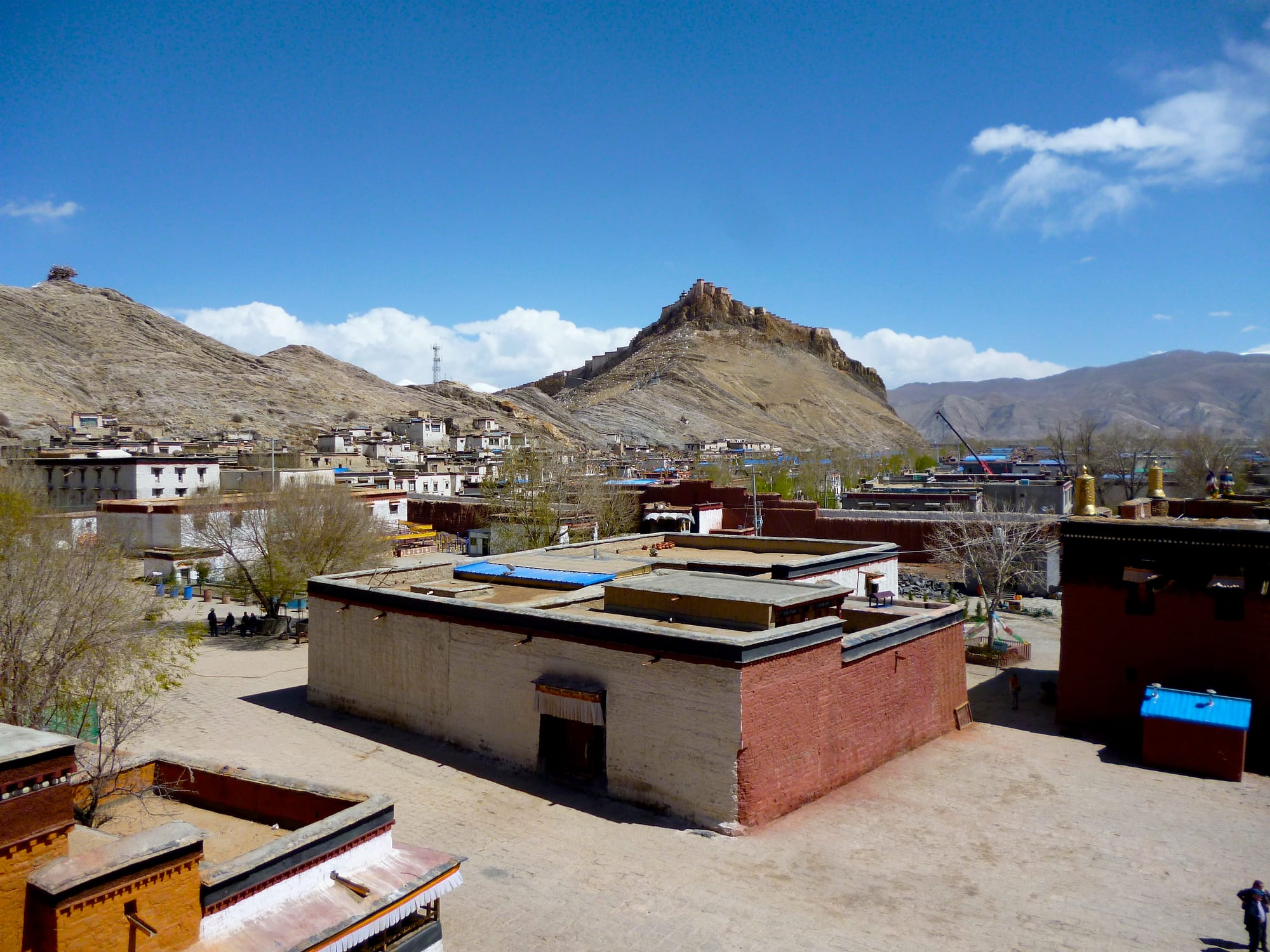
Flat-roofed white and red Tibetan buildings below a rocky hill topped by the walls of a ruined fortress under a deep blue sky

Tibet, China

Gyantse

The old town of Gyantse below the walls of its hilltop dzong. (JanManu / Wikimedia Commons · CC BY-SA 4.0)

A small town in the Nyang Chu valley of central Tibet, at about 4,000 metres, known for two things standing side by side: a fortress on a bare rock above the houses, and the walled Palcho Monastery with its Kumbum, a tiered stupa of many chapels. Once a wool-trading centre on the route to Sikkim and India, it keeps more of its old Tibetan street pattern than the larger cities.

Neighbourhoods

  • The old Tibetan town
    • First-time visitors
    • Historic district
    • Walking

    The lanes of whitewashed, flat-roofed houses with painted window frames that run between the monastery gate and the foot of the fortress rock. Courtyards, small shops and teahouses open off them, and the street pattern is largely the one the town has had for centuries.

    Open in Maps
  • Around Palcho Monastery
    • Temples
    • Pilgrim life
    • Quiet

    The northern end of the town, where a long ochre wall climbs the slope around the monastery compound and the Kumbum. Pilgrims walk the circuit outside the walls, and the ground between the gate and the old houses is open and dusty, with long views to the fort.

    Open in Maps
  • The new main street
    • Hotels and restaurants
    • Close to transport

    The wide modern avenue south of the old town, lined with shops, guesthouses, Sichuanese restaurants and the buildings of the county administration. Tour vehicles and buses stop here, and it is where most visitors sleep and eat.

    Open in Maps
  • The valley farmland
    • Countryside
    • Views

    Barley and rapeseed fields spread along the Nyang Chu on both sides of the town, dotted with villages, irrigation channels and lines of poplars. Tracks through them give the classic view back to the fort on its rock.

    Open in Maps

Things to do

The monastery and the fort

  • Palcho Monasterylandmark

    A 15th-century walled compound, unusual in having housed monks of several Buddhist schools together, containing the Kumbum — the largest chörten in Tibet, a tiered stupa whose 108 chapels hold hundreds of wall paintings and images.

    Open in Maps
  • Gyantse Dzonglandmark

    The fortress on the rock above the town, defended against a British expedition in 1904, reached by a steep stepped path and giving a wide view over the valley.

    Open in Maps

The town and the valley

  • The old Tibetan quarterneighborhood

    A surviving grid of traditional houses, courtyards and small shops between the monastery and the fort, where the old street pattern is still largely intact.

    Open in Maps
  • The monastery koratrail

    The walking circuit that follows the monastery's hillside wall clockwise, used by pilgrims and giving views down over the roofs of the compound.

    Open in Maps

Short trips from the town

  • Yamdrok Lakeattraction

    A turquoise freshwater lake more than 70 kilometres long on the road towards Lhasa, one of the three largest in Tibet, held sacred and ringed by snow-capped mountains.

    Open in Maps
  • Tashilhunpo Monasterylandmark

    In Shigatse, west along the valley, the great monastery founded in 1447 and seat of the Panchen Lamas, with a gilded Maitreya statue and the tombs of past incumbents.

    Open in Maps
  • Shalu Monasterylandmark

    Between Gyantse and Shigatse, an 11th-century monastery with Chinese-style glazed roofs and early murals, linked with the scholar Buton Rinchen Drub.

    Open in Maps

Seasonal events

  • Gyantse horse-racing festivalthe fourth Tibetan lunar month, usually May or June

    A gathering of several days on the meadows outside town for horse racing, archery and displays of riding, with trading stalls and picnic tents.

  • LosarFebruary or March

    Tibetan New Year, with family visits, new prayer flags on the rooftops and offerings at Palcho Monastery.

  • Saga DawaMay or June

    The month marking the Buddha's birth, enlightenment and death, when the kora paths are busiest and many people give alms.

Eat and drink

Long-standing places and food districts in Gyantse. Hours, ratings and directions come from your maps app, always current.

Gyantse classics

  • Tibetan teahouses in the old townrestaurant

    Plain rooms serving sweet milk tea and salted butter tea by the thermos, momo dumplings and thukpa noodle soup to farmers and drivers.

    Open in Maps
  • Sichuanese kitchens on the main streetneighborhood

    The modern street is lined with small restaurants run by migrants from Sichuan, serving stir-fries, rice dishes and hotpot, which is what most evening meals in town look like.

    Open in Maps

Markets and street food

  • The town marketmarket

    Stalls of barley flour, dried yak meat, hard chura cheese, butter and tea bricks, alongside fruit and vegetables brought up from lower valleys.

    Open in Maps

Experience Gyantse

History

Gyantse grew where the Nyang Chu valley opens out, on a route linking central Tibet with the Chumbi valley, Sikkim and the plains of India. A local dynasty descended from the Sakya-era nobility built the fort on the rock in the 14th century, and their descendants founded Palcho Monastery in the 15th, adding the Kumbum, whose chapels were painted by artists working in a style that fused Tibetan with Nepalese and Chinese models. The monastery unusually housed colleges of more than one Buddhist school within a single wall.

Wool and trade carried the town through the following centuries. Gyantse was the third town of Tibet after Lhasa and Shigatse, a market where the wool of the northern grasslands was gathered for export south, and its weavers gave their name to a tradition of Tibetan carpet making. In 1904 a British expedition under Francis Younghusband fought its way up the valley; Tibetan defenders held the dzong through a siege before it fell, and the convention that followed gave Britain the right to station a trade agent in the town.

The 20th century took away most of what had made the place prosperous. The southern trade collapsed when the border with India closed after 1959, the monastery, the fort and the Kumbum were ransacked in the Cultural Revolution, and a flood nearly destroyed the town in 1954. Restoration since the 1980s has repaired the Kumbum and parts of the fort, and the old quarter has kept much of its traditional street pattern, while a new administrative town has grown up to the south.

Culture & Customs

Gyantse's identity rests on its monastery and its craft. The Kumbum's painted chapels are the reason art historians come to a town of this size, and the style of image-making associated with 15th-century Gyantse is studied as a distinct school. Carpet weaving is the town's other old trade: Tibetan carpets knotted in a technique using a rod to form the pile were made here for monastery seats, saddles and beds, and weaving still goes on in the valley.

Religious life follows the ordinary rhythms of Tsang. People circle the monastery wall clockwise in the morning, refill butter lamps before festivals, and hang new prayer flags on the rooftops at Losar. The horse and archery festival, held on the meadows below the fort in the fourth Tibetan month, brings riders and archers from the surrounding farming villages, and families pitch tents and picnic for days. The fort's own history is commemorated in the town as a story of resistance.

Manners follow Tibetan custom: white khata scarves are exchanged at arrivals and departures, tea is topped up after every sip, and guests are pressed to eat more than they intend. Tibetan is the language of the lanes, fields and market, Mandarin that of offices and schools, and most working-age residents move between the two.

Daily Life

Gyantse is a county seat of around eight thousand people, with a further tens of thousands in the villages of the county around it. It feels like what it is: a farming town where tractors and motorbikes outnumber cars in the old lanes, dogs sleep in the sun and shopkeepers sit outside. Most families are Tibetan, with a smaller Han and Hui population running shops, restaurants and building work along the newer street.

Barley is the backbone of the valley, with wheat, rapeseed, peas and potatoes in the irrigated fields and yaks, sheep and goats on the slopes above. Threshing in late summer is a communal business, with grain spread on rooftops and courtyards. Beyond farming, work means government offices, road building, small workshops, carpet weaving and the tourist traffic that passes through between Lhasa and Shigatse.

The day is shaped by the sun. Work begins early while the air is cold and still, the middle of the day is bright and hot in the thin atmosphere, and the streets empty soon after dark, especially in winter. Ongoing changes are the same as elsewhere on the plateau: new housing on the edges of town, better roads, more domestic tourism, young people leaving for jobs in Lhasa or beyond, and the balance between conserving the old quarter and rebuilding it.

Food

Gyantse eats what the valley grows. Barley is roasted and ground into tsampa, mixed by hand with butter tea into a dough and eaten at breakfast or carried into the fields. Po cha, butter tea, is churned from brick tea, salt and yak butter and poured all day; sweet milk tea has become the everyday alternative in teahouses. Momos, dumplings steamed or fried with yak meat or vegetables, and thukpa, a noodle soup, are the standard meals, with shapale, a fried meat pastry, as the usual snack.

Dairy and meat come from the herds. Yak meat is eaten fresh in stews with radish and potato, or dried in strips through the winter until it is hard and salty; milk becomes yoghurt, soft cheese and chura, dried cubes chewed slowly for hours. Chang, a cloudy beer brewed at home from barley, is poured at weddings, festivals and the horse fair, and refused only with difficulty.

Vegetables were historically scarce at this altitude, and potatoes, radishes and cabbage still dominate, although greenhouses along the valley now supply green vegetables for much of the year. The other half of the town's eating is migrant cooking: Sichuanese restaurants with their stir-fries and hotpot, and Hui noodle counters pulling lamian to order in clear beef broth. Visitors' menus add fried rice, egg dishes and, near the monastery, a little Nepalese-influenced food.

Planning tools

Budget

Gyantse is normally a stop on a tour between Lhasa and Shigatse, so the guide, driver and permits set the cost rather than the town itself, where guesthouses and meals are cheap. Entry to Palcho Monastery and the Kumbum is charged separately, as is the climb to the fort.

Daily Budget Midrange
USD 180–370 (private guide and vehicle, comfortable hotel, restaurant meals, all permits)
Daily Budget Shoestring
USD 90–150 (shared small-group tour, guesthouse room, teahouse meals, monastery entry)

Sharing a vehicle and guide with other travellers is the largest single saving; monastery and fortress tickets are paid on the spot in cash.

Best Time to Visit

April to June and September to October give clear skies, open passes on the road from Lhasa and comfortable daytime temperatures. Barley and rapeseed turn the valley green and yellow in summer, and the horse festival falls in late spring or early summer. Winter is dry, bright and very cold, and travel to Tibet has often been restricted in March.

Suggested Number of Days

The town's main sights fit comfortably into a day, and many tours pass through in an afternoon. Staying a night allows a slower look at the monastery, the climb to the fort and a walk into the farmland, and breaks the long drive from Lhasa at a useful altitude.

First Visit
1 day
With Surroundings
2 days

Transportation

Foreign visitors arrive and leave in a licensed agency's vehicle with a guide. The town itself is small enough to cross on foot in twenty minutes, and there are a few taxis and three-wheelers. Buses and shared vehicles link Gyantse with Shigatse and Lhasa, though permit rules limit how foreigners may use them.

Carry the passport and permit copies: they are checked at hotels and at checkpoints on the roads in and out of the valley.

Airport & Station Connections

Gyantse lies about 90 kilometres by road east of Shigatse, an easy drive of under two hours down the Nyang Chu valley. From Lhasa the usual approach is the southern highway over passes past Yamdrok Lake and the Karo La, roughly 260 kilometres and most of a day with stops. The nearest airport and railway station are at Shigatse.

Walkability

Everything in the town is walkable: the main street, the old quarter and the monastery gate lie within about a kilometre of each other on flat ground. The climb to the dzong is short but steep and hard work at this altitude, and the surfaces underfoot in the old lanes are rough and dusty.

Safety

Crime is very low and the town is quiet after dark. The chief concern is altitude: Gyantse stands at about 4,000 metres, higher than Lhasa, and headaches and breathlessness are common, particularly on the steps up to the fort. There are checkpoints on the roads and a visible security presence, and political conversations can create problems for local Tibetans. Images of the Dalai Lama are banned, and photographing police, soldiers or checkpoints should be avoided.

Acclimatise in Lhasa before coming, take the climb to the dzong slowly, avoid politics in conversation, and follow the guide's rules on photography inside chapels. Check current official travel advice before travelling.

Climate

High, dry and sunny, with strong ultraviolet light and a big fall in temperature after sunset. Most of the year's modest rainfall comes in July and August, usually in the evening, and spring afternoons are often windy and dusty.

Summer
mild days of about 15–22°C, nights near 5–8°C, with showers in July and August
Winter
bright days of about 3–8°C, nights well below freezing, and occasional snow on the passes

Local Customs

The same etiquette applies as elsewhere in Tibet: walk clockwise around chapels, stupas and kora paths, remove hats indoors, do not point feet at images, and ask before photographing people. Photography is restricted or charged for inside the Kumbum chapels, where flash would damage the paintings. Tipping is not customary in China, but guides and drivers on Tibet tours are commonly tipped at the end of a trip.

Take a khata scarf or a cup of tea with both hands, dress with shoulders and knees covered in religious buildings, and keep politics and the Dalai Lama out of conversation for the sake of local people.

Common Payment Methods

The currency is the Chinese yuan renminbi. Payment by phone app is normal even in small shops, and cards work in the better hotels, but cash is what most visitors need here: monastery tickets, teahouses, market stalls and butter-lamp offerings all run on notes. There are bank branches and cash machines in town, but far fewer than in Shigatse.