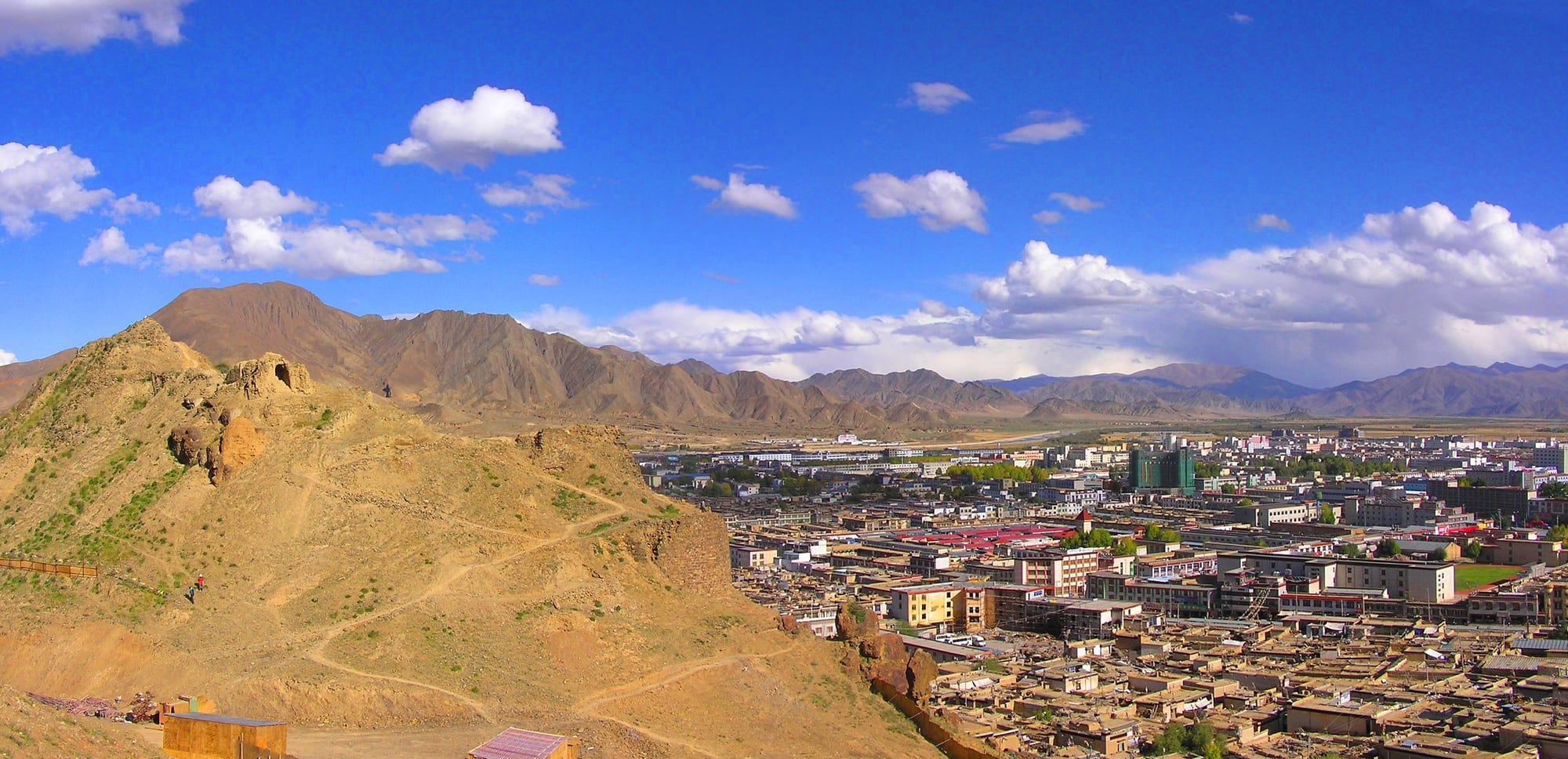
Shigatse spread across a dry valley below bare brown mountains, with a ruined hilltop wall in the foreground under a blue sky

Tibet, China

Shigatse

Shigatse seen from the ridge below its hilltop dzong, with the Tibetan quarter in the foreground and the modern city beyond. (Peter Vigier / Wikimedia Commons · CC BY 2.5)

The second city of central Tibet, set at about 3,840 metres where the Nyang Chu meets the Yarlung Tsangpo. It grew around Tashilhunpo Monastery, founded in 1447 and the seat of the Panchen Lamas, and was the capital of the old province of Tsang. Today a monastery town of white walls and gilded roofs sits beside a much larger modern city on the road west towards Everest and Nepal.

Neighbourhoods

  • Tashilhunpo and the monastery quarter
    • First-time visitors
    • Historic district
    • Pilgrim life

    The western side of town, where the white and ochre halls of Tashilhunpo climb the hillside behind a walled forecourt. Pilgrims walk the kora path that circles the monastery, and the lanes below it hold guesthouses, tea shops and stalls selling incense, prayer flags and butter.

    Open in Maps
  • The old Tibetan town
    • Local life
    • Markets
    • Walking

    The low, flat-roofed Tibetan houses between the monastery and the hill of the dzong, with courtyards, workshops and a street market where villagers from the surrounding valleys trade cloth, jewellery and household goods. It is the oldest-feeling part of the city and easy to cross on foot.

    Open in Maps
  • The new town
    • Hotels and restaurants
    • Close to transport

    The grid of wide avenues, offices, shops and hotels that now makes up most of Shigatse, built out across the plain since the 1990s. Most of the larger hotels, banks, supermarkets and Sichuanese restaurants are here, along with the bus station.

    Open in Maps
  • Below the dzong
    • Viewpoints
    • Quiet and residential

    The slopes under the rebuilt fortress on its rock, reached by steps and lanes from the old town. The ground below is residential and quiet, and the terrace beside the walls gives the widest view over the rooftops to the mountains that ring the valley.

    Open in Maps

Things to do

Monasteries

  • Tashilhunpo Monasterylandmark

    Founded in 1447 by Gendun Drup, later recognised as the First Dalai Lama, and the seat of the Panchen Lamas — a walled town of chapels and courtyards holding a gilded Maitreya statue some 26 metres high and the tombs of several Panchen Lamas.

    Open in Maps
  • Shalu Monasterylandmark

    About 20 kilometres south of the city, a small 11th-century monastery known for Chinese-style glazed tiled roofs and for early murals, and associated with the scholar Buton Rinchen Drub.

    Open in Maps
  • Narthang Monasterylandmark

    The monastery about 15 kilometres west of Shigatse whose printing house, the oldest of Tibet's three great printing centres, turned out editions of the Kangyur and Tengyur until 1959.

    Open in Maps
  • Ngor Monasterylandmark

    The site of a Sakya-school monastery founded in 1429 about 20 kilometres south-west of the city, later destroyed and known to art historians for its library of Sanskrit texts and its 15th-century Newar-derived paintings.

    Open in Maps

The town

  • Shigatse Dzonglandmark

    The fortress on the ridge above the old town, seat of the kings of Tsang and a smaller forerunner of the Potala, destroyed in the 20th century and rebuilt in the 2000s on its old footprint.

    Open in Maps
  • The Tibetan quarter marketmarket

    An open street market beside the old town where traders sell prayer flags, wool, jewellery, dried yak cheese and household goods to people from the surrounding farming villages.

    Open in Maps

Short trips from the city

  • Sakya Monasterylandmark

    The grey-walled fortress-monastery about 130 kilometres west of Shigatse, founded in 1073 and seat of the Sakya school whose lamas governed Tibet in the 13th and 14th centuries, with an enormous library of manuscripts.

    Open in Maps
  • Palcho Monasterylandmark

    In Gyantse, east of Shigatse, a walled complex whose Kumbum is a tiered stupa of 108 chapels painted with murals of the 15th century.

    Open in Maps
  • Gyantse Dzonglandmark

    The fort on a crag above Gyantse, defended against a British expedition in 1904 and reached by a stepped path with a long view over the valley.

    Open in Maps

Seasonal events

  • LosarFebruary or March

    Tibetan New Year, marked with family visits, offerings at Tashilhunpo and crowds on the kora paths.

  • Saga DawaMay or June

    The month commemorating the Buddha's birth, enlightenment and death, when pilgrim numbers and acts of merit rise sharply across Tibet.

  • Tashilhunpo thangka displayJune or July, by the Tibetan calendar

    The monastery unfurls a giant appliqué thangka on the stone terrace built for it, drawing pilgrims from across Tsang for three days of ceremonies.

Eat and drink

Long-standing places and food districts in Shigatse. Hours, ratings and directions come from your maps app, always current.

Shigatse classics

  • Tibetan teahouses near Tashilhunporestaurant

    Simple rooms serving sweet milk tea or salted butter tea by the thermos, momo dumplings filled with yak meat, and thukpa noodle soup.

    Open in Maps
  • Sichuanese restaurants in the new townneighborhood

    The commercial streets are lined with kitchens run by migrants from Sichuan, serving stir-fries, hotpot and rice dishes that make up much of the everyday eating-out in the city.

    Open in Maps

Markets and street food

  • The old-town market stallsmarket

    Stalls selling dried yak meat, hard cubes of chura cheese, barley flour, bricks of tea and seasonal fruit trucked up from lower valleys.

    Open in Maps
  • Bakeries and noodle countersneighborhood

    Small counters around the bus station and the main avenues turn out hand-pulled beef noodles and fried bread, a legacy of Hui and Gansu traders who settled along the highway towns.

    Open in Maps

Experience Shigatse

History

Shigatse grew up in the valley of Tsang, the province west of Lhasa, at a meeting of routes that carried barley, salt, wool and tea between the plateau, the Nepalese passes and the trade towns of the south. The founding event was the building of Tashilhunpo in 1447 by Gendun Drup, a disciple of Tsongkhapa later counted as the First Dalai Lama. The monastery became the largest Gelug foundation in Tsang and drew scholars, craftsmen and traders to the settlement below it.

In the late 16th century the rulers known as the Tsangpa made Shigatse their capital, and in the early 17th century Karma Phuntsok Namgyal raised a fortress on the ridge above the town. Their defeat in 1642, when the Mongol Güshi Khan installed the Fifth Dalai Lama's government in Lhasa, ended Tsang's independent power, but the city kept a second kind of authority: the Fourth Panchen Lama, abbot of Tashilhunpo, was recognised as a line of reincarnations, and his successors held Tashilhunpo and much of the surrounding district. The monastery's own estate made Shigatse a centre of wealth and learning, and European travellers, including the Scottish envoy George Bogle in 1774, came to the Panchen's court rather than to Lhasa.

The 20th century was hard on the city. The dzong was demolished in 1961, after the 1959 uprising, and Tashilhunpo, though damaged, escaped the worst of the destruction that struck most Tibetan monasteries. The succession of the Panchen Lama has been disputed since 1995: the boy recognised by the Dalai Lama has not been seen in public since that year, and the government named its own candidate. Since the 1990s the old quarter has been ringed by a far larger modern city, and the fortress was rebuilt on its rock in the 2000s.

Culture & Customs

Shigatse's public life turns on Tashilhunpo. Pilgrims arrive from the villages of Tsang and from much further away, walk the kora clockwise around the monastery walls, spin the long ranks of prayer wheels and pour butter into the lamps in the chapels; some measure the circuit in full-body prostrations. Monks study, debate in the courtyards and prepare the ceremonies that mark the Tibetan lunar calendar, and the giant appliqué thangkas hung from the monastery's stone terrace in summer draw the biggest crowds of the year.

The city is the cultural capital of Tsang, a province with its own dialect, dress and farming traditions, and Shigatse people are recognised elsewhere in Tibet by their speech. Local crafts include carpet and cloth weaving, metalwork for monastery fittings, and the carving of mani stones. Tibetan opera, Lhamo, is performed at festivals, and songs sung while threshing or building are still part of village work in the valleys nearby.

Daily courtesies are shared with the rest of Tibet: white khata scarves offered on arrival and departure, tea cups refilled after every sip, and a general reserve towards strangers that gives way quickly over a thermos of butter tea. Mandarin is the language of offices, schools and much of the new town, and Tibetan of homes, markets and the monastery, so many residents move between the two through the day.

Daily Life

Roughly 120,000 people live in the urban district, within a prefecture-level city of about 800,000 spread over an enormous area of farmland, grazing country and mountain. The population mixes Tibetan families, many with roots in the surrounding farming villages, with Han and Hui migrants who run shops, restaurants and building firms, most of whom arrived after the highways and the railway improved.

Barley is the anchor of the rural economy around the city, along with wheat, rapeseed, potatoes and herds of yaks and sheep on the higher ground. In the city itself the work is government administration, construction, trade, transport along the Nepal highway, and tourism, which is overwhelmingly domestic and concentrated in the warmer months.

The day starts early, with tea and tsampa and a circuit of the kora for older residents before shops open, and ends early too: the streets empty after dark in winter. Power, water and internet reach the new town well and the outlying villages unevenly. Current issues are those of the region as a whole — the pace of migration and construction, the cost of housing in the new districts, the future of grazing land, and the resettlement of herders into permanent villages.

Food

Everyday eating in Shigatse is Tibetan and built for the altitude. Tsampa, roasted barley flour, is kneaded by hand with butter tea into a dough and eaten at breakfast and as a portable meal. Po cha, butter tea, is churned from brick tea, salt and yak butter and drunk through the day; sweet milk tea, sold by the thermos in teahouses, is the modern rival. Yak meat appears fresh in stews, dried in strips hung up through the winter, and minced into momos, the steamed or fried dumplings sold everywhere. Thukpa, a noodle soup with meat and vegetables, is the standard hot meal, and shapale, a fried meat pastry, the standard snack.

Dairy carries much of the diet. Yak and dri milk is made into yoghurt, into soft fresh cheese and into chura, hard cubes dried until they must be chewed for a long time. Barley also becomes chang, a cloudy home-brewed beer poured at festivals and weddings, while bottled Lhasa Beer stands in for it in restaurants. Vegetables are limited by the climate, so potatoes, radishes, cabbage and greenhouse produce from lower valleys do most of the work.

The other half of the city's food is migrant. Sichuanese kitchens serve stir-fried dishes and hotpot to office workers; Hui and Gansu cooks pull lamian beef noodles and bake flatbread; and the market sells dried fruit, nuts and tea from the trade routes that made the town. Restaurant menus in the tourist quarter combine all three, with Nepalese and Indian dishes added for visitors heading towards the border.

Planning tools

Budget

Shigatse is visited almost entirely as part of an organised tour, so the guide, driver, vehicle and permits dominate the cost and are usually paid to an agency before arrival. Hotels and food in the city itself are cheap by Chinese standards, and sharing a vehicle in a small group brings the daily figure down considerably.

Daily Budget Midrange
USD 180–370 (private guide and vehicle, comfortable hotel, restaurant meals, all permits)
Daily Budget Shoestring
USD 90–150 (shared small-group tour, guesthouse room, teahouse meals, monastery entry)

Costs are quoted per vehicle and per guide rather than per person, so joining others on the same route is the single biggest saving; monastery entry fees are extra.

Best Time to Visit

April to June and September to October bring clear skies, warm days and open roads west towards Everest. Summer is greener and busiest with domestic visitors, with showers mostly at night. Winter is dry and sunny by day but very cold after dark, and travel to Tibet has often been restricted in March.

Suggested Number of Days

Most tours give Shigatse a night and part of a day on the way west or back. Adding the monasteries in the surrounding valleys, or using the city as a base before continuing towards Everest, makes three or four days worthwhile. Altitude and long driving distances shape the pace more than the number of sights.

First Visit
1–2 days
With Surroundings
3–4 days

Transportation

Foreign visitors travel in a licensed agency's vehicle with a guide, which handles all movement between towns. Within the city the centre is small enough to walk, and there are metered taxis, shared minibuses and three-wheelers for short hops. A railway runs down from Lhasa to a station on the edge of the city, and long-distance buses use the main station, though permit rules limit how foreigners may use them.

Keep the passport and permit copies to hand: they are checked at hotels and at road checkpoints along the highways.

Airport & Station Connections

Most visitors arrive by road from Lhasa, roughly 280 kilometres away by the southern route through Gyantse or the faster northern highway along the Yarlung Tsangpo, a drive of several hours either way. Trains run from Lhasa to Shigatse in around three hours. Shigatse Peace Airport, about 43 kilometres from the city, has a limited number of domestic flights, and the road west continues towards Tingri, the Everest region and the Nepal border.

Walkability

The old town, the market and Tashilhunpo are all within a comfortable walk of one another on flat ground, and the monastery kora is a gentle circuit. The new town is laid out on a much larger scale, with wide roads and long blocks, and the climb to the dzong is steep. At this altitude every walk feels harder than its distance suggests, especially in the first days.

Safety

Crime is low and the streets are quiet at night. The main risk is altitude: the city stands at about 3,840 metres, higher than Lhasa, and headaches, breathlessness and poor sleep are common. There is a visible security presence, with checkpoints on the highways and cameras in public spaces, and political conversations can create difficulties for local Tibetans. Images of the Dalai Lama are banned, and photographing police, soldiers or checkpoints should be avoided.

Spend two or three days at lower altitude in Lhasa first, drink plenty of water, avoid politics in conversation, and follow the guide's rules on photography inside monasteries. Check current official travel advice before travelling.

Climate

High, dry and very sunny, with a large difference between day and night. Almost all the rain falls in July and August, usually as evening or overnight showers, and the air is thin and dusty in spring when the wind picks up across the valley.

Summer
mild days of about 15–22°C, cool nights near 8°C, with short showers in July and August
Winter
sunny days around 5–10°C, nights well below freezing, and little snow on the valley floor

Local Customs

Monastery etiquette is the main thing to learn: walk clockwise around chapels, stupas and kora paths, remove hats, do not point feet at images or step over people's legs, and ask before photographing monks, pilgrims or chapel interiors, where photography is often forbidden or charged for. Small notes are useful as offerings. Tipping is not customary in China, though guides and drivers on Tibet tours are commonly tipped at the end.

Accept a khata scarf or a cup of tea with both hands, keep politics and the Dalai Lama out of conversation for the sake of local people, and dress with shoulders and knees covered inside religious buildings.

Common Payment Methods

The currency is the Chinese yuan renminbi. Mobile payment through phone apps is used almost everywhere, including by market stalls, and cards are accepted in hotels and larger shops; smaller teahouses and monastery offerings run on cash. Bank branches and ATMs are in the new town, but they thin out quickly on the roads west, so most visitors carry enough cash for several days.