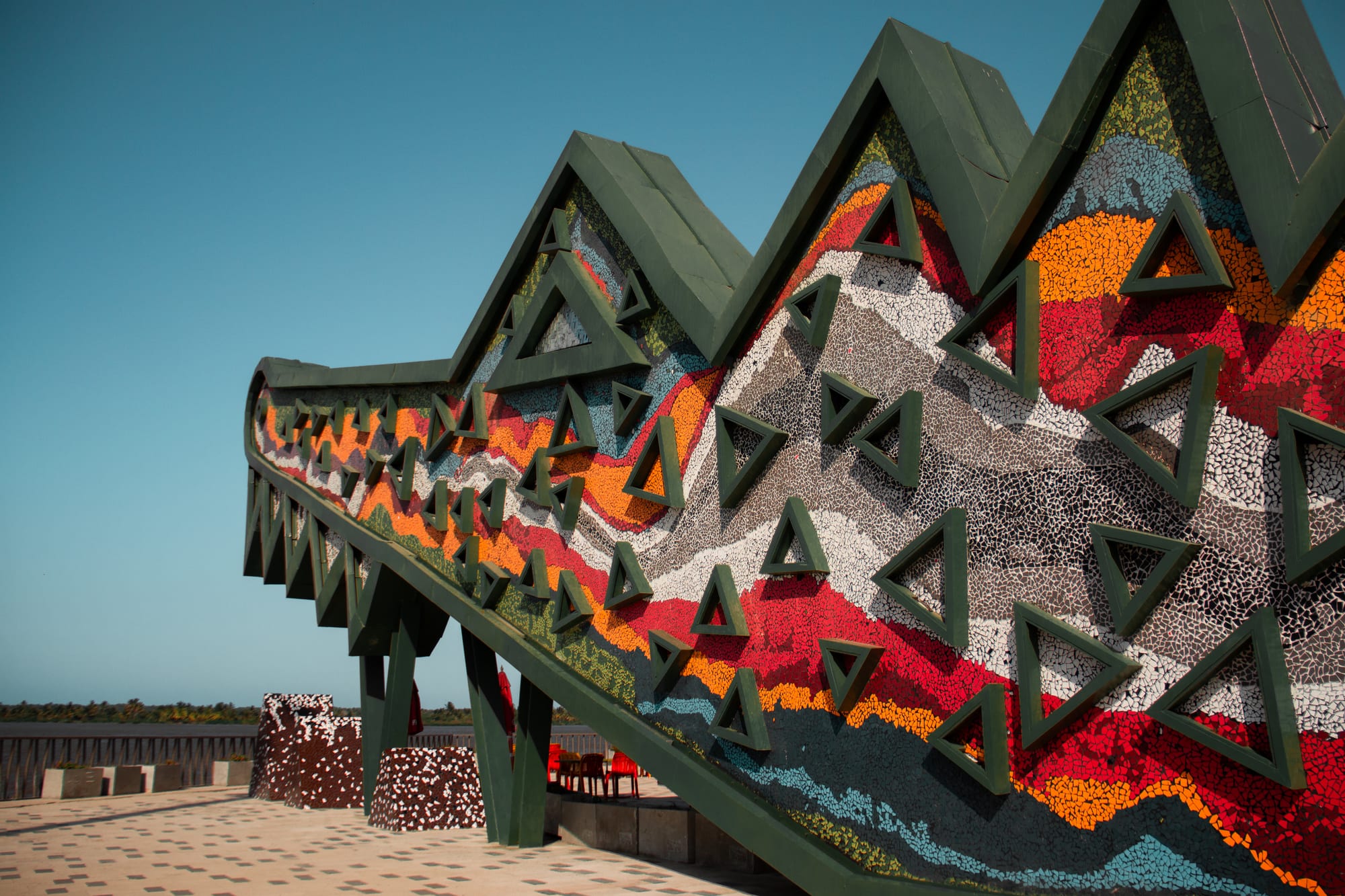
A huge crocodile-head structure covered in red, orange, white and green mosaic, rising over a paved riverside promenade

Cartagena & the Caribbean Coast, Colombia

Barranquilla

The Caimán del Río, a crocodile-shaped food hall on Barranquilla's Gran Malecón beside the Magdalena. (IAmJesusDavid / Wikimedia Commons · CC BY-SA 4.0)

Colombia's fourth-largest city and the biggest on the Caribbean coast, on the west bank of the Magdalena near its mouth. A river and sea port that grew with steamships, railways, aviation and waves of immigrants into the country's 'Golden Gate', it is an industrial city best known for its Carnival, recognised by UNESCO, and for the music and food of the coast.

Neighbourhoods

  • Centro Histórico
    • Historic district
    • Markets
    • Local life

    The old commercial heart near the river, a nationally protected area since 1999 that includes parts of San Roque and downtown. Government offices, the Paseo de Bolívar, the restored Antigua Aduana and busy street markets around San Roque church fill its streets; it is lively by day but not a place to wander at night.

    Open in Maps
  • El Prado
    • Architecture
    • Museums
    • Quiet and residential

    A traditional district along a central boulevard, with Republican-era mansions, the Spanish-style Hotel El Prado, the Museo Romántico and leafy squares such as Parque Santander and Parque de los Fundadores.

    Open in Maps
  • Alto Prado and El Country
    • Best for food
    • Nightlife
    • Upmarket stays

    Exclusive districts north of El Prado around Carrera 53 and Washington Park, where many of the city's best restaurants, bars and nightclubs are concentrated.

    Open in Maps
  • Riomar and the north
    • Modern hotels
    • Shopping
    • Business

    The north of the city, with many of its apartment towers and recent buildings such as the World Trade Center of Barranquilla; the Riomar locality also holds the Othman Ben Affan Mosque.

    Open in Maps

Things to do

Landmarks and architecture

  • Queen Mary Cathedrallandmark

    The Metropolitan Cathedral of María Reina in the centre, begun in 1955 and known for its stained-glass windows.

    Open in Maps
  • Ventana al Mundolandmark

    A monumental window-shaped sculpture on a roundabout in the north of the city, built in 2018 for the Central American and Caribbean Games, with milestones of the city's history on its bases.

    Open in Maps
  • Pumarejo Bridgelandmark

    The bridge over the Magdalena that has linked the city with the east of the country since December 2019, replacing a bridge of 1974 whose low clearance was criticised as an obstacle to river shipping.

    Open in Maps
  • Romelio Martínez Stadiumlandmark

    A stadium built in 1934 for the 1935 National Games, with an Art Deco grandstand, the city's main ground until 1986 and a national monument since 1995.

    Open in Maps

Museums and culture

  • Museo del Caribemuseum

    The museum of the Caribbean region in the Parque Cultural del Caribe, alongside a children's library and the Mediateca Macondo, devoted to the work of Gabriel García Márquez.

    Open in Maps
  • Museo Románticomuseum

    A Republican mansion in El Prado holding the city's history, from Carnival queens' costumes to the typewriter on which García Márquez wrote his first novel, Leaf Storm.

    Open in Maps
  • Museo del Carnavalmuseum

    The Carnival museum, opened in 2011 in the Casa del Carnaval, telling the story of the city's great festival.

    Open in Maps
  • Antigua Aduanalandmark

    The Republican-era former customs buildings, restored in the 1990s as a cultural complex housing the Biblioteca Piloto del Caribe and the historical archive of Atlántico.

    Open in Maps

The river and the coast

  • Gran Malecónpark

    The riverside promenade along the Magdalena, with plazas, monuments and the crocodile-shaped Caimán del Río food hall.

    Open in Maps
  • Bocas de Cenizaviewpoint

    The mouth of the Magdalena, named for the ash-coloured water where the river meets the sea, reached past Las Flores along the breakwater; theft and robbery at knifepoint have been known to occur there, and many residents advise visitors to avoid it.

    Open in Maps
  • Puerto Colombiaattraction

    The coastal town north-west of the city, once Colombia's main port and the landing place of many immigrants, known for its long pier and, since 2023, the tallest lighthouse in South America.

    Open in Maps

Sport and nights out

  • Estadio Metropolitano Roberto Meléndezattraction

    El Metro, the home of Junior and the stadium where Colombia's national team has played many World Cup qualifiers.

    Open in Maps
  • Barranquilla Zoopark

    A zoo with an emphasis on Colombian fauna and the protection of endangered species.

    Open in Maps

Seasonal events

  • Barranquilla Carnivalthe four days before Ash Wednesday, February or early March

    One of the biggest carnivals in the world, opening with the Battle of the Flowers on Saturday and followed by the Great Parade and an orchestra festival; UNESCO proclaimed it a Masterpiece of the Oral and Intangible Heritage of Humanity in 2003.

  • Día de Barranquilla7 April

    The city's day, marking the grant of the title of villa in 1813 — Barranquilla celebrates this rather than a founding date.

Eat and drink

Long-standing places and food districts in Barranquilla. Hours, ratings and directions come from your maps app, always current.

Barranquilla classics

  • Fritosrestaurant

    Fried snacks — arepas, empanadas and arepas de huevo — sold from street stalls and small shops across the city.

    Open in Maps
  • Bocachico and river fishrestaurant

    Fried bocachico from the Magdalena, served in the seafood restaurants by the river at Las Flores, near Bocas de Ceniza.

    Open in Maps

Food districts and markets

  • Carrera 53 and Washington Parkneighborhood

    The city's smartest dining area in Alto Prado and El Country, with fine restaurants, bars and nightclubs.

    Open in Maps
  • Centro market streetsmarket

    Stalls of fruit and vegetables along Carreras 43 and 44, street markets in the alleys north of San Roque church and fish markets along the canal on Calle 30.

    Open in Maps
  • Lebanese and Arab kitchensneighborhood

    Restaurants serving Lebanese food, a legacy of the Syrian and Lebanese immigrants who shaped the city's commerce.

    Open in Maps

Experience Barranquilla

History

The Spanish chronicler Gonzalo Fernández de Oviedo described the site in 1533 as a landing place for canoes carrying dried shrimp and salt to trade on the Magdalena, and the Kamash people lived in the area. A permanent settlement grew up around 1629 near the hacienda of San Nicolás de Tolentino, founded by Nicolás de Barros, but unlike Cartagena or Santa Marta Barranquilla was never formally founded by the Spanish. It dates its civic life instead from 7 April 1813, when the independent state of Cartagena granted it the title of villa.

The river made it. Steamships on the Magdalena, introduced in the 1820s, turned it into the exchange point between the interior and the world and a principal port for exporting coffee. The Bolívar Railway of 1869–71 was the first in Colombia; the country's first telephones were installed here in 1885; and the pier at Puerto Colombia, built in 1893, became one of the longest in the world. Immigrants arrived from Syria, Lebanon, Palestine, Germany, Italy, the United States, China and Japan, and a Jewish community settled, making it one of Colombia's most cosmopolitan cities. In 1919 SCADTA, the forerunner of Avianca, began commercial flights here, and the city's airport is regarded as the first in South America; works to open the river mouth at Bocas de Ceniza were completed in 1936, with a new maritime terminal.

Barranquilla was one of Colombia's fastest-growing cities until the 1970s, earning the nickname "Golden Gate of Colombia", then fell into economic decline from the 1960s to the early 1980s. It became a special industrial and port district in 1993, hosted the Central American and Caribbean Games in 2018 and opened a new bridge over the Magdalena in 2019.

Culture & Customs

The Carnival defines the city. Held over the four days before Ash Wednesday, it opens with the Battle of the Flowers and continues with the Great Parade and a festival of orchestras, drawing on traditions that date to the 19th century — costumes, folk dances, songs and parades. Colombia's Congress declared it a national cultural masterpiece, and in 2003 UNESCO proclaimed it a Masterpiece of the Oral and Intangible Heritage of Humanity. Its slogan sums up the local attitude: "Quien lo vive, es quien lo goza" — those who live it are those who enjoy it.

Music runs through the year. Cumbia and the other rhythms of the coast are part of everyday life, champeta, which grew up in Cartagena and Palenque, was later taken up by Barranquilla songwriters, and the city's orchestras and its Concert of the Month, held since 1957, keep classical music alive. Commercial radio in Colombia began in Barranquilla in 1929. A sculpture of Shakira was added to one of the city's public spaces in 2007, and Gabriel García Márquez, whose typewriter for his first novel is kept in the Museo Romántico, is remembered in its museums and libraries.

Immigration shaped the city's character: a synagogue and a mosque stand among its churches, and Arab and Jewish families have long been prominent in its commerce. Football is a passion — Junior, founded in 1924 and nicknamed the Sharks, plays at the Metropolitano, and the national team has played many World Cup qualifiers there — and baseball and boxing have been popular since the early 20th century.

Daily Life

The 2018 census counted about 1.2 million people in the city, making it Colombia's fourth-most populous, and more than 2 million live in the metropolitan area, which takes in Soledad, Malambo, Galapa and Puerto Colombia. Barranquilla is a major industrial centre: its factories produce vegetable oils, pharmaceuticals, chemicals, food and drink, building materials, clothing and metal parts, and its river and sea port, the third of the Caribbean coast region, ships coffee, cotton and petroleum alongside manufactured goods.

The city is known for its chaotic urban planning, a legacy of its spontaneous growth as a port. The centre is crowded, noisy and commercial — traffic there can exceed 90 decibels at peak hours — while the north, around El Prado, Alto Prado and Riomar, has the apartment towers and most of the smart restaurants. Air and water pollution from traffic, industry and sewage are recognised problems, and in the rainy seasons sudden street floods, the arroyos, can be deadly in poorly drained neighbourhoods.

Daily routines bend around the heat, with buses, taxis and TransMetro carrying people across the city. Weekends mean the beaches north-west along the Atlántico coast, and football at the Metropolitano.

Food

Barranquilla eats like the rest of the coast, with a few dishes of its own. Arroz con coco, rice cooked in coconut milk, comes with fried fish — often bocachico from the Magdalena — and patacones, flattened fried green plantain. Sancocho, a thick soup of meat or fish with root vegetables, is the weekend dish, and sancocho de guandul, made with pigeon peas and meat, is a local favourite. From neighbouring Soledad come butifarras soledeñas, small round sausages.

Fritos — fried snacks — are the everyday food of the street: arepas, empanadas, arepas de huevo with an egg sealed inside, and carimañolas of cassava stuffed with meat or cheese. Bollos, maize or cassava dough steamed in leaves, are sold everywhere. The seafood restaurants by the river at Las Flores, near Bocas de Ceniza, serve fish straight from the water, and the market streets of the centre sell fruit, vegetables and fish.

The city's immigrant history shows on its menus. Lebanese and other Arab restaurants are part of the local scene, and the smart restaurants around Carrera 53 and Washington Park range from Colombian to international cooking. Cold beer, rum and fresh fruit juices are the drinks of the heat.

Planning tools

Budget

Barranquilla is a business city rather than a resort and is much cheaper than Cartagena, with set-lunch places and street food at local prices. Budget hotels are found in the Centro Histórico. Carnival is the exception, when taxi fares can double.

Daily Budget Midrange
USD 90–180 (hotel in El Prado or the north, restaurant dinners, taxis or ride-hailing)
Daily Budget Shoestring
USD 35–60 (budget hotel or hostel, fritos and set lunches, buses)

Book months ahead for Carnival, and agree taxi fares before setting off, especially at night and on holidays, when surcharges apply.

Best Time to Visit

Carnival, in the four days before Ash Wednesday in February or early March, is the reason most visitors come. From late November to early April the trade winds make the heat more bearable during the day. The rains fall from April to June and from August to November, when sudden street floods can make some streets dangerous.

Suggested Number of Days

One or two days are enough for the city's museums, architecture and riverfront outside Carnival. Carnival itself needs at least four days, and the beaches and towns along the Atlántico coast add a day or two more.

First Visit
1–2 days
With Surroundings
3–4 days

Transportation

The city is spread out and most visitors use taxis or ride-hailing, which has operated since 2015. Taxi fares are set by zones rather than by meter, with surcharges at night, at weekends, during Carnival and for the airport. TransMetro, a bus-rapid-transit system of articulated buses in their own lanes, and many ordinary buses carry most residents; a prepaid card, sold at major stops and some supermarkets, is needed for many buses.

Avoid motorbike taxis, which are cheap but whose drivers are often reckless, and hold on tight on buses, which move off before passengers are seated.

Airport & Station Connections

Ernesto Cortissoz International Airport is in the neighbouring municipality of Soledad, about 12 km from the city centre, with domestic flights and international routes; it is a focus city for Avianca and the most important airport of northern Colombia for cargo. The long-distance bus terminal lies well outside the city centre: Cartagena is about two to two and a half hours away and Santa Marta roughly two.

Walkability

Barranquilla is not a walking city overall: districts are spread out, traffic is heavy and noisy, and the heat is intense. El Prado's boulevard and squares, the Gran Malecón and the Washington Park area are pleasant on foot, and the Centro Histórico is walkable by day.

Safety

Colombia is far safer for visitors than its reputation, and the main cities and tourist regions are well travelled, but crime requires attention. In Barranquilla the centre is not particularly safe at night, and theft and robbery at knifepoint have occurred around Bocas de Ceniza. During the rains, flash-flooding streets, the arroyos, are a real danger.

Use app taxis or ride-hailing after dark, avoid Bocas de Ceniza, as many residents advise, and never try to cross a flooded street during a storm. Check current official travel advice before travelling.

Climate

Hot all year, with an average temperature of about 28°C, daytime highs around 32–33°C and lows around 24°C. Trade winds cool the days a little from late November to early April; the rainy seasons run from April to June and from August to November, when downpours flood some streets.

Summer
the rainy seasons, April–June and August–November: around 32–33°C by day, humid, with heavy storms
Winter
late November–early April: drier and windier, still around 32°C by day and 24°C at night

Local Customs

Like other costeños, Barranquilleros see themselves as warmer, louder and more relaxed about time than people from the Andean interior, and Carnival is taken very seriously. A service charge of about 10 per cent is often added in better restaurants; taxi drivers are not usually tipped.

Ask before photographing people in residential streets, and keep phones and valuables out of sight in Carnival crowds.

Common Payment Methods

The currency is the Colombian peso (COP). Cards are widely taken in shopping centres, hotels and restaurants in the north, but markets, street food, buses and many taxis need cash. ATMs are common; use those inside banks and shopping centres.