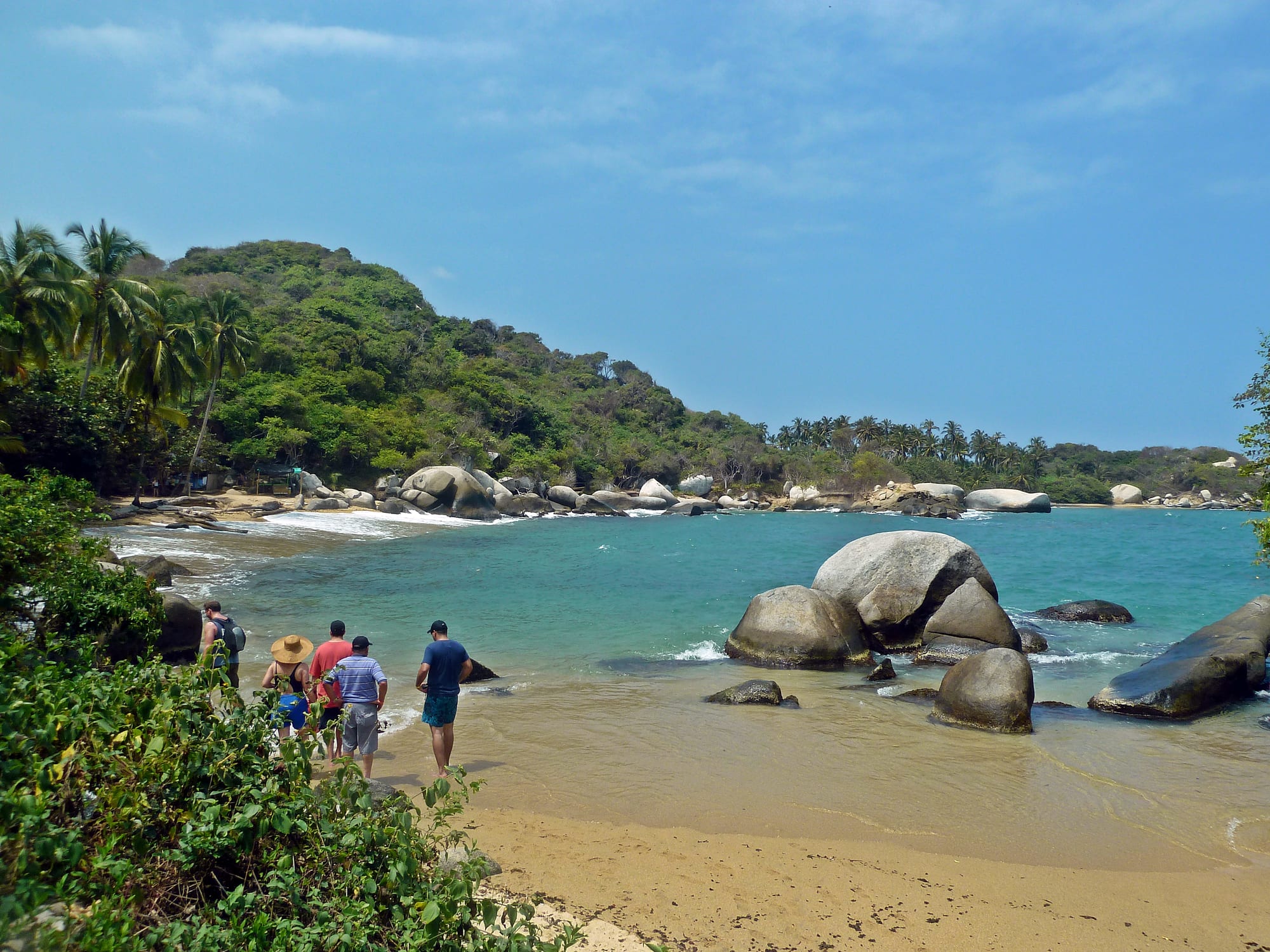
A sandy cove with large granite boulders in turquoise water, backed by palm trees and a forested hill

Colombia

Cartagena & the Caribbean Coast

La Piscina, a boulder-sheltered cove in Tayrona National Park on the coast east of Santa Marta. (David Shankbone / Wikimedia Commons · CC BY-SA 3.0)

Colombia's northern coastal lowlands, from the cattle savannas of Córdoba to the desert tip of La Guajira and out to the islands of San Andrés — the costeño country of walled Cartagena, the Sierra Nevada de Santa Marta, river towns on the Magdalena, vallenato and the world of García Márquez.

Explore Cartagena & the Caribbean Coast

History

The coast was home to many peoples before the Spanish: the Zenú of the Sinú and San Jorge river plains, who built vast systems of raised fields and canals, and the Tairona of the Sierra Nevada de Santa Marta, who laid out stone-terraced towns such as Ciudad Perdida, founded around the 9th century. Their descendants, the Kogi, Arhuaco, Wiwa and Kankuamo, still live in the mountains, and the Wayuu hold the Guajira peninsula.

Santa Marta, founded in 1525, is the oldest surviving Spanish city in Colombia, but Cartagena, founded by Pedro de Heredia in 1533, became the prize. Its harbour shipped the gold and silver of the continent to Spain and received enslaved Africans for much of South America, and it was ringed with walls and forts after pirate raids, including Francis Drake's in 1586. In 1741 the city withstood a large British siege under Admiral Vernon, defended by Blas de Lezo. Escaped slaves founded free communities in the hinterland, of which San Basilio de Palenque survives.

Cartagena declared independence in 1811 and paid for it with a Spanish siege in 1815. Simón Bolívar died at Santa Marta in 1830. The 20th century brought the banana boom around Ciénaga and the killing of striking plantation workers there in 1928, the rise of Barranquilla as a major port, and later the violence of guerrillas and, above all, right-wing paramilitaries, whose main blocs demobilised by 2006. Tourism, trade and a growing Barranquilla have defined the years since.

Culture & Customs

Costeños see themselves as a people apart from the Andean interior: warmer, louder, quicker of speech, more relaxed about time, and prouder of their African and Indigenous roots. The coastal accent drops its final "s" and runs its words together, and the heat shapes everything from dress to the hour of the siesta.

Music is the region's great export. Cumbia grew from African, Indigenous and Spanish elements along the Magdalena, vallenato — accordion, caja drum and guacharaca scraper — from the cattle country around Valledupar, whose Festival de la Leyenda Vallenata is held each spring, and champeta from Cartagena's Afro-Colombian neighbourhoods. The Barranquilla Carnival, with its costumed dances and marimondas, is recognised by UNESCO as intangible heritage, as is the culture of San Basilio de Palenque, where Palenquero, a Spanish-based creole, is still spoken. Gabriel García Márquez was born in Aracataca in 1927, and the region's river towns and banana country run through his novels.

Identities vary within the region. The Wayuu of La Guajira are organised in matrilineal clans and weave the bright mochila bags now sold across the country; the Arhuaco and Kogi wear white and regard the Sierra Nevada as the heart of the world. On San Andrés and Providencia the Raizal people speak an English-based creole, a legacy of British and Caribbean settlement. Colombia's sovereignty over the islands was contested by Nicaragua; a 2012 International Court of Justice ruling upheld Colombian sovereignty but redrew the maritime boundary in Nicaragua's favour.

Daily Life

Barranquilla, with about 1.2 million people, is the largest city and a working port and industrial centre at the mouth of the Magdalena. Cartagena has nearly 900,000, most of them far from the walled city in poorer neighbourhoods; Santa Marta has around half a million, and Valledupar, Montería, Sincelejo and Riohacha are the other departmental capitals.

The economy combines ports and petrochemicals at Cartagena, coal from the huge open-cast Cerrejón mine in La Guajira and from Cesar, cattle ranching across the savannas of Córdoba, Sucre and Cesar, bananas and palm oil around Santa Marta, and tourism. Inequality is stark: tourist Cartagena sits beside some of the country's poorest districts, and La Guajira suffers chronic water shortages and child malnutrition in Wayuu communities. The border with Venezuela brings heavy migration and informal trade.

Days begin early to beat the heat, slow in the afternoon and come alive after dark, when families sit out on plastic chairs on the pavement, music plays from shopfronts and street stalls fry arepas. Weekends mean the beach, a riverside sancocho or a picó — the huge painted sound systems that power street parties in Barranquilla and Cartagena.

Food

Coastal cooking leans on coconut, plantain, cassava and fish. Arroz con coco, rice cooked in coconut milk until it browns and caramelises, is served with fried mojarra (tilapia) and patacones, flattened fried green plantain. The arepa de huevo is a deep-fried maize arepa with an egg cooked inside, eaten as a street snack from Cartagena to Barranquilla, and carimañolas are fried cassava fritters stuffed with meat or cheese. Bollos — maize or cassava dough steamed in leaves — are sold on every corner.

Inland, the savannas of Córdoba and Sucre produce mote de queso, a thick soup of ñame (yam) with chunks of salty queso costeño, and suero costeño, a tangy soured cream eaten with almost everything. Barranquilla is known for butifarras soledeñas, small round sausages from Soledad, and La Guajira for friche, young goat boiled, then fried with its offal and blood. On San Andrés the signature dish is rondón, a stew of fish, snails, cassava and dumplings in coconut milk.

Sweets are a coastal passion: cocadas (coconut sweets), enyucado (cassava cake) and the tamarind and guava sweets sold from stalls in Cartagena's old city. Drinks run to fresh juices of lulo, corozo and mango, cold beer, and rum.

Attractions & Natural Wonders

Cartagena's walled city, a UNESCO World Heritage Site, holds the cathedral, the Palace of the Inquisition, the church of San Pedro Claver and street after street of balconied houses, with the Castillo de San Felipe de Barajas on its hill outside the walls and the monastery of La Popa above the city. Getsemaní, the old artisans' quarter, is now its liveliest district. Boats run south-west to the Rosario Islands, part of a national park of coral reefs, and to the beaches of Barú, and the Totumo mud volcano lies up the coast.

Santa Marta has its old centre and the Quinta de San Pedro Alejandrino, the estate where Bolívar died. East of the city, Tayrona National Park combines jungle trails with beaches at Arrecifes and Cabo San Juan, and the villages of Minca in the hills and Palomino on the coast are bases for the Sierra. The trek to Ciudad Perdida, known locally as Teyuna, takes four to six days through the Sierra Nevada to climb more than a thousand stone steps to the terraces.

Inland, Mompox, a UNESCO-listed colonial town on a branch of the Magdalena, is reached across the river plains, while Valledupar is the home of vallenato. In La Guajira, desert tours leave Riohacha for the salt flats of Manaure, the beaches and Pilón de Azúcar hill at Cabo de la Vela, and the dunes of Punta Gallinas, the northernmost point of mainland South America. Far offshore, San Andrés offers diving and Johnny Cay, and quieter Providencia its reefs and the Old Providence McBean Lagoon National Park.

Cities in Cartagena & the Caribbean Coast

Planning basics

Budget

The coast has Colombia's widest price range. Cartagena's walled city is the most expensive place to stay in the country, and boat trips to the islands, Tayrona entry fees and the guided Lost City trek are real costs; San Andrés adds a flight and an island tourist card. Barranquilla, Santa Marta, Mompox and the inland towns are much cheaper, and the getting-around in La Guajira is usually by shared 4x4 tour.

Daily Budget Midrange
USD 110–220 (boutique hotel, restaurant dinners, an island boat trip or guided tour)
Daily Budget Shoestring
USD 40–70 (hostel in Getsemaní or Santa Marta, set lunches, buses)

Stay in Getsemaní rather than inside the walls to cut Cartagena costs, and book the Lost City trek and Guajira tours through licensed operators.

Safety

Cartagena, Santa Marta and the main tourist routes are well travelled, but pickpocketing, phone snatching and overcharging are common in the busy districts, and drink-spiking is a known risk in nightlife areas. Armed groups linked to drug trafficking are active in parts of the rural interior, including southern Bolívar and Córdoba and remoter corners of the Sierra Nevada, and the Venezuelan border areas of La Guajira and Cesar have smuggling and crime. Heat, sun and strong sea currents are everyday hazards.

Use licensed guides for the Lost City and La Guajira, agree boat and taxi prices in advance, swim only where locals do, and keep to the main routes in the rural interior. Check current official travel advice before travelling.

Climate

Hot and humid all year on the coast, with the heat eased by the trade winds from December to March, the driest months. La Guajira is arid, with little rain at any time, while the Sierra Nevada rises from coastal heat through cloud forest to snow peaks above 5,000 metres. The rains fall mainly from about September to November, and the islands sit in the hurricane belt, though direct hits are rare.

Summer
the wetter half of the year, roughly May–November: 28–34°C, heavy afternoon downpours, very humid
Winter
December–March is dry and breezy, 26–32°C, and the peak season

Transportation

Cartagena, Barranquilla, Santa Marta and San Andrés have airports with direct flights from Bogotá and Medellín. Buses and shared vans link the coastal cities — Cartagena to Barranquilla is about two hours, Barranquilla to Santa Marta roughly two more — and continue along the coast road to Palomino and Riohacha. Mompox is a long road journey inland, the Rosario Islands are reached by boat from Cartagena, and the far north of La Guajira is 4x4 country without paved roads.

Fly to the coast from the interior; the overland buses from Bogotá or Medellín take the best part of a day.

Best Time to Visit

December to April brings dry weather and the busiest season, with Christmas, New Year and Easter packed in Cartagena and Santa Marta. Barranquilla's Carnival falls in the days before Lent, and Valledupar's vallenato festival in April. Tayrona closes for part of February and at other times each year at the request of the Indigenous peoples of the Sierra, so check the dates before planning.