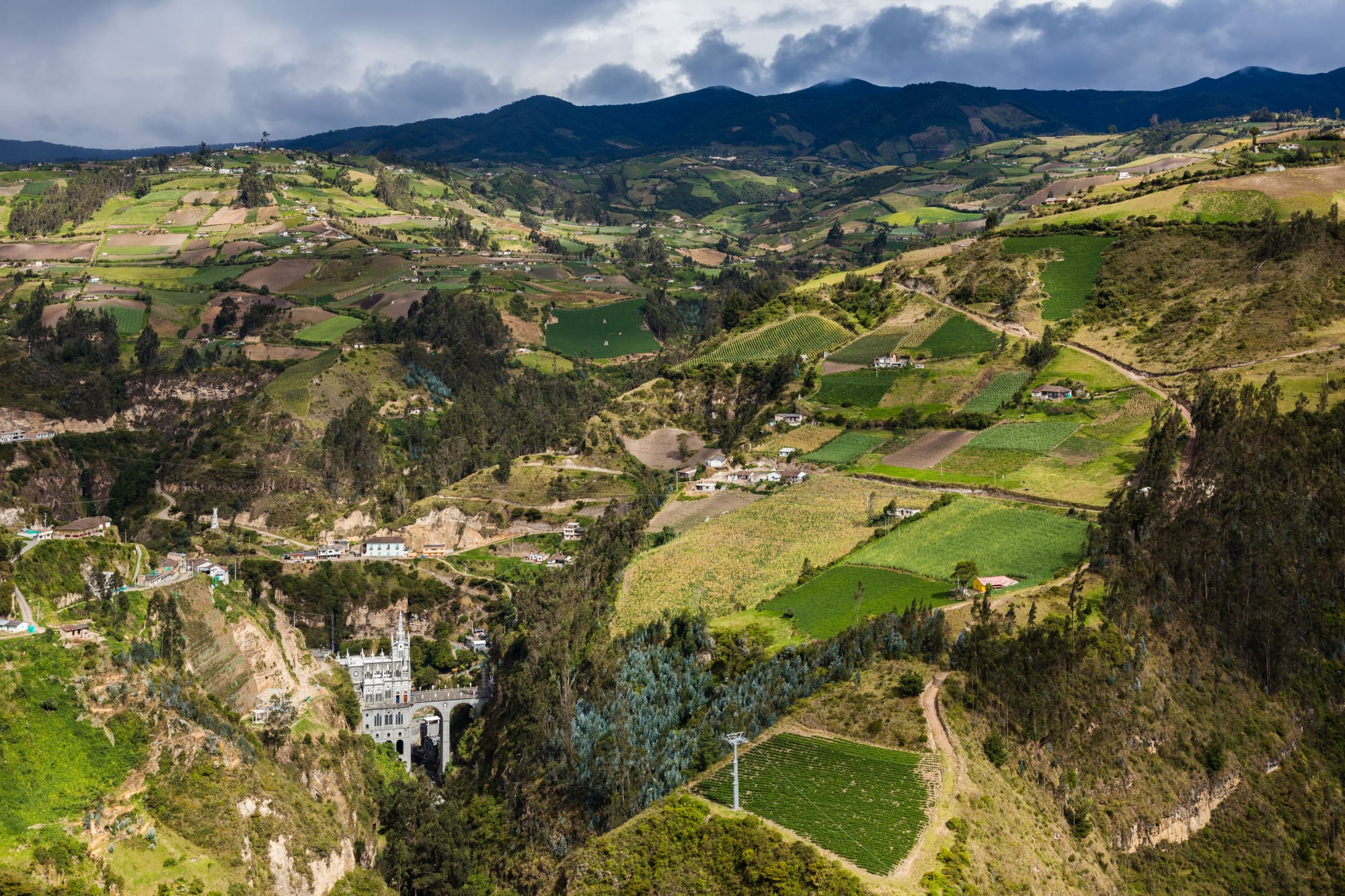
A grey Gothic church on a bridge in a green gorge, below a patchwork of fields and dark mountains

Colombia

Cali, the Pacific & the Southwest

The Las Lajas sanctuary in its gorge near Ipiales, in the highlands of Nariño. (Diego Delso / Wikimedia Commons · CC BY-SA 4.0)

Colombia's south-west, from the sugar-cane valley around Cali over the Andes of Cauca and Nariño to the Ecuadorian border, and west to the rain-soaked Pacific coast of Chocó — a region of salsa, colonial Popayán, Indigenous highlands and Afro-Colombian coastal culture, and one still marked by armed conflict in its rural areas.

Explore Cali, the Pacific & the Southwest

History

The south-west has deep pre-Columbian roots. The people of Tierradentro whose culture flourished from around 200 BC, dug and painted underground tombs in the hills of Cauca, and the Tumaco-La Tolita culture on the Pacific coast made fine gold and pottery. Sebastián de Belalcázar, advancing north from Quito, founded Cali in 1536 and Popayán in 1537. Popayán became the seat of a wealthy colonial province, whose aristocratic families grew rich from the gold of the Pacific lowlands, mined by enslaved Africans.

After abolition in 1851, the descendants of those workers stayed on the coast, which remains largely Afro-Colombian. Popayán gave the republic several presidents and much of its early elite, but the Cauca valley and Cali grew on sugar cane, and Buenaventura became the country's main Pacific port. In 1983 an earthquake on Holy Thursday wrecked Popayán's colonial centre, which was restored.

From the 1980s the Cali cartel built a vast cocaine business, dismantled in the mid-1990s. The FARC, the ELN and later paramilitaries fought across Cauca, Nariño and Chocó, and the region suffered some of the worst massacres and displacement of the conflict. After the 2016 peace accord, FARC dissident factions, the ELN and trafficking groups moved into areas the FARC left, and fighting continues in rural Cauca and along the Pacific coast. Indigenous and Afro-Colombian communities, organised through their own councils and guard movements, have been among the most affected, and many of their leaders have been killed.

Culture & Customs

Cali calls itself the world capital of salsa: its dancers are known for fast footwork, its dance schools train champions, and the Feria de Cali in late December fills the city with concerts and a parade of dancers. Cali also hosts the Petronio Álvarez festival of Pacific music, a major celebration of Afro-Colombian culture. The marimba music and traditional chants of the southern Pacific, shared with Ecuador, are recognised by UNESCO, and viche, a cane spirit made along the coast, is protected by Colombian law as part of the region's heritage.

Popayán is formal, Catholic and proud of its colonial heritage. Its Holy Week processions, dating back to the 16th century, are recognised by UNESCO as intangible heritage, and it was named a UNESCO City of Gastronomy in 2005. Pasto's Carnival of Blacks and Whites, held in the first week of January, also holds UNESCO recognition: on its best-known days revellers paint each other with black cosmetics and then white talc, before a parade of huge floats. The city's craftsmen also work barniz de Pasto, a decorative varnish made from the resin of the mopa-mopa tree.

Cauca and Nariño have large Indigenous populations, among them the Nasa, the Misak of Silvia in their distinctive blue dress, and the Pasto people of the south. In Chocó, most people are Afro-Colombian and there are Emberá and Wounaan communities in the rainforest.

Daily Life

Cali has about 2.2 million people and is the capital of Valle del Cauca, one of Colombia's most productive departments. Pasto and Popayán each have several hundred thousand people, Buenaventura and Tumaco are the main Pacific ports, and Quibdó, the capital of Chocó, has around 130,000.

The Cauca valley is covered in sugar cane, processed into sugar and ethanol, and Cali has industry, services and trade. Buenaventura handles much of the country's foreign trade. Chocó, rich in forest and gold, has some of the country's highest poverty rates. In Cauca and Nariño, smallholders grow coffee, potatoes and other crops, and coca is widespread in the remote lowlands. The 2021 national strike, which turned violent, was especially intense in Cali, and road blockades remain a common form of protest in the region.

Cali runs late: people dance on weeknights as well as weekends, and the heat pushes the city's life outdoors. Popayán and Pasto are quieter, with an early Andean rhythm, while on the coast life follows the tides and the boats.

Food

Cali's street food is a cornerstone of the city's identity: pandebono, cheese bread made with cassava starch, eaten warm; aborrajados, fried ripe plantain stuffed with cheese; and chontaduro, the orange fruit of the peach palm, boiled and sold with salt or honey. Drinks include lulada, made from crushed lulo fruit, and champús, a drink of maize, pineapple, lulo and spices. Cholado, shaved ice with fruit, condensed milk and syrups, is the afternoon treat.

Popayán's cooking uses pipián, a peanut and potato stew, which fills empanadas de pipián, small fried pastries served with peanut sauce, and tamales de pipián. Pasto's signature dish is cuy, roasted guinea pig, served with potatoes, and in the cold evenings people drink hervido, a hot fruit drink often laced with aguardiente.

The Pacific coast cooks with coconut, fish and shellfish: encocado is seafood in coconut sauce, and tapao is fish stewed with green plantain. Viche, the local sugar-cane spirit, is the base of many infusions and remedies.

Attractions & Natural Wonders

Cali's attractions are its dance halls and salsa schools, the colonial church of La Merced, the San Antonio district and the Cristo Rey statue above the city. North of Cali, the Hacienda El Paraíso is the setting of Jorge Isaacs's 19th-century novel María, and the Basilica of the Lord of Miracles in Buga draws pilgrims.

Popayán's white colonial centre has churches, museums and the old Humilladero bridge. Puracé National Park, with its volcano and hot springs, lies to the east, and further north-east across the mountains is Tierradentro, whose painted underground tombs, cut into the hillsides around San Andrés de Pisimbalá, are a UNESCO World Heritage Site. It is the neighbour of the San Agustín statues across the border in Huila.

Nariño's centre is Pasto, beneath the Galeras volcano, with the Laguna de la Cocha, a large high-altitude lake, to its east. Further south, the Las Lajas Sanctuary, a neo-Gothic basilica built into the Guáitara canyon and linked to its far side by a bridge, is near Ipiales and the Ecuadorian border.

The Pacific coast of Chocó is rainforest meeting the sea. Around Nuquí and Bahía Solano, humpback whales arrive to breed, the Utría National Park protects a jungle-lined inlet, and there are waterfalls, hot springs and surf. Offshore, Gorgona island, a former prison, is a national park, and Malpelo island, far out at sea, is a UNESCO-listed marine sanctuary known for its hammerhead sharks.

Cities in Cali, the Pacific & the Southwest

Planning basics

Budget

Cali, Popayán and Pasto are cheap by Colombian standards, with low hotel prices and filling set lunches. The Pacific coast is the exception: Nuquí and Bahía Solano can only practically be reached by air, and the eco-lodges there sell packages with meals and boat trips that cost far more than city travel.

Daily Budget Midrange
USD 80–160 in the cities; Pacific lodge packages with flights, meals and whale trips cost considerably more
Daily Budget Shoestring
USD 30–55 (hostel, set lunches, buses) in the Andean cities

Book Pacific lodges as a package including boat transfers and meals, and pay for whale-watching through the lodge.

Safety

This is one of the parts of Colombia most affected by armed groups. FARC dissident factions, the ELN and drug-trafficking organisations fight over coca-growing and smuggling routes in rural Cauca, Nariño and Chocó, and Buenaventura and Tumaco have high levels of gang violence. Cali has street robbery and drink-spiking. Popayán, Pasto, Ipiales and the main road are visited without trouble by most travellers, and the Nuquí and Bahía Solano lodges receive visitors mainly by air.

Avoid rural Cauca and the Pacific coast outside the organised whale-watching towns, do not travel by road at night, and check current conditions before visiting Tierradentro. Check current official travel advice before travelling.

Climate

Cali, in the Cauca valley at about 1,000 metres, is hot, with warm evenings cooled by a breeze from the Pacific. Popayán, at around 1,750 metres, is mild, and Pasto, above 2,500 metres, is cool and often overcast. The Chocó coast is one of the rainiest places on Earth, hot and humid with rain in every month.

Summer
the drier spells of December–February and June–August bring hot sunny days of 28–32°C in Cali and 18–22°C in Pasto
Winter
the wetter months bring afternoon storms in the valley and almost daily heavy rain on the Pacific coast

Transportation

Cali's airport is the main hub, with Pasto, Popayán, Quibdó and the Pacific towns served by smaller airports; Nuquí and Bahía Solano are usually reached by small plane, with boats between villages. Buses link Cali to Popayán in about three hours and to Pasto in around nine, on the Pan-American Highway, which is sometimes blocked by protests or landslides. Tierradentro is a slow bus ride over unpaved mountain roads.

Check the state of the Pan-American Highway before travelling south of Popayán, and travel by day.

Best Time to Visit

The season when humpback whales visit the Pacific coast to breed is the best time for Nuquí and Bahía Solano. Cali's salsa fair runs in late December, Pasto's Carnival of Blacks and Whites in the first week of January, and Popayán's Holy Week processions at Easter. The Petronio Álvarez festival of Pacific music is held in Cali in August.