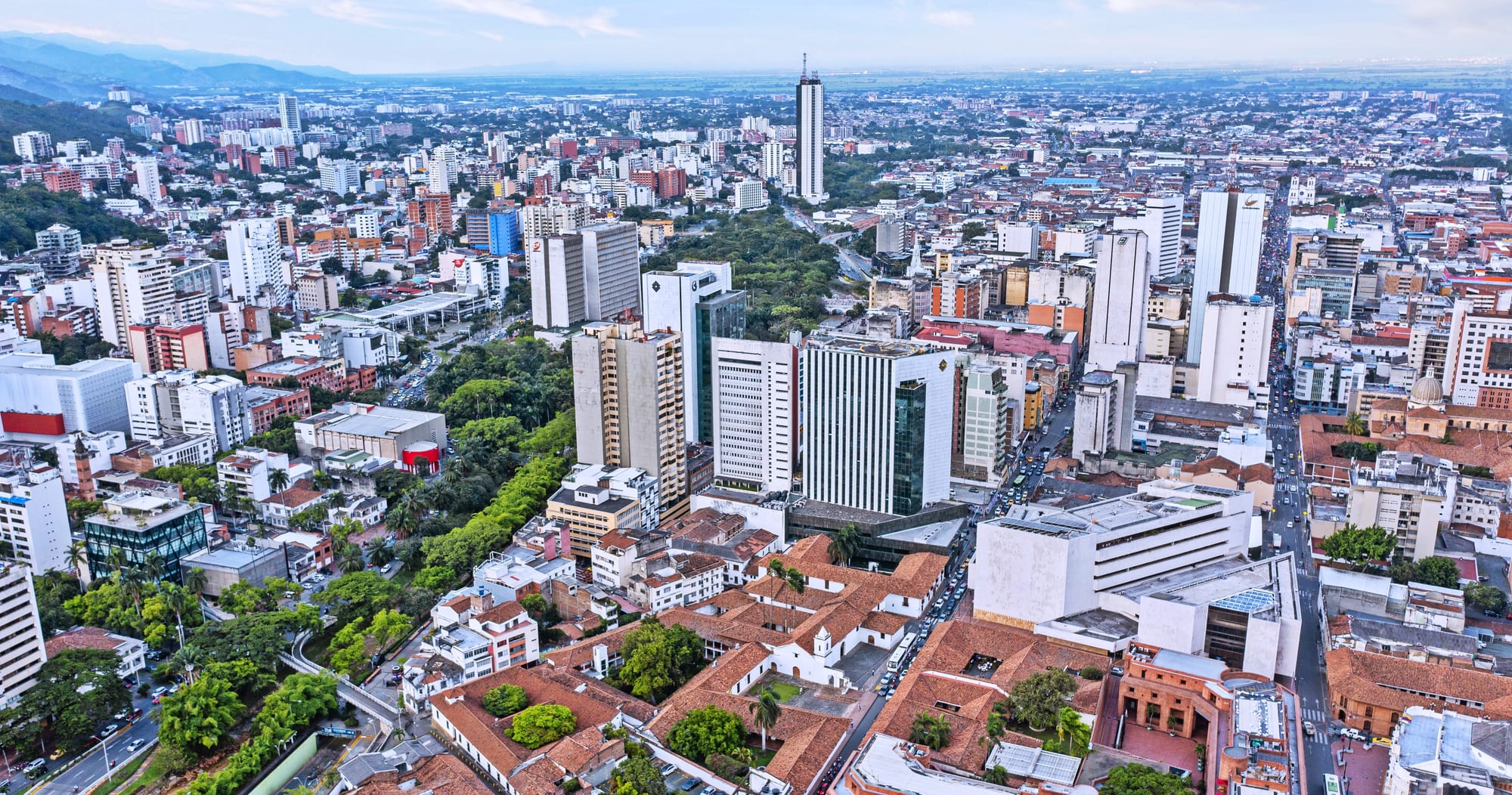
Aerial view of central Cali, with tiled colonial roofs in front, white tower blocks behind and green hills on the left

Cali, the Pacific & the Southwest, Colombia

Cali

The centre of Cali, with the Cali River's tree-lined banks running between the old quarter and the towers. (Johannes Bud / Wikimedia Commons · CC BY-SA 4.0)

The capital of Valle del Cauca and Colombia's third most populous city, spread across the hot Cauca valley beneath the Farallones de Cali. Founded in 1536 and grown rich on sugar cane and industry, it calls itself the world capital of salsa. In August 2026 it was among the cities worst hit by a major earthquake.

Neighbourhoods

  • Historic centre
    • First-time visitors
    • Historic district
    • Museums

    The old core around the Plaza de Caycedo, the city's main square, with the cathedral, the Palacio Nacional, colonial churches such as La Merced and San Francisco, and the Calima Gold Museum. Busy and commercial by day, much quieter at night.

    Open in Maps
  • San Antonio
    • Historic district
    • Cafés
    • Backpackers

    Cali's most traditional neighbourhood, on a hill just west of the centre, with low colonial-style houses, the hilltop Iglesia de San Antonio and a park looking over the city. Its streets hold hostels, cafés and small restaurants, and it is the usual base for independent travellers.

    Open in Maps
  • Granada and Avenida Sexta
    • Best for food
    • Nightlife

    North of the river, the Granada district has many of the city's better restaurants and hotels on quiet streets, while nearby Avenida Sexta has bars and salsa clubs. The Cali River, lined with trees and the La Tertulia museum, runs close by.

    Open in Maps
  • San Fernando
    • Best for food
    • Bars
    • Local life

    A residential district best known for the Parque del Perro, a small square named after a local dog and ringed by restaurants and bars that fill in the evenings.

    Open in Maps
  • Juanchito
    • Salsa
    • Nightlife

    Across the Cauca River on the city's eastern edge, and technically in another municipality, Juanchito is lined with large salsa clubs. It lies beside some of the poorest parts of the area.

    Open in Maps
  • The south and Ciudad Jardín
    • Quiet and residential
    • Shopping

    The newer, greener south of the city, with residential districts such as Ciudad Jardín, universities, shopping centres and the restaurants of Avenida San Joaquín. The Pance River, a weekend escape for caleños, starts further south.

    Open in Maps

Things to do

Landmarks and viewpoints

  • Cristo Reyviewpoint

    A 26-metre statue of Christ on the Cerro de los Cristales west of the city, inaugurated in 1953, with the widest view over Cali and the valley.

    Open in Maps
  • Cerro de las Tres Crucestrail

    A hill in the north-west of the city topped by three large crosses, a popular early-morning hike and a place of pilgrimage during Holy Week.

    Open in Maps
  • Plaza de Caycedolandmark

    The main square of the city, named after the independence hero Joaquín de Caicedo y Cuero and surrounded by the cathedral, the Palacio Nacional and the Otero building.

    Open in Maps
  • El Gato del Ríolandmark

    Hernando Tejada's cat sculpture beside the Cali River, inaugurated in 1996 and now a famous landmark of the city.

    Open in Maps
  • Cali Towerlandmark

    The 45-storey tower inaugurated in 1982, the city's tallest building, holding offices and a hotel.

    Open in Maps
  • San Antonio church and parkviewpoint

    A colonial-style church on the top of the San Antonio hill, beside a park with views over the centre.

    Open in Maps

Museums

  • La Tertulia Museummuseum

    The city's museum of modern art, on the banks of the Cali River, with international exhibitions and an art-house cinema.

    Open in Maps
  • Calima Gold Museummuseum

    A one-room museum of the Bank of the Republic in the historic centre, with some 600 pre-Hispanic objects of gold, pottery and stone from the Llama, Yotoco and Sonso societies of the region.

    Open in Maps
  • Museo Arqueológico La Mercedmuseum

    An archaeological and religious art museum in the colonial La Merced complex, beside the church built where the city's first mass was said in 1537.

    Open in Maps

Parks and the river

  • Cali Zoopark

    The city zoo, with animals from Colombia and from around the world.

    Open in Maps
  • Pance Riverpark

    A river descending from the mountains in the far south of the city, whose banks are a popular place for recreation at weekends.

    Open in Maps

Salsa, sport and nights out

  • Juanchito salsa clubsneighborhood

    The large salsa clubs across the Cauca River, the traditional place to see caleños dance late into the night.

    Open in Maps
  • Avenida Sexta and Menganeighborhood

    The northern nightlife strips, where many of the city's salsotecas and dance clubs are found.

    Open in Maps
  • Estadio Olímpico Pascual Guerreroattraction

    The city's football stadium, home of América de Cali; it was damaged in the earthquake of August 2026.

    Open in Maps

Short trips from the city

  • Farallones de Calipark

    The mountains of the Western Cordillera that rise west of the city, protected as a national park.

    Open in Maps
  • Buga and the Lord of the Miracleslandmark

    In the town of Buga to the north, the basilica of the Lord of the Miracles holds an image of Christ that draws more than three million pilgrims a year.

    Open in Maps

Seasonal events

  • Feria de Cali25–30 December

    The city's great festival since 1957, first held the year after the 1956 explosion, with the Salsódromo parade of dancers, horse parades, concerts and parties.

  • Petronio Álvarez festivalAugust

    A festival of the music of Colombia's Pacific coast, highlighting composers and groups of Afro-Colombian music.

  • Summer salsa festivalearly July

    A week of salsa concerts, dance shows and contests in which record collectors compete to play the rarest tracks.

Eat and drink

Long-standing places and food districts in Cali. Hours, ratings and directions come from your maps app, always current.

Cali classics

  • Pandebono bakeriescafe

    Bakeries all over the city sell pandebono, warm cheese bread rings made with cassava starch, a classic breakfast.

    Open in Maps
  • Cholado in Jamundíneighborhood

    The town just south of Cali is famous for its cholado stands — shaved ice piled with chopped fruit, syrups and condensed milk.

    Open in Maps

Food districts

  • San Antonioneighborhood

    Small cafés and restaurants in old houses on the hill, with marranitas, champús and other Valle del Cauca staples alongside international food.

    Open in Maps
  • Granadaneighborhood

    The north-side district with a wide choice of sit-down restaurants, from Pacific seafood to international cooking.

    Open in Maps
  • Parque del Perroneighborhood

    The square in San Fernando ringed by restaurants and bars, busy with locals in the evenings.

    Open in Maps

Experience Cali

History

Sebastián de Belalcázar, who had broken away from Pizarro's conquest of Peru, founded Santiago de Cali on 25 July 1536, a few kilometres north of its present site; a year later it was moved to the banks of the Cali River, where the first mass was said on the site of today's La Merced church. Belalcázar moved the provincial capital to Popayán in 1540, and Cali remained a small town: in 1793 it had about 6,500 people, about 1,100 of them enslaved Africans. On 3 July 1810 its leaders refused to recognise the Spanish regency, seventeen days before Bogotá, and the towns of the valley joined the independence war.

The city changed in the 20th century. The railway to the port of Buenaventura and the creation of the Valle del Cauca department, with Cali as its capital, made it a trading hub, and from the 1930s factories and foreign companies arrived. On 7 August 1956 army lorries loaded with dynamite exploded near the railway station, destroying eight blocks and killing more than 1,000 people; the Feria de Cali was first held the next year. The 1971 Pan American Games crowned a period of civic pride.

From the 1980s the Cali Cartel ran one of the world's largest cocaine businesses from the city, at its height in the mid-1990s. Cali was a centre of the 2021 national protests, when the MIO bus network was badly damaged and several people died in clashes. On 10 August 2026 a magnitude 7.4 earthquake centred in Chocó killed 153 people in Cali and damaged buildings and hospitals across the city.

Culture & Customs

Cali calls itself the Capital Mundial de la Salsa, the world capital of salsa, and the music is everywhere: in record collections, taxis and the salsotecas where people dance on any night of the week. Competition-level dancers give lessons, and the monthly Delirio show presents salsa as a large stage spectacle. The Feria de Cali, held every year from 25 to 30 December, opens with a horseback parade and the Salsódromo, a parade of salsa musicians and dancers, and continues with concerts and dance parties.

The city is also a centre of Afro-Colombian culture: the Petronio Álvarez festival every August brings the marimba, drums and songs of the Pacific to the city. Indigenous people from Cauca are present too: in 2021 Misak protesters pulled down the statue of the city's founder that stood on a hill above the city.

Cali is proud of being Colombia's sports capital, the first Colombian city to host the Pan American Games, and its two big football clubs, América de Cali and Deportivo Cali, divide the city. Its nicknames include La Sucursal del Cielo, the branch office of heaven.

Daily Life

Cali had an estimated 2.3 million residents in 2026, making it Colombia's third most populous city, and its metropolitan area takes in the industrial town of Yumbo to the north and Jamundí to the south. The economy rests on industry, trade and services, with sugar cane still covering the valley; companies such as the confectioner Colombina and the pharmacy chain Drogas La Rebaja are based here, and the port of Buenaventura links the city to the Pacific.

The city is sharply divided between comfortable districts in the north and south, with green streets, shopping centres and universities, and hillside districts such as Siloé, served by the MIO Cable; violent crime is concentrated in a small number of streets. Commutes by public transport are long, averaging well over an hour a day. Life runs on the heat: early mornings, a long lunch, and evenings outdoors in parks, on the river walk and in the dance halls.

The August 2026 earthquake hit Cali hard: rescuers worked at dozens of collapsed buildings, the University Hospital of Valle was badly damaged, curfews were imposed and soldiers were sent to keep order. Recovery and rebuilding shape daily life in parts of the city.

Food

Cali's food is that of the Valle del Cauca, rich in cheese, plantain and tropical fruit. Pandebono, a ring or ball of cheese bread made with cassava starch, is eaten warm, often at breakfast with hot chocolate. Aborrajados are fried sweet plantains filled with cheese; marranitas are balls of green plantain filled with chicharrón, fried pork skin; and chontaduro, the fruit of the peach palm, is sold on the street with salt or honey.

Drinks are a big part of the city's food culture. Lulada, a drink that originated in Cali, is made from lulo and has the texture of a smoothie; champús is a thick drink of maize, pineapple, lulo and other ingredients; and cholado, shaved ice piled with fruit, syrups and condensed milk, is the afternoon treat, especially in the nearby town of Jamundí. Fresh fruit juices are sold everywhere.

Seafood dishes of the Pacific coast also appear on the city's menus. The San Antonio hill, the Granada district and the bars around San Fernando's Parque del Perro are the main areas for eating out.

Planning tools

Budget

Cali is inexpensive by Colombian standards: set lunches, street food, buses and taxis cost little, and hostels and guesthouses are plentiful in San Antonio. Prices rise for the Feria in late December, when rooms fill up and the big concerts and shows charge entry.

Daily Budget Midrange
USD 80–160 (hotel in Granada or San Antonio, sit-down dinners, app taxis, a salsa class)
Daily Budget Shoestring
USD 30–55 (hostel bed, set lunches, street snacks, MIO buses)

Many of the best things — the San Antonio streets, the river walk and the Calima Gold Museum — cost little or nothing.

Best Time to Visit

Cali is warm all year. The drier months, broadly December to February and June to August, are the most comfortable; the main rainy seasons run from March to May and October to November, though rain can fall at any time. The Feria in late December is the busiest and most expensive time, and the most lively.

Suggested Number of Days

Two or three days are enough for the city itself and a few evenings of salsa. Allow four to six to add a dance course, the mountains above the city or the towns of the Cauca valley.

First Visit
2–3 days
With Surroundings
4–6 days

Transportation

The MIO bus rapid transit system, opened in 2009, runs articulated buses on dedicated lanes along the main roads, and its MIO Cable line climbs to the hillside district of Siloé. Ordinary buses fill the gaps, and taxis and ride-hailing apps are widely used, above all at night. The central bus terminal has coaches across the country.

Use app taxis or ones called by a hotel or restaurant after dark, especially for trips to and from the salsa clubs.

Airport & Station Connections

Alfonso Bonilla Aragón International Airport lies in Palmira, in the Cauca valley north-east of the city, and is reached by taxi or minibus along the highway. It has flights across Colombia and to other countries. Buses link Cali to Popayán in about three hours and to Pasto in around nine.

Walkability

The historic centre, San Antonio and the river walk to Granada are compact and pleasant on foot by day, though the heat makes midday walking tiring. The city is long and spread out, so most trips between districts are by taxi or MIO. Some central streets empty out after dark and are best crossed by taxi.

Safety

Colombia is far safer for visitors than its reputation, and the main cities and tourist regions are well travelled, but crime requires attention. Cali had a murder rate of about 26 per 100,000 people in 2025, though homicides are concentrated in a small share of the city's streets. For visitors the main risks are street robbery and phone theft. The August 2026 earthquake damaged buildings across the city.

Keep phones out of sight in the street, use app taxis at night, never accept drinks from strangers, and check the state of damaged areas after the 2026 earthquake. Check current official travel advice before travelling.

Climate

A hot tropical climate at about 1,000 metres, with little change through the year. The average temperature is around 24°C, with typical highs near 30°C and lows near 17°C. Cali lies in the rain shadow of the Western Cordillera, so it is much drier than the Pacific coast, with two rainy seasons.

Summer
the drier seasons, which locals call summer, can bring days of 30–34°C and nights of 15–17°C
Winter
the rainy seasons, which locals call winter, bring days of 28–30°C, nights of 18–20°C and afternoon showers

Local Customs

Caleños are informal and sociable, and dancing is part of social life: salsa is heard in homes, taxis and clubs at all hours. Light, casual clothing suits the heat, with more modest dress for churches. Check restaurant bills for a voluntary service charge before tipping.

Ask before photographing people, and in poor hillside districts do not photograph homes or residents without permission.

Common Payment Methods

The currency is the Colombian peso (COP), with prices running into thousands. Cards are accepted in hotels, malls and most restaurants; cash is needed for street food, small shops and buses. Use ATMs inside banks or shopping centres by day.