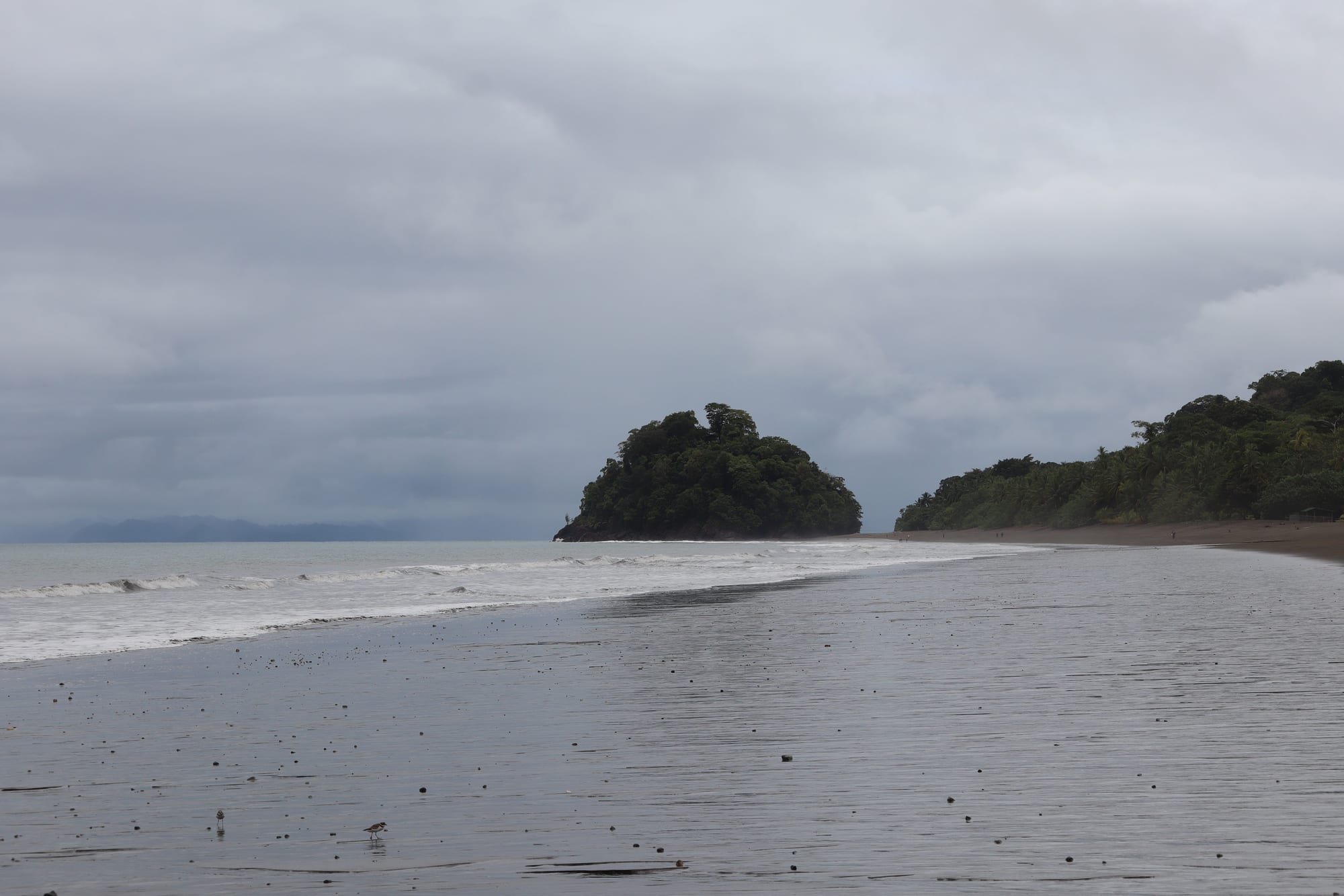
A wide, wet grey-sand beach under heavy cloud, with a forested islet offshore and jungle-covered headland behind

Cali, the Pacific & the Southwest, Colombia

Nuquí

The Pacific shore at Nuquí, on Colombia's Chocó coast. (Diferoch / Wikimedia Commons · CC BY-SA 4.0)

A small Afro-Colombian town on the Gulf of Tribugá, on Chocó's Pacific coast, where rainforest-covered hills meet the beaches. Settled in the early 20th century by traders in forest products, it lives from fishing, farming and community tourism, and is best known for the humpback whales that come to the gulf and nearby Utría to give birth.

Neighbourhoods

  • Nuquí town
    • Local life
    • Close to the airport

    The municipal centre, home to about 3,000 people, with the airport, the hospital, the school, shops and the boat landing. It is a working Afro-Colombian town rather than a resort, and the starting point for boats to the lodges and villages along the gulf.

    Open in Maps
  • Guachalito and the southern beaches
    • Beaches
    • Lodges
    • Surf

    South of the town, reached by boat, a string of beaches backed by rainforest, among them Guachalito and Terquito, where most of the eco-lodges stand. Turtles nest on Guachalito's sand from August to November, and the surf breaks of the area are nearby.

    Open in Maps
  • Termales, Coquí and Joví
    • Community tourism
    • Rivers and mangroves

    Small coastal villages of the municipality, each linked to an experience: the hot springs of Termales, the mangroves of Coquí explored by canoe, and the river of Joví with its guided canoe trips upstream.

    Open in Maps

Things to do

Whales and the sea

  • Gulf of Tribugáattraction

    The bay around the town, a breeding ground for humpback whales and a dive area with a rocky sea bed, small corals and large schools of fish, declared a Mission Blue 'Hope Spot'.

    Open in Maps
  • Guachalito beachbeach

    A beach south of the town, backed by forest, where loggerhead and hawksbill turtles nest from August to November.

    Open in Maps
  • Surf beachesbeach

    Breaks such as Terquito and the Río Termales mouth draw surfers to the coast south of the town.

    Open in Maps

Rivers, mangroves and hot springs

  • Termales hot springsattraction

    Thermal pools close to the beach at the village of Termales, one of the area's best-known excursions.

    Open in Maps
  • Coquí mangrovespark

    Mangrove channels near the village of Coquí, explored by canoe with local guides.

    Open in Maps
  • Joví rivertrail

    A forest river near the village of Joví, explored on guided canoe trips.

    Open in Maps

Short trips from the town

  • Utría National Natural Parkpark

    A national park created in 1987 north of the gulf, protecting rainforest, coral reefs and the Utría cove, where humpback whales give birth from August to October; the park has trails, beaches and a visitor centre.

    Open in Maps

Eat and drink

Long-standing places and food districts in Nuquí. Hours, ratings and directions come from your maps app, always current.

Pacific cooking

  • Fish and coconut kitchensrestaurant

    The town's small restaurants and the lodges serve the fish of the gulf fried or cooked in coconut milk, with plantain and rice.

    Open in Maps
  • Fruit and village producemarket

    Coconut, plantain, borojó and other fruit grown in the villages around the gulf, sold in the town's shops and by local growers.

    Open in Maps

Experience Nuquí

History

Emberá communities live along the rivers that run into the Gulf of Tribugá, and most people on the coast are Afro-Colombian, descendants of enslaved Africans brought to the Chocó under Spanish rule; slavery in Colombia was abolished in 1851. Nuquí itself is young. Early in the 20th century a trader from Baudó, Juanico Castro, came with Indigenous workers in search of tagua, raicilla and rubber to sell in Panama, and the first settler families came from Buenaventura.

The village began as a dependency of El Valle, to the north. When the husband of a woman from Nuquí was named mayor of El Valle, he agreed to take the post only if the municipal seat moved to his wife's home town; the move was made in 1915, and Nuquí was formally created as a municipality by a national decree in 1917.

In recent decades the gulf has become a focus of debate over development. Plans for a deep-water port at the village of Tribugá, with a railway to Quibdó, would give inland Colombia a shorter route to the Pacific; scientists and residents have raised concerns over the port, and the gulf has been declared a 'Hope Spot' for ocean conservation.

Culture & Customs

Most people in the municipality are Afro-Colombian, and the rest belong largely to Emberá communities living along the Valle, Nuquí, Jurubidá and Panguí rivers. Both groups are strongly oriented towards conservation of the environment.

Tourism here is meant to be community-based: local people run boats, guide canoe trips through the mangroves and up the rivers, cook in the lodges and lead visitors to the hot springs, and community divers have taken part in removing abandoned fishing nets and monitoring the reefs. Visitors are guests in working villages, not in a resort.

The town is also known beyond the coast through music: members of ChocQuib Town, the hip hop and urban music group from Chocó, have their roots here, and their song 'Nuquí (Te Quiero Para Mí)' was filmed in and around the town and its beaches. Viche, the cane spirit made along the Pacific coast, is the base of many local drinks and remedies.

Daily Life

The municipality has about 8,100 inhabitants, of whom about 3,100 live in the town of Nuquí itself, and the rest in villages such as Arusí, Coquí, Joví, Jurubidá, Panguí, Termales and Tribugá. The town has the area's airport, hospital, secondary school and shops.

Most families live from small-scale fishing, from farming plantain, rice, cacao, maize, coconut, borojó, cassava and other crops, from small-scale livestock raising, and from ecotourism and community-based tourism. Chocó has some of the highest poverty rates in Colombia and one of the lowest standards of living of any department.

On the coast, life follows the tides and the boats, which link the villages with the town. During the whale season, from June to November, the lodges fill and much of the local economy turns to visitors, while the debate over the planned port at Tribugá, and what it would mean for fishing and tourism, concerns many families.

Food

Nuquí's food is that of the Chocó coast: fish and shellfish from the gulf, plantain, rice and coconut. Encocado is fish or seafood cooked in coconut sauce, and tapao is fish stewed with green plantain. Ark clams are an important food for the coastal communities, and fish is often simply fried and served with plantain and rice.

The forest and the farms supply fruit. Chontaduro, the fruit of the peach palm, is boiled and eaten with salt; borojó, a fruit grown in the villages, is made into juices, jams and sweets; and coconut appears in rice, sweets and drinks. Palms such as chontaduro remain an important source of food for the communities around the gulf. Viche, the local cane spirit, is drunk on its own or mixed with fruit juices.

Most visitors eat in their lodge, where meals are usually included and built around the day's catch. In the town, a few small restaurants serve the same coastal cooking.

Planning tools

Budget

Nuquí is far more expensive than the Andean cities. Almost every visitor arrives by small plane, and most stay in eco-lodges along the coast that sell packages including meals, boat transfers and whale-watching trips. Simple rooms in the town are cheaper, but boat trips to the beaches, the hot springs and Utría add up.

Daily Budget Midrange
USD 160–300 (eco-lodge package with meals, boat transfers and guided trips)
Daily Budget Shoestring
USD 50–90 (simple guesthouse in the town, local meals, shared boat trips)

Book a lodge package that includes boat transfers and meals, and pay for whale-watching through the lodge.

Best Time to Visit

Humpback whales are in the area from June to November and give birth in Utría cove from August to October, which makes those months the high season. Turtles nest on the beaches from August to November. Diving is best from March to August. Rain falls all year, with the least in January and February.

Suggested Number of Days

Flights and boat transfers take time, so most visitors stay at least four or five days. A week allows a longer stay at Utría and more chances to see whales, which depend on weather and sea conditions.

First Visit
4–5 days
With Surroundings
6–8 days

Transportation

The coast is travelled by boat, which links the town with the lodges and villages. Trips to the beaches, villages, hot springs and Utría are made by launch or on foot along the shore and forest paths with local guides.

Pack valuables and electronics in waterproof bags for boat transfers, which can be wet in rough seas.

Airport & Station Connections

Reyes Murillo Airport, which serves the town, has flights from Medellín, Bogotá, Pereira and Quibdó, mostly in small planes. Boats also run up the coast from the port of Buenaventura, a long journey, and from El Valle in Bahía Solano.

Walkability

The town is small enough to cross on foot in minutes. Beyond it, walking means beaches and forest trails, and the lodges are spread along the coast between boat landings.

Safety

Colombia is far safer for visitors than its reputation, and the main cities and tourist regions are well travelled, but crime requires attention. Rural Chocó and much of the Pacific coast are affected by armed groups; the Nuquí and Bahía Solano lodges receive visitors mainly by air. A magnitude 7.4 earthquake on 10 August 2026 damaged buildings and more than ten airports across the west and the coffee region, including Pereira and Armenia; aftershocks remain possible.

Stay within the organised whale-watching area, travel by plane rather than overland or by sea from elsewhere on the coast, and follow lodge and guide advice on currents and boat trips. Check current official travel advice before travelling.

Climate

A very wet tropical rainforest climate, with very heavy rain in every month and an average temperature of around 28°C. The Chocó coast is one of the rainiest places on Earth.

Summer
the least rainy months, January and February, bring more sun, with temperatures still around 28°C
Winter
the wettest months, peaking in October, bring almost daily heavy rain, with temperatures still around 28°C

Local Customs

Most people are Afro-Colombian, with Emberá Indigenous communities along the rivers, and tourism is largely community-run. Local guides, boatmen and cooks are part of the visit, and visitors are guests in working villages.

Ask before photographing people, especially in Emberá communities. Alcohol is banned inside Utría National Park, and visitors there must carry identification and have been vaccinated against yellow fever and tetanus at least ten days before.

Common Payment Methods

The currency is the Colombian peso (COP). Lodge packages are usually paid in advance; for anything else, bring enough cash from the city, as this is a small, remote town.