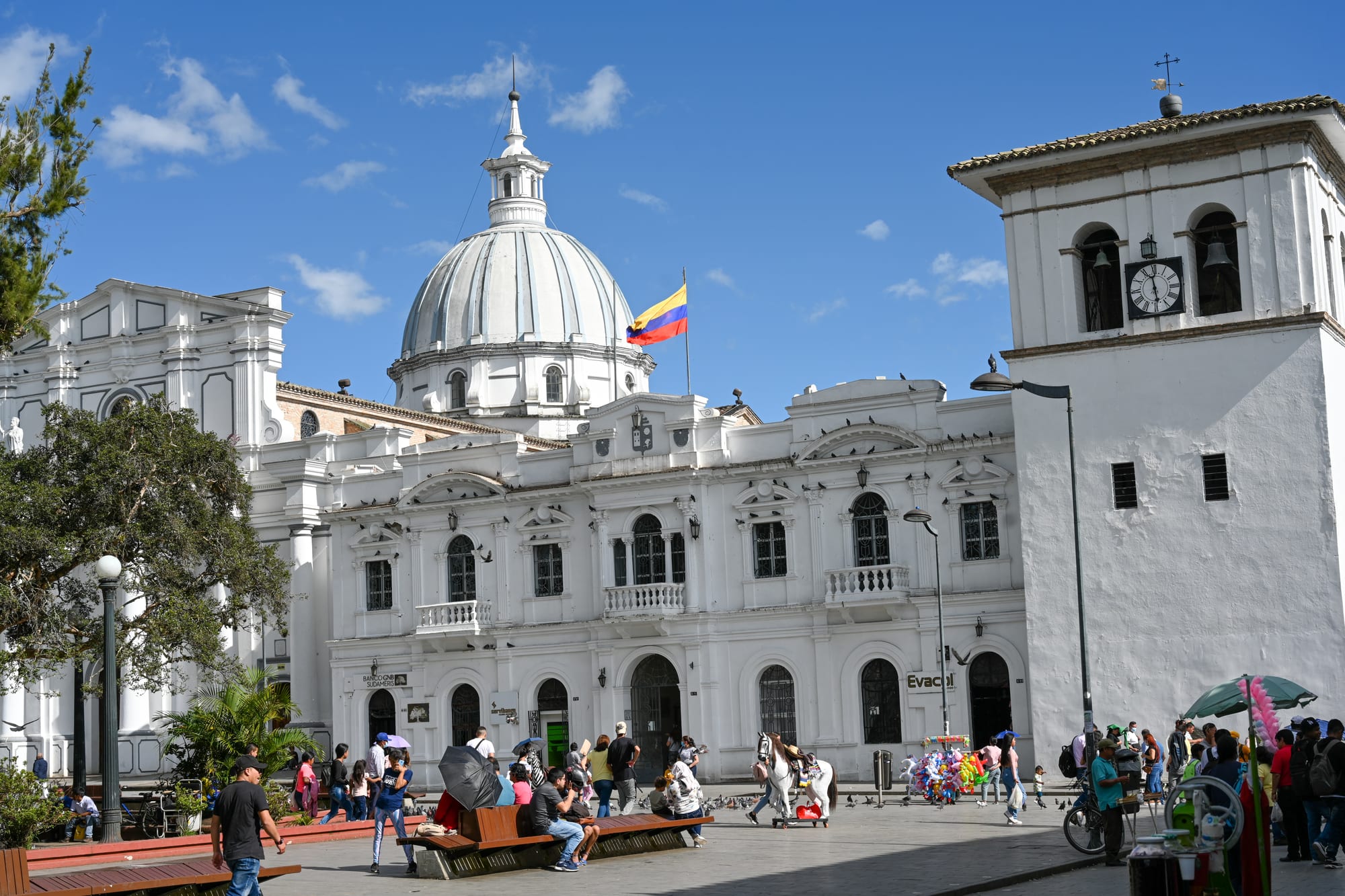
A white domed cathedral and a white clock tower on a sunny square, with people sitting on benches in front

Cali, the Pacific & the Southwest, Colombia

Popayán

The cathedral and the Torre del Reloj on Parque Caldas, the main square of Popayán. (Hernan Vanegas / Wikimedia Commons · CC BY 4.0)

The capital of Cauca, in the Pubenza valley between two ranges of the Andes at about 1,760 metres. Founded in 1537 and enriched by colonial gold, it gave Colombia seventeen presidents. Its whitewashed centre, rebuilt after the 1983 earthquake, is known for UNESCO-recognised Holy Week processions and a cooking tradition that made it the first UNESCO City of Gastronomy.

Neighbourhoods

  • Historic centre
    • First-time visitors
    • Historic district
    • Museums

    The grid of whitewashed colonial streets around Parque Caldas, with the cathedral, the clock tower, the churches of San Francisco, Santo Domingo and San José, house museums and the old cloisters of the University of Cauca. Most hotels, cafés and restaurants are here, and the Holy Week processions follow its streets.

    Open in Maps
  • Belén and the eastern hills
    • Viewpoints
    • Quiet and residential

    On the eastern edge of the centre, the stone steps known as the quingos climb to the small Belén chapel, while the Morro del Tulcán, a pre-Hispanic mound topped by a statue of the city's founder, rises nearby. Both look out over the white roofs.

    Open in Maps
  • Bolívar and the market district
    • Local life
    • Markets

    North of the centre across the old Humilladero bridge, the former El Callejón district, now called Bolívar, has a large food market near Plaza Bolívar with cheap everyday meals.

    Open in Maps
  • The modern north
    • Shopping
    • Students

    Outside the colonial core, newer residential districts and shopping malls such as Campanario and Terra Plaza show the everyday city of today.

    Open in Maps

Things to do

Churches and landmarks

  • Cathedral of Our Lady of the Assumptionlandmark

    The neoclassical cathedral consecrated in 1906 on Parque Caldas, whose 40-metre dome was rebuilt after the 1983 earthquake.

    Open in Maps
  • Parque Caldas and the Torre del Relojlandmark

    The main square, laid out at the city's founding, with a statue of the scientist Francisco José de Caldas and the brick clock tower of 1673–82, nicknamed 'the nose of Popayán'.

    Open in Maps
  • Iglesia de San Franciscolandmark

    A large church rebuilt after the earthquake of 1736, whose façade has been called the finest example of baroque architecture in Colombia.

    Open in Maps
  • La Ermitalandmark

    The oldest church in the city, dating from 1546, where an altar and colonial paintings came to light after the 1983 earthquake.

    Open in Maps
  • University of Caucalandmark

    One of Colombia's oldest universities, founded in 1827 and housed in the former Dominican cloister beside the church of Santo Domingo.

    Open in Maps
  • Puente del Humilladerolandmark

    A brick bridge of 1873 on tall arches linking the centre with the north, long the main way into the city and intact through many earthquakes.

    Open in Maps

Viewpoints

  • Morro del Tulcánviewpoint

    A pre-Hispanic truncated pyramid, the city's main archaeological site, topped by an equestrian statue of Belalcázar and crowded at sunset at weekends.

    Open in Maps
  • Capilla de Belénviewpoint

    A small hilltop chapel reached by the stone steps of the quingos, keeper of the image of the city's patron, with one of the best views of Popayán.

    Open in Maps

Museums

  • Casa Museo Mosqueramuseum

    The family house of the Mosqueras, whose members held the highest offices in 19th-century Colombia, with colonial art and family collections, run by the University of Cauca.

    Open in Maps
  • Archdiocesan Museum of Religious Artmuseum

    An 18th-century mansion of the Arboleda family holding religious art, silverware and paintings of the Quito School.

    Open in Maps
  • Natural History Museummuseum

    The University of Cauca's museum of the region's insects, butterflies and birds, with a collection of pre-Columbian pottery.

    Open in Maps

Short trips from the city

  • Puracé National Natural Parkpark

    A high Andean national park to the east, with the Puracé volcano, hot springs and Andean wildlife.

    Open in Maps
  • Coconuco hot springsattraction

    Thermal pools near the small town of Coconuco, about an hour from the city.

    Open in Maps
  • Silviaattraction

    A highland town in the land of the Misak, or Guambiano, people, known for their distinctive blue dress, with a market on Tuesdays.

    Open in Maps

Seasonal events

  • Holy Week processionsHoly Week, March or April

    Night processions from Tuesday to Holy Saturday, recorded since 1558, in which cargueros carry heavy wooden platforms with religious images through the centre; inscribed by UNESCO as intangible heritage in 2009.

  • Religious Music FestivalHoly Week

    A festival of sacred music begun in the 1960s, bringing choirs and soloists from around the world to the city's churches during Holy Week.

  • Carnavales de Pubenza4–9 January

    A week of festivities, known as the Fiestas de Pubenza until 2012 and historically linked to the Blacks and Whites celebrations of south-western Colombia.

  • National Gastronomy CongressSeptember

    A food congress held each year since 2003, with guest countries and cooks, recognised as part of Popayán's UNESCO City of Gastronomy status.

Eat and drink

Long-standing places and food districts in Popayán. Hours, ratings and directions come from your maps app, always current.

Popayán classics

  • Empanadas de pipiánrestaurant

    Small fried pastries filled with pipián, a stew of potato and peanut, served with a peanut chilli sauce — the city's signature snack.

    Open in Maps
  • Helado de pailacafe

    Ice cream made in a wide, heavy copper pan, a traditional treat of the region.

    Open in Maps
  • Bakeries of the historic centrecafe

    Bakeries selling rosquillas, molletes, cucas and other old-fashioned breads and biscuits, with tinto coffee.

    Open in Maps

Markets

  • Bolívar marketmarket

    The food market north of the Humilladero bridge, a place for cheap, genuine local meals.

    Open in Maps

Experience Popayán

History

No written record survives of the Indigenous village that stood here before the Spanish, but the Morro del Tulcán, a truncated pyramid on the edge of the centre, shows the area was settled by a chiefdom society long before. Sebastián de Belalcázar arrived on 13 January 1537 and Popayán was then governed under the jurisdiction of the Royal Audiencia of Quito. Lying on the route between Lima, Quito and Cartagena, it became a transfer point for gold going north to Spain, and from 1760 it had a mint striking gold and silver coins.

Its landowning families grew rich, built the churches and mansions of the centre, and sent their sons to the University of Cauca, founded in 1827. Popayán gave the republic seventeen presidents, including Tomás Cipriano de Mosquera, as well as the scientist Francisco José de Caldas and the poet Guillermo Valencia. Its cathedral long held the Crown of the Andes, a 16th-century crown set with emeralds, later sold to raise money for charitable purposes.

The city has been destroyed several times by earthquakes. The most recent, on the morning of Holy Thursday, 31 March 1983, lasted only eighteen seconds but killed 267 people and damaged 14,000 buildings, most of them in the historic centre. Rebuilding took more than a decade and led to Colombia's first seismic building code. The centre was restored in its white colonial form, though a few empty lots remain.

Culture & Customs

Holy Week defines Popayán. Processions have been recorded since 1558, and every night from Tuesday to Holy Saturday the pasos, platforms bearing old carved religious images, are carried through the centre on the shoulders of the cargueros along a route in the shape of a cross that takes in the main churches. Being chosen to carry a paso is a great honour. UNESCO inscribed the processions on its intangible heritage lists in 2009, and the week also brings a festival of religious music begun in the 1960s.

The city's reputation as the 'White City' and the 'University City' reflects a cultured, conservative identity built by its old families, its poets and its university, whose students give the centre much of its life during the year. In 2005 UNESCO named Popayán its first City of Gastronomy, recognising cooking traditions passed down orally for generations.

Popular culture has its own roots. The chirimía, a band of cane flutes and drums, plays at Christmas and other celebrations, and farmers on the plateau play string music. In early January the Carnavales de Pubenza, historically linked to the Blacks and Whites celebrations of south-western Colombia, fill the city for a week. The Misak, or Guambiano, people of the highlands around Silvia, recognisable by their distinctive blue dress, make many of the crafts sold in the city.

Daily Life

The national statistics office projected the municipality's population at about 346,000 for 2025. Popayán is the administrative capital of Cauca and a university city, and the countryside around it grows coffee and food crops.

Daily life is quieter and earlier than in Cali. The historic centre fills with office workers, students and shoppers by day and empties after dark, while most residents live in newer districts outside the colonial core, and shop in the malls and the markets. The 1983 earthquake still shapes the centre: rebuilding took more than ten years, the disaster led to laws requiring earthquake-resistant building, and a few lots in the old streets have never been rebuilt.

Cauca's conflict is never far away. The department is one of the parts of Colombia most affected by armed groups, and protests and road blockades on the Pan-American Highway, the city's link to Cali and to Pasto, are a recurring part of life, as are Indigenous movements organised through their own councils.

Food

Popayán's cooking blends Spanish and Indigenous traditions, and the city is proud of it. Its signature is pipián, a stew of potato and peanut, which fills empanadas de pipián, small fried pastries served with a peanut chilli sauce, and tamales de pipián. Carantanta, crisp fragments of maize dough scraped from the pot, is eaten as a snack or in soup, and the city's soups include sancocho and sango. Ullucos, an Andean tuber, appear as a vegetable.

Breads and sweets are a large part of the tradition: rosquillas, molletes and cucas from the bakeries, and at Christmas a table of hojaldras, manjar blanco, a sweet cream of milk, sugar and rice, dulce cortado and figs in syrup. Helado de paila, ice cream made in a large, shallow copper pan, is a classic, and champús is a drink of maize, panela, lulo, pineapple and spices.

Aguardiente caucano is the anise spirit of Cauca, and toley water is a local drink. Each September the National Gastronomy Congress brings cooks to the city, and the market near Plaza Bolívar is the place for cheap, everyday regional food.

Planning tools

Budget

Popayán is one of the cheaper cities in Colombia, with low hotel prices and filling set lunches. The exception is Holy Week, when rooms fill long in advance and prices rise sharply.

Daily Budget Midrange
USD 80–150 (colonial-house hotel in the centre, sit-down dinners, museums, taxis and a day trip)
Daily Budget Shoestring
USD 30–50 (hostel bed, set lunches, empanadas and market meals, local buses)

Walking the centre, its churches when open and the viewpoints costs nothing; book well ahead for Holy Week.

Best Time to Visit

Popayán is mild all year. Holy Week, at Easter, is the time to see the city at its most famous, though also at its most crowded. It is humid all year, with a drier season locals call summer and a wetter season they call winter. Early January brings the Pubenza festivities and September the gastronomy congress.

Suggested Number of Days

One or two days cover the historic centre and its viewpoints. Allow three to five to add the highland country around the city, and more for Holy Week or for the longer journey east to Tierradentro.

First Visit
1–2 days
With Surroundings
3–5 days

Transportation

The historic centre is best seen on foot. Taxis are cheap and plentiful for longer trips, and local buses cover the rest of the city. Buses to the towns and parks of the surrounding highlands leave from the main bus station.

Travel by day on the roads around the city, and check road conditions before trips into rural Cauca.

Airport & Station Connections

Guillermo León Valencia Airport has flights to Bogotá. Many visitors instead fly to Cali and travel south by road, which takes about three hours by bus on the Pan-American Highway; buses also run south to Pasto and Ipiales and east to San Agustín.

Walkability

The colonial centre is compact, flat and easy on foot, and almost every sight is within a few blocks of Parque Caldas. The climbs to Belén and the Morro del Tulcán are short but steep.

Safety

Colombia is far safer for visitors than its reputation, and the main cities and tourist regions are well travelled, but crime requires attention. Popayán itself is visited without trouble by most travellers, but rural Cauca is among the parts of Colombia most affected by armed groups, and a bombing on the Pan-American Highway in Cauca in April 2026 killed 20 people. A magnitude 7.4 earthquake on 10 August 2026 damaged buildings and more than ten airports across the west and the coffee region, including Pereira and Armenia; aftershocks remain possible.

Keep to the city and the main routes, travel by day, and check current conditions before trips into rural Cauca. Check current official travel advice before travelling.

Climate

A mild highland climate at about 1,760 metres, with an average temperature of around 18°C. It stays humid through the year, with much less rain in the dry season than in the wet one.

Summer
the drier season, which locals call summer, brings more sun, with the average temperature still around 18°C
Winter
the wetter season, which locals call winter, brings frequent rain, with the average temperature still around 18°C

Local Customs

Popayán is formal, Catholic and proud of its colonial heritage and its families. During Holy Week the processions are religious acts rather than shows: spectators keep quiet, stay out of the way of the cargueros and dress soberly.

Dress modestly in churches, avoid flash photography during services and processions, and ask before photographing Misak people in Silvia.

Common Payment Methods

The currency is the Colombian peso (COP). Cards are accepted in hotels and many restaurants in the centre; cash is needed in markets, small bakeries and on buses. ATMs are found around the centre.