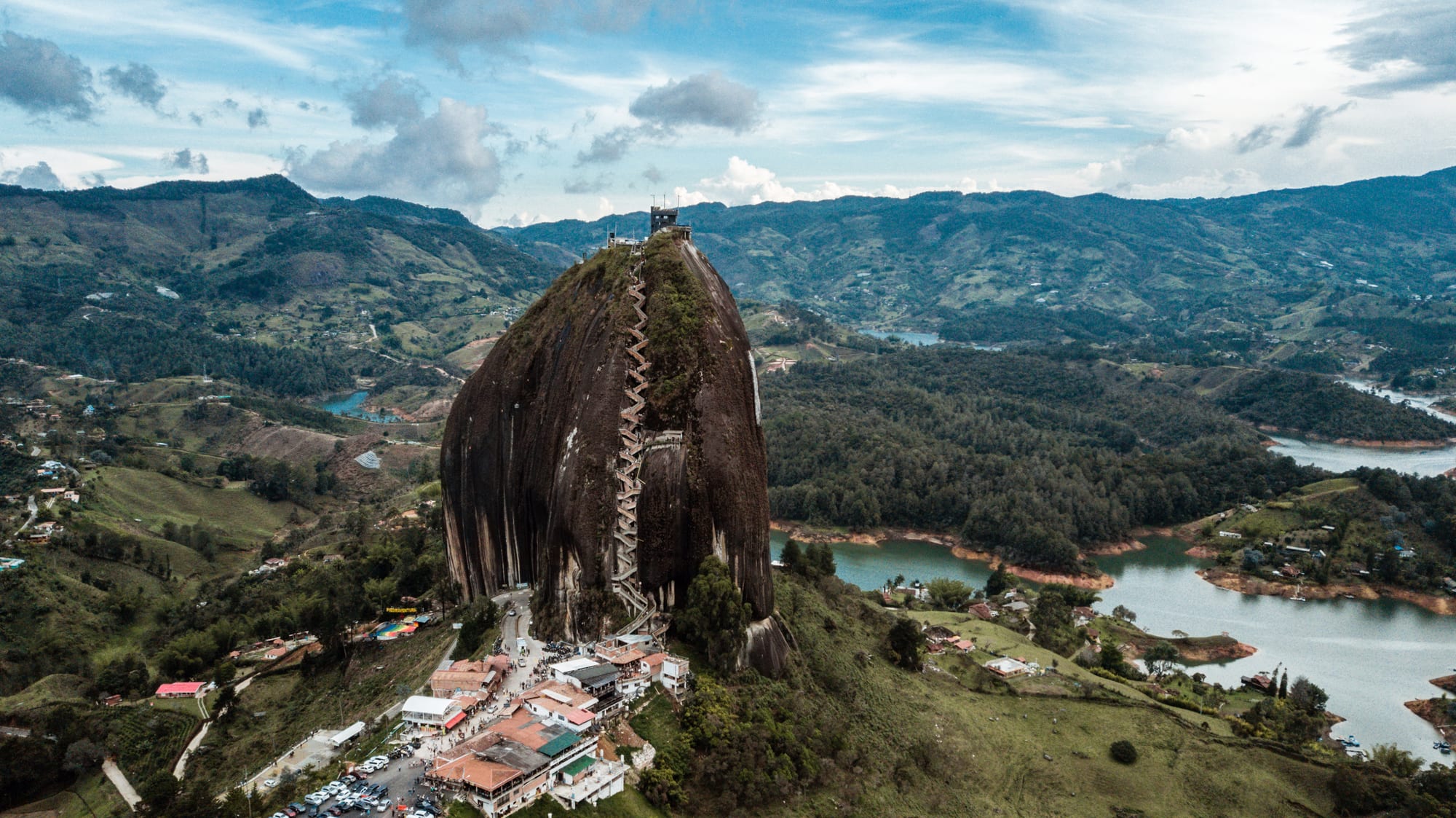
Aerial view of a huge dark granite rock with a zigzag staircase, rising above green hills and winding reservoir arms

Colombia

Medellín & the Coffee Region

The Piedra del Peñol above the Guatapé reservoir in eastern Antioquia. (Juan Gómez / Wikimedia Commons · CC BY 2.0)

The paisa country of the Central Andes, running from Antioquia and its capital Medellín south through the coffee departments of Caldas, Risaralda and Quindío — a region shaped by 19th-century settlers, steep coffee slopes and wax-palm valleys, and by Medellín's journey from cartel violence to urban reinvention.

Explore Medellín & the Coffee Region

History

Before the Spanish arrived, the valleys of the Cauca and its tributaries were home to chiefdoms such as the Quimbaya, whose gold figures and flasks, now in Bogotá's Gold Museum and the Quimbaya Museum in Armenia, are among the finest of pre-Columbian metalwork. Spanish settlement from the 16th century centred on gold mining, with Santa Fe de Antioquia the colonial capital; Medellín, in the Aburrá valley, was granted its town charter in 1675 and replaced Santa Fe as the provincial capital in 1826.

The region's modern shape comes from the Antioquian colonisation of the 19th century, when families of settlers moved south into the forested slopes of the Central Cordillera, clearing land for farms and founding towns: Manizales in 1849, Pereira in 1863 and Armenia in 1889. Coffee, planted on these family smallholdings from the late 1800s, made the area Colombia's economic engine, and the department of Caldas, created in 1905, was split in 1966 when Risaralda and Quindío became departments of their own. Medellín meanwhile became the country's industrial centre, built on textiles.

From the late 1970s Pablo Escobar's Medellín cartel made the city the centre of the cocaine trade and, by the early 1990s, one of the most violent in the world; Escobar was killed there in 1993. Guerrillas and paramilitaries fought over the city's hillside comunas into the 2000s. Since then investment in transport, libraries and parks has transformed Medellín's image. In 1999 an earthquake centred near Armenia killed more than a thousand people and destroyed much of the city, which was rebuilt.

Culture & Customs

The paisas — people of Antioquia and the coffee departments — are known across Colombia as hard-working, commercial, devout, proud and talkative, with a sing-song accent and the use of "vos" rather than "tú". Family is central, Catholicism strong, and the arriero, the mule driver who carried goods over the mountains, remains a regional symbol, complete with carriel, a leather shoulder bag, poncho and hat.

Medellín's great festival is the Feria de las Flores in August, when silleteros from the village of Santa Elena carry huge flower arrangements on their backs through the city. The city is a centre of reggaeton and Latin pop, home to stars such as J Balvin and Karol G, as well as a strong tango tradition, left by the singer Carlos Gardel, who died in a plane crash there in 1935. The painter and sculptor Fernando Botero, born in Medellín, gave his city the rounded bronzes of Plaza Botero.

In the coffee region, the culture of the finca — the family coffee farm — shapes daily life. The UNESCO-listed Coffee Cultural Landscape recognises the smallholder farms, steep plantations and bahareque houses of wood, cane and earth with painted balconies. Towns hold fiestas for the harvest, Manizales stages a large fair in January, and Pereira and Armenia have lively fairs of their own.

Daily Life

Medellín has about 2.5 million people and the wider Aburrá valley around four million, making it Colombia's second city. Manizales has nearly half a million, Pereira's wider urban area more than 700,000 and Armenia about 300,000; the rest of the region is market towns and farms.

Medellín runs on commerce, finance, textiles and clothing, services and a growing technology sector, and draws growing numbers of foreign residents. Its hillside comunas remain poorer, and sex tourism has expanded in the city, alongside police operations against the gangs that drug and rob visitors. Rural Antioquia produces gold, bananas in Urabá, cattle and hydroelectric power. In the coffee departments, coffee remains important but farms have diversified into avocado, plantain, tourism and cattle, and many young people have left for the cities or abroad.

Days start early, especially on the farms, where pickers begin at dawn during the harvest. In the towns, men gather in cafés with billiard tables on the plaza, families take Sunday drives to the countryside, and Medellín's residents fill the metro and the Parque Lleras bars.

Food

Paisa food is hearty and generous. Beyond the bandeja paisa, frijoles antioqueños — red beans cooked with pork and green plantain — are eaten almost daily, served with rice, ground beef and the thin, plain white maize arepa that accompanies every Antioquian meal. Mondongo is a tripe soup, sancocho a stew of chicken or beef with potatoes, cassava and plantain, and chicharrón, thick deep-fried pork belly, is a weekend treat.

Mazamorra, a drink of cooked white maize in milk, is sipped after lunch with a piece of panela, the unrefined cane sugar that also sweetens aguapanela, the everyday hot drink. At Christmas every family makes natilla, a set custard of milk and panela, with buñuelos, fried cheese dough balls. In the coffee region, rainbow trout from the mountain streams is served with patacones in Salento, and roadside stalls sell obleas and arequipe.

Coffee here means both the cheap tinto sold on the street and, increasingly, specialty single-farm coffee tasted at fincas and in Medellín's cafés. The local spirit is aguardiente Antioqueño, an anise-flavoured cane spirit, and the region also makes rum.

Attractions & Natural Wonders

Medellín is best seen from above, riding the metro to the Metrocable lines that climb over the comunas to Parque Arví, a forest reserve on the ridge. The centre has Plaza Botero and the Museum of Antioquia, and the Comuna 13 district — once one of the city's most violent — now draws visitors to its graffiti and outdoor escalators. The Botanical Garden, Pueblito Paisa on Nutibara hill, and the Museo Casa de la Memoria, on the conflict, round out a visit.

Two hours east, Guatapé's houses are decorated with colourful zócalos, relief panels along their lower walls, and the Piedra del Peñol, a granite monolith, rises above the reservoir, with more than 700 steps to the top. Santa Fe de Antioquia, north-west of Medellín, has colonial streets and the Puente de Occidente suspension bridge, and Jardín and Jericó, to the south-west, are colonial towns in coffee country.

The Eje Cafetero is dotted with coffee farms that offer tours. Salento, in Quindío, is the most visited town, with the Cocora Valley, where Quindío wax palms — Colombia's national tree — stand in pasture before a cloud forest; Filandia is a quieter neighbour. Armenia has the Quimbaya Museum and, nearby, the Parque del Café theme park. Pereira's cathedral and Bolívar statue sit near the hot springs of Santa Rosa de Cabal, and Manizales, on its ridge, is the gateway to Los Nevados National Park and the active Nevado del Ruiz volcano.

Cities in Medellín & the Coffee Region

Planning basics

Budget

Medellín's El Poblado and Laureles districts have prices well above the national average, driven by foreign visitors and remote workers, while the rest of the city and the Antioquian towns are cheaper. The coffee region is moderate: Salento's hostels and restaurants are busy and a little dearer than neighbouring towns, and farm stays range from simple rooms to boutique haciendas. Coffee tours, jeep rides to Cocora and Guatapé day trips are modest extras.

Daily Budget Midrange
USD 90–180 (hotel or finca stay, restaurant dinners, coffee tour, a guided trip or two)
Daily Budget Shoestring
USD 35–60 (hostel, menú del día, metro and buses, shared jeeps)

Stay in Laureles or a small coffee town rather than El Poblado or Salento's centre to stretch the budget.

Safety

Medellín is far safer than in the 1990s, but phone snatching, robbery and above all drink-spiking are real risks, and a growing number of foreign visitors have been drugged and robbed by criminal groups in nightlife areas, in some cases fatally. The coffee region's towns and farms are among the calmest parts of the country. Parts of rural Antioquia — the Bajo Cauca and north-eastern gold-mining areas and parts of Urabá — have armed groups involved in drug trafficking and illegal mining.

Meet dates in public places, never leave drinks unattended, use app taxis at night, and keep to the tourist towns in rural Antioquia. Check current official travel advice before travelling.

Climate

This is the tierra templada: Medellín, at about 1,500 metres, earns its "city of eternal spring" nickname with warm days all year, and the coffee towns between 1,300 and 2,000 metres are similar but damper, with cool evenings. Rain falls often, mostly in heavy afternoon showers, peaking in April–May and October–November. Higher up, the Cocora Valley is cool and misty and Los Nevados has freezing nights and snow on the summits.

Summer
the drier spells of December–February and July–August bring sunny days around 24–28°C in Medellín and 20–25°C in the coffee towns
Winter
the wet months bring daily downpours and grey afternoons, 18–24°C, with mud on farm tracks and landslides on mountain roads

Transportation

Medellín's José María Córdova airport, in the hills at Rionegro, has international and domestic flights; Pereira and Armenia have smaller airports, and Manizales a small one prone to weather closures. Within Medellín the metro, trams and Metrocable are clean and cheap. Buses link Medellín to Manizales and Pereira in about five to six hours on winding roads, and Guatapé is around two hours away. In the coffee towns, old Willys jeeps act as shared taxis, including from Salento to Cocora.

Use the metro and cable cars to see Medellín's hillside neighbourhoods, and fly rather than ride the long road from Bogotá.

Best Time to Visit

The drier windows of December to February and July to August are best for walking in Cocora and Los Nevados. Medellín's Feria de las Flores takes over the city in early August, and its Christmas lights along the river fill December. The main coffee harvest falls in the second half of the year, with a smaller one earlier, when farms are busiest.