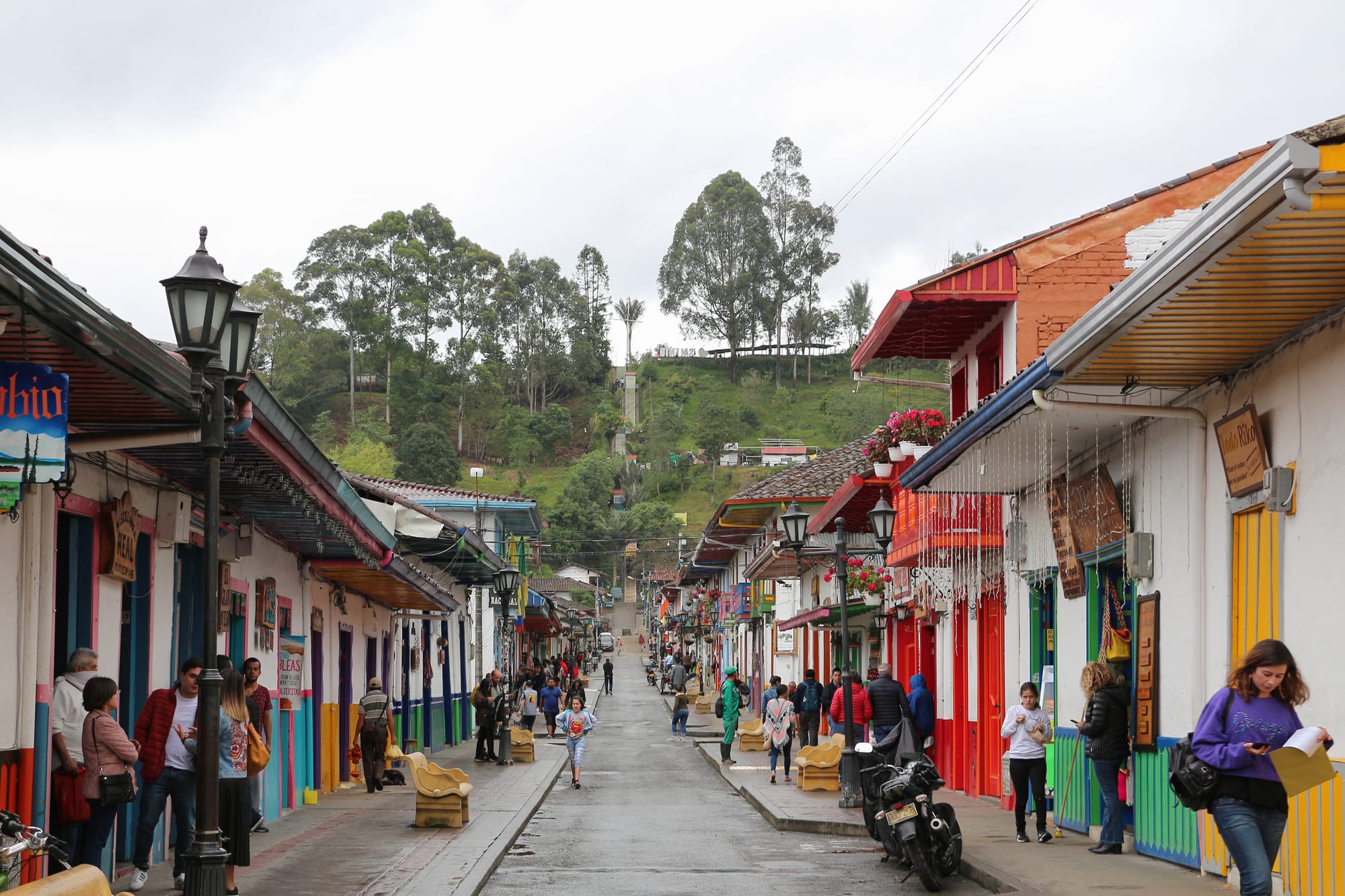
A street of brightly painted one- and two-storey houses with balconies and lamp posts, leading to a wooded hill

Medellín & the Coffee Region, Colombia

Salento

Carrera 6, the Calle Real, running up towards the Alto de la Cruz lookout in Salento. (Bernard Gagnon / Wikimedia Commons · CC BY-SA 4.0)

A small town of painted bahareque houses on a plateau above the Quindío River, the oldest municipality in Quindío. Bypassed when the old road over the Andes was rerouted, it kept its traditional architecture and is now part of the UNESCO-listed Coffee Cultural Landscape and the gateway to the wax palms of the Cocora Valley.

Neighbourhoods

  • The town square and Calle Real
    • First-time visitors
    • Historic district
    • Best for food

    The compact centre around the main square and its church, where jeeps leave for the valley and restaurants serve trout. Carrera 6, the Calle Real, runs north-east from the square past the best-kept bahareque houses, lined with craft shops and cafés, to the steps up to the lookout.

    Open in Maps
  • The edge of town and the coffee farms
    • Quiet and residential
    • Farm stays

    Lanes leading out from the town towards the coffee and dairy farms of the surrounding slopes, several of which offer tours and stays. Quieter than the centre, with views over the Quindío valley, but a walk or a jeep ride from the restaurants.

    Open in Maps
  • The Cocora Valley
    • Walking
    • Nature

    The upper valley of the Quindío River, a jeep ride east of town, with pasture, wax palms, cloud forest and a small settlement of restaurants and campsites at Cocora. Cool, misty and silent at night.

    Open in Maps

Things to do

In town

  • Calle Reallandmark

    Carrera 6, the town's main street, where Salento's traditional bahareque architecture of wood, cane and earth is best preserved, with handicraft shops in the brightly painted houses.

    Open in Maps
  • Alto de la Cruzviewpoint

    A lookout reached by 250 steps from the end of the Calle Real, marked with the fourteen Stations of the Cross, with wide views over the Cocora Valley and the mountains of Los Nevados.

    Open in Maps
  • Tejoattraction

    Colombia's traditional game of throwing metal weights at small gunpowder charges, played in a tejo bar in town, usually at weekends.

    Open in Maps

The Cocora Valley and the coffee country

  • Cocora Valleypark

    Part of Los Nevados National Natural Park since 1985 and the main home of the Quindío wax palm, Colombia's national tree, whose tall trunks stand in open pasture beneath cloud forest; reached by jeep 11 km up the valley, then explored on foot or horseback.

    Open in Maps
  • Acaime Natural Reservepark

    A reserve in the cloud forest about 5 km east of the Cocora settlement, reached on foot or horseback along the valley trails.

    Open in Maps
  • Coffee farmsattraction

    Coffee farms in the countryside around the town, many offering tours of a few hours that end with a cup of their own coffee, and some with rooms.

    Open in Maps

Short trips from the town

  • Filandiaattraction

    A quieter coffee town of painted houses in northern Quindío, 26 km north of Armenia.

    Open in Maps
  • Parque del Caféattraction

    A theme park founded by the National Federation of Coffee Growers near Montenegro, mixing amusement rides with a coffee garden, shows and traditional architecture.

    Open in Maps
  • Los Nevados National Natural Parkpark

    The high-mountain national park that takes in part of Salento municipality, including the Nevado del Quindío, at 4,750 metres the highest point in the department.

    Open in Maps

Seasonal events

  • Fiestas de Salentofirst week of January

    The town's festival, marking the anniversary of Salento's foundation on 5 January 1842.

Eat and drink

Long-standing places and food districts in Salento. Hours, ratings and directions come from your maps app, always current.

Salento classics

  • Trout restaurants on the main squareneighborhood

    The restaurants around the square specialise in rainbow trout farmed further up the Cocora Valley, cooked in a variety of sauces and served on a large patacón, a fritter of green plantain.

    Open in Maps

Cafés and bars

  • Calle Real cafésneighborhood

    Coffee houses and bars in the painted houses of Carrera 6, serving coffee grown on the surrounding farms.

    Open in Maps

Experience Salento

History

The colonial road from Popayán to Bogotá crossed the Central Cordillera by the Quindío Pass and ran through the site of today's Salento. In 1830 Simón Bolívar travelled it and ordered it improved, and after the civil war known as the Guerra de los Supremos political prisoners from Panama, Antioquia and Cauca were sent to a penal colony here, called Barcinales, to repair and maintain it. On finishing their sentences they were given land, and the town dates its foundation to 5 January 1842, making it the first settlement of the modern era in what is now Quindío.

The first village grew down in the valley at Boquía, where the Boquía stream meets the Quindío River, and its families farmed upstream in the Cocora valley. Around 1854 a flood destroyed it, and the survivors rebuilt on the plateau at Barcinales. A census of 1864 counted 581 inhabitants, including farmers, merchants, doctors and watchmakers. In 1865 the settlement became a municipality and was renamed Villa de Nueva Salento, after the Salento region of southern Italy.

When the main road between Cali and Bogotá was later diverted, Salento was left isolated and grew far more slowly than the rest of the coffee region. That neglect preserved more of its traditional architecture than almost any other town in the Eje Cafetero, and in recent decades it has become one of the most visited places in Colombia. In 2011 its historic centre was inscribed on the UNESCO World Heritage List as part of the Coffee Cultural Landscape.

Culture & Customs

Salento's identity rests on its houses. Built in bahareque, a framework of wood and cane filled with earth, and painted in strong colours with balconies, doors and window frames picked out in contrasting shades, they are best seen along the Calle Real, whose shops sell locally made handicrafts. The town belongs to the paisa culture of the coffee region: Catholic, sociable and proud of the settlers who cleared these slopes.

The wax palm is the town's emblem. The Quindío wax palm, which can grow taller than any other palm, is Colombia's national tree, and the Cocora Valley holds most of its remaining wild population. It was once cut for Palm Sunday celebrations, which led to its protection; felling it is now forbidden by law, and the valley has been part of Los Nevados National Natural Park since 1985. The name Cocora is said to come from a Quimbaya princess, daughter of the chief Acaime, and to mean 'star of water'.

Weekends bring Colombian families from Armenia and Pereira to the square, and evenings in town can include a game of tejo, the national sport of hurling metal weights at small gunpowder charges. The town's festival takes place in the first week of January, around the anniversary of its foundation.

Daily Life

The municipality had an estimated population of about 9,700 in 2023, spread across a large territory that rises from about 1,300 metres in the west to 4,750 metres at the Nevado del Quindío. The town itself sits at about 1,895 metres on a plateau with steep drops to the valley on its northern and western sides, 24 km north-east of Armenia.

Tourism is now the main business in town: guesthouses, restaurants, craft shops, guiding, horse hire and the jeeps that shuttle visitors up the valley. Outside the town, farming remains important, with dairy cattle, coffee and flowers among the main products, and trout are raised in the upper Cocora Valley.

Weekdays are quiet, with the square given over to local life; at weekends and on public holidays visitors pour in from the nearby cities and the streets fill. Growth in visitor numbers has made tourism the main source of work in the town.

Food

Trout is Salento's dish. Rainbow trout farmed in the upper Cocora Valley is served in the restaurants on the square in a range of sauces, most often on a large patacón, a flattened fritter of green plantain. The menú del día, a cheap set lunch of soup and a main course, is the everyday meal.

The wider paisa kitchen is here too: frijoles, red beans cooked with pork, served with rice, plain white arepas and plantain, and bandeja paisa for big appetites. Street stalls and bakeries sell sweets made with panela, unrefined cane sugar, and arequipe, a milk caramel spread.

Coffee is grown on the farms around the town, and the cafés of the Calle Real serve it alongside the cheap tinto of everyday life. Farm tours end with a cup of the farm's own coffee. In the evening there is aguardiente, the anise spirit of the region, or beer at a tejo bar.

Planning tools

Budget

Salento is busy and a little dearer than neighbouring towns, but still inexpensive by international standards. Set lunches and trout dinners are good value; farm stays, guided coffee tours, horse rides in the valley and jeep rides to Cocora are the extras. Weekends and holidays, when visitors arrive from Armenia and Pereira, push up room prices.

Daily Budget Midrange
USD 80–160 (guesthouse or finca stay, trout dinners, a coffee tour, a guided walk or horse ride)
Daily Budget Shoestring
USD 35–55 (hostel bed, menú del día, shared jeeps, walking in the valley)

Visit midweek for a quieter town and valley; Filandia nearby is cheaper and less crowded.

Best Time to Visit

The drier spells of December–February and July–August are best for walking in the Cocora Valley, when the trails are less muddy. The town fills up at weekends and on public holidays and celebrates its founding in the first week of January.

Suggested Number of Days

Two or three days are enough for the town, the valley and a coffee farm. Four or five allow for neighbouring towns, a farm stay or longer walks into the high mountains. Rainy afternoons can cost time on the trails.

First Visit
2–3 days
With Surroundings
4–5 days

Transportation

The town is small enough to cross on foot. Old Willys jeeps, the shared taxis of the coffee region, leave from the main square for Cocora, 11 km up the valley, roughly every hour, and can be hired for farm visits. Buses link the town to Armenia and Pereira.

Check the time of the last bus back to Armenia or Pereira, which leaves the main square in the early evening.

Airport & Station Connections

Salento is 24 km north-east of Armenia and about an hour by bus from Pereira's main terminal. The nearest airports are El Edén, 13 km south-west of Armenia, and Matecaña, on the edge of Pereira; both were among more than ten airports damaged by the earthquake of 10 August 2026, so check flight operations before booking. Some buses from Pereira stop at Circasia, where passengers change.

Walkability

Very walkable: the square, the Calle Real and the steps to the lookout are all within a few minutes of each other, though streets are steep in places. The valley trails are muddy after rain and need proper shoes.

Safety

Colombia is far safer for visitors than its reputation, and the main cities and tourist regions are well travelled, but crime requires attention. The coffee region's towns and farms are among the calmest parts of the country. A magnitude 7.4 earthquake on 10 August 2026 damaged buildings and airports across the coffee region, including Pereira and Armenia, and aftershocks remain possible.

Carry warm, waterproof layers and start valley walks early, as mist and rain come in during the afternoon. Check current official travel advice before travelling.

Climate

Subtropical highland at about 1,900 metres, with an average annual temperature of about 17°C — cooler and damper than Medellín, with chilly evenings. Rain falls often, in heavy afternoon showers, peaking in April–May and October–November; the Cocora Valley above town is cooler and often misty.

Summer
the drier spells of December–February and July–August bring more sunshine and firmer trails, around an annual average of about 17°C
Winter
the wetter months stay near the same 17°C average but bring daily downpours, grey afternoons and mud on farm tracks

Local Customs

Salento is a quiet, Catholic farming town that becomes crowded with Colombian visitors at weekends. The wax palm is the national tree and protected by law: felling it is forbidden, and visitors should stay on the trails and not damage the palms.

A 10 per cent service charge is generally added to the bill in better restaurants; taxi drivers are not usually tipped. Ask before photographing people, and dress modestly in the church.

Common Payment Methods

The currency is the Colombian peso (COP). Cash is needed for jeeps, buses, many restaurants and small shops; cards are taken in some hotels and cafés. There are bank ATMs on the main square, but bringing enough cash from a city is sensible.