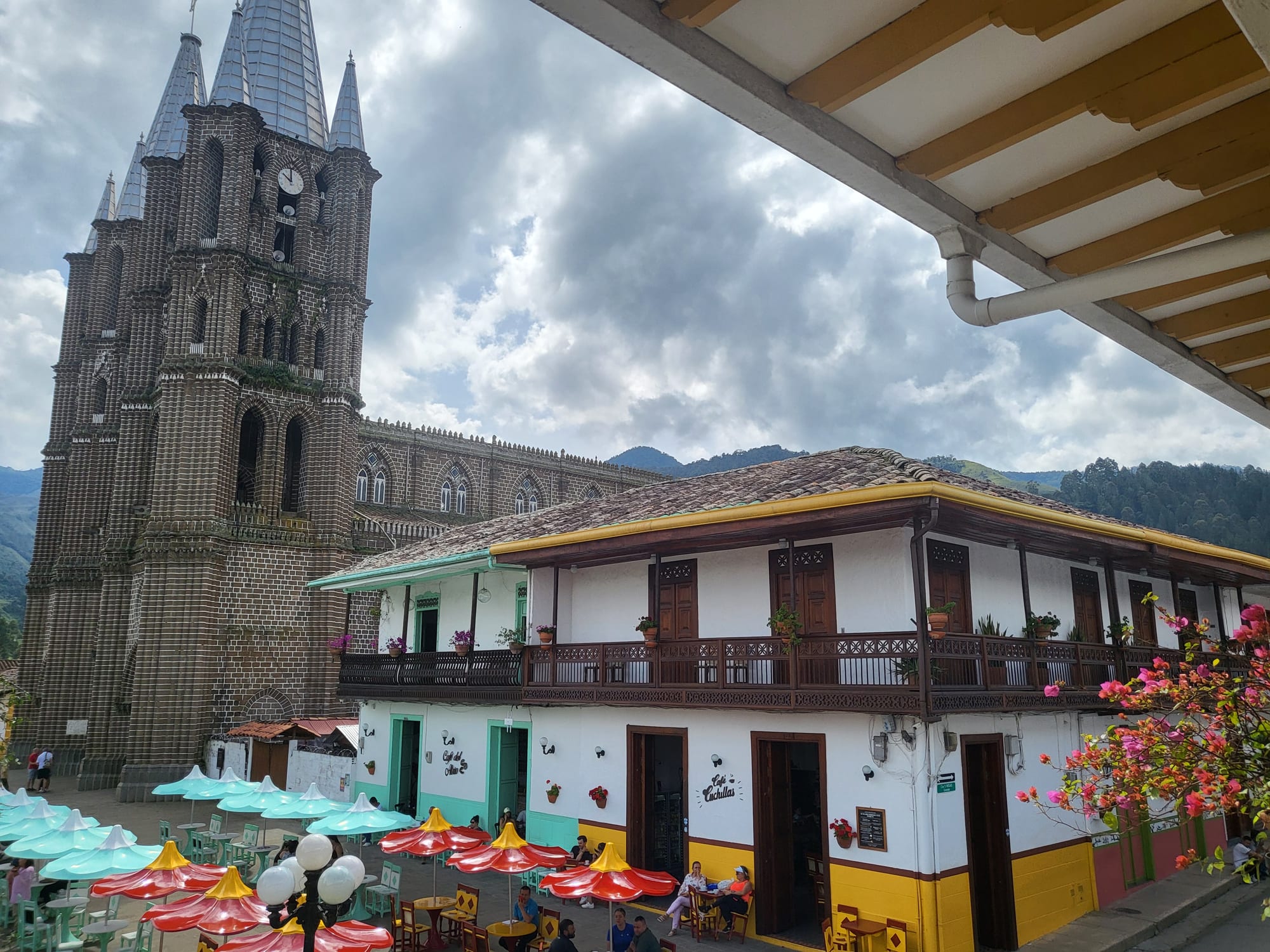
A tall dark stone church with spires beside a white two-storey house with wooden balconies and café tables on a plaza

Medellín & the Coffee Region, Colombia

Jardín

The Basilica of the Immaculate Conception and a balconied house on the main square of Jardín, Antioquia. (Xemenendura / Wikimedia Commons · CC BY-SA 4.0)

A coffee town in south-western Antioquia, founded by settlers in the 1860s between the San Juan River and the Western Cordillera. Its stone Neo-Gothic basilica and main square are national monuments, its whitewashed houses have barely changed in 140 years, and its cable cars, waterfalls and cloud-forest birds have made tourism a basic source of income.

Neighbourhoods

  • The main square and the old town
    • First-time visitors
    • Historic district
    • Cafés

    The Parque Principal, also called El Libertador, paved with river stones and filled with gardens and brightly painted wooden chairs, with the basilica on one side and cafés, shops and inns on the others. The surrounding streets of whitewashed houses with coloured doors and balconies hold many of the town's lodgings.

    Open in Maps
  • The countryside and the valley slopes
    • Nature
    • Quiet and residential
    • Birdwatching

    Coffee, plantain and sugarcane farms, trout ponds and cloud-forest reserves on the slopes around the town, reached by cable car, moto-ratón, jeep or on foot. Quieter than the square, with valley views, but a ride from the restaurants.

    Open in Maps

Things to do

The town

  • Basilica of the Immaculate Conceptionlandmark

    A Neo-Gothic church built of hand-cut stone from the nearby Tapartó river, a national monument since 1980 and a minor basilica since 2003, standing over the main square. Its interior was damaged in the earthquake of August 2026, which destroyed several religious images.

    Open in Maps
  • Parque Principallandmark

    The main square, also known as El Libertador plaza, declared a national monument in 1985, paved with stones from the Tapartó river and set with gardens and painted wooden chairs.

    Open in Maps
  • Clara Rojas Museummuseum

    A museum of 19th-century furniture and objects from the period of the Antioquian colonisation.

    Open in Maps
  • César Moisés Rojas Peláez House of Culturemuseum

    A building opened in 1880, now the town's house of culture, which holds the ashes of the writer Manuel Mejía Vallejo.

    Open in Maps

Cable cars and viewpoints

  • La Garrucha cable carviewpoint

    One of two cable car lines completed in 2007 to help farmers from the surrounding villages bring their goods to market, crossing the valley to a viewpoint with a café; La Garrucha can also be reached by road or on a hiking loop.

    Open in Maps
  • Alto de las Floresviewpoint

    The hilltop with a statue of Cristo Rey from which, the story goes, the founders first saw the valley and called it a garden, with views over the town; it can be reached on foot.

    Open in Maps

Nature around the town

  • Gallito de Roca Reservepark

    A viewing platform near the town where Andean cocks-of-the-rock, males with brilliant orange plumage, can be watched.

    Open in Maps
  • Cueva del Esplendortrail

    The Cave of Splendour, where a waterfall plunges through a hole in the roof of a cave into a pool, reached by a walk of about 10 km from town.

    Open in Maps
  • Charco Corazónpark

    The 'Heart Pool', a natural swimming hole where the La Herrera and La Bonita streams meet, one of several river pools around the town.

    Open in Maps

Eat and drink

Long-standing places and food districts in Jardín. Hours, ratings and directions come from your maps app, always current.

Jardín classics

  • Trout farmsrestaurant

    Trout from the local rivers and from farms around the town is the town's dish, served whole with patacones, rice and salad.

    Open in Maps
  • Dulces de Jardíncafe

    A well-known confectionery shop in the town, started in 1995, selling local sweets.

    Open in Maps

Cafés and bars

  • Cafés on the main squareneighborhood

    The bars and cafés around the plaza serve coffee grown in the municipality and fresh juices by day, and beer and aguardiente in the evening, at tables set out on the plaza.

    Open in Maps

Experience Jardín

History

The earliest traces of people in the valley are graves probably left by the Chamí, speakers of the Catío language, who were also known as Docatoes after the Docató, today's San Juan River. Spanish settlement came late. Jardín grew out of the Antioquian colonisation of the 19th century, which was at its peak in the 1860s: in 1863 the settler Indalecio Peláez claimed large tracts of land between two streams, the Volcanes and El Salado. Legend says the founders, looking down on the forested valley from the Alto de las Flores, were so taken with its beauty that they called it a garden — jardín.

In 1864 the priest José María Gómez Ángel and two other priests arrived, having fled General Mosquera, then in Medellín, and encouraged the settlers to create a more independent village. Jardín became a parish in 1871 and was declared a town in 1882. Coffee, plantain, beans and sugarcane became its living, and the great stone basilica rose over the square, built of stone cut by hand from the Tapartó river.

Unlike many Antioquian towns, Jardín has remained largely unchanged for about 140 years. Its main square was declared a national monument in 1985, and in 2012 the national government named it a heritage town of Colombia, the second municipality in Antioquia to receive the distinction. Tourism has since become a basic source of income.

Culture & Customs

Jardín's architecture is its pride: whitewashed houses with brightly painted doors, windows and balconies, many hung with flowers, and cowhide chairs, some hand-painted with local scenes. The main square, with its gardens and coloured wooden chairs, is the centre of town life, where farmers and visitors share the tables of the cafés around the basilica.

The town is part of the paisa world of south-western Antioquia — Catholic, hard-working and proud of its settler origins — and its basilica, a Neo-Gothic church that became a minor basilica in 2003, is the focus of religious life. The writer Manuel Mejía Vallejo is honoured in the House of Culture, which holds his ashes, and the Clara Rojas Museum preserves the furniture of the colonisation era. Crafts were traditionally made by nuns.

The countryside matters as much as the town. Jardín's rivers, the San Juan, Claro and Dojurgo, run through cloud forest that is home to more than 300 bird species, and visitors come to watch the Andean cock-of-the-rock at a reserve near the town and to look for the yellow-eared parrot. About a tenth of the population is Indigenous, and the municipality has its own municipal anthem, the 'Hymn to Jardín'.

Daily Life

The 2018 census counted about 13,500 people in the municipality, which lies between the San Juan River and a branch of the Western Cordillera, bordering Andes, Jericó and Támesis to the north and the department of Caldas to the south.

For generations most people grew coffee, plantains, beans and sugarcane, and agriculture remains important; trout farming is another local business. Today tourism is a basic source of income: the town has more than 40 hotels, far more than most Antioquian municipalities, along with restaurants, guides, moto-ratón drivers and craft makers. The two cable car lines, completed in 2007, were built partly so that farmers from the villages of La Selva, La Linda and La Salada could bring their goods to town and return home.

The rhythm of the day centres on the square. Farmers come into town to sell and to meet, cafés fill through the afternoon and evening, and on weekends and holidays visitors from Medellín crowd the plaza. Rain is frequent throughout the year, and life adjusts around afternoon showers.

Food

Trout is Jardín's dish. Caught in the local rivers or raised in farms around the town, it is served whole with patacones (fried green plantain), rice and salad, and trout farms around the town double as places to eat it. The menú del día, a set lunch of soup and a main course, is the everyday meal.

The rest of the cooking is Antioquian: frijoles, red beans cooked with pork, with rice and a plain white arepa; bandeja paisa for big appetites; and sancocho, a stew of meat with potato, cassava and plantain. Sweets are a local pride, and a confectionery shop founded in the town in 1995 has become one of its best-known businesses.

Coffee grown on the surrounding slopes is drunk in the cafés of the square, both as tinto, small cups of sweet black coffee, and as better local brews, alongside fresh fruit juices. In the evening the same tables turn to beer and aguardiente, the anise spirit of Antioquia.

Planning tools

Budget

Jardín is cheaper than Medellín's tourist districts and Salento, with a wide choice of lodgings for its size — more than 40 hotels, far more than most Antioquian towns. Set lunches and trout dinners are good value; cable car rides, guided walks to the Cave of Splendour and birdwatching guides are the modest extras. Weekends and holidays, when visitors arrive from Medellín, are busiest.

Daily Budget Midrange
USD 80–150 (hotel on or near the square or a farm stay, restaurant meals, a guided walk or birdwatching trip)
Daily Budget Shoestring
USD 30–50 (hostel bed, menú del día, cable car and walks)

Come midweek for a calmer square and easier rooms; many of the best things — the plaza, the basilica, the walks — cost nothing.

Best Time to Visit

Rain falls in every month, so there is no dry season as such, but the drier spells of December–February and July–August are the easiest for walks to the waterfalls and reserves. Early mornings are the time for birdwatching. Weekends and holidays fill the square with visitors.

Suggested Number of Days

Two or three days cover the town, the cable car and one longer walk. Three to five allow for birdwatching, several walks into the countryside and the neighbouring colonial towns of the south-west.

First Visit
2–3 days
With Surroundings
3–5 days

Transportation

The town centre is small and walkable. Moto-ratones, motorcycles pulling small passenger carts, act as taxis and offer tours, and jeeps reach the farms and trailheads. The cable car crosses the valley to La Garrucha.

Agree on the fare and the route before setting off in a moto-ratón or jeep.

Airport & Station Connections

Buses run from Medellín's South terminal several times a day, along a winding route through Caldas, Amagá, Bolombolo, Hispania and Andes; the journey takes several hours. Shared taxis and private cars also make the trip. A small bus runs once a day from Riosucio in Caldas to the south. The nearest major airports are in and around Medellín.

Walkability

Very walkable: everything in the town is within a few minutes of the square, and walking trails lead out into the countryside, including the loop to La Garrucha. Streets are steep and the rural paths muddy after rain.

Safety

Colombia is far safer for visitors than its reputation, and the main cities and tourist regions are well travelled, but crime requires attention. Jardín is a calm, well-visited town; the earthquake of 10 August 2026 damaged the interior of its basilica. The main hazards are on country walks: slippery paths, river crossings after rain and mountain roads affected by landslides in the wet months.

Take a local guide for the longer walks to the waterfalls and caves, and keep to the tourist towns of south-western Antioquia. Check current official travel advice before travelling.

Climate

A subtropical highland climate with abundant rain all year. Mean daily temperatures are about 19°C, with moderate humidity, so days are mild and evenings cool; rain often comes as heavy afternoon showers.

Summer
the drier spells of December–February and July–August bring more sunshine around the mean of about 19°C
Winter
the wetter months keep the same mild 19°C mean but bring daily downpours and muddy trails

Local Customs

Jardín is a Catholic town, and its basilica dominates the main square. Life revolves around the square, where locals sit alongside visitors. About a tenth of the municipality's people are Indigenous.

A 10 per cent service charge is generally added to the bill in better restaurants; drivers are not usually tipped. Dress modestly in the basilica, and ask before photographing people.

Common Payment Methods

The currency is the Colombian peso (COP). Cash is needed for moto-ratones, the cable car, small shops and many restaurants; cards are accepted in some hotels and cafés. Bringing enough cash from Medellín is sensible.