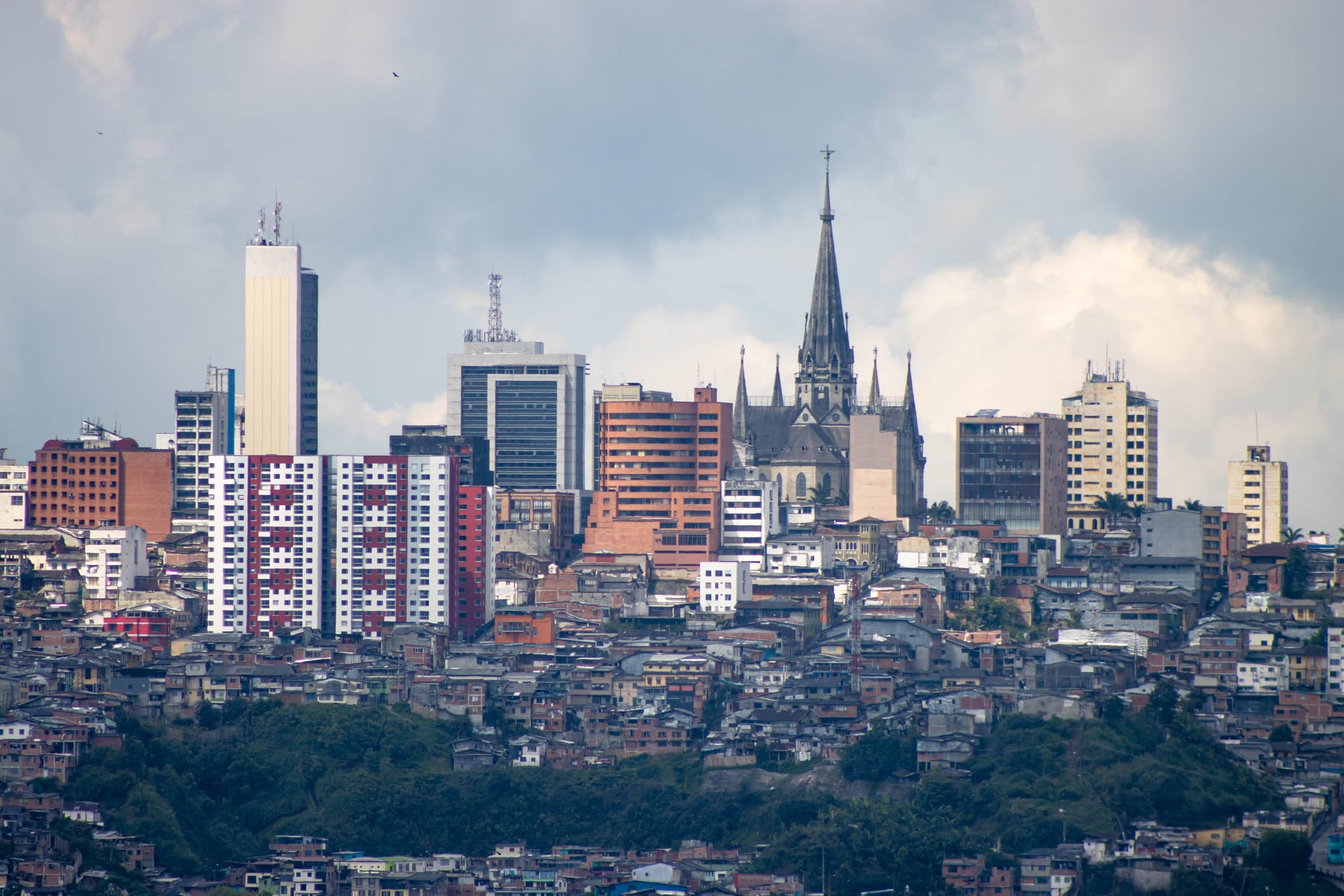
Downtown Manizales on a ridge, with tower blocks and the tall Gothic spire of the cathedral above hillside houses

Medellín & the Coffee Region, Colombia

Manizales

Downtown Manizales on its ridge, with the spire of the cathedral rising over the centre. (Sebastian Jiménez / Wikimedia Commons · CC BY 2.0)

The capital of Caldas, built along steep ridges of the Central Cordillera at about 2,150 metres, within sight of the glaciers of Nevado del Ruiz. Founded by Antioquian settlers in 1849 and made rich by coffee, it is a university city with a towering Neo-Gothic cathedral, a January fair and a theatre festival, and it was hard hit by the earthquake of August 2026.

Neighbourhoods

  • The historic centre
    • First-time visitors
    • Architecture
    • Close to public transport

    The old core on the ridge-top around the Plaza de Bolívar, with the cathedral and streets rebuilt after the fires of the 1920s. The cable car runs down from here to the bus station.

    Open in Maps
  • Avenida Santander and El Cable
    • Nightlife
    • Students
    • Best for food

    The city's first and still most important avenue, running east along the ridge past the Teatro Los Fundadores, the University of Caldas and the Antonio Nariño park to El Cable, named after the old station of the coffee cableway, an entertainment area of bars and restaurants.

    Open in Maps
  • Chipre
    • Views
    • Quiet and residential

    The district at the western end of the city and its highest point, cool and often foggy, with an observation tower in a park looking down over the valley.

    Open in Maps
  • Villamaría
    • Quiet and residential
    • Local life

    A separate town to the south, part of the metropolitan area and linked to Manizales by a line of the cable car from the bus station.

    Open in Maps

Things to do

Landmarks of the centre

  • Manizales Cathedrallandmark

    The Neo-Gothic cathedral on the Plaza de Bolívar, completed in 1939 after fire destroyed its predecessor; more than 110 metres tall and among Latin America's tallest churches, a minor basilica since 1951 and a national monument. One of its towers was badly damaged in the August 2026 earthquake.

    Open in Maps
  • Plaza de Bolívarlandmark

    The main square of the city, in front of the cathedral.

    Open in Maps
  • Avenida Santanderneighborhood

    The ridge-top avenue that has been the city's backbone since its early days, lined with theatres, universities, parks and towers.

    Open in Maps

Cable cars and viewpoints

  • Manizales Gondola Lifttransit hub

    The Cable Aéreo, opened in 2009, carrying passengers 2.1 km from the centre down to the bus station and, since its extension in 2014, on to Villamaría, with wide views of the city's slopes.

    Open in Maps
  • Chipre observation towerviewpoint

    A watchtower in the Parque Observatorio in the Chipre district, the highest part of the city, with views over Manizales and the valley below.

    Open in Maps

Museums and gardens

  • Gold Museum of the Banco de la Repúblicamuseum

    The Manizales branch of the central bank's museum of pre-Columbian goldwork.

    Open in Maps
  • Universidad de Caldas museumsmuseum

    The university's museums of natural history, art and archaeology, alongside its botanical garden.

    Open in Maps
  • Recinto del Pensamientopark

    An ecological park, the Recinto del Pensamiento Jaime Restrepo Mejía, listed among the city's main tourist sites.

    Open in Maps
  • Los Yarumos Ecoparkpark

    A large ecological park named after the yarumo tree, with hiking trails and views over the city and the mountains around it.

    Open in Maps

Sport

  • Estadio Palograndeattraction

    The 31,000-seat home of Once Caldas, the club that won the Copa Libertadores in 2004.

    Open in Maps

Short trips from the city

  • Termales del Otoñoattraction

    Hot springs just outside the city, reached by taxi, the closest of the thermal pools for which the region is known.

    Open in Maps
  • Los Nevados National Natural Parkpark

    The high-mountain park east of the city, with Colombia's highest and northernmost active volcanoes, glaciers and páramo; visits leave Manizales early in the morning with authorised guides.

    Open in Maps
  • Nevado del Ruizviewpoint

    The glacier-capped stratovolcano of 5,321 metres on the border of Caldas and Tolima, the highest point of both, whose 1985 eruption caused the Armero tragedy and which remains active.

    Open in Maps

Seasonal events

  • Feria de ManizalesJanuary

    The city's great annual fair, created in the 1950s, with parades, concerts, exhibitions and folk music shows.

  • International Coffee PageantJanuary

    The Reinado Internacional del Café, held in Manizales since 1957 as part of the fair, with entrants from coffee-producing countries.

  • Manizales International Theatre FestivalSeptember–October

    One of the major theatre events of Latin America, founded in 1968.

  • Manizales Jazz FestivalSeptember–October

    An annual festival that brings jazz musicians to the city's stages.

Eat and drink

Long-standing places and food districts in Manizales. Hours, ratings and directions come from your maps app, always current.

Food districts and cafés

  • Zona Rosaneighborhood

    The city's nightlife district of bars and restaurants, busy with its large student population.

    Open in Maps
  • Cafés of the centrecafe

    Coffee houses around the historic centre in a city whose economy was built on coffee, serving tinto and coffee from the surrounding farms.

    Open in Maps

Experience Manizales

History

Manizales was founded on 12 October 1849 by a group of twenty Antioquian settlers, the Expedition of the 20, who came from Neira and Salamina during the colonisation of the slopes of the Central Cordillera. The site was a difficult one, a set of narrow ridges and steep slopes in an area prone to earthquakes, but the soil was fertile, and coffee planted on the surrounding hills made the town the commercial centre of what became, in 1905, the department of Caldas.

Coffee shaped its growth. Because the terrain made railways hard to build, a cableway was built to carry coffee over the mountains between Manizales and Mariquita in Tolima, one of the great engineering works of its time in Colombia; its main station, La Camelia, was designed by the New Zealand engineer James Ferguson Lindsay. Fires in 1922, 1925 and 1926 destroyed much of the city, including its old cathedral, and the centre was rebuilt, with the present cathedral completed in 1939. Earthquakes in 1962, when an aftershock brought down one of the cathedral's towers, and 1979 caused further damage.

On 13 November 1985 an eruption of Nevado del Ruiz sent lahars down the mountain that buried the town of Armero in Tolima and killed about 23,000 people in all, including in Chinchiná in Caldas. In the late 20th century many universities were founded in the city. On 10 August 2026 a magnitude 7.4 earthquake centred in Chocó killed six people in Caldas, five of them in Manizales, destroyed at least 1,300 homes in the city and badly damaged one of the cathedral's towers.

Culture & Customs

Manizales thinks of itself as a city of culture and learning. The Manizales International Theatre Festival, founded in 1968, is one of the major theatre events of Latin America, and the city also holds a jazz festival, an image festival in April and a rock festival in October. Its several universities draw students from across Colombia, and the city has a reputation for having more universities for its size than anywhere else in the country.

The Feria de Manizales in January is the great popular event. Created in the 1950s, it began with bullfights and the 'manolas' parade, a Spanish-style procession; today it also brings parades, concerts, exhibitions and folk music, and it hosts the International Coffee Pageant, held in the city since 1957. The fair is spoken of in Colombia alongside the Barranquilla Carnival.

The city is proud of its architecture: the cathedral, among the tallest churches in Latin America, and buildings of bahareque, wood and cane filled with earth, such as the old station of the coffee cableway. Football means Once Caldas, the club that won the Copa Libertadores in 2004 and plays at the Palogrande stadium. Like the rest of the coffee region, Manizales is paisa in culture — Catholic, enterprising and attached to the memory of its settler founders.

Daily Life

Manizales had an estimated 475,700 people in 2026, and about 588,000 in the wider metropolitan area with Neira, Palestina and Villamaría. The city lies at about 2,150 metres in the basin of the Chinchiná River, in the northern part of the Eje Cafetero, and its main avenues follow the ridges east to west.

Coffee remains at the heart of the economy. The departmental Committee of Coffee Growers, the coffee warehouse company Almacafé and the national coffee research centre Cenicafé are based here, alongside threshers, cooperatives and exporters, and factories make liquor, shoes, chocolate, soap and other goods, though some have shrunk or moved away. Universities, with some 30,000 students, and call centres are now among its main economic activities, and a World Bank study in 2010 ranked Manizales the easiest Colombian city in which to do business.

Daily life is shaped by altitude and rain: cool mornings, frequent showers and fog that sometimes closes the local airport. The August 2026 earthquake damaged more than 4,000 homes in the city, and the planned Coffee Airport at Palestina remains the region's long-awaited answer to its poor air links.

Food

The food of Manizales is the paisa cooking of the coffee region: frijoles, red beans cooked with pork, with rice, ground meat, plantain and the plain white arepa; bandeja paisa for big appetites; and sancocho, a stew of meat with potato, cassava and plantain. The menú del día, a set lunch of soup, main course and juice, is the everyday meal.

Some specialities belong to the mountains around the city. On the road up to Los Nevados, travellers stop for aguapanela con queso, hot water sweetened with panela, unrefined cane sugar, with fresh cheese. Chorizos from nearby Santa Rosa de Cabal, obleas and cheese ice cream are other local favourites.

Coffee is everywhere, from tinto, small cups of sweet black coffee, to single-farm brews from the hills around the city, and visits to coffee farms end with a tasting. In the evenings the Zona Rosa's bars serve beer and aguardiente, the anise spirit of the region.

Planning tools

Budget

Manizales is cheaper than Medellín and Salento, with prices set by a local and student population rather than by foreign visitors. Set lunches, the cable car and city buses cost little; guided trips into Los Nevados, hot springs and coffee-farm visits are the main extras. Rooms are scarcer and dearer during the January fair.

Daily Budget Midrange
USD 80–160 (hotel in the centre or near Avenida Santander, restaurant dinners, a guided trip to Los Nevados or the hot springs)
Daily Budget Shoestring
USD 30–50 (hostel bed, menú del día, buses and cable car)

Book a licensed guide for any trip into Los Nevados, and check whether the park and the volcano area are open before planning around them.

Best Time to Visit

The city has two wetter and two drier seasons a year, with October and April the wettest months. The drier spells around December–February and July–August are best for clear views of the volcano and for trips into Los Nevados. January brings the fair, and September–October the theatre and jazz festivals.

Suggested Number of Days

Two or three days are enough for the city, its viewpoints and a coffee farm. Allow four or five for an early-morning trip into Los Nevados, the hot springs and the coffee towns nearby. Weather and the altitude of the park can add a day.

First Visit
2–3 days
With Surroundings
4–5 days

Transportation

The city is long and narrow, strung along its ridges, so travel east to west is flatter and faster than north to south. Avenida Santander and Avenida Paralela are the main arteries. The Cable Aéreo gondola links the centre, the bus station and Villamaría, and buses and taxis cover the rest.

Use the cable car between the centre and the bus station: it is quicker than the road and gives the best views of the city's slopes.

Airport & Station Connections

La Nubia Airport, 8 km south-east of the centre, takes only turboprop aircraft in daylight and sometimes closes because of fog, rain or wind; a new Coffee Airport is under construction at Palestina, Caldas, to replace it. Pereira's Matecaña airport is the usual alternative. The earthquake of August 2026 damaged both airports, and part of Matecaña collapsed. Buses arrive at the Los Cámbulos terminal, beside the cable car; Medellín is about five to six hours away by road.

Walkability

The historic centre and Avenida Santander are walkable, but the city sits on steep ridges and slopes, so walks often climb sharply and cross-town journeys are easier by bus, taxi or cable car. Evenings are cool and often damp.

Safety

Colombia is far safer for visitors than its reputation, and the main cities and tourist regions are well travelled, but crime requires attention. In Manizales natural hazards are real: the magnitude 7.4 earthquake of 10 August 2026 killed five people in the city and damaged more than 4,000 homes, and was followed by more than 100 aftershocks. Nevado del Ruiz is an active volcano, and earthquakes, landslides and eruptions are the area's natural threats.

Follow the alert level for Nevado del Ruiz and park closures before any trip into Los Nevados, and check the local situation after the 2026 earthquake. Check current official travel advice before travelling.

Climate

A subtropical highland climate at about 2,150 metres, moist all year, with an average temperature of about 16°C and monthly averages that change little. About 1,500 mm of rain falls a year, with October the wettest month. Los Nevados above the city is far colder, with snow on the summits.

Summer
the drier spells bring clearer skies and views of the volcano, around the 16°C average
Winter
the wet seasons keep the 16°C average but bring frequent rain, fog and grey days

Local Customs

Manizales is a Catholic university city, proud of its coffee heritage and of the settlers who founded it. The January fair is its great social event. Many of its students come from other parts of Colombia.

A 10 per cent service charge is generally added to the bill in better restaurants; taxi drivers are not usually tipped. Dress modestly in the cathedral and bring warm layers for the evenings.

Common Payment Methods

The currency is the Colombian peso (COP). Cards are widely accepted in the city's shops, hotels and restaurants; cash is needed for buses, small cafés, street food and trips into the countryside. ATMs are plentiful — use those inside banks or shopping centres, by day.