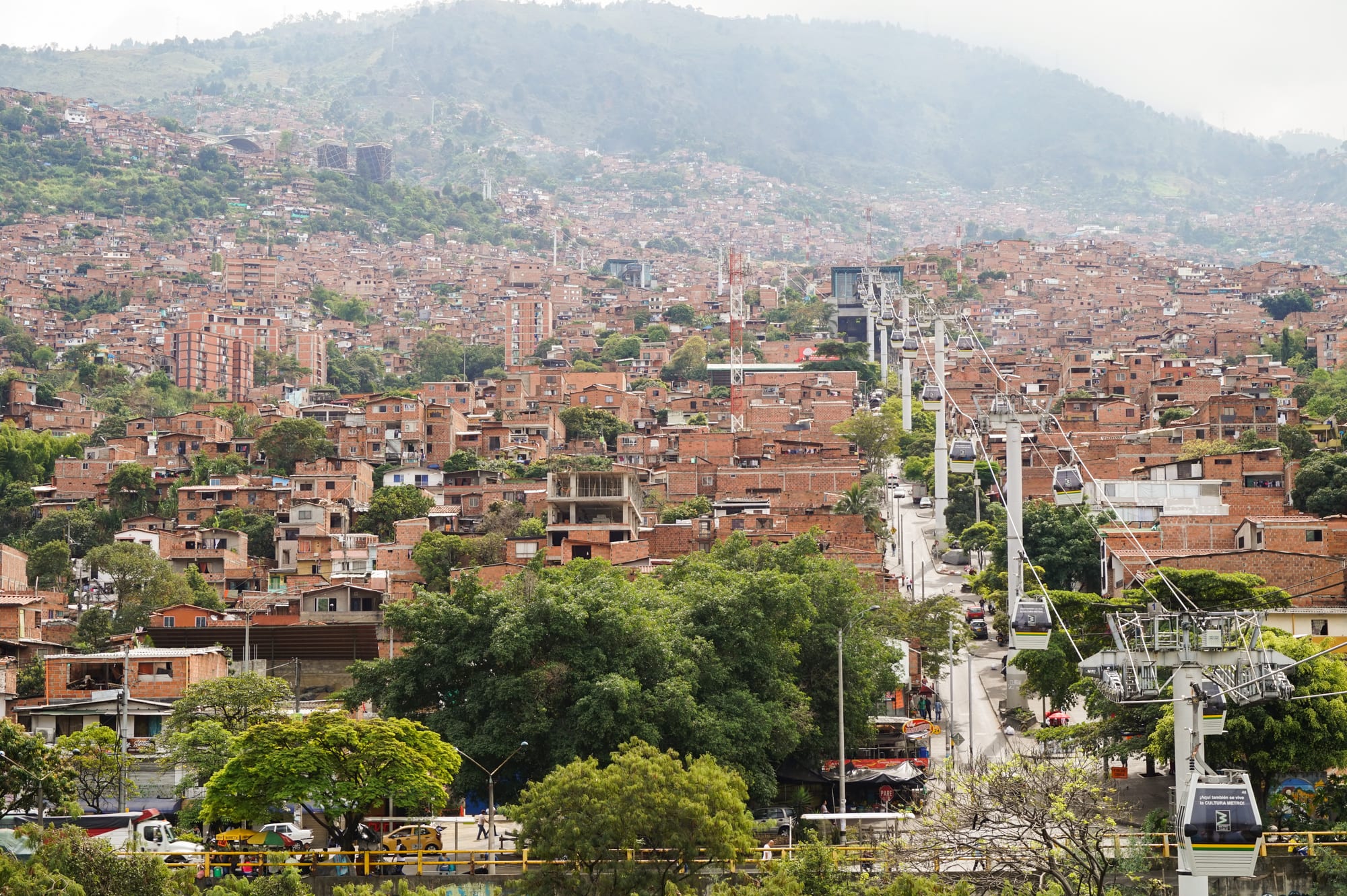
Cable car cabins on Metrocable Line K climbing over a hillside packed with red-brick houses in Medellín

Medellín & the Coffee Region, Colombia

Medellín

Metrocable Line K rising over the brick houses of Medellín's north-eastern hillsides. (Bernard Gagnon / Wikimedia Commons · CC BY-SA 4.0)

The capital of Antioquia and Colombia's second city, spread along the floor and steep sides of the Aburrá Valley in the Central Andes. Gold, coffee and textiles made it rich; the cartel years made it notorious. Since the 1990s a metro, hillside cable cars, outdoor escalators and library parks have reshaped its image, and its spring-like climate draws growing numbers of visitors.

Neighbourhoods

  • El Centro
    • First-time visitors
    • Museums
    • Close to public transport

    The old heart of the city around Berrío Park, Botero Plaza and Bolívar Park, where the town of 1675 was laid out. Busy, noisy and commercial by day, with the Museum of Antioquia, the Palace of Culture and the cathedral within a few blocks and several metro stations; much quieter after dark.

    Open in Maps
  • El Poblado
    • Nightlife
    • Best for food
    • Hotels and restaurants

    The hillside commune in the south-east, on the site of the first Spanish settlement of 1616, now the city's business and wealthiest residential district. Tower blocks among green slopes, shopping centres, and the restaurants and bars of the Zona Rosa between Parque Poblado and Parque Lleras.

    Open in Maps
  • Laureles
    • Quiet and residential
    • Local life

    A modern middle-class district west of the Medellín River, with Estadio and Suramericana beside it — tree-lined streets laid out in curving diagonals and circles, neighbourhood restaurants and cafés, and the city's main sports complex.

    Open in Maps
  • Comuna 13 (San Javier)
    • Street art
    • Local life

    A western hillside commune of around 160,000 people that was among the most violent parts of the city in the early 2000s. Outdoor escalators and two Metrocable lines now link it to the metro, and its graffiti, music and community-run tours have made it a major attraction.

    Open in Maps
  • Envigado
    • Quiet and residential
    • Local life

    A separate municipality immediately south of El Poblado, one of the ten towns of the Aburrá Valley, reached by metro. More traditional and residential than its neighbour, with its own football club and Otraparte, the house museum and café of the writer and philosopher Fernando González.

    Open in Maps

Things to do

The old centre

  • Botero Plazalandmark

    A 7,000-square-metre open square in the old quarter displaying 23 rounded bronze sculptures by Fernando Botero, who donated them for the renovation of the neighbouring museum in 2004.

    Open in Maps
  • Rafael Uribe Uribe Palace of Culturelandmark

    A Gothic Revival public building by the Belgian architect Agustín Goovaerts on Botero Plaza, a national monument now used for concerts, exhibitions and archives, and open to the public free of charge.

    Open in Maps
  • Berrío Parklandmark

    The plaza at the geographical heart of the city and its traditional meeting place, on the site where the town was founded, with a metro station of the same name.

    Open in Maps
  • Metropolitan Cathedral of Medellínlandmark

    The Metropolitan Cathedral Basilica of the Immaculate Conception, on the north side of Bolívar Park in the Villanueva neighbourhood.

    Open in Maps
  • Nutibara Hill and Pueblito Paisaviewpoint

    A rocky hill in the middle of the valley on the west bank of the river, with a sculpture park, an open-air auditorium and the Pueblito Paisa, a reproduction of a traditional Antioquian village, above views of the city.

    Open in Maps

Museums

  • Museum of Antioquiamuseum

    The first museum founded in Antioquia, on Botero Plaza, with a large collection of works by Fernando Botero and Pedro Nel Gómez.

    Open in Maps
  • Medellín Museum of Modern Artmuseum

    The MAMM, founded in 1978, whose collection includes many works by the Medellín-born painter Débora Arango.

    Open in Maps
  • Parque Exploramuseum

    An interactive science museum opened in 2008, with more than 300 exhibits, a planetarium, a vivarium and South America's largest freshwater aquarium.

    Open in Maps

Metro, cable cars and hillsides

  • Medellín Metrotransit hub

    Opened in 1995 and still the only metro in Colombia, crossing the metropolitan area from north to south and from the centre to the west.

    Open in Maps
  • Metrocabletransit hub

    Gondola lines built from 2004 to carry residents of the steep hillside settlements to the metro — Line K, over communes 1 and 2, was the first cable car in the world dedicated to public transport on a fixed schedule.

    Open in Maps
  • Comuna 13 escalatorsneighborhood

    Outdoor escalators built to climb a hillside of the western commune, now the centre of walking tours past murals, street dancers and small shops.

    Open in Maps
  • Ayacucho Tramtransit hub

    A rubber-tyred tram line opened in 2016, with nine stations, three of them interchanges with the metro and Metrocable.

    Open in Maps

Parks and gardens

  • Botanical Garden of Medellínpark

    A 14-hectare garden with thousands of plants, more than a hundred recorded bird species and an orchid collection housed in the Orchideorama.

    Open in Maps
  • Arví Parkpark

    A forest reserve and pre-Hispanic archaeological site of some 16,000 hectares on the eastern rim of the valley, reached by Metrocable Line L, with many kilometres of walking trails.

    Open in Maps

Sport

  • Atanasio Girardot Sports Complexattraction

    The sports complex beside Laureles whose main stadium is the home of the city's two rival football clubs, Atlético Nacional and Independiente Medellín.

    Open in Maps

Seasonal events

  • Feria de las FloresAugust

    The city's great festival, held in August since 1958, whose central event is the parade of silleteros from Santa Elena carrying huge flower arrangements on their backs, alongside concerts and a classic car parade.

  • Alumbrado navideñoDecember

    Millions of Christmas lights and light shows along the Medellín River and La Playa Avenue, a tradition that draws large crowds.

  • International Horse FairOctober

    An exhibition of paisa horse culture with riders and horses from several countries, held since 2009.

Eat and drink

Long-standing places and food districts in Medellín. Hours, ratings and directions come from your maps app, always current.

Food districts

  • Zona Rosa, El Pobladoneighborhood

    The dense cluster of restaurants and bars between Parque Poblado and Parque Lleras, where most of the city's international and upmarket cooking is found.

    Open in Maps
  • Laurelesneighborhood

    Neighbourhood restaurants, arepa places and cafés along the tree-lined avenues west of the river, more local in feel than El Poblado.

    Open in Maps

Cafés

  • El Café de Otrapartecafe

    A café in Envigado beside the Casa Museo Otraparte, the former home of the writer and philosopher Fernando González.

    Open in Maps

Experience Medellín

History

In 1616 the Spanish official Francisco de Herrera Campuzano settled 80 Indigenous people in a village called San Lorenzo de Aburrá, on the site of today's El Poblado, in a valley the Spanish had named after its native inhabitants. The town itself, the Villa de Nuestra Señora de la Candelaria de Medellín, was proclaimed on 2 November 1675 at the place where the Aná stream met the Medellín River — today's Berrío Park. Its first census that year counted about 3,000 people. In 1826 it became the capital of Antioquia, and through the 19th century it grew rich as a trading town, first exporting gold and then coffee.

Industry followed in the early 20th century. Local families founded large companies, among them the textile firm Coltejer in 1907, and the city became an industrial centre, building its first airport, Olaya Herrera, in 1932. The population rose from about 60,000 in 1905 to about 358,000 in 1951 and then tripled again to more than a million by 1973, as migrants from the countryside built homes on the steep slopes faster than the city could plan for them.

The city became the home of Pablo Escobar's Medellín cartel, and in 1991 it recorded 7,273 murders; after Escobar's death in 1993 gangs, guerrilla militias and paramilitaries fought over the hillside comunas into the 2000s. The metro opened in 1995, the first Metrocable line in 2004, and successive mayors invested in transport, libraries and parks in the poorest districts. By 2017 the murder rate had fallen to 23 per 100,000 people, from 266 in 1991, and in 2013 the Urban Land Institute named Medellín the world's most innovative city.

Culture & Customs

Medellín is the capital of paisa culture — commercial, devout, sociable and fiercely proud of Antioquia. The Pueblito Paisa on Nutibara Hill recreates a traditional village of the region. The city's biggest celebration is the Feria de las Flores in August, when silleteros, flower growers from the rural district of Santa Elena, carry great wooden frames of flowers on their backs through the streets; the festival, first held in May, moved to August in 1958. In December millions of Christmas lights along the river and La Playa Avenue draw large crowds.

Music runs from tango to reggaeton. The tango singer Carlos Gardel died in a plane crash in Medellín in 1935, and the city adopted tango as its own: there is a Casa Gardeliana in the Manrique neighbourhood and an international tango festival. Today reggaeton is a strong presence, with hundreds of groups and many concerts a year. The International Poetry Festival was founded in 1991, and the art of Fernando Botero and Débora Arango hangs in the city's museums. Football divides the city between Atlético Nacional, founded in 1947, and Independiente Medellín, founded in 1913.

Daily Life

The 2018 census counted about 2.4 million people in the city of Medellín, and the metropolitan area of the Aburrá Valley — ten municipalities including Bello, Itagüí and Envigado — has more than four million, the second-largest in Colombia after Bogotá. The city is divided into 16 urban communes and a rural fringe of corregimientos such as Santa Elena. Wealth follows the valley: El Poblado in the south-east is the richest district, Laureles and the west are comfortably middle class, while the northern and western hillsides are working-class and poorer.

The economy is built on textiles and clothing, steel, food and drink, chemicals, construction, energy and services, and the city promotes itself as a centre of innovation and technology. The metro, used by hundreds of thousands of people a day, sets the rhythm of working life.

Growing numbers of foreign visitors and remote workers have pushed up rents and prices in El Poblado and Laureles, and drugging and robbery of foreigners by criminal groups in nightlife areas and through dating apps have become a recognised problem. Many hillside neighbourhoods still live with informal housing, unemployment and the presence of local criminal groups.

Food

Medellín eats the hearty food of Antioquia. Meals come with an arepa — here made of cooked, ground maize with no other ingredients — often eaten with butter or cheese. The bandeja paisa piles beans, rice, ground beef, chicharrón (fried pork belly), sausage, a fried egg, plantain, avocado and an arepa onto one platter, and sancocho de gallina is a hen soup with potato, cassava and plantain. Arepas de choclo are made from fresh corn.

The menú del día, a set lunch of soup, a main plate and a fresh juice, is what most people eat at midday, and street stalls sell empanadas, buñuelos (fried cheese dough balls) and fruit cut to order. At Christmas families make natilla, a set pudding of maize starch, milk and panela, unrefined cane sugar, to eat with buñuelos.

To drink there is tinto, plain black coffee, and coffee from the region in the city's cafés. Aguardiente Antioqueño, an anise-flavoured cane spirit, is the drink of parties and football matches, and a small local brewery, Tres Cordilleras, makes wheat beer and ales. El Poblado's Zona Rosa has the widest range of international restaurants.

Planning tools

Budget

Medellín is good value by international standards, but El Poblado and Laureles, where most visitors stay, are well above Colombian prices. The metro, cable cars and menú del día lunches keep daily costs low; hotel rooms, dinners in the Zona Rosa, guided tours and app taxis at night are where the money goes. Rooms are scarcer and dearer during the Flower Festival in August.

Daily Budget Midrange
USD 90–180 (hotel in El Poblado or Laureles, restaurant dinners, a guided tour, app taxis)
Daily Budget Shoestring
USD 35–60 (hostel bed, menú del día lunches, arepas, metro and cable cars)

A single rechargeable transit card covers the metro, Metrocable, tram and integrated buses; the cable car rides and many plazas and parks cost little or nothing.

Best Time to Visit

Any time of year. The average temperature is about 22°C and changes little through the year, which earned the city the name 'City of the Eternal Spring'. The drier spells of December–February and July–August are best for walking; August brings the Flower Festival and December the Christmas lights, both busy and lively.

Suggested Number of Days

Three or four days covers the centre, the hillside neighbourhoods and the museums at an easy pace. Allow five to seven to add day trips into eastern and south-western Antioquia. Festival weeks and the slower pace of the hillside rides can add a day.

First Visit
3–4 days
With Surroundings
5–7 days

Transportation

The metro runs the length of the valley and is integrated with the Metrocable gondola lines, the Ayacucho tram and bus rapid transit lines into one network, with a single payment card. It is clean, cheap and the easiest way to cross the city. Taxis and ride-hailing apps fill the gaps, especially at night and up the steep streets of El Poblado.

Use app taxis rather than hailing cars on the street at night, and travel outside the morning and evening rush when the metro is very crowded.

Airport & Station Connections

José María Córdova International Airport, Colombia's second-largest, is in Rionegro, about 20 km south-east of Medellín over the eastern ridge, with international and domestic flights; the smaller Olaya Herrera Airport in the city handles regional flights. Long-distance buses use the North and South terminals: Manizales and Pereira are about five hours away on winding roads.

Walkability

Individual districts are walkable — the centre's plazas and museums sit close together, and Laureles and El Poblado's Zona Rosa are pleasant on foot — but the city is long and the hillsides are very steep, so the metro and cable cars do most of the work between them. Pavements in the centre are crowded with street vendors by day.

Safety

Colombia is far safer for visitors than its reputation, and the main cities and tourist regions are well travelled, but crime requires attention. Medellín's murder rate has fallen steeply since the early 1990s. The main risks for visitors now are phone snatching, robbery and drink spiking, especially by criminal groups who target foreigners met in nightlife areas or through dating apps; some cases have been fatal. The centre empties after dark and is best left by then. A magnitude 7.4 earthquake on 10 August 2026 damaged buildings and more than ten airports across the west and the coffee region, including Pereira and Armenia; aftershocks remain possible.

Keep phones out of sight on the street, never leave a drink unattended or accept one from a stranger, meet new acquaintances in public places and use app taxis at night. Check current official travel advice before travelling.

Climate

Mild and spring-like all year at about 1,500 metres: the average is about 22°C, with temperatures ranging between roughly 17 and 28°C. There are no real seasons, only wetter and drier periods; rain falls mostly in heavy afternoon showers, peaking in April–May and October–November.

Summer
the drier spells of December–February and July–August bring sunny days around 24–28°C
Winter
the wetter months bring daily downpours and grey afternoons, with days of 18–24°C

Local Customs

Paisas are known for their warmth, talkativeness and pride in their city, and use 'vos' rather than 'tú'. Many residents are tired of foreigners who know the city only through its cartel past.

A 10 per cent service charge is generally added to the bill in better restaurants; taxi drivers are not usually tipped. Dress modestly in churches, and ask before photographing people in the hillside neighbourhoods.

Common Payment Methods

The currency is the Colombian peso (COP), with prices running into the thousands. Cards are widely accepted in El Poblado, Laureles and shopping centres; cash is needed for street food, small shops and some taxis. ATMs are everywhere — use those inside banks or shopping centres, by day.