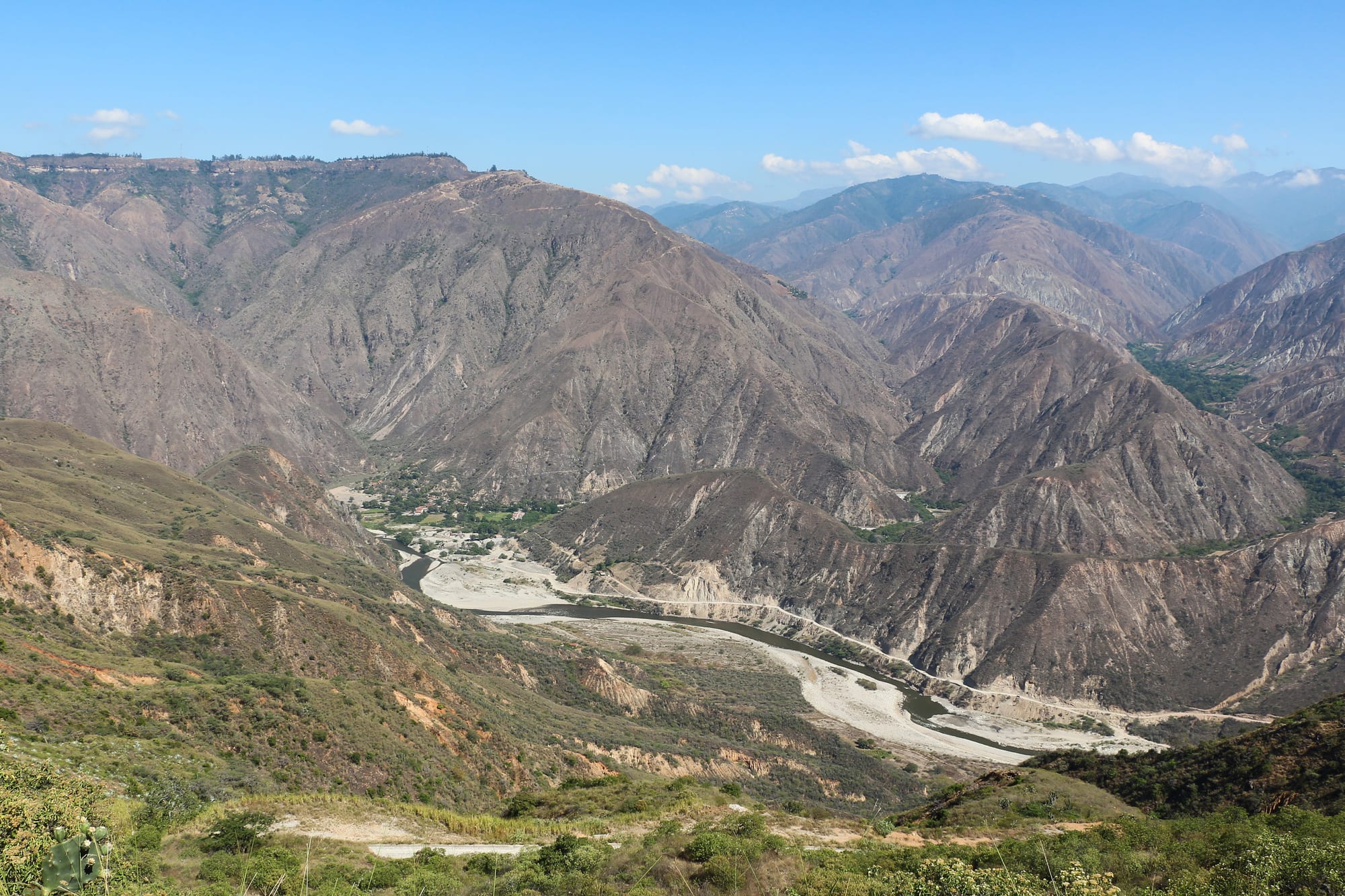
Deep, dry mountain canyon with a pale, braided river winding along its floor under a clear blue sky

Colombia

Bogotá & the Andean Heartland

The Chicamocha Canyon, cut by the Chicamocha river through the mountains of Santander. (Bernard Gagnon / Wikimedia Commons · CC BY-SA 4.0)

The Eastern Cordillera of the Andes, from the capital's high plateau through the old Muisca lands of Cundinamarca and Boyacá to the canyons of Santander and the Venezuelan border at Cúcuta — the cradle of Colombian independence, a land of colonial towns, páramo moorland and the snow peaks of El Cocuy.

Explore Bogotá & the Andean Heartland

History

The high plateau around Bogotá was the heartland of the Muisca, a farming people of the savanna and valleys organised under two rulers — the zipa at Bacatá, near present-day Bogotá, and the zaque at Hunza, now Tunja. They mined salt, traded emeralds and worked gold, and their ceremony of a ruler covered in gold dust offering treasure at Lake Guatavita became the legend of El Dorado.

Gonzalo Jiménez de Quesada's expedition conquered the Muisca and founded Santafé de Bogotá in 1538, and Tunja followed a year later. Bogotá became the seat of the Viceroyalty of New Granada in the 18th century, and the provinces grew colonial towns of whitewashed churches and plazas such as Villa de Leyva, founded in 1572. In 1781 the Comuneros revolt against new taxes began in Socorro, in Santander, and marched on the capital.

Independence was decided here: Bolívar's army crossed the Andes from the plains and beat the Spanish at the Battle of Boyacá on 7 August 1819, and the constitution of Gran Colombia was drawn up at the Congress of Cúcuta in 1821. In Bogotá, the assassination of the Liberal leader Jorge Eliécer Gaitán on 9 April 1948 set off the riots known as the Bogotazo, and in 1985 the M-19 guerrillas' seizure of the Palace of Justice ended in an army assault that left about a hundred dead. The capital has since grown to around eight million people. In Catatumbo, on the Venezuelan border, the conflict has not ended: in early 2025 fighting between the ELN and a FARC dissident faction displaced tens of thousands of people.

Culture & Customs

Andean Colombians are known for reserve, formality and politeness: the courteous "usted" is used even among family, and requests come wrapped in "¿me regala…?" and "con mucho gusto". Bogotanos — rolos in local slang — are the most formal of all, while Boyacenses are thought of as country people, and Santandereanos have a name for bluntness and a quick temper.

The countryside keeps older habits. The ruana, a heavy woollen poncho, is still worn against the cold in Boyacá, where Ráquira is known for its pottery and the market towns sell wool and baskets. Tejo, Colombia's national sport, is played in almost every village: teams throw heavy metal discs at clay boards set with small packets of gunpowder that explode on a hit, usually with a lot of beer. Carranga, a quick, humorous string music of guitars and requinto, grew from Boyacá's farms.

Catholicism is strong, with Holy Week processions in Pamplona and pilgrimages to the shrine of the Virgin at Chiquinquirá, Colombia's patron. Bogotá is the national centre of the arts, with the Ibero-American Theatre Festival, large book and art fairs, a big university population and the Rock al Parque festival. On Sundays and holidays, the city's ciclovía turns main roads over to cyclists and runners.

Daily Life

Bogotá, with about eight million people, dominates: it is the seat of government, finance, media and most national companies, and its suburbs spill onto the Sabana towns of Soacha, Chía and Mosquera. Bucaramanga has around 600,000 people in the city and more in its metropolitan area, Cúcuta about 800,000, and Tunja some 180,000; the rest of the region is small towns and farming villages.

The economy runs from government, services and industry in Bogotá to the flower farms of the Sabana, which grow cut flowers for export, and potatoes, dairy and onions on the Boyacá plateau. Boyacá's mines produce coal and most of Colombia's emeralds, around Muzo and Chivor. Santander grows cacao, tobacco and coffee, and Cúcuta lives from trade with Venezuela, long disrupted by border closures until relations were restored in 2022; the city has absorbed large numbers of Venezuelan migrants.

Days begin early and cold, with hot chocolate or tinto and bread before work. Bogotá's traffic is heavily congested, and commutes on the crowded TransMilenio can take hours. Weekends in the capital mean trips to the countryside — a roadside lunch, a day in Villa de Leyva — and the Sunday ciclovía.

Food

Highland cooking is built for the cold: soups, potatoes, maize and dairy. Beyond Bogotá's ajiaco, the capital's breakfasts include changua, a soup of milk, water, eggs and spring onion, and hot chocolate served with a slice of soft white cheese to melt into the cup, alongside almojábanas, cheesy maize-flour rolls. The tamal santafereño, wrapped in plantain leaf, holds maize dough, pork, chicken and vegetables. In Boyacá, cuchuco is a thick soup of wheat with pork ribs, potatoes and beans, and the markets sell arepas boyacenses, sweet arepas made with wheat flour, cheese and panela.

Santander has the boldest food in the country. Hormigas culonas, large queen ants toasted and salted, are a seasonal snack around Barichara and San Gil; cabro, roast goat, is served with pepitoria, a rice dish made with the animal's blood and offal; and mute is a hearty soup of maize, pork and vegetables. Carne oreada, air-dried salted beef, and cheese-filled obleas — wafers spread with arequipe caramel — are sold along the highways.

Cúcuta is known for pastel de garbanzo, a chickpea pastry often served with mute. Drinks include chicha, the fermented maize drink of the Muisca, aguardiente, and Bogotá's growing craft-beer scene.

Attractions & Natural Wonders

Bogotá's colonial core, La Candelaria, holds Plaza de Bolívar with the cathedral and Capitol, the Gold Museum, the Botero Museum and street art along its steep lanes. Monserrate's cable car and funicular climb to a church above the city, and the north has the colonial square and Sunday market of Usaquén. The páramos of Chingaza and Sumapaz, the latter one of the largest in the world, lie within reach of the city.

North of the capital, the Salt Cathedral of Zipaquirá is carved into the tunnels of a salt mine, and Lake Guatavita, the crater lake of the El Dorado ceremony, lies in the hills to the east. In Boyacá, the Puente de Boyacá battlefield, the colonial churches of Tunja and the whitewashed town of Villa de Leyva — with its huge cobbled plaza, fossil museums and the Muisca standing stones of El Infiernito nearby — are the classic loop, with Lake Tota, Colombia's largest natural lake, further east.

Santander centres on Barichara, a stone-built colonial village above the Suárez valley, and the paved Camino Real that leads down to Guane. San Gil is the base for rafting and paragliding, and the Chicamocha Canyon, with its cable car and national park, lies on the road to Bucaramanga. In the far north-east of Boyacá, El Cocuy National Park protects the glaciated peaks of the Sierra Nevada del Cocuy, whose highest summit, Ritacuba Blanco, rises above 5,300 metres.

Cities in Bogotá & the Andean Heartland

Planning basics

Budget

Prices sit around the national average. Bogotá's northern districts — Chapinero, Zona G, Usaquén — have capital-city prices for hotels and restaurants, while La Candelaria's hostels and the set lunches everywhere stay cheap. Villa de Leyva and Barichara are weekend escapes for Bogotanos and cost more on Saturdays and holidays; San Gil's adventure sports and a guided trip in El Cocuy are the extra costs outside the city.

Daily Budget Midrange
USD 90–180 (hotel in Chapinero or a colonial posada, restaurant dinners, museum entries, a guided day trip)
Daily Budget Shoestring
USD 35–60 (hostel, menú del día lunches, TransMilenio and intercity buses)

Visit the colonial towns on weekdays, when rooms are cheaper and the plazas quieter.

Safety

Bogotá's safety varies by district: the north is generally calm, while robbery and phone theft are common in parts of the centre and La Candelaria after dark, and drink-spiking is a known risk in nightlife areas. The Boyacá and Santander tourist towns are calm. Norte de Santander is different: the Catatumbo region, near the Venezuelan border, is a coca-growing zone where armed groups operate, and the Cúcuta border area has high crime. Altitude sickness is a mild risk on arrival and a serious one on the Cocuy peaks.

Use app taxis in Bogotá, stay out of Catatumbo and the rural border areas, and acclimatise before going high in El Cocuy. Check current official travel advice before travelling.

Climate

Altitude decides everything. Bogotá, at about 2,600 metres, is cool and often grey, with frequent afternoon showers and chilly nights; the Boyacá plateau is similar, and the páramo and the Cocuy peaks are cold, with frost and snow at height. The Santander canyons and the lowlands around Cúcuta are hot and dry. Rain falls mainly in April–May and October–November.

Summer
no true summer; the drier spells of December–March and July–August bring sunny days of 18–22°C in Bogotá and 30°C or more in Cúcuta and the canyons
Winter
no true winter; the wetter months bring grey days of 12–18°C in Bogotá, cold nights near freezing on the high plateau and snow on the Cocuy peaks

Transportation

Bogotá's El Dorado airport is the country's main hub, with flights to Bucaramanga and Cúcuta. The city has the TransMilenio bus-rapid-transit system and a metro under construction; Zipaquirá is about an hour by bus and on some weekends by tourist train. Buses reach Villa de Leyva in about four hours, Bucaramanga in around nine and the Cocuy villages in ten or more, over winding mountain roads.

Take buses by day in the mountains, and allow extra time: landslides close roads in the rainy months.

Best Time to Visit

December to February is the driest period and the best for El Cocuy, whose trails may be closed or restricted at other times, and for clear days in Bogotá. July and August are a second drier window. The cities are fine year-round; Easter week is marked by processions in Pamplona, and Villa de Leyva holds a kite festival in August.