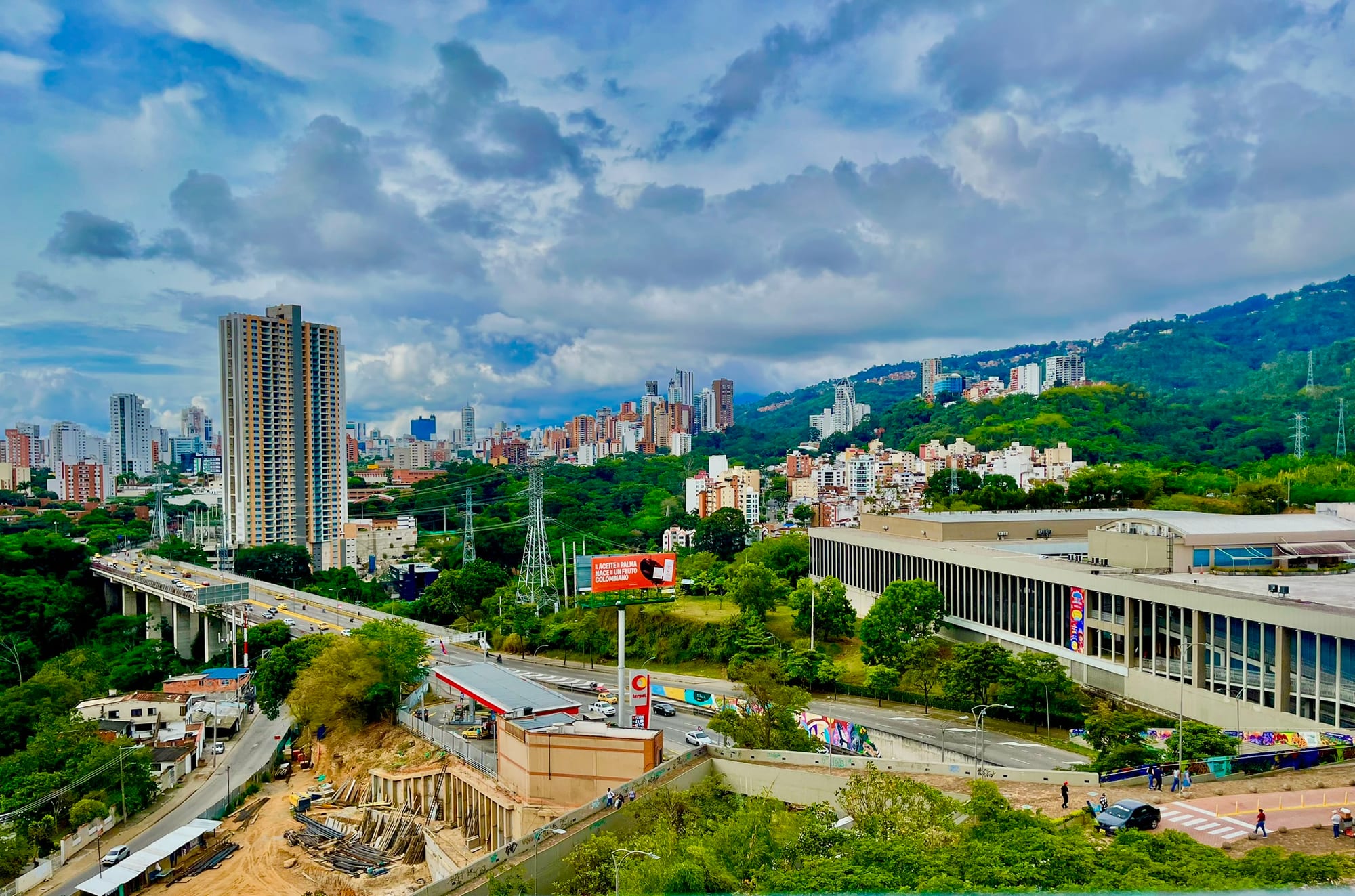
High-rise towers and green wooded hills of Bucaramanga under a cloudy sky, with a viaduct and a road junction in front

Bogotá & the Andean Heartland, Colombia

Bucaramanga

Bucaramanga's towers and wooded slopes seen from the Cacique shopping centre. (Ángel Páez / Wikimedia Commons · CC BY 4.0)

The capital of Santander, on a plateau in the Eastern Andes above the Río de Oro canyon. Founded in 1622 near alluvial gold diggings, it grew slowly until the 1960s and is now the centre of a metropolitan area of more than a million people, known as the City of Parks, with a mild climate, big universities and the Chicamocha Canyon within reach.

Neighbourhoods

  • Centro
    • Historic district
    • Museums
    • Local life

    The older city around Parque Santander, with the Cathedral of the Holy Family, the Club del Comercio and the Casa de Bolívar museum. It is busy and commercial by day, with government offices, banks and shops, and much quieter at night.

    Open in Maps
  • Cabecera del Llano
    • First-time visitors
    • Best for food
    • Nightlife

    The most modern and most popular part of the city for visitors, with large shopping centres, cinemas, restaurants and bars, and many of the city's hotels. The Parque del Agua lies between it and the centre.

    Open in Maps
  • Girón
    • Historic district
    • Quiet and residential

    A colonial town on the city's western side, now part of the metropolitan area, with cobbled streets of white-walled houses, a basilica and a religious art museum. For centuries it was more important than Bucaramanga itself; today it offers a slower base and traditional food.

    Open in Maps

Things to do

In the city

  • Parque Santanderpark

    The central square of the old city, faced by the Cathedral of the Holy Family and the Club del Comercio, one of the oldest social clubs in the country.

    Open in Maps
  • Museo Casa de Bolívarmuseum

    The seat of the Santander Academy of History, holding clothes and objects associated with Simón Bolívar's stay in the city and archaeological finds, including mummies.

    Open in Maps
  • Parque del Aguapark

    A park with water features and an auditorium between the centre and Cabecera, one of the more than 160 parks that give the city its nickname.

    Open in Maps
  • Morroricoviewpoint

    A lookout east of the city on the road to Cúcuta, with a panorama over Bucaramanga and a statue of the Sacred Heart visited at Easter.

    Open in Maps

Around the metropolitan area

  • Girónneighborhood

    The first and long the most important Spanish town of the area, a colonial national monument with the Basilica of the Lord of Miracles, a pilgrimage church, and a museum of religious art.

    Open in Maps
  • Floridablancaattraction

    A neighbouring municipality known for its parks, for the sweets made there, and for the Piedra del Sol, a large rock carved with spirals and circles by the Guane over a thousand years ago.

    Open in Maps
  • Ruitoque plateauviewpoint

    A plateau about 15 minutes' drive from the city, the area's centre for adventure sports and especially paragliding, from the launch site known as Las Águilas.

    Open in Maps

Short trips from the city

  • Mesa de los Santosviewpoint

    A high plateau above the Chicamocha Canyon south of the city, reached by road or by the cable car across the canyon from the national park.

    Open in Maps
  • Chicamocha National Parkpark

    A park on the rim of the Chicamocha Canyon, up to 2,000 metres deep, with viewpoints and a cable car across the canyon.

    Open in Maps

Eat and drink

Long-standing places and food districts in Bucaramanga. Hours, ratings and directions come from your maps app, always current.

Santander classics

  • Girón's traditional foodneighborhood

    The neighbouring colonial town, about 15 minutes from Bucaramanga, has a traditional fritanga market of fried foods.

    Open in Maps
  • Hormigas culonasneighborhood

    The big roasted ants that have made Bucaramanga's food known nationally and abroad, available only seasonally, in May and June.

    Open in Maps

Food districts

  • Cabecera del Llanoneighborhood

    The modern district with the largest choice of restaurants, cafés and bars, from Santander cooking to international food.

    Open in Maps
  • Floridablanca's sweetsneighborhood

    Most of the area's sweets are made in Floridablanca, known for its obleas, thin wafers spread with arequipe caramel.

    Open in Maps

Experience Bucaramanga

History

Bucaramanga began as an Indigenous settlement: the first economic activity in the area was the washing of gold from alluvial deposits, above all in the La Rosita ravine. The town was founded on 22 December 1622, but for two centuries it stood in the shadow of Girón, the first and most important Spanish town in the region, and only overtook it in population and economic weight in the early 19th century.

In 1828 the city received Simón Bolívar, whose stay is remembered in the house that is now the Casa de Bolívar museum. The region was devastated by the Thousand Days War of 1899–1902, one of whose battles was fought at Palonegro, on the hill where the airport now stands, and Bucaramanga grew only modestly through the first half of the 20th century.

From the 1960s the city grew rapidly, spreading into Floridablanca, Girón and Piedecuesta, which now form one metropolitan area with it. Universities, commerce, industry and the research institute of the state oil company Ecopetrol now underpin its economy. In 2024 Atlético Bucaramanga, founded in 1949, won the national football championship for the first time.

Culture & Customs

Bucaramanga calls itself the City of Parks: more than 160 parks are scattered through it, and it is also known as La Ciudad Bonita de Colombia, Colombia's Beautiful City. Its people share the Santander character that the rest of the country recognises — frank and quick-tempered.

The city is a university town. The Industrial University of Santander, founded in 1944, is one of the leading research universities in Colombia, and private universities including the Autonomous University of Bucaramanga add to a large student population. Cultural life runs through a long list of festivals: an international piano festival organised by the Industrial University since 1984, a storytelling festival held since 1992, a book fair, film, theatre, street theatre and circus festivals, and a blues and jazz festival.

Football is followed passionately: Atlético Bucaramanga plays at the Américo Montanini stadium. Religion remains part of public life, with the statue of the Sacred Heart at Morrorico visited at Easter and the Basilica of the Lord of Miracles in Girón drawing pilgrims.

Daily Life

About 613,000 people lived in the city in a 2023 projection, and the metropolitan area, with Floridablanca, Girón and Piedecuesta, has about 1.3 million, making it one of the largest in Colombia after Bogotá, Medellín, Cali, Barranquilla and Cartagena. Bucaramanga has the fifth-largest economy in the country by GDP and has had one of the lowest unemployment rates among Colombian cities.

The economy rests on commerce, services, education and industry. The Chimitá industrial zone near Girón holds production plants, the Colombian Petroleum Institute, the research branch of Ecopetrol, is based here, and large shopping centres cluster in Cabecera and the south of the city, with a customs-free zone planned for the metropolitan area.

Getting around changed in 2025, when Metrolínea, the bus rapid transit system opened in 2009, lost most of its buses after its operator's contract ended amid accumulated debts; only 10 of its 34 original stations remain in operation, and buses and taxis carry most travellers. Weekends take people out to the parks, to Girón, to the Ruitoque plateau or to the Chicamocha Canyon.

Food

Bucaramanga's cooking is the hearty food of Santander. Mute santandereano is a soup of grains, vegetables, herbs and meat; pepitoria, sometimes called fricassee, combines goat offal and blood with white rice; and the table is completed by roasted meats, arepas of maíz pelado — hulled maize — and tamales.

The city's most famous food is the hormiga culona, a large queen ant toasted and salted. The ants have made Bucaramanga known for its food far beyond Colombia, and they have even been exported to Tokyo and London. They are available only seasonally, in May and June, when the ants emerge from underground.

Neighbouring towns add their own specialities. Floridablanca makes most of the area's sweets, including obleas, thin wafers spread with arequipe caramel, and Girón, about 15 minutes away, is known for its traditional fritanga. Fresh tropical fruit is sold in the markets, and the city's restaurants, especially in Cabecera, range from Santander kitchens to international food.

Planning tools

Budget

Bucaramanga is cheaper than Bogotá or Medellín for rooms and meals, and the set lunch and local buses keep daily costs low. Hotels in Cabecera cost more than those in the centre. Paragliding, trips to the Chicamocha park and its cable car are the main extra expenses.

Daily Budget Midrange
USD 90–180 (hotel in Cabecera, restaurant dinners, a paragliding flight or a day at Chicamocha)
Daily Budget Shoestring
USD 35–60 (hostel bed, menú del día lunches, buses and shared taxis)

Many of the city's best spaces — its parks, Girón's colonial streets and the viewpoints — cost nothing.

Best Time to Visit

The city is mild all year. December to March and July and August are the drier spells, best for paragliding and canyon views; April–May and October–November bring more rain. Holiday weekends fill the nearby colonial towns and the Chicamocha park.

Suggested Number of Days

Two days are enough for the city, its parks and a neighbouring town. Allow four or five to take in the canyon and the colonial towns further south. Weather affects outdoor plans, so a spare day helps.

First Visit
2 days
With Surroundings
4–5 days

Transportation

Taxis and city buses are the main way around. Metrolínea, the city's bus rapid transit system, lost most of its buses in April 2025 when its operator's contract ended; a transition plan with leased buses keeps part of it running, but most of its stations are out of service. Buses and taxis link the city with Floridablanca, Girón and Piedecuesta, and minibuses (busetas) to Pamplona and Cúcuta leave from near the Parque del Agua.

Use app taxis or registered taxis rather than unmarked cars, especially at night.

Airport & Station Connections

Palonegro International Airport stands on a hill about 7 km west of the city, near Lebrija, reached by a mountain road — around 25 minutes to the city by car. It has flights from Colombia's major cities and some international flights. Long-distance buses run to Bogotá by way of San Gil, a road journey of around ten hours, and minibuses run to Pamplona and Cúcuta.

Walkability

The centre and Cabecera are each walkable, with many small parks, though the city is built across slopes and ravines and the walk between the two takes a while. The neighbouring municipalities and viewpoints need a taxi or bus. Pavements can be busy and uneven in the centre.

Safety

Colombia is far safer for visitors than its reputation, and the main cities and tourist regions are well travelled, but crime requires attention. In Bucaramanga, as in other Colombian cities, street robbery and phone theft are the main risks for visitors, and drink-spiking is a known danger in nightlife areas.

Keep phones and jewellery out of sight, use app taxis at night, never accept drinks from strangers, and choose established operators for paragliding. Check current official travel advice before travelling.

Climate

Neither hot nor cold, with an average temperature of about 22°C. Cool winds from the peaks to the east keep days cooler than in other cities at similar altitude, while warm air rising from the canyon to the west keeps nights mild. There are wetter and drier periods rather than summer and winter.

Summer
no true summer; the drier spells of December–March and July–August are sunny and mild, around 22°C on average
Winter
no true winter; the wetter months bring more rain, with the average still about 22°C and mild nights

Local Customs

Santandereanos have a reputation for bluntness and a quick temper; the local manner is direct but not unfriendly. A greeting comes before any question, and 'usted' is the normal form of address with strangers. Football support for Atlético Bucaramanga runs deep. Churches are working places of worship, so modest dress is expected inside.

Check whether service is already included on a restaurant bill before tipping, and ask before photographing people.

Common Payment Methods

The currency is the Colombian peso (COP). Cards are widely accepted in Cabecera's shopping centres, hotels and restaurants; cash is needed for buses, small shops and street food. Use ATMs inside banks or shopping centres, by day.