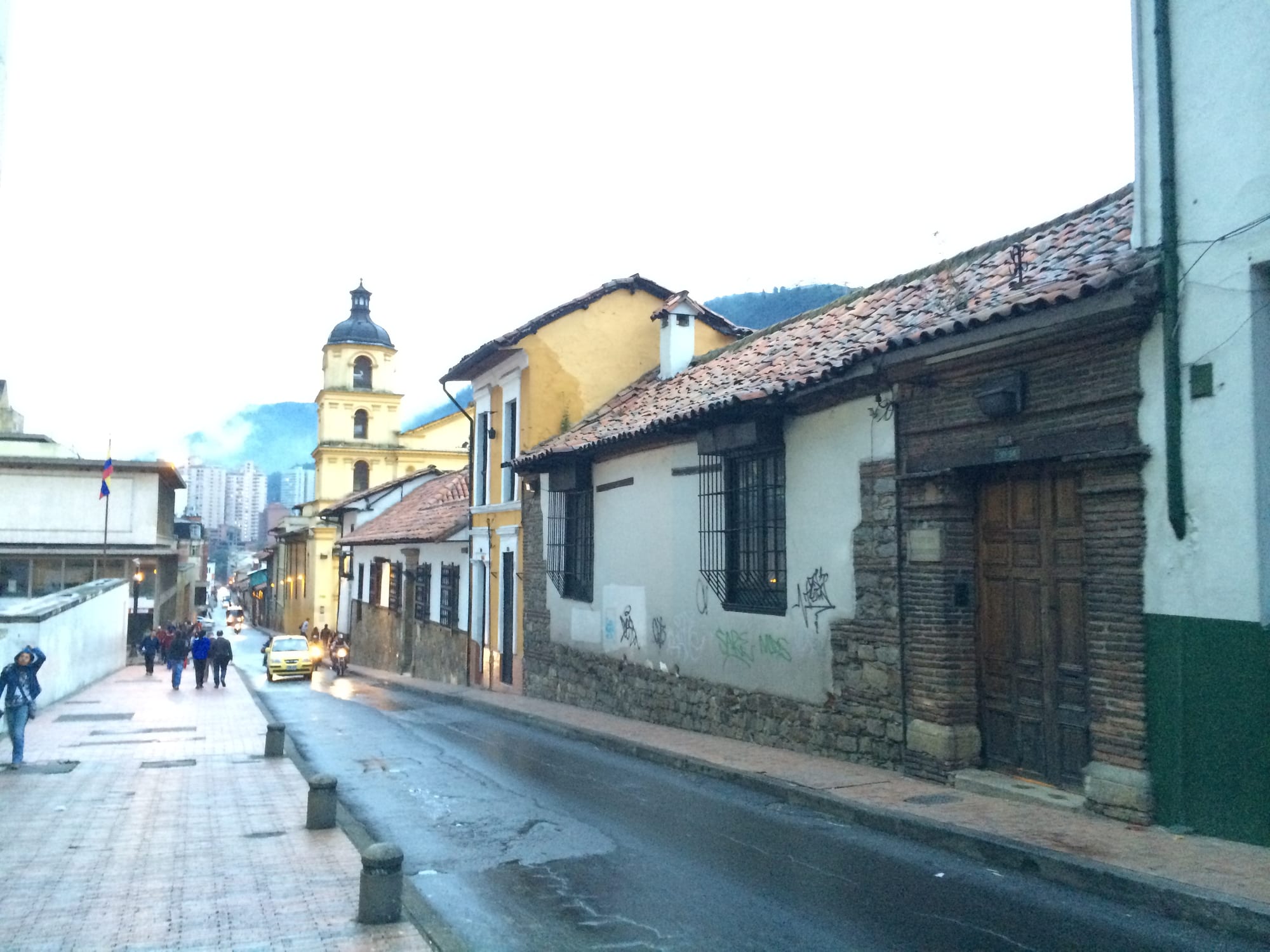
A wet street in La Candelaria lined with tiled colonial houses, a yellow church tower and green hills behind

Bogotá & the Andean Heartland, Colombia

Bogotá

A street of colonial houses in La Candelaria, the historic centre of Bogotá, with the Eastern Hills behind. (Jimmy Gómez N / Wikimedia Commons · CC BY-SA 3.0)

Colombia's capital, spread across a high plateau of the Eastern Andes at about 2,640 metres beneath the hills of Monserrate. Founded by the Spanish in 1538 on Muisca land, it grew from a colonial seat of government into a city of more than seven million, with a colonial core in La Candelaria, the Gold Museum, a busy theatre and music scene and a cool, often grey climate.

Neighbourhoods

  • La Candelaria
    • First-time visitors
    • Historic district
    • Museums

    The historic centre where the city was founded in 1538, with colonial, Baroque and Art Deco buildings on steep streets climbing towards the Eastern Hills. Plaza de Bolívar, the Gold Museum, the Botero Museum, universities, libraries and many hostels are here; it is lively by day and much quieter after dark.

    Open in Maps
  • Chapinero
    • Best for food
    • Nightlife
    • Shopping

    One of the more affluent districts, running north from Calle 39 along the foot of the hills, with the financial district between Calle 72 and Calle 100. It holds several of the city's main dining and nightlife areas, including the restaurant streets of Zona G and the shops and bars around Zona T.

    Open in Maps
  • Usaquén
    • Quiet and residential
    • Markets
    • Best for food

    A separate town until it was annexed in 1954, now a well-off northern district against the Eastern Hills. Its small colonial centre around the old square has restaurants and cafés, and a Sunday market.

    Open in Maps
  • Teusaquillo
    • Parks
    • Architecture
    • Quiet and residential

    A central, middle- and upper-class district north-west of downtown with many of the city's heritage houses, green avenues and the campus of the National University. Simón Bolívar Park, which holds the botanical garden, lies within it.

    Open in Maps
  • La Macarena
    • Best for food
    • Arts and culture

    A small hillside neighbourhood in the Santa Fe district just north of the centre, known for its restaurants and bars and a short walk from the National Museum and the Museum of Modern Art.

    Open in Maps

Things to do

Famous landmarks

  • Plaza de Bolívarlandmark

    The main square, called Plaza Mayor until 1821, framed by the cathedral, the Capitol and the Palace of Justice, with Pietro Tenerani's 1846 statue of Bolívar, the city's first public monument.

    Open in Maps
  • Primatial Cathedral of Bogotálandmark

    The Neoclassical cathedral on Plaza de Bolívar, designed by Domingo de Petrés and built between 1807 and 1823 on the site of three earlier cathedrals.

    Open in Maps
  • Teatro Colónlandmark

    Colombia's National Theatre, a Neoclassical horseshoe auditorium designed by Pietro Cantini and inaugurated in 1892, modelled on the Palais Garnier in Paris at about half the size.

    Open in Maps
  • Torre Colpatrialandmark

    A 196-metre, 50-storey tower opened in 1979, the tallest building in Colombia for decades and lit every night by a coloured LED system.

    Open in Maps

Museums

  • Gold Museummuseum

    The largest collection of gold artefacts in the world, displaying pre-Columbian goldwork and tumbaga alongside pottery, stone and textiles from the societies that lived in Colombia before the Spanish conquest.

    Open in Maps
  • Botero Museummuseum

    A museum in La Candelaria run by the Bank of the Republic, holding works by Fernando Botero and pieces by other international artists from his private collection.

    Open in Maps
  • National Museum of Colombiamuseum

    The country's largest and oldest museum, with more than 20,000 pieces covering archaeology, Indigenous and Afro-Colombian culture, the independence era and Colombian painting.

    Open in Maps
  • Colonial Museummuseum

    A museum of art and objects from the colonial period, founded in 1942, with more than 1,600 pieces.

    Open in Maps
  • Bogotá Museum of Modern Artmuseum

    MAMBO, one of the country's main institutions for modern and contemporary art.

    Open in Maps
  • Quinta de Bolívarmuseum

    The colonial country house that was Simón Bolívar's residence in the capital after the war of independence, now a museum of his life and times.

    Open in Maps
  • Luis Ángel Arango Libraryattraction

    A public library founded in 1958 that now fills two city blocks and holds about two million works, part of the Bank of the Republic's cultural complex beside the Botero Museum.

    Open in Maps

Walks, parks and viewpoints

  • Monserrateviewpoint

    The mountain above the city centre, rising to 3,152 metres, with a 17th-century church of El Señor Caído at the top, reached by cable car, funicular or the pilgrims' path, and wide views west over the city.

    Open in Maps
  • Simón Bolívar Parkpark

    One of the largest urban parks in the world, with a boating lake, cycle paths, sports grounds and a large space for concerts and events.

    Open in Maps
  • Bogotá Botanical Gardenpark

    Colombia's largest botanical garden, founded in 1955 and named after José Celestino Mutis, specialising in Andean and páramo plants, with an orchid collection.

    Open in Maps

Short trips from the city

  • Salt Cathedral of Zipaquiráattraction

    An underground church built in the tunnels of a salt mine 200 metres below ground near Zipaquirá, with carvings in the halite rock, a working place of worship that draws pilgrims and visitors.

    Open in Maps
  • Lake Guatavitapark

    A small circular lake in the hills 57 km north-east of Bogotá, where Muisca rituals involving gold inspired the legend of El Dorado.

    Open in Maps

Seasonal events

  • Ibero-American Theatre FestivalEaster week, every two years

    A very large international theatre festival, with hundreds of performances in theatres and on the streets.

  • Rock al Parquemid-year

    A free rock festival held since 1995, with more than 50 bands and crowds of up to 400,000, one of the city's free 'al Parque' festivals, alongside those of salsa, hip hop and jazz.

Eat and drink

Long-standing places and food districts in Bogotá. Hours, ratings and directions come from your maps app, always current.

Bogotá classics

  • Traditional cooking in La Candelarianeighborhood

    The old centre is the place to find ajiaco, the chicken and potato soup of the capital, along with hot chocolate served with cheese, tamales and other highland dishes.

    Open in Maps

Food districts

  • Zona Gneighborhood

    A cluster of restaurant streets in Chapinero, the city's best-known gourmet area — the G stands for gourmet.

    Open in Maps
  • La Macarenaneighborhood

    A hillside neighbourhood near the centre with a concentration of independent restaurants.

    Open in Maps
  • Usaquénneighborhood

    Restaurants and cafés around the old colonial centre of the northern district, busiest at weekends.

    Open in Maps

Experience Bogotá

History

Before the Spanish arrived, the Bogotá savanna was the heartland of the Muisca, whose population on the plateau may have reached half a million. Gonzalo Jiménez de Quesada's expedition conquered them and founded the city on 6 August 1538, by tradition at the spot now called the Chorro de Quevedo in La Candelaria. As Santafé it became the seat of the Royal Audiencia of the New Kingdom of Granada in 1550 and, after 1717, the capital of the Viceroyalty of New Granada. It stayed small: a census of 1789 counted about 18,000 people.

After Bolívar's victory at the Battle of Boyacá in 1819 the city became the capital of Gran Colombia, and Bolívar renamed it Bogotá in honour of the Muisca. Growth was slow until after 1870, when migrants from the eastern highlands began to arrive. On 9 April 1948 the assassination of the Liberal leader Jorge Eliécer Gaitán set off the riots known as the Bogotazo, which left much of downtown destroyed, and in 1985 the guerrilla seizure of the Palace of Justice on Plaza de Bolívar ended in an army assault.

The second half of the 20th century brought explosive growth, fed by migration from the countryside and by people displaced by the armed conflict. From the 1990s a series of mayors set out to tame the sprawl: TransMilenio opened in 2000, and hundreds of kilometres of cycle paths followed. Construction of the city's first metro line began at the start of the 2020s.

Culture & Customs

Bogotá is the national centre of the arts. The Ibero-American Theatre Festival, held in Easter week every two years, fills theatres and streets with hundreds of performances, and the city has dozens of stages, from the 19th-century Teatro Colón, the National Theatre, to small independent halls in La Candelaria. Rock al Parque, a free festival held since 1995, is one of a family of free 'al Parque' festivals, alongside jazz, salsa and hip hop.

The Bank of the Republic runs a cluster of cultural institutions in La Candelaria — the Gold Museum, the Botero Museum and the Luis Ángel Arango Library among them — and the city has a large university population, an international book fair and a busy gallery scene. Street art covers many walls in the centre.

Bogotanos, nicknamed rolos, are known as the most formal people in a formal part of the country, and politeness is expected in every exchange. The Sunday ciclovía, which closes about 121 km of roads to cars for cyclists, runners and skaters, is one of the city's most loved institutions. Catholic tradition remains strong: Monserrate, sacred to the Muisca before the Spanish, is still a pilgrimage climb.

Daily Life

The 2018 census counted about 7.4 million people within the city's limits, and some estimates add a large floating population of migrant workers and displaced people. Bogotá is a Capital District divided into 20 localities, from the wealthy north to working-class districts in the south such as Ciudad Bolívar, Kennedy, Bosa and Usme, where many displaced families have settled. Residential property is officially classed into socioeconomic strata.

The city is the country's political, financial, industrial and educational centre, home to the national government, most large companies and many universities, and its suburbs spread onto the Sabana towns around it. Carlos Fernando Galán was elected mayor in 2023 for the term running to 2027.

Days start early and cool. Traffic is a constant subject: a 'pico y placa' rule keeps cars off the road at peak hours according to their number plates, and commutes on crowded TransMilenio buses can be long. Weekends bring the ciclovía, family lunches and trips out of the city.

Food

Ajiaco is the capital's signature dish: a thick soup of chicken and several kinds of potato, flavoured with the herb guascas, served with cream, capers, avocado and maize. Breakfast may be changua, a soup of milk, water, eggs and spring onion, or hot chocolate served with a slice of soft white cheese to melt into the cup, alongside almojábanas, cheesy maize-flour rolls. The tamal santafereño, wrapped in plantain leaf, holds maize dough with pork, chicken and vegetables.

Through the day, tinto — small cups of sweet black coffee — is sold from thermoses on the street, and the menú del día, a set lunch of soup, main course and juice, feeds much of the working city. Fruit stalls sell tropical fruits brought up from the lowlands, often blended into juices with water or milk.

The northern districts hold most of the city's restaurants, from Zona G's gourmet streets in Chapinero to the cafés of Usaquén, and the city has a growing craft-beer scene. Chicha, the fermented maize drink of the Muisca, and aguardiente, the anise spirit, are the traditional drinks.

Planning tools

Budget

Bogotá costs around the national average. The northern districts — Chapinero, Zona G, Usaquén — have capital-city prices for hotels and restaurants, while La Candelaria's hostels and the set lunches sold all over the city stay cheap. Taxis and TransMilenio fares are low; day trips out of the city and evenings in the north are where spending rises.

Daily Budget Midrange
USD 90–180 (hotel in Chapinero or a colonial posada, restaurant dinners, museum entries, a guided day trip)
Daily Budget Shoestring
USD 35–60 (hostel bed in La Candelaria, menú del día lunches, TransMilenio)

The menú del día — soup, main course and juice at lunchtime — is the cheapest good meal in the city, and Monserrate's path and Plaza de Bolívar cost nothing.

Best Time to Visit

The city can be visited all year: the temperature barely changes between months. December, January, July and August are the driest months, with more sunny days; April, May and September to November are the rainiest months, with overcast days and afternoon showers. Easter week in the years of the theatre festival is the busiest cultural season.

Suggested Number of Days

Two or three days cover the historic centre, the main museums and the view from the hills. Four or five allow day trips onto the plateau north of the city. The altitude and the city's traffic both argue for a slower pace than in a lowland capital.

First Visit
2–3 days
With Surroundings
4–5 days

Transportation

TransMilenio, a bus rapid transit system opened in 2000, runs on dedicated lanes along the main avenues and, with feeder buses, is the backbone of public transport. A metro line is under construction and projected to open in 2028. Taxis and ride-hailing apps are widely used; traffic is heavily congested at peak hours. The city has one of the largest networks of bicycle paths in Latin America, and on Sundays and public holidays the ciclovía closes main roads to cars.

Use app taxis rather than hailing cabs on the street, and avoid TransMilenio at rush hour with bags or valuables.

Airport & Station Connections

El Dorado International Airport, the busiest in Colombia and the main hub of Avianca, lies in the Fontibón district west of the centre — about 20 minutes by taxi. TransMilenio buses also serve it. Long-distance buses reach the city from across the country, but the mountain roads are slow, and most visitors from the coast arrive by air.

Walkability

La Candelaria and the downtown blocks around it are compact and best seen on foot, though the streets climb steeply towards the hills, and at about 2,640 metres visitors can tire quickly soon after arriving. The rest of the city is large and spread out — it covers about 1,587 square kilometres — so the north and the centre are linked by TransMilenio or taxi rather than on foot. Chapinero and Usaquén are pleasant to walk within.

Safety

Colombia is far safer for visitors than its reputation, and the main cities and tourist regions are well travelled, but crime requires attention. In Bogotá safety varies by district: the north is generally calm, while robbery and phone theft are common in parts of the centre and La Candelaria after dark, and drink-spiking is a known risk in nightlife areas. Altitude can bring headaches and breathlessness on arrival.

Keep phones out of sight in the street, use app taxis at night, never accept drinks from strangers, and go gently on arrival at altitude. Check current official travel advice before travelling.

Climate

A subtropical highland climate: cool all year, with an average temperature of about 14.5°C. Days usually reach 18–19°C and nights fall to around 7°C; morning fog is common and full days of clear sun are unusual. There are drier and wetter periods rather than summer and winter.

Summer
no true summer; the driest months, December–January and July–August, bring more sunshine, with the warmest maximums, near 20°C, in March
Winter
no true winter; the rainiest months — April, May and September to November — are mostly overcast, with highs around 18°C and lows around 7°C

Local Customs

Bogotanos are known for reserve and formality: the polite 'usted' is normal even among family, and requests come wrapped in courtesies such as '¿me regala…?'. A greeting before any question in a shop is expected. Dress in the city is more formal and darker than on the coast, and a warm layer and umbrella are part of daily wear. Churches are working places of worship; dress modestly and keep quiet during services.

Check whether a service charge has already been added to a restaurant bill before tipping. Ask before photographing people, especially vendors and police.

Common Payment Methods

The currency is the Colombian peso (COP), with prices running into the thousands. Cards are widely accepted in the north and in most restaurants, hotels and shops; cash is needed for street food, small shops and some taxis. ATMs are everywhere — use those inside banks or malls, by day.