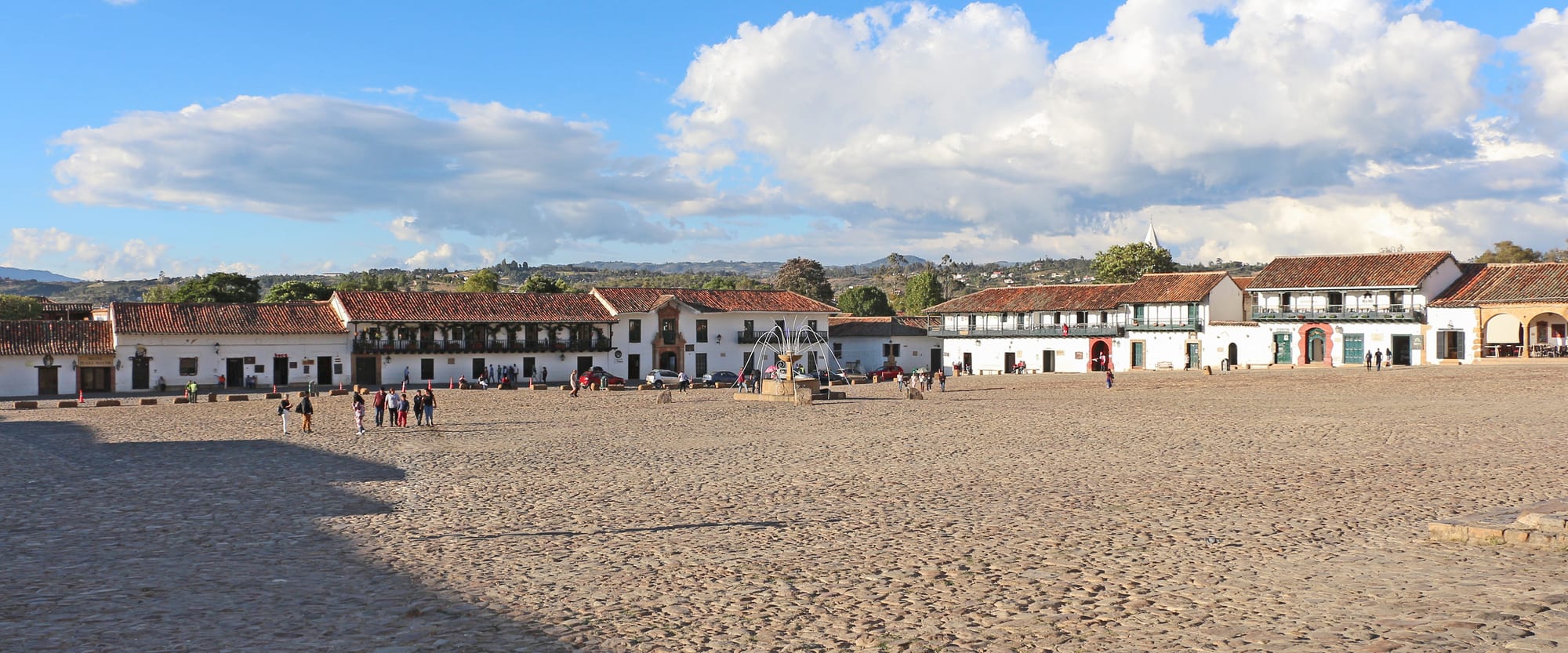
A huge sunlit cobbled square ringed by white colonial houses with tiled roofs and wooden balconies, a fountain at its centre

Bogotá & the Andean Heartland, Colombia

Villa de Leyva

The cobbled Plaza Mayor of Villa de Leyva, Boyacá. (Bernard Gagnon / Wikimedia Commons · CC BY-SA 4.0)

A colonial town in Boyacá, in a dry, high valley about 37 km west of Tunja, founded in 1572. Off the main trade routes and without mines, it changed little for four centuries and keeps its cobbled streets, whitewashed houses and a vast cobbled main square. Fossil beds, Muisca standing stones and new vineyards surround it, and weekend visitors from Bogotá fill it.

Neighbourhoods

  • The Plaza Mayor and the colonial centre
    • First-time visitors
    • Historic district
    • Best for food

    The grid of cobbled streets around the main square, lined with whitewashed one- and two-storey houses, many from the 16th century, with wooden balconies and tiled roofs. Museums, churches, restaurants and most guesthouses are within a few blocks, and the streets are quiet on weekdays and crowded at weekends.

    Open in Maps
  • The valley outskirts
    • Quiet and residential
    • Countryside
    • Wineries

    Beyond the old centre the town gives way to farms, country houses and vineyards in a dry, eroded landscape of hills, with the fossil sites and Muisca stones a few kilometres west and the green slopes of Iguaque rising to the north-east.

    Open in Maps

Things to do

The colonial town

  • Plaza Mayorlandmark

    The town's focus, at 14,000 square metres the largest square in Colombia and believed to be the largest entirely cobbled square in South America, with the House of the First Congress, where the Congress of the United Provinces of New Granada met in 1812, on its north corner.

    Open in Maps
  • Casa Museo Antonio Nariñomuseum

    The house where the independence leader Antonio Nariño, translator of The Rights of Man into Spanish, spent the last years of his life, now a museum.

    Open in Maps
  • Museo del Carmenmuseum

    A museum of religious art on the Plazuela del Carmen, beside the church of Nuestra Señora del Carmen.

    Open in Maps
  • Casa Terracotaattraction

    A house built entirely by hand from clay and baked in the sun.

    Open in Maps

Fossils and Muisca sites

  • El Fósilmuseum

    A museum built around a near-complete skeleton of the giant marine reptile Monquirasaurus, found in 1977 about 5 km west of town and left where it was discovered.

    Open in Maps
  • Museo Paleontológicomuseum

    A collection of fossils from the valley, including ammonites, marine reptiles, fish and plants from the Cretaceous rocks of the Paja Formation.

    Open in Maps
  • El Infiernitoattraction

    A pre-Columbian site on the outskirts of town with rows of standing stones, earthworks and burial mounds, used by the Muisca for ceremonies and as an astronomical observatory.

    Open in Maps

Short trips from the town

  • Lake Iguaquepark

    A high mountain lake north-east of town, sacred in Muisca belief as the place from which the first mother, Bachué, emerged, inside a flora and fauna sanctuary declared in 1977.

    Open in Maps
  • La Periqueratrail

    A group of seven waterfalls in the cloud forest about 15 km from the town centre.

    Open in Maps
  • Ráquiraattraction

    A small town south-west of Villa de Leyva known across Boyacá for its pottery and craft shops.

    Open in Maps

Seasonal events

  • Festival of Astronomylate January or early February

    A festival devoted to astronomy, held at the start of the year.

  • International Kite FestivalAugust

    The Festival del Viento y las Cometas, an international kite-flying festival held in the town each August.

  • Gastronomic festivalNovember

    A festival of food and local produce held in the town each November.

  • Festival of Lights7 December

    The town's Festival of Lights, held each year on 7 December at the start of the Christmas season.

Eat and drink

Long-standing places and food districts in Villa de Leyva. Hours, ratings and directions come from your maps app, always current.

Food around the plaza

  • Restaurants around the Plaza Mayorneighborhood

    Cafés and restaurants in the colonial houses on and around the main square serve Boyacá dishes such as cuchuco soup and arepas alongside international cooking for weekend visitors.

    Open in Maps
  • Set-lunch placesneighborhood

    A few blocks from the square, small restaurants serve the menú del día — soup, main course and juice — to local workers.

    Open in Maps

Wine and local produce

  • Vineyards of the valleyneighborhood

    The cool temperatures, dry climate and rich soil have made the valley a small wine region, with a number of wineries opening around the town in recent years.

    Open in Maps

Experience Villa de Leyva

History

When the Spanish arrived, the valley belonged to the Muisca and was ruled by the zaque of Hunza, whose seat stood where Tunja is now. The Muisca left their mark in the standing stones of El Infiernito and in the legend of Lake Iguaque, in the mountains above the valley, from which the first mother, Bachué, was said to have emerged.

The town was founded on 12 June 1572 and named after Andrés Díaz Venero de Leiva, the first president of the New Kingdom of Granada. It lay away from the main trade routes, in a dry valley with no mineral deposits worth exploiting, and so it grew slowly and changed little: its streets and large central plaza are still paved with cobblestones, and many buildings date from the 16th century. In 1812 the First Congress of the United Provinces of New Granada met in a house on the main square, and the independence leader Antonio Nariño spent his last years and died in the town.

The isolation that kept Villa de Leyva poor preserved it. It was declared a national monument in 1954 and became one of Colombia's Heritage Towns in 2010, and it is on Colombia's tentative list for UNESCO World Heritage status. Tourism, mostly from Bogotá, now drives the town, and the valley's fossils — from the Paja Formation, among the richest fossil-bearing rocks of Colombia — have made it a centre of palaeontology.

Culture & Customs

Villa de Leyva's identity is bound up with its preserved colonial fabric: whitewashed walls, green or brown wooden doors and balconies, clay tiles and cobbles that residents and the heritage rules keep largely unchanged. The Plaza Mayor is the town's stage, where storytellers perform weekly for passers-by and festivals take over through the year.

The calendar is unusually full for a small town. A festival of astronomy comes at the start of the year; a jazz festival comes in the middle of the year; the August kite festival fills the windy skies over the valley; a gastronomic festival is held in November; and on 7 December the Festival of Lights opens the Christmas season. Smaller celebrations include a water festival, a tree festival and an onion beauty pageant in October.

The town shares the rural culture of Boyacá: woollen ruanas, pottery from nearby Ráquira, and tejo, the national sport, played with heavy discs and small charges of gunpowder. Newcomers from the cities, drawn by the peace and quiet of the countryside, have settled in the valley and brought their own culture with them.

Daily Life

The 2018 census counted about 14,400 people in the municipality, roughly half of them in the town and the rest in the rural districts around it. Life changes with the week. On weekdays the town is calm, with locals crossing an almost empty square; at weekends and on public holidays visitors from Bogotá fill the guesthouses, restaurants and streets.

Tourism is the main source of work — guesthouses, restaurants, craft shops, guides and transport — alongside farming in the valley and a young wine industry that has grown up around the town in recent years, helped by the cool temperatures, dry climate and rich soil.

The area's landscape is fragile. The semi-desert valley receives little rain, and the mountains of Iguaque above it are an important source of water for the whole area; a forest fire once burned a large part of the Iguaque sanctuary. Local tour operators guide visitors into the Iguaque sanctuary and across the desert, with its viewpoints and blue pools, and at festival time many young visitors camp in the valley.

Food

Villa de Leyva eats in the Boyacá way: hearty highland food built for cool evenings. Cuchuco, a thick soup of wheat with pork ribs, potatoes and beans, is the regional classic, and the sweet arepas boyacenses, made with wheat flour, cheese and panela, are sold in shops and markets. Changua, a breakfast soup of milk, eggs and spring onion, and hot chocolate with cheese are morning staples, as across the Andean highlands.

For visitors, the restaurants in the colonial houses around the Plaza Mayor serve everything from regional dishes to international cooking aimed at weekenders from Bogotá, while a few blocks away small places serve the menú del día. Bread, sweets and dairy from the plateau are part of everyday eating.

The valley's newest product is wine: a number of wineries have opened around the town in recent years, taking advantage of the cool, dry climate. Aguardiente and chicha, the old fermented maize drink of the highlands, remain the traditional drinks of the region.

Planning tools

Budget

Villa de Leyva is a weekend escape for Bogotanos, and prices for rooms and meals are higher than in most Boyacá towns, rising further on Saturdays, public holidays and festival weekends. Midweek it is calm and noticeably cheaper. Museum entries are small; guided trips to the waterfalls or Iguaque add to the cost.

Daily Budget Midrange
USD 90–180 (colonial posada, restaurant dinners, museum entries, a guided day trip)
Daily Budget Shoestring
USD 35–60 (hostel or simple guesthouse, menú del día lunches, local minibuses)

Visit on weekdays, when rooms are cheaper and the plaza is quiet.

Best Time to Visit

The valley is dry for much of the year. Mid-August brings the Festival del Viento y las Cometas, the kite festival; and early December has the Festival of Lights. Weekdays outside holidays are the quietest time, while long weekends and Easter fill the town.

Suggested Number of Days

The colonial centre can be seen in a day, but most visitors stay a night or two to enjoy the square in the evening. Allow three or four days to include the fossil sites, the waterfalls and the hike into the mountains, or a side trip to nearby craft towns.

First Visit
1–2 days
With Surroundings
3–4 days

Transportation

The town centre is walked; its cobbles are hard on wheeled luggage. Taxis, bicycles, guided tours and local transport reach the fossil sites and El Infiernito on the valley floor. Minibuses run frequently to Tunja, and buses link the town with Bogotá.

Wear sturdy shoes for the cobbles, and bring sun protection for walks in the dry valley.

Airport & Station Connections

There is no airport; the nearest major one is Bogotá's El Dorado. Buses from Bogotá take about four hours over the plateau, and minibuses run often from Tunja, the department capital, 37 km to the east. Many visitors from Bogotá drive up for the weekend.

Walkability

The colonial centre is small and entirely walkable, with the main sights a few blocks from the Plaza Mayor, though the large uneven cobbles call for care, especially after dark. The fossil sites and El Infiernito lie a few kilometres out of town along open roads.

Safety

Colombia is far safer for visitors than its reputation, and the main cities and tourist regions are well travelled, but crime requires attention. The Boyacá tourist towns are calm, and Villa de Leyva is a quiet, well visited place where the main hazards are the uneven cobbles and the strong sun at altitude.

Keep valuables out of sight in the crowds of holiday weekends, and carry water and sun protection on walks in the valley. Check current official travel advice before travelling.

Climate

A dry, semi-desert valley at about 2,150 metres, with an average temperature of about 18°C. Days are often sunny and warm, while evenings turn windy and cold. Rain is light on the valley floor and heavier on the green mountains of Iguaque to the north-east.

Summer
no true summer; the average temperature stays around 18°C all year, with dry, warm days and windy, cold evenings
Winter
no true winter; the average stays around 18°C, and the semi-desert valley stays drier than the mountains around it

Local Customs

Manners follow the formal Andean pattern: a greeting comes before any question, and 'usted' is the normal form of address with strangers. The town's churches are working places of worship, and storytellers often perform in the main square.

Check whether service is already included on a restaurant bill before tipping, and ask before photographing people.

Common Payment Methods

The currency is the Colombian peso (COP). Many restaurants and hotels take cards, but small shops, market stalls, minibuses and taxis expect cash, so it is worth arriving with some pesos.