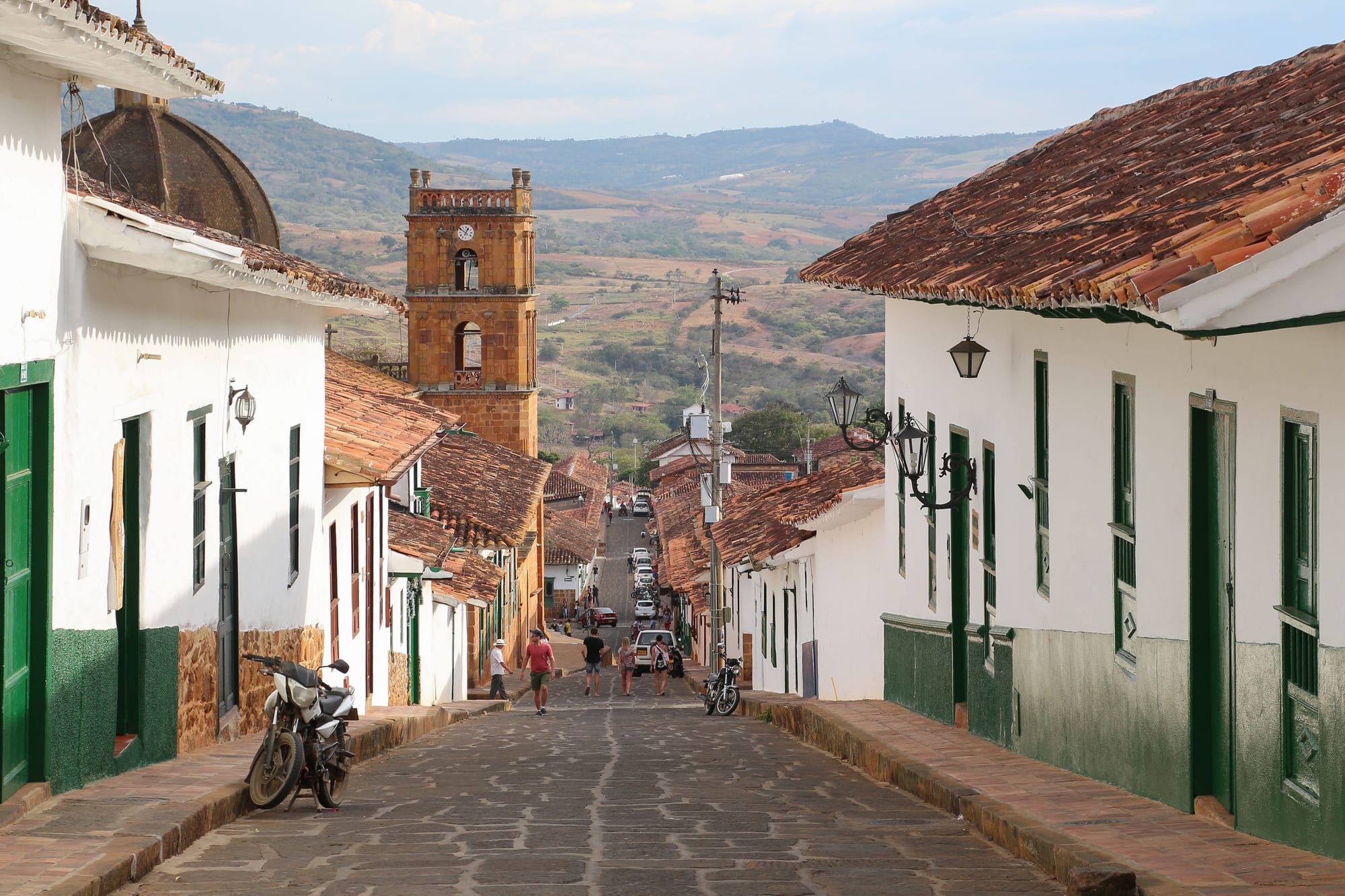
A sloping stone-paved street between whitewashed houses with green doors and tiled roofs, a stone bell tower and dry hills beyond

Bogotá & the Andean Heartland, Colombia

Barichara

Calle 5 in Barichara, Santander, with the tower of the Cathedral of the Immaculate Conception. (Bernard Gagnon / Wikimedia Commons · CC BY-SA 4.0)

A small colonial town in Santander, about 21 km from San Gil, built of local yellow stone above the valley of the Suárez river. It grew from an 18th-century parish founded around a stone said to bear an image of the Virgin, and its historic centre, a national monument since 1978, draws visitors, film-makers and walkers on the old path to Guane.

Neighbourhoods

  • The historic centre
    • First-time visitors
    • Historic district
    • Best for food

    The grid of stone-paved streets around the main square and the cathedral, lined with whitewashed single-storey houses with green or brown doors and clay-tile roofs. Guesthouses, restaurants, craft shops and the town's chapels are all within a few blocks.

    Open in Maps
  • The edge of the town and the viewpoint
    • Views
    • Quiet and residential

    The streets leading to the town's viewpoint, a lookout about 600 metres long between two parks with views over the valley of the Suárez river; this side of town is quieter, with more gardens and open views.

    Open in Maps

Things to do

The colonial town

  • Cathedral of the Immaculate Conceptionlandmark

    The main church, built of local stone in memory of the Virgin of the Rock, supported by ten carved monolithic columns, each five metres high.

    Open in Maps
  • Capilla de Santa Bárbaralandmark

    One of the town's chapels, built like its other churches of the local yellow stone.

    Open in Maps
  • Capilla de San Antoniolandmark

    One of the town's chapels.

    Open in Maps
  • Barichara Cemeterylandmark

    A cemetery built of the local yellow stone and known for its grilles and windows.

    Open in Maps
  • The town viewpointviewpoint

    The mirador on the edge of town, looking out over the valley of the Suárez river.

    Open in Maps

Walks and short trips

  • Camino Real to Guanetrail

    An old stone-paved path that runs from Barichara down to the village of Guane, a walk of roughly 90 minutes to three hours depending on pace.

    Open in Maps
  • Guaneattraction

    A small village about 9 km away, dating from 1540, with an archaeological museum and the church of Santa Lucía.

    Open in Maps
  • Chicamocha National Parkpark

    A park on the rim of the Chicamocha Canyon, up to 2,000 metres deep, with viewpoints and a cable car across the canyon.

    Open in Maps

Eat and drink

Long-standing places and food districts in Barichara. Hours, ratings and directions come from your maps app, always current.

Santander classics

  • Restaurants of the historic centreneighborhood

    Restaurants in the old stone houses serve the cooking of the Guanentá province — carne oreada, mute soup, sancocho, cabro with pepitoria — alongside modern dishes for weekend visitors.

    Open in Maps
  • Hormigas culonasneighborhood

    The large queen ants of the region, a traditional food of the Guane people, toasted or fried with salt and sold as a seasonal snack around the town's squares.

    Open in Maps

Experience Barichara

History

The land around Barichara belonged to the Guane people before the Spanish conquest, and the nearby village of Guane was founded in 1540. Barichara itself grew from a legend. In the early 18th century — in 1702, according to the story — a peasant is said to have seen the Virgin Mary, whose image appeared carved on a stone. The rock became an object of worship and the villagers decided to build a church, though the local priest did not believe in the miracle, and the Church never accepted the image.

The parish was established in 1751. It was first called Vare-Florence, then Vara-echada, and finally Barichara, which means "place of rest" in the Guane language. The town was built almost entirely of local yellow stone: streets, houses, churches and the cemetery. Barichara was also the birthplace of Aquileo Parra, President of Colombia from 1876 to 1878, whose house is one of the sights of the town.

On 3 August 1978 the historic centre was declared a national monument, recognised as a prime example of informal urban development in the Andalusian style, with its original 18th-century layout and late-colonial architecture well preserved. Since then tourism has become the town's main business, and Barichara has been used as a location for telenovelas and films.

Culture & Customs

Stone defines Barichara. Its streets, houses and churches are built of the same yellow stone, and the cathedral stands on ten monolithic columns, each five metres high. The cemetery is known for its grilles and windows. The town is widely considered one of the best-preserved and most beautiful colonial villages in Colombia, and that reputation has made it a setting for television and cinema, as well as a host of film festivals — among them the Festival de Cine Verde — theatre and other events.

The Guane past is part of local identity. Barichara's name comes from the Guane language, the archaeological museum in Guane keeps the memory of the people who lived here before the Spanish, and the hormigas culonas eaten in the town are a Guane tradition.

Santandereanos are known across Colombia for bluntness and a quick temper. Catholic tradition is strong, and the legend of the Virgin of the Rock remains part of the town's story.

Daily Life

Barichara's people are divided between the stone-built town and the farms of the surrounding countryside in the province of Guanentá. San Gil, 21 km away by paved road, is the nearest larger town for shopping and services, and Bucaramanga, the department capital, is about 110 km away.

Tourism dominates the economy: guesthouses in old houses, restaurants, craft shops, guides and the buses that shuttle to San Gil every 20 to 30 minutes. The historic centre is a protected national monument, so the town's old houses have been kept rather than replaced. The Guane heritage survives in names, food and crafts, and a small number of people in Santander still identify as Guane — about 812 in a 2005 national estimate — living mainly in Bucaramanga, Barichara and other towns of the department.

The pace is slow on weekdays, when the streets are quiet. At weekends and on holidays visitors from Bogotá and Bucaramanga arrive in numbers, and walkers set out on the Camino Real to Guane.

Food

Barichara shares the cooking of the Guanentá province of Santander, among the most distinctive in the country. Carne oreada is a local classic; mute is a hearty soup of maize, pork and vegetables; cabro is roast goat, served with pepitoria, a rice dish made with the animal's blood and offal. Sancocho stew, caldo de huevo — an egg broth — and tamales are everyday dishes.

The arepa santandereana is made from cooked maize dough shaped by hand and cooked on a tiesto, a round, slightly concave clay griddle made in the Guane manner and set directly over the fire. The most famous local food is hormigas culonas: large queen ants, a traditional food of the Guane people, whose heads, wings and legs are removed before the bodies are fried or toasted and seasoned with salt. They are a seasonal snack around Barichara and San Gil, the main centres of production.

Traditional drinks include masato, a fermented drink, guarapo, made from fermented cane juice, and aguapanela, hot or cold water sweetened with panela, unrefined cane sugar.

Planning tools

Budget

Barichara is a favourite weekend escape, and its guesthouses and restaurants cost more than in neighbouring San Gil, with prices rising on weekends and public holidays. Simple lunches and the bus to San Gil stay cheap; adventure trips are booked from San Gil.

Daily Budget Midrange
USD 90–180 (colonial posada, restaurant dinners, a guided day trip)
Daily Budget Shoestring
USD 35–60 (hostel or simple guesthouse, set lunches, buses to San Gil)

Come midweek for lower room prices and quieter streets.

Best Time to Visit

The town can be visited all year. At nearby San Gil the wettest months are April–May and September–October, and the drier months between them are the most comfortable for walking the Camino Real. Holiday weekends and Easter are the busiest times.

Suggested Number of Days

The town itself is small and can be seen in a day, but most visitors stay a night or two for the quiet evenings. Allow three or four days to include the surrounding countryside and the trips based in nearby San Gil.

First Visit
1–2 days
With Surroundings
3–4 days

Transportation

The town is walked; there is no need for a car within it. Buses run frequently through the day between Barichara and the local bus terminal in San Gil, a trip of about 45 minutes. Taxis and tour vehicles reach Guane and the canyon viewpoints.

Sturdy shoes are needed for the steep stone streets and the Camino Real.

Airport & Station Connections

There is no airport. Most visitors arrive by bus from Bogotá or Bucaramanga to San Gil and change there to the local bus. Bucaramanga, about 110 km away, has an airport; Bogotá is a long bus journey through the mountains.

Walkability

The centre is compact and pleasant on foot, a few blocks in each direction, though the stone streets are steep and uneven. The Camino Real to Guane is a real walk, much of it downhill on old paving, best started early and with water.

Safety

Colombia is far safer for visitors than its reputation, and the main cities and tourist regions are well travelled, but crime requires attention. Barichara, like the other Santander tourist towns, is calm. The main hazards are the sun, the heat on walks in the middle of the day and slippery stone after rain.

Carry water and sun protection on the Camino Real and keep an eye on valuables on busy holiday weekends. Check current official travel advice before travelling.

Climate

At about 1,300 metres, much warmer than the high plateau around Bogotá. Days are usually sunny and warm, with wetter and drier periods rather than summer and winter; at nearby San Gil the wettest months are April–May and September–October.

Summer
no true summer; the drier months are sunny and warm, and in the San Gil area the low ground beside the Chicamocha, Suárez and Sogamoso rivers reaches highs of about 32°C
Winter
no true winter; the wetter months bring showers and more cloud, while temperatures change little — nearby San Gil, a little lower, averages about 24°C

Local Customs

Santandereanos have a reputation for directness. A greeting comes before any question, and 'usted' is the normal form of address with strangers. Churches and chapels are working places of worship, so modest dress and quiet are expected inside.

Check whether service is already included on a restaurant bill before tipping, and ask before photographing people.

Common Payment Methods

The currency is the Colombian peso (COP). Some guesthouses and restaurants take cards, but small shops, buses and many cafés expect cash, so it is worth carrying pesos, especially at weekends.